
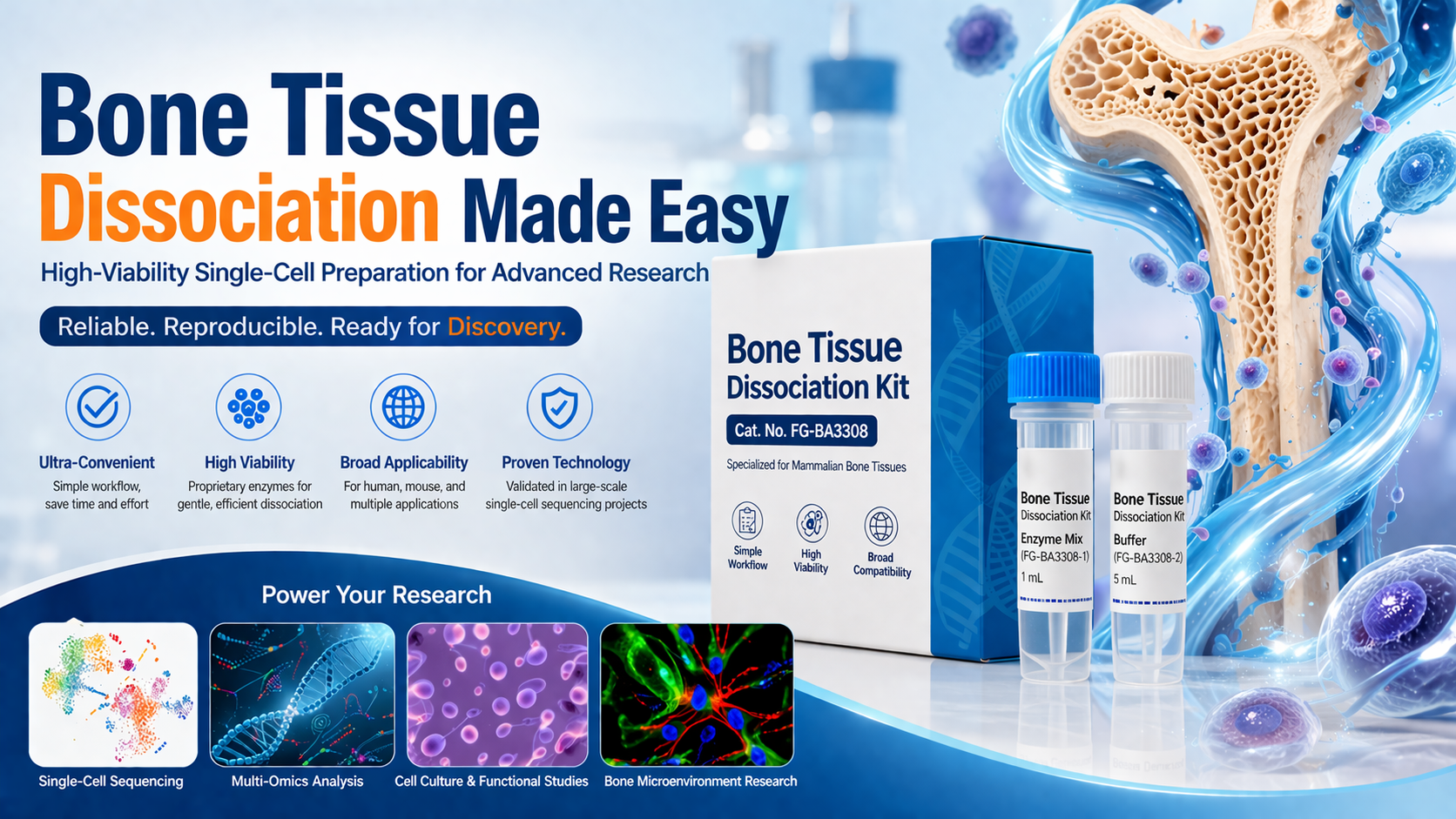
Are you researchers working on bone tissue studies constantly getting tripped up by the challenges of tissue dissociation? With their highly calcified structures and complex extracellular matrices, obtaining a single-cell suspension that is both highly viable and free of aggregates is a daunting task. The process is not only tedious, but even a minor oversight can compromise downstream experimental results—making it a veritable "roadblock" on the path of scientific discovery!
Worry no more! Firegene proudly presents its Bone Tissue Dissociation Kit (Cat. No. FG-BA3308)—specifically developed for mammalian bone tissues. Backed by mature technology and exceptional empirical data, this kit offers a reliable, all-in-one solution for bone tissue dissociation, making it easy for even beginners to master!
1. Product Advantages
Ultra-Convenient Operation: The optimized experimental workflow is simple and straightforward, requiring no complex procedures. It significantly saves time and effort, enabling the effortless dissociation of bone tissue and the efficient preparation of high-quality single-cell suspensions.
High Cell Viability: Utilizing a proprietary, optimized enzymatic digestion formula, the kit gently yet efficiently dissociates bone tissue. The resulting single-cell suspensions exhibit high viability, a low rate of cell aggregation, and excellent nucleated cell yield—providing ideal samples for downstream experiments and ensuring the reliability of experimental results right from the source.
Broad Applicability: Suitable for bone tissue samples from various mammalian species, including humans and mice. It meets the diverse requirements of cell-related assays—such as single-cell sequencing and cell culture—and is compatible with a wide range of bone tissue research scenarios.
Highly Mature Technology: Backed by years of accumulated expertise in tissue dissociation, the underlying technical system is stable and reliable. It has undergone rigorous validation through numerous single-cell sequencing projects involving a large volume of samples, demonstrating superior data performance and providing enhanced assurance for scientific research outcomes.
2. Experimental Data
Talk is cheap; Firegene conducted specialized experiments on fresh mouse bone tissue and successfully completed pilot single-cell sequencing projects using bone tissue samples of both human and mouse origin. The results demonstrated outstanding performance across all key metrics.
Data Performance of Bone Tissue After Dissociation in Some Actual Projects


 Single-Cell Sequencing Data Results of Bone Tissue After Dissociation in Some Actual Projects
3. Application Areas
I. Single-Cell Sequencing Research
Leveraging high-quality single-cell suspensions prepared using this kit, researchers can conduct various single-cell omics analyses to decipher the cellular landscape and molecular mechanisms of bone tissue—serving as a foundational basis for precision research in the skeletal field:
1. Single-Cell Transcriptome Sequencing: Analyze the gene expression profiles of distinct cell subpopulations within bone tissue—such as identifying specific subsets like periosteal stem cells, osteoblasts, and hematopoietic stem cells—to elucidate the molecular regulatory networks governing skeletal development and homeostatic maintenance;
2. Integrated Single-Cell Multi-Omics Analysis: Combine techniques such as single-cell ATAC-seq and proteomics sequencing to comprehensively dissect the cellular heterogeneity of bone tissue across multiple dimensions—including gene expression, chromatin accessibility, and protein levels—thereby exploring the functional specialization and regulatory mechanisms of skeletal cells;
3. Bone Tissue Microenvironment Research: Utilize single-cell sequencing to characterize the cellular composition and interaction networks within diverse microenvironments—such as the bone marrow, cortical bone, and periosteum—thereby defining the molecular underpinnings of the hematopoietic bone marrow niche and bone-immune system interactions.
II. Culture and Functional Studies of Bone Tissue-Related Cells
The highly viable single cells obtained through kit-mediated dissociation can be directly utilized for in vitro cell culture and functional validation, thereby providing high-quality cellular material for fundamental research on skeletal cells:
1. Isolation and Culture of Skeletal Stem Cells: Isolate stem/progenitor cells—such as periosteal stem cells and bone marrow mesenchymal stem cells—from bone tissue; conduct in vitro colony formation assays and tri-lineage differentiation induction experiments (osteogenic, chondrogenic, and adipogenic) to validate the stemness characteristics and differentiation potential of these stem cells.
2. In Vitro Studies of Functional Bone Tissue Cells: Culture osteoblasts, osteoclasts, hematopoietic cells, and other cell types; perform experiments on cell proliferation, apoptosis, differentiation, and functional validation to explore the physiological regulatory mechanisms governing skeletal cells.
3. Construction of Cell Co-culture Systems: Establish co-culture models involving bone cells and immune cells, or bone cells and vascular cells, to simulate the in vivo bone tissue microenvironment and investigate intercellular interactions.
FireGene, light your research with passion, innovation, and profession.
FireGene Single-Cell Sample Prep
Looking for validated dissociation kits?
FireGene's tissue dissociation kits are optimized for specific organ types — brain, tumor, liver, GI, reproductive, and more. Validated for 10x Genomics Chromium and BD Rhapsody workflows.


