
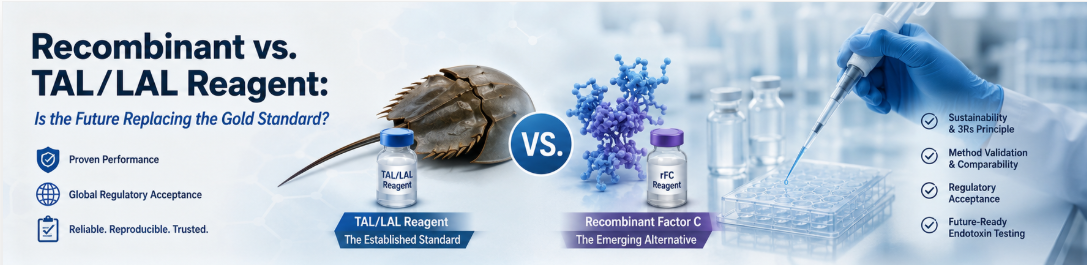
I. Introduction: A Turning Point in Endotoxin Testing
Endotoxin testing has long been a cornerstone of pharmaceutical quality control, ensuring that injectable drugs, biologics, and medical devices are free from harmful bacterial endotoxins. For decades, the industry has relied on TAL/LAL Reagent–based Bacterial Endotoxin Testing (BET) as the gold standard.
However, recent regulatory updates and sustainability concerns have brought recombinant technologies, particularly Recombinant Factor C (rFC), into the spotlight. With increasing discussion around animal-free testing and evolving pharmacopeial guidance, a critical question has emerged:
Is recombinant technology truly replacing TAL/LAL Reagent — or simply complementing it?
II. Understanding the Technologies: TAL/LAL vs. Recombinant Methods
1. What Is TAL/LAL Reagent?
TAL/LAL Reagent is derived from horseshoe crab blood and reacts specifically with endotoxins (lipopolysaccharides from Gram-negative bacteria). It is widely used in:
- Gel clot assays
- Kinetic turbidimetric assays
- Chromogenic endotoxin assays
Its reliability, regulatory acceptance, and extensive historical data make it the benchmark method in endotoxin testing.
2. What Is Recombinant Factor C (rFC)?
Recombinant Factor C is a synthetic version of the endotoxin-sensitive protein found in horseshoe crab blood. It eliminates the need for animal-derived materials and is often promoted as:
- Sustainable
- Animal-free
- Highly specific
III. Why Recombinant Methods Are Gaining Attention
1. Sustainability and the 3Rs Principle
The push for Replacement, Reduction, and Refinement (3Rs) in animal use has accelerated interest in recombinant alternatives. Pharmaceutical companies are under increasing pressure to adopt environmentally responsible practices.
2. Regulatory Support Is Growing — But Not Absolute
Regulatory bodies have begun acknowledging recombinant methods:
- Acceptance in certain applications
- Inclusion in pharmacopeial chapters (e.g., USP <86>)
- Encouragement for innovation
However, acceptance does not equal full replacement.
3. Market Positioning and Industry Momentum
Many suppliers promote rFC as the “next generation” of endotoxin testing. This narrative has driven strong online search volume around terms like:
- “LAL alternative”
- “animal-free endotoxin testing”
- “recombinant endotoxin assay”
IV. The Reality: Why TAL/LAL Reagent Remains the Industry Standard
Despite growing interest in recombinant methods, TAL/LAL Reagent continues to dominate global endotoxin testing workflows.
1. Regulatory Confidence and Proven Performance
TAL/LAL Reagent methods are:
- Fully harmonized across USP, Ph. Eur., and JP
- Widely accepted by regulatory authorities worldwide
- Supported by decades of validation data
Switching away from this standard introduces regulatory complexity.
2. Validation Burden for Recombinant Methods
Transitioning to recombinant methods requires:
- Full method validation
- Comparability studies
- Product-specific interference testing
- Documentation for regulatory submission
This process can take months or even years, increasing operational risk.
3. Lack of Universal Global Acceptance
While some regions accept recombinant methods, others still expect:
- Traditional TAL/LAL Reagent–based validation
- Supporting data from compendial methods
For global manufacturers, this creates compliance challenges.
V. Hybrid Reality: Coexistence, Not Replacement
The industry is not moving toward a single solution — it is evolving into a dual-method ecosystem:
- TAL/LAL Reagent = regulatory stability + global acceptance
- Recombinant methods = innovation + sustainability
Most pharmaceutical companies are adopting a risk-based approach, maintaining TAL/LAL systems while exploring recombinant validation in parallel.
VI. How to Decide: Choosing the Right Endotoxin Testing Strategy
When evaluating TAL/LAL Reagent versus recombinant methods, laboratories should consider:
1. Regulatory Risk
Will your product be submitted globally?
If yes, TAL/LAL Reagent remains the safest path.
2. Validation Resources
Do you have the time and budget for full method revalidation?
3. Product Compatibility
Some complex biologics may behave differently across testing platforms.
4. Audit Readiness
Inspectors prioritize:
- Proven methods
- Clear documentation
- Consistent results
VII. Why Many Labs Continue to Rely on TAL/LAL Reagent
Even as recombinant technologies gain attention, TAL/LAL Reagent remains the most practical and reliable choice for many laboratories due to:
- Established regulatory acceptance
- Lower validation burden
- Strong reproducibility
- Compatibility with existing workflows
VIII. FireGene: Supporting Reliable and Compliant Endotoxin Testing
As regulatory expectations evolve, laboratories need solutions that balance compliance, performance, and operational efficiency.
FireGene provides high-quality TAL/LAL Reagent–based endotoxin testing solutions designed to support:
- USP, Ph. Eur., and JP compliance
- Consistent lot-to-lot performance
- Comprehensive documentation (COA, traceability)
- Method validation and transfer support
🔗 Learn more: https://firegene.com/products/kinetic-chromogenic-endotoxin-test-kit
By focusing on reliability and regulatory alignment, FireGene helps laboratories reduce validation risks while maintaining audit readiness.
IX. Best Practices for Future-Proof Endotoxin Testing
To stay competitive in a changing regulatory landscape:
- Maintain validated TAL/LAL Reagent methods
- Monitor recombinant method developments
- Implement robust documentation systems
- Train teams on evolving regulatory expectations
- Evaluate changes through a risk-based framework
X. Conclusion: Evolution, Not Replacement
Recombinant technologies are reshaping the conversation around endotoxin testing — but they are not replacing TAL/LAL Reagent anytime soon.
Instead, the industry is entering a phase of coexistence, where innovation and proven methods work side by side.
For laboratories focused on compliance, efficiency, and global market access, TAL/LAL Reagent remains the foundation of endotoxin testing programs.
FireGene, light your research with passion, innovation, and profession.


