
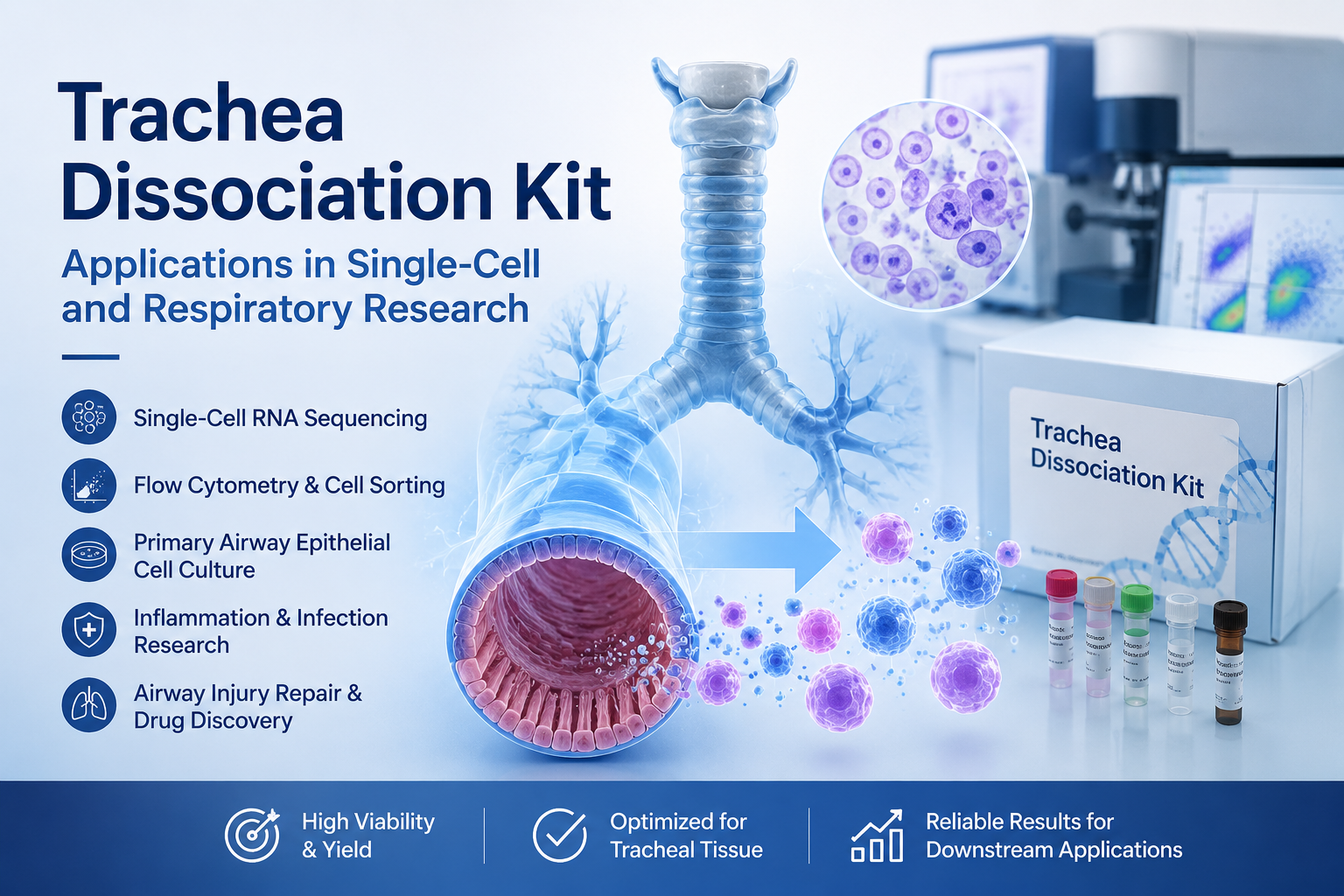
In respiratory research, the trachea is more than a simple airway passage. It acts as a critical barrier between the external environment and the lower respiratory tract, participating in mucus secretion, mucociliary clearance, immune defense, epithelial repair, and airway homeostasis. As technologies such as single-cell RNA sequencing, flow cytometry, primary cell culture, and spatial biology continue to advance, researchers are increasingly interested in understanding the cellular composition and functional changes within tracheal tissue.
However, tracheal tissue contains multiple cell types, including epithelial cells, basal cells, ciliated cells, goblet cells, smooth muscle cells, fibroblasts, endothelial cells, and immune cells. To study these cell populations at the cellular or molecular level, intact tissue first needs to be efficiently dissociated into a high-quality single-cell suspension. This is where a Trachea Dissociation Kit becomes an essential sample preparation tool.
What Is a Trachea Dissociation Kit?
A Trachea Dissociation Kit is designed to dissociate tracheal tissue into a single-cell suspension. It typically uses an optimized enzyme system and buffer conditions to break down extracellular matrix components, loosen cell-cell connections, and release individual cells from the tissue structure.
Compared with manual mincing or single-enzyme digestion methods, a tissue-specific dissociation kit can provide more consistent results. It helps improve cell recovery while reducing excessive cellular damage, making the prepared suspension more suitable for downstream applications.
In simple terms, the main purpose of a Trachea Dissociation Kit is to convert tracheal tissue into a single-cell suspension for further analysis or culture.
Key Applications of Trachea Dissociation Kit
1. Single-Cell RNA Sequencing
Single-cell RNA sequencing is one of the most important applications of a Trachea Dissociation Kit. Tracheal tissue contains diverse cell populations, including ciliated epithelial cells, goblet cells, basal cells, secretory cells, immune cells, and stromal cells. Single-cell sequencing allows researchers to analyze gene expression profiles at single-cell resolution.
In studies of airway development, inflammation, infection, injury, and tissue repair, single-cell RNA sequencing can help answer questions such as:
What cell populations are present in tracheal tissue?
Which cell types increase or decrease under disease conditions?
Do airway epithelial cells show abnormal differentiation?
How do immune cells respond to infection or inflammation?
What role do basal cells and progenitor cells play during epithelial repair?
High-quality single-cell suspension is critical for successful single-cell sequencing. Over-digestion may reduce cell viability and affect RNA quality, while incomplete dissociation may lead to cell clumps and biased cell recovery. A Trachea Dissociation Kit helps researchers prepare more reliable trachea-derived single-cell samples for sequencing workflows.
2. Flow Cytometry and Cell Sorting
A Trachea Dissociation Kit is also widely used for flow cytometry analysis. After dissociation, tracheal cells can be stained with antibodies to identify specific cell populations, analyze immune cell infiltration, or measure surface marker expression.
For example, in airway inflammation models, researchers may analyze CD45-positive immune cells and further distinguish macrophages, neutrophils, T cells, B cells, or dendritic cells. In airway epithelial studies, markers such as EpCAM, CD24, NGFR, or KRT5 may be used to characterize epithelial subtypes.
For fluorescence-activated cell sorting, a clean and viable single-cell suspension is especially important. The quality of tissue dissociation directly affects sorting efficiency, cell viability, and downstream experimental reliability.
3. Primary Airway Epithelial Cell Culture
Primary cells derived from tracheal tissue are valuable tools for respiratory biology research. Compared with immortalized cell lines, primary airway epithelial cells more closely represent physiological conditions in vivo. They are useful for studying epithelial barrier function, ciliary differentiation, mucus secretion, and inflammatory responses.
Cells prepared using a Trachea Dissociation Kit can be further cultured in vitro to establish airway epithelial cell models. In some studies, these cells may also be used in air-liquid interface culture systems to induce differentiation into a more physiologically relevant airway epithelial layer with ciliated and mucus-producing cells.
These models can support research on:
Airway epithelial barrier damage and repair
Ciliogenesis and ciliary function
Mucin expression and mucus hypersecretion
Effects of environmental irritants on airway cells
Drug regulation of airway epithelial inflammation
Therefore, a Trachea Dissociation Kit is not only useful for analytical experiments but also for preparing primary cells for functional studies.
4. Respiratory Inflammation and Infection Research
The trachea plays an important role in respiratory immune defense. When exposed to bacteria, viruses, allergens, smoke, pollutants, or other irritants, tracheal epithelial cells and resident immune cells can rapidly respond to injury or infection.
By dissociating tracheal tissue into single cells, researchers can directly analyze local cellular responses in respiratory disease models. In infection studies, a Trachea Dissociation Kit can help isolate epithelial and immune cells from tracheal tissue to evaluate cytokine expression, immune cell recruitment, and epithelial damage.
In allergic airway inflammation models, researchers may examine goblet cell hyperplasia, mucus production, eosinophil infiltration, and type 2 inflammatory responses. In chronic airway disease research, including asthma, chronic obstructive pulmonary disease, and airway remodeling studies, trachea-derived single-cell analysis can provide deeper insight into disease-associated cellular changes.
5. Airway Injury, Repair, and Regeneration Studies
The airway epithelium has the ability to repair itself after injury. Basal cells, progenitor cells, stromal cells, and immune cells all participate in the repair process. A Trachea Dissociation Kit can be used to prepare single-cell suspensions from tracheal tissue collected at different time points after injury.
This allows researchers to compare cellular composition between normal tissue, injured tissue, and tissue undergoing repair. They can investigate whether basal cells are activated, whether ciliated cells are regenerated, whether inflammatory cells decline over time, and whether genes related to epithelial barrier restoration are re-expressed.
Such studies are valuable for understanding airway regeneration, abnormal repair, chronic epithelial damage, fibrosis, and airway remodeling.
6. Drug Screening and Mechanism-of-Action Studies
In respiratory drug discovery, trachea-derived cells can be used to evaluate how candidate compounds affect airway biology. After preparing a single-cell suspension with a Trachea Dissociation Kit, researchers can combine the sample with flow cytometry, cell culture, qPCR, transcriptomic analysis, or protein assays.
Common research applications include:
Evaluating anti-inflammatory drug effects on immune cell infiltration
Studying protective effects of compounds on airway epithelial cells
Assessing pro-repair activity in epithelial regeneration models
Testing inhaled compounds or environmental toxicants
Analyzing drug effects on cytokines, chemokines, and barrier-related genes
Because different tracheal cell types may respond differently to the same treatment, single-cell-level analysis can provide more detailed information than bulk tissue assays.
Why Is Tracheal Tissue Dissociation Quality Important?
The quality of tracheal tissue dissociation directly influences downstream experimental results. An ideal trachea-derived single-cell suspension should have:
High cell viability
Low cell debris
Minimal cell clumping
Good recovery of target cell populations
Preserved surface markers
RNA quality suitable for molecular analysis
Stable batch-to-batch performance
If the dissociation conditions are not suitable, researchers may encounter reduced viability, biased cell recovery, excessive debris, damaged surface antigens, or poor sequencing quality. Therefore, choosing an optimized tracheal tissue dissociation method is an important step for generating reliable and reproducible data.
Who Can Benefit from Using a Trachea Dissociation Kit?
A Trachea Dissociation Kit is suitable for researchers working in respiratory biology, airway disease models, immunology, toxicology, drug discovery, and single-cell analysis. It is especially useful for studies involving:
Tracheal tissue single-cell RNA sequencing
Airway epithelial cell isolation
Mouse or animal tracheal tissue research
Airway inflammation models
Respiratory infection studies
Airway injury and repair research
Flow cytometry and cell sorting
Primary tracheal cell culture
Respiratory drug efficacy evaluation
For laboratories that need to obtain reliable single-cell suspensions from tracheal tissue, this type of kit can simplify sample preparation and improve experimental consistency.
Conclusion
A Trachea Dissociation Kit is an important sample preparation tool for tracheal tissue research. Its value lies not in directly detecting a specific biomarker, but in enabling researchers to obtain high-quality single-cell suspensions from complex tracheal tissue.
With the rapid development of single-cell sequencing, flow cytometry, primary cell culture, and respiratory disease models, optimized tissue dissociation has become increasingly important. In studies of airway inflammation, infection, epithelial repair, immune microenvironment, and drug response, a Trachea Dissociation Kit provides a practical bridge between intact tissue samples and cell-level analysis.
For researchers aiming to explore the cellular composition and functional changes of the trachea, this kit offers a reliable starting point for advanced respiratory research workflows.
FireGene, light your research with passion, innovation, and profession.
FireGene Single-Cell Sample Prep
Looking for validated dissociation kits?
FireGene's tissue dissociation kits are optimized for specific organ types — brain, tumor, liver, GI, reproductive, and more. Validated for 10x Genomics Chromium and BD Rhapsody workflows.


