
Introduction
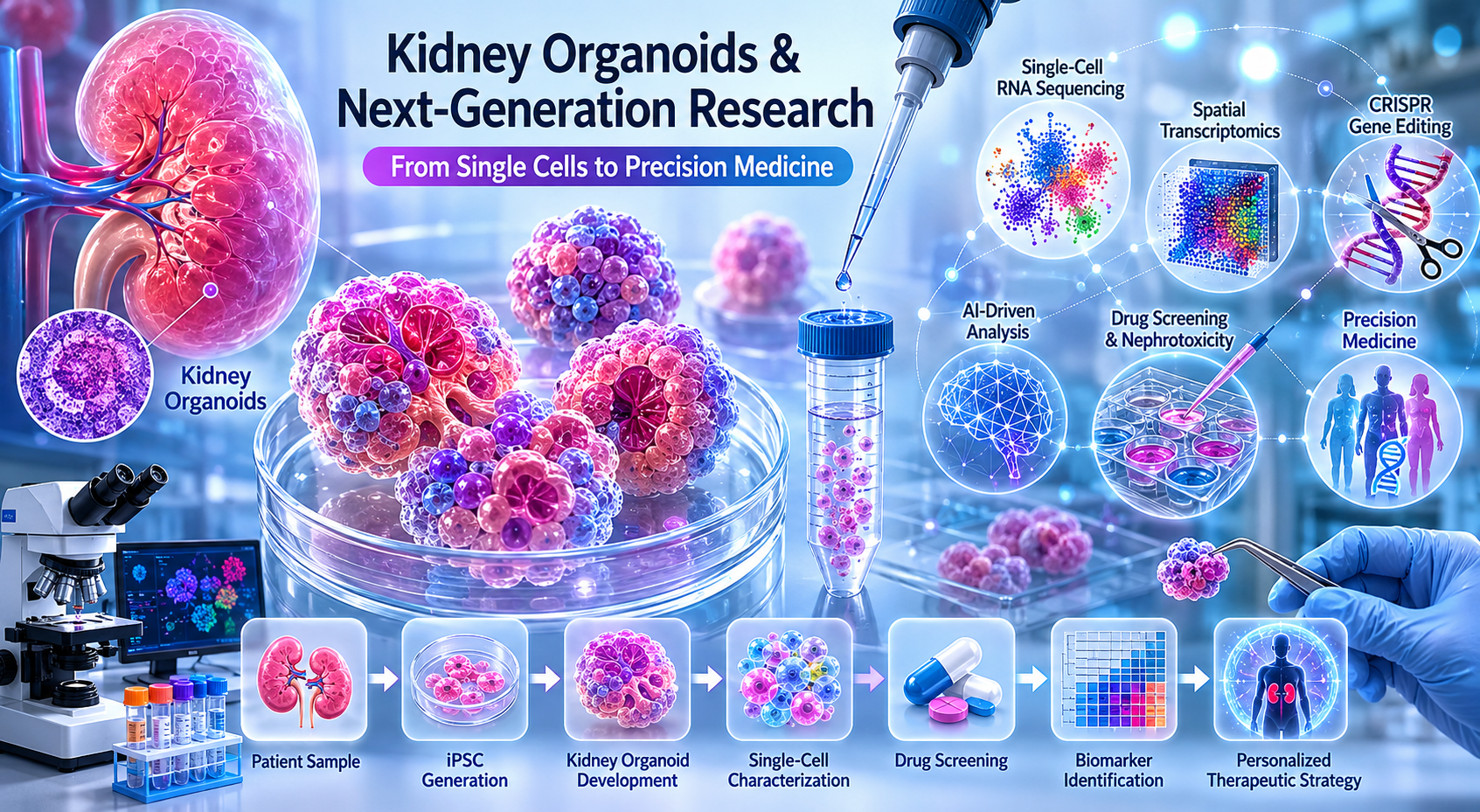
Kidney organoids have rapidly evolved from a promising experimental technology into one of the most influential platforms in modern nephrology research. Combined with advances in single-cell sequencing, spatial biology, CRISPR gene editing, artificial intelligence, and precision medicine, organoids are transforming how researchers study kidney development, disease progression, drug responses, and personalized therapies.
In 2026, kidney organoids are no longer viewed simply as laboratory models. They are increasingly becoming foundational tools for:
- Disease Modeling
- Drug Discovery
- Nephrotoxicity Screening
- Regenerative Medicine
- Biomarker Discovery
- Precision Medicine
- Functional Genomics
However, regardless of how sophisticated downstream technologies become, one reality remains unchanged:
The quality of biological insights depends heavily on the quality of the starting cell suspension.
Whether researchers perform Single-Cell RNA Sequencing (scRNA-seq), Spatial Transcriptomics, Flow Cytometry, Cell Sorting, Proteomics, CRISPR Screens, or Multi-Omics analysis, poor dissociation workflows can significantly compromise data quality.
This article explores why optimized single-cell preparation has become a critical success factor in next-generation kidney organoid research.
Why Kidney Organoids Have Become a Major Research Trend
Traditional kidney research has historically relied on:
- Animal Models
- Immortalized Cell Lines
- Primary Tissue Samples
Each system offers advantages but also important limitations.
Animal models frequently fail to fully replicate human disease biology.
Cell lines lack the multicellular complexity of native tissue.
Primary human samples remain limited and difficult to obtain.
Kidney organoids help bridge these gaps.
Modern organoids may contain:
- Podocyte-like Cells
- Proximal Tubular Cells
- Distal Tubular Cells
- Collecting Duct Structures
- Stromal Populations
- Endothelial-like Cells
This complexity makes organoids highly attractive for translational research.
Comparison of Major Kidney Research Models
| Research Model | Human Relevance | Cellular Complexity | Single-Cell Compatible | Precision Medicine Potential |
|---|---|---|---|---|
| Immortalized Cell Lines | Low | Low | Yes | Limited |
| Animal Models | Medium | High | Yes | Limited |
| Primary Tissue | High | High | Yes | Moderate |
| Kidney Organoids | Very High | High | Yes | Excellent |
This comparison explains why kidney organoids are becoming increasingly important in modern nephrology research.
The Rise of Precision Medicine in Kidney Disease
Precision medicine aims to replace generalized treatment strategies with individualized therapeutic approaches.
Patients diagnosed with the same clinical condition often exhibit:
- Different genetic mutations
- Distinct molecular signatures
- Variable disease progression
- Different treatment responses
Kidney organoids provide an ideal platform for investigating these differences.
Patient-derived iPSC organoids are increasingly being used to model:
- Polycystic Kidney Disease (PKD)
- Alport Syndrome
- Focal Segmental Glomerulosclerosis (FSGS)
- Diabetic Kidney Disease
- Acute Kidney Injury (AKI)
- Rare Genetic Nephropathies
Researchers can now evaluate patient-specific therapeutic responses before treatments reach the clinic.
Precision Medicine Workflow
Modern precision nephrology increasingly follows a workflow similar to the following:
Patient Sample
↓
iPSC Generation
↓
Kidney Organoid Development
↓
Single-Cell Characterization
↓
Drug Screening
↓
Biomarker Identification
↓
Personalized Therapeutic Strategy
At several points within this workflow, high-quality single-cell isolation becomes essential.
Why Single-Cell Sequencing Is Essential for Organoid Research
A kidney organoid is not a uniform structure.
Instead, it contains diverse cellular populations at different developmental stages.
Bulk sequencing masks this complexity.
Single-cell RNA sequencing enables researchers to identify:
- Cell Type Composition
- Developmental Trajectories
- Disease-Associated States
- Drug Response Profiles
- Cellular Heterogeneity
- Rare Populations
This capability has made scRNA-seq one of the most widely adopted tools in organoid research.
Why High-Quality Single-Cell Isolation Matters
The most advanced sequencing platform cannot compensate for poor sample preparation.
Common consequences of inadequate dissociation include:
Reduced Cell Viability
Damaged cells contribute unwanted background noise.
Cell Aggregation
Aggregates interfere with droplet-based sequencing systems.
Ambient RNA Contamination
Dead cells release RNA into the suspension.
Population Bias
Fragile cell populations may be selectively lost.
Reduced Reproducibility
Sample preparation often becomes the largest source of experimental variability.
For this reason, many laboratories are adopting dedicated Kidney Dissociation Kits to improve consistency during organoid preparation:
Common Challenges in Kidney Organoid Dissociation
Researchers frequently encounter:
Incomplete Dissociation
Residual aggregates may reduce sequencing performance.
Overdigestion
Excessive enzymatic exposure can damage sensitive populations.
Variable Recovery
Differences between operators can introduce variability.
Low Viability
Poor processing may significantly reduce cell quality.
Cellular Stress Responses
Improper handling may alter gene expression before analysis.
These challenges are driving increased demand for standardized Kidney Tissue Dissociation Solutions:
Why Spatial Transcriptomics Is Reshaping Organoid Research
One of the fastest-growing technologies in 2026 is Spatial Transcriptomics.
Unlike scRNA-seq, spatial technologies preserve tissue architecture while measuring gene expression.
Popular platforms include:
- 10x Genomics Visium HD
- Xenium
- NanoString CosMx
Researchers increasingly combine:
- scRNA-seq
- Spatial Transcriptomics
- Proteomics
to generate comprehensive organoid atlases.
Importantly, scRNA-seq datasets often serve as reference maps for spatial analyses, making high-quality cell isolation even more important.
CRISPR Functional Genomics and Kidney Organoids
CRISPR technologies are rapidly transforming organoid research.
Applications include:
- Gene Knockout Studies
- CRISPRi
- CRISPRa
- Perturb-seq
- Functional Screening
Researchers can now investigate how specific genetic changes influence organoid development and disease progression.
Successful CRISPR screening experiments depend heavily on generating viable single-cell suspensions suitable for downstream sequencing.
Many laboratories incorporate dedicated Kidney Cell Isolation Reagents to support these workflows:
AI-Driven Organoid Analysis
Artificial intelligence is becoming increasingly integrated into organoid research.
AI tools are now used for:
- Cell Annotation
- Image Analysis
- Drug Response Prediction
- Biomarker Discovery
- Multi-Omics Integration
Several pharmaceutical companies are actively developing AI-driven organoid platforms to accelerate therapeutic discovery.
However, AI models are only as reliable as the data they receive.
High-quality cell isolation therefore remains a fundamental requirement.
Kidney Organoids in Drug Discovery
Drug development represents one of the most commercially significant applications of kidney organoids.
Researchers utilize organoids for:
Nephrotoxicity Screening
Identifying kidney toxicity earlier in development.
Drug Efficacy Studies
Evaluating therapeutic performance.
Biomarker Discovery
Identifying predictive indicators of treatment response.
Precision Therapeutics
Testing individualized treatment strategies.
Increasingly, pharmaceutical organizations are adopting standardized Research-Grade Kidney Dissociation Kits to improve reproducibility:
Case Study: Improving Organoid Sequencing Outcomes
A research group investigating patient-derived kidney organoids experienced:
- Low cell recovery
- High aggregate levels
- Poor sequencing quality
The team initially suspected library preparation problems.
However, detailed workflow analysis revealed that dissociation represented the primary bottleneck.
After implementing a more standardized single-cell preparation workflow, researchers observed:
- Improved viability
- Increased cell recovery
- Reduced aggregates
- Better sequencing metrics
The sequencing platform remained unchanged.
The quality of cell isolation improved.
Choosing the Right Kidney Research Supplier
When selecting a Kidney Research Supplier, researchers should evaluate:
Reproducibility
Can results be replicated across studies?
Tissue-Specific Optimization
Is the solution designed specifically for kidney tissue?
Workflow Simplicity
Can laboratories implement the protocol efficiently?
Application Compatibility
Support for:
- Organoid Research
- Single-Cell Sequencing
- Flow Cytometry
- Cell Sorting
- Spatial Omics
- Drug Discovery
is increasingly important.
For these applications, many researchers seek a specialized Single Cell Kidney Tissue Dissociation Kit developed specifically for renal tissue processing:
Frequently Asked Questions
What are kidney organoids?
Kidney organoids are stem cell-derived three-dimensional structures that mimic key aspects of kidney development and function.
Why are kidney organoids important for precision medicine?
They allow researchers to model patient-specific disease mechanisms and therapeutic responses.
Why is scRNA-seq commonly used with organoids?
It enables detailed characterization of cellular composition and heterogeneity.
What viability is recommended before sequencing?
Many laboratories aim for viability above 70–80%.
What causes low cell recovery?
Common causes include incomplete dissociation, overdigestion, and mechanical stress.
Why do organoids contain immature cell populations?
Current organoid systems partially recapitulate developmental processes and may not achieve full adult maturation.
Can organoids be used for drug screening?
Yes. Drug discovery and nephrotoxicity assessment are among the fastest-growing applications.
How does spatial transcriptomics complement scRNA-seq?
Spatial technologies preserve tissue architecture while scRNA-seq provides detailed cellular characterization.
Why is reproducibility important in organoid research?
Variability can significantly impact biological interpretation and cross-study comparisons.
How can standardized dissociation workflows help?
They improve consistency, cell viability, and reproducibility across experiments.
Conclusion
Kidney organoids are rapidly becoming one of the most important platforms in modern nephrology research.
Combined with single-cell sequencing, spatial transcriptomics, CRISPR functional genomics, artificial intelligence, and precision medicine, they are transforming how scientists investigate kidney biology and therapeutic development.
Yet regardless of how advanced downstream technologies become, the success of these studies still depends on one foundational principle:
High-quality biological insights begin with high-quality cell isolation.
As organoid research continues to expand, laboratories that prioritize optimized tissue dissociation workflows will be better positioned to generate reproducible data, accelerate discoveries, and support the future of precision nephrology.
References
- Nature Reviews Nephrology. Kidney Organoids and Precision Medicine.
- Cell Stem Cell. Human Kidney Organoids for Disease Modeling.
- Nature Biotechnology. Spatial Omics and Organoid Research.
- Nature Reviews Genetics. Single-Cell Technologies in Precision Medicine.
- Kidney International. Organoid-Based Drug Discovery Platforms.
- Cell Reports Medicine. Patient-Derived Organoids and Personalized Therapeutics.
- Nature Medicine. AI Applications in Biomedical Research.
- Trends in Biotechnology. Future Directions in Organoid Science.
FireGene Single-Cell Sample Prep
Looking for validated dissociation kits?
FireGene's tissue dissociation kits are optimized for specific organ types — brain, tumor, liver, GI, reproductive, and more. Validated for 10x Genomics Chromium and BD Rhapsody workflows.


