
SDS-PAGE remains one of the most widely used techniques in protein research, quality control, and molecular biology laboratories. Although gel percentage, sample preparation, staining method, and electrophoresis conditions all influence the final result, the electrophoresis buffer system is one of the most important factors determining protein migration, band sharpness, and resolution. Among common SDS-PAGE buffer systems, Tris-Glycine, Bis-Tris, and Tricine systems are frequently used, but they are not interchangeable in every application.
Each system has its own buffer chemistry, separation characteristics, and preferred molecular weight range. Understanding the differences helps researchers select a suitable system for routine protein analysis, high-resolution electrophoresis, Western blot preparation, or small peptide separation.
What Is an Electrophoresis Buffer System?
In SDS-PAGE, the electrophoresis buffer provides ions that conduct current, maintain pH, and support protein migration through the polyacrylamide gel. SDS binds to proteins and gives them a broadly uniform negative charge, allowing separation primarily based on molecular weight. However, the buffer ions also participate in the stacking and resolving process, which directly affects how tightly protein bands are focused and how clearly different molecular weights are separated.
Different buffer systems use different trailing ions and operating pH ranges. These differences determine whether the system is better suited for general protein separation, sharper band formation, or low-molecular-weight protein and peptide analysis.
Tris-Glycine System: The Classic and Universal SDS-PAGE Choice
The Tris-Glycine system is the traditional Laemmli SDS-PAGE buffer system and is still widely used in research laboratories. It typically uses Tris, glycine, and SDS as the main components. In many laboratories, Tris-Glycine-SDS running buffer is the default choice for routine protein electrophoresis.
The main advantage of the Tris-Glycine system is its broad applicability. It is suitable for many standard protein samples, especially medium- to high-molecular-weight proteins. For routine SDS-PAGE, protein expression analysis, purification monitoring, and Western blot sample preparation, Tris-Glycine is often sufficient and reliable.
This system is also cost-effective and familiar to most users. Because it has been used for decades, many published protocols, troubleshooting guides, and laboratory workflows are built around Tris-Glycine gels and buffers. For users who need a robust and economical electrophoresis system, Tris-Glycine remains a practical option.
However, Tris-Glycine has limitations. Its alkaline operating conditions may not be ideal for all proteins, especially when high band sharpness or improved resolution is required. Small proteins and peptides may migrate too quickly and show poor separation in the low-molecular-weight region. When the target protein is very small, the Tris-Glycine system may produce compressed or poorly resolved bands near the bottom of the gel.
Therefore, Tris-Glycine is best described as a general-purpose SDS-PAGE system. It is suitable for routine experiments but may not be the best choice when researchers need high resolution for small proteins or enhanced band clarity for sensitive downstream analysis.
Bis-Tris System: Mild Conditions and Improved Band Resolution
The Bis-Tris system is commonly used in modern precast gel platforms and high-resolution SDS-PAGE workflows. Unlike the classic Tris-Glycine system, Bis-Tris gels usually operate at a near-neutral pH. Running buffers often use MOPS or MES as the buffering ions, depending on the desired molecular weight separation range. A Tris/MOPS/SDS running buffer is generally suitable for medium- to high-molecular-weight proteins, while MES-based systems are often used for lower molecular weight proteins.
One of the key benefits of the Bis-Tris system is its mild electrophoresis environment. The near-neutral pH helps reduce protein degradation and certain pH-related artifacts during electrophoresis. This is especially valuable when analyzing sensitive samples, modified proteins, or proteins intended for downstream Western blotting.
Bis-Tris systems are also known for producing sharp, clean bands with good reproducibility. Compared with traditional Tris-Glycine systems, Bis-Tris gels often provide better resolution in many applications, particularly when used with optimized precast gels and matching running buffers. Researchers who need consistent electrophoresis performance may prefer Bis-Tris systems for routine protein analysis and publication-quality results.
Another advantage is flexibility. By choosing different running buffers, such as MOPS or MES, users can adjust the separation range. MOPS buffer is commonly selected for proteins in a broader medium-to-high molecular weight range, while MES buffer offers improved separation for smaller proteins. This makes the Bis-Tris system more adaptable than many traditional systems.
However, Bis-Tris systems may require more attention to compatibility. The gel type, running buffer, sample buffer, and electrophoresis conditions should be matched correctly. Using an incompatible buffer can reduce resolution or alter migration behavior. In addition, Bis-Tris systems are often associated with precast gel formats, which may be more expensive than conventional hand-cast Tris-Glycine gels.
In practical terms, Bis-Tris is a strong choice when users want improved band sharpness, mild running conditions, and reliable resolution. It is especially useful for Western blot workflows, comparative protein analysis, and experiments where reproducibility is important.
Tricine System: Specialized for Small Proteins and Peptides
The Tricine system was developed to improve the separation of low-molecular-weight proteins and peptides. In this system, tricine replaces glycine as the trailing ion. This change significantly improves the resolution of small proteins, which are often difficult to separate using conventional Tris-Glycine SDS-PAGE.
The key advantage of the Tricine system is its excellent performance in the low-molecular-weight region. It is particularly suitable for proteins and peptides below approximately 30 kDa, including small enzymes, peptide hormones, antimicrobial peptides, synthetic peptides, signaling peptides, and protein fragments. For peptide-focused research, the Tricine system is often the preferred electrophoresis method.
In a standard Tris-Glycine system, small proteins and peptides may migrate rapidly and appear compressed near the dye front. This makes it difficult to distinguish closely related molecular weights. Tricine improves the migration behavior of small proteins, allowing better band spacing and higher resolution.
For researchers working with peptides, this advantage is critical. Peptides may differ by only a few amino acids or have small molecular weight differences. A buffer system with poor low-molecular-weight resolution may fail to show meaningful separation. Tricine SDS-PAGE provides a more suitable electrophoretic environment for these challenging samples.
The Tricine system is not necessarily the best option for all proteins. For routine medium- or high-molecular-weight protein analysis, Tris-Glycine or Bis-Tris systems may be simpler and more practical. Tricine gels can also require more specific protocols, including optimized gel composition and buffer preparation. However, when the target analyte is a peptide or small protein, the benefit in resolution usually outweighs the added complexity.
Key Differences Among the Three Systems
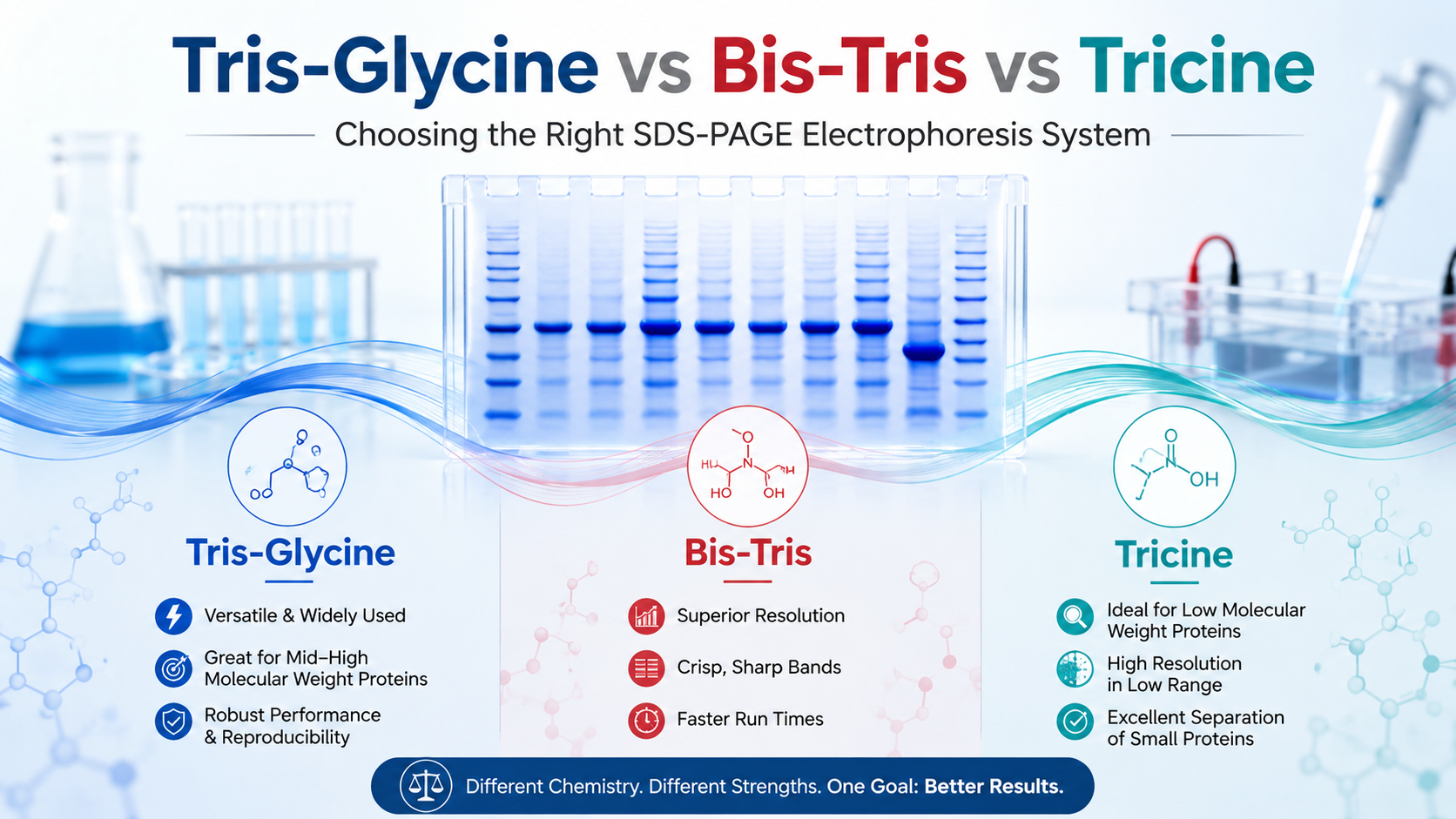
The most important difference among Tris-Glycine, Bis-Tris, and Tricine systems is their target application range.
Tris-Glycine is a universal and economical system for routine SDS-PAGE. It is suitable for general protein separation and widely used in standard laboratory workflows. Its main limitation is lower resolution for small proteins and peptides.
Bis-Tris is a mild and high-resolution system, often used with precast gels and MOPS or MES running buffers. It offers sharper bands and improved reproducibility, making it suitable for Western blotting and applications that require clean electrophoresis results.
Tricine is a specialized system for small proteins and peptides. It offers superior resolution in the low-molecular-weight region and is preferred for peptide research, small protein analysis, and low-molecular-weight target detection.
From a selection perspective, researchers can use a simple rule: choose Tris-Glycine for routine protein electrophoresis, Bis-Tris for sharper and more reproducible bands, and Tricine for low-molecular-weight proteins and peptides.
How to Choose the Right SDS-PAGE Buffer System
When selecting an electrophoresis system, the first factor to consider is the molecular weight of the target protein. If the target protein is in the common medium-to-high molecular weight range, Tris-Glycine or Bis-Tris may be appropriate. If the target is a small protein or peptide, Tricine is usually the better option.
The second factor is the required resolution. For quick routine checks, Tris-Glycine may provide enough information. For publication-quality gels, Western blotting, or comparison between similar samples, Bis-Tris may deliver cleaner and more reproducible results.
The third factor is sample sensitivity. Some proteins may be more stable under milder electrophoresis conditions. In such cases, Bis-Tris systems may be preferred because of their near-neutral pH environment.
The fourth factor is workflow compatibility. Laboratories using hand-cast gels may prefer Tris-Glycine because it is familiar and economical. Laboratories using commercial precast gels may often choose Bis-Tris. Laboratories focused on peptide products, small proteins, or low-molecular-weight biological molecules should consider Tricine systems.
Conclusion
Tris-Glycine, Bis-Tris, and Tricine electrophoresis systems each serve different SDS-PAGE needs. Tris-Glycine is the classic general-purpose system for routine protein analysis. Bis-Tris provides mild conditions, sharp bands, and strong reproducibility for high-quality electrophoresis and Western blot workflows. Tricine is designed for small proteins and peptides, offering superior separation in the low-molecular-weight range.
Choosing the correct electrophoresis buffer system can significantly improve gel quality, reduce troubleshooting time, and generate more reliable protein analysis results. For laboratories working across different protein types, having access to all three systems provides flexibility for routine, high-resolution, and peptide-focused electrophoresis applications.
FireGene, light your research with passion, innovation, and profession.


