
LAL vs TAL Reagent: Key Differences, Cost, Performance, and How to Choose
When performing endotoxin testing, one of the most common questions laboratories face is: LAL vs TAL reagent — which one should you choose?
Both LAL (Limulus Amebocyte Lysate) and TAL (Tachypleus Amebocyte Lysate) are widely used in endotoxin detection. However, differences in cost, sourcing, and supply stability can significantly impact your decision.
In this guide, we provide a detailed comparison of LAL vs TAL reagents, including performance, cost, and real-world application considerations.
What Is LAL and TAL in Endotoxin Testing?
Endotoxin testing relies on a clotting reaction derived from horseshoe crab blood.
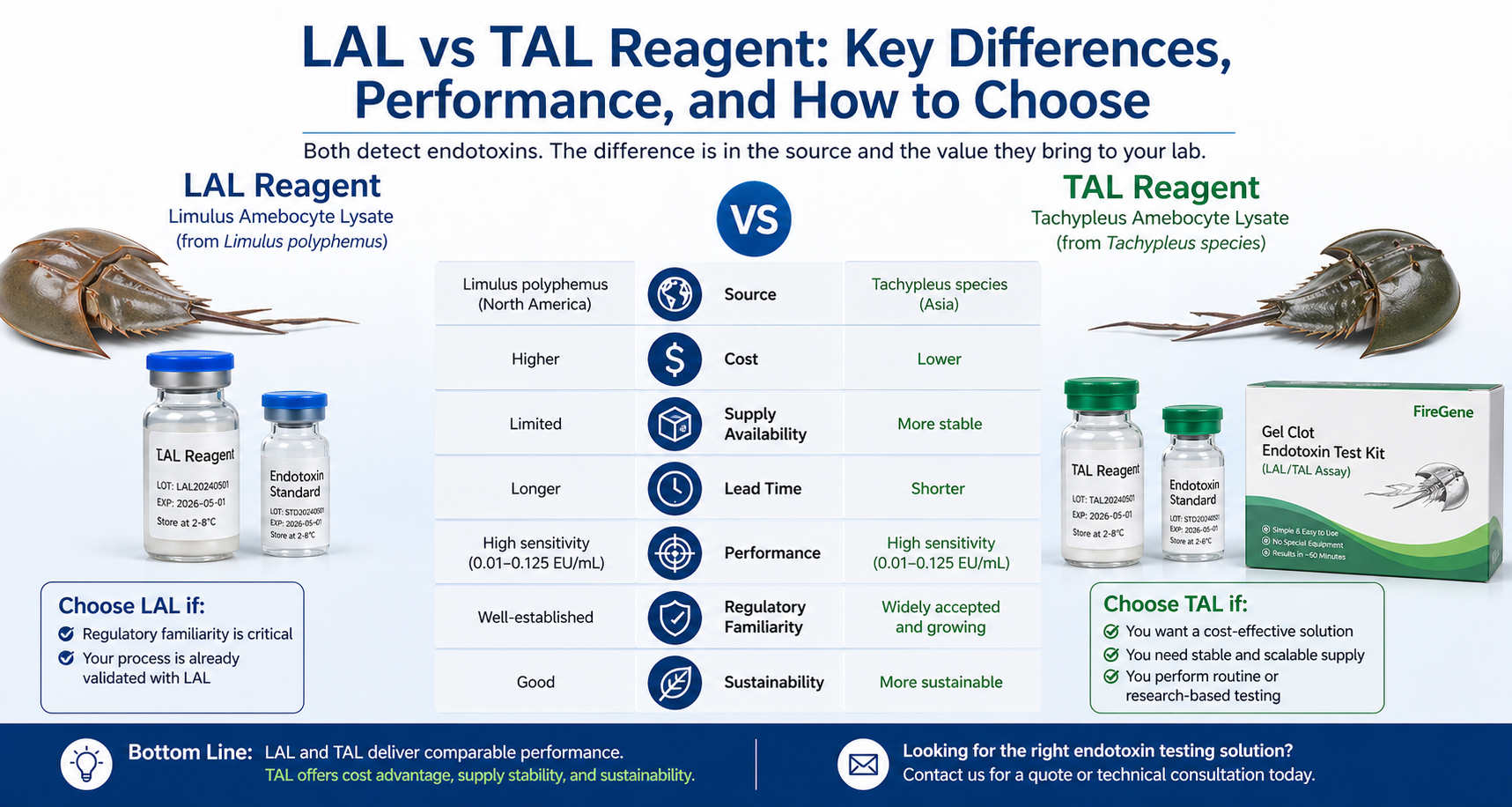
- LAL reagent is extracted from Limulus polyphemus (North America)
- TAL reagent is derived from Tachypleus species (Asia)
Both reagents detect endotoxins through the same biochemical cascade.
👉 From a scientific perspective, LAL vs TAL is not a difference in mechanism, but in sourcing and supply chain.
LAL vs TAL: Performance Comparison
One of the biggest concerns when switching reagents is performance.
Sensitivity
Both LAL and TAL reagents typically offer:
- Detection range: 0.01–0.125 EU/mL
- High specificity to endotoxins
Accuracy and Reliability
Numerous applications show:
- Comparable reproducibility
- Equivalent detection mechanisms
- No significant difference in standard assays
👉 In most laboratory settings, TAL performs at the same level as LAL.
Cost Comparison: Why TAL Is Gaining Popularity
Cost is a major factor in endotoxin testing, especially for:
- Routine QC labs
- High-throughput testing
- Research institutions
| Factor | LAL | TAL |
|---|---|---|
| Price | Higher | Lower |
| Availability | Limited | More stable |
| Lead Time | Longer | Shorter |
👉 As a result, many labs are shifting toward TAL as a cost-effective endotoxin testing solution.
Sustainability and Supply Considerations
The global supply of horseshoe crabs has become a concern.
- LAL depends on North American species
- TAL offers more flexible sourcing
👉 This makes TAL a more sustainable and scalable option for long-term use.
Practical Use: Which One Is Easier to Work With?
In real lab conditions, ease of use matters.
Gel clot TAL kits provide:
- Simple protocol
- No need for specialized instruments
- Fast visual results
👉 For example, the
Gel Clot Endotoxin Test Kit (LAL/TAL Assay)
is widely used for routine endotoxin screening due to its simplicity.
When Should You Choose LAL?
Choose LAL reagent if:
- You must strictly follow established pharmacopeia familiarity
- Your process is already validated with LAL
- Regulatory preference is a priority
When Should You Choose TAL?
Choose TAL reagent if:
- You want to reduce testing costs
- You need stable and scalable supply
- You perform routine or research-based testing
👉 For most laboratories, TAL offers the best balance of performance + cost efficiency.
LAL vs TAL: Final Recommendation
For modern laboratories:
- Performance → equivalent
- Cost → TAL advantage
- Supply → TAL advantage
👉 Therefore, TAL is increasingly becoming the preferred choice for endotoxin testing.
🚀 Optimize Your Endotoxin Testing Workflow
If you are evaluating alternatives to LAL, starting with a gel clot assay is a practical approach.
The
Gel Clot Endotoxin Test Kit (LAL/TAL Assay)
provides:
- Reliable endotoxin detection
- Easy implementation
- Cost-effective testing
👉 Request a quote or contact our team to explore a more efficient endotoxin testing solution.
FireGene, light your research with passion, innovation, and profession.


