
Endotoxin testing is a critical requirement in pharmaceuticals, biologics, and medical devices to ensure product safety and regulatory compliance.
Among all available methods, the gel clot assay and chromogenic assay are the most widely used due to their reliability, sensitivity, and regulatory acceptance.
In this guide, we provide a detailed comparison of gel clot vs chromogenic endotoxin testing methods to help you choose the right solution for your application.
What Is Endotoxin Testing?
Endotoxins are lipopolysaccharides (LPS) found in Gram-negative bacteria. Even at low levels, they can trigger:
- Fever
- Inflammatory responses
- Severe complications in patients
Because of this, endotoxin testing is required in:
- Injectable drugs
- Biologics
- Vaccines
- Medical devices
The LAL/TAL assay remains the gold standard for endotoxin detection.
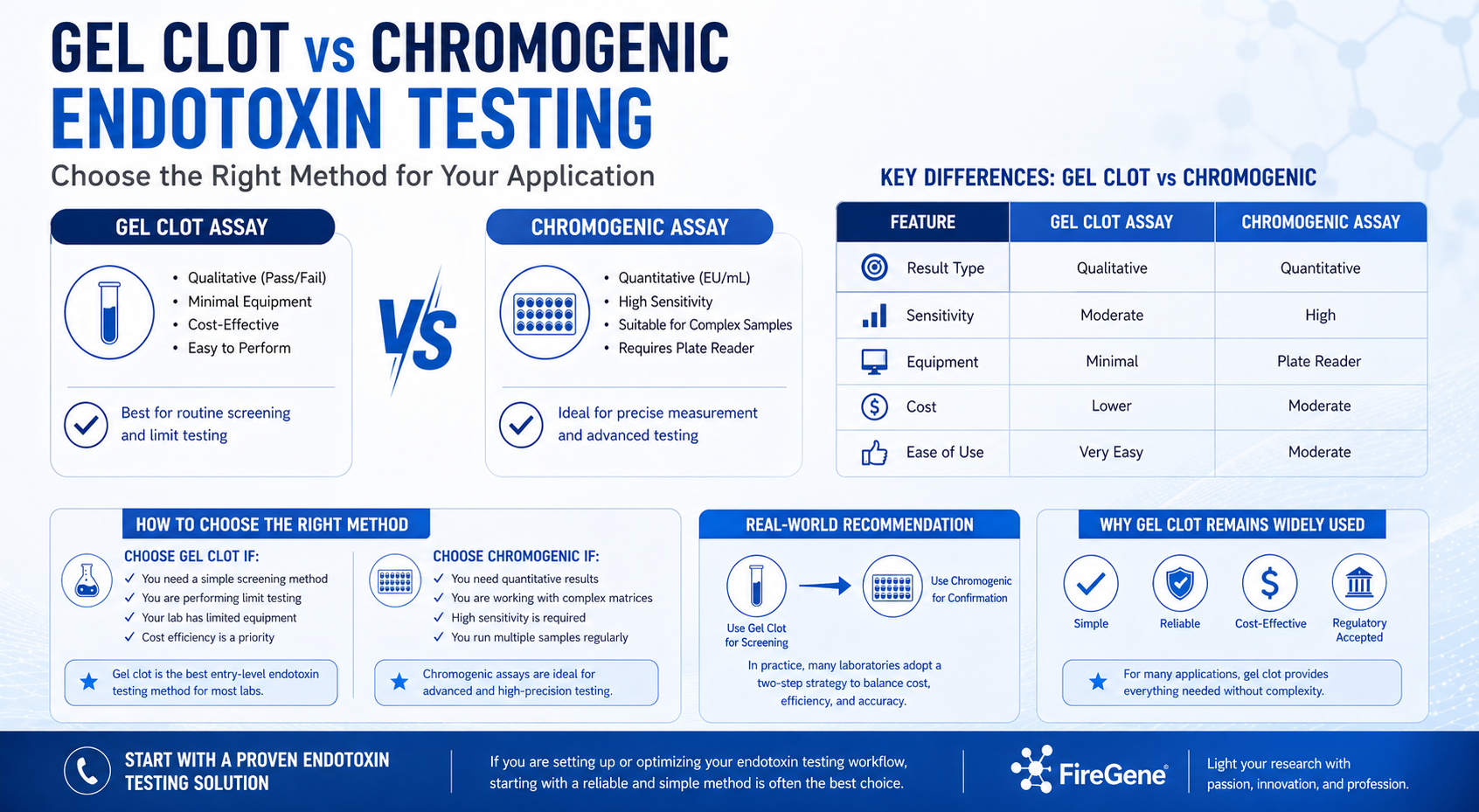
Overview of Gel Clot vs Chromogenic Assays
Gel Clot Method (Qualitative)
The gel clot method is the simplest and most traditional endotoxin testing approach.
Key features:
- Qualitative (pass/fail result)
- Minimal equipment required
- Cost-effective
- Easy to perform
👉 It is commonly used for routine screening and limit testing.
A typical example is the
Gel Clot Endotoxin Test Kit (LAL/TAL Assay)
which allows rapid detection through visible gel formation.
Chromogenic Method (Quantitative)
The chromogenic assay measures endotoxin concentration through a colorimetric reaction.
Key features:
- Quantitative results (EU/mL)
- High sensitivity
- Suitable for complex samples
- Requires microplate reader
👉 This method is ideal when precise endotoxin levels must be determined.
Key Differences: Gel Clot vs Chromogenic
| Feature | Gel Clot Assay | Chromogenic Assay |
|---|---|---|
| Result Type | Qualitative | Quantitative |
| Sensitivity | Moderate | High |
| Equipment | Minimal | Plate reader |
| Cost | Lower | Moderate |
| Ease of Use | Very easy | Moderate |
How to Choose the Right Method
Choose Gel Clot If:
- You need a simple screening method
- You are performing limit testing
- Your lab has limited equipment
- Cost efficiency is a priority
👉 Gel clot is the best entry-level endotoxin testing method for most labs.
Choose Chromogenic If:
- You need quantitative results
- You are working with complex matrices
- High sensitivity is required
- You run multiple samples regularly
👉 Chromogenic assays are ideal for advanced and high-precision testing.
Real-World Recommendation
In practice, many laboratories adopt a two-step strategy:
- Use gel clot for routine screening
- Use chromogenic assays for quantitative confirmation
👉 This approach balances cost, efficiency, and accuracy.
Common Mistakes in Method Selection
- Choosing quantitative methods when not needed
- Over-investing in equipment too early
- Ignoring workflow simplicity
👉 Many labs achieve reliable results using gel clot alone.
Why Gel Clot Remains Widely Used
Despite newer technologies, gel clot remains popular because it is:
- Simple
- Reliable
- Cost-effective
- Regulatory accepted
👉 For many applications, it provides everything needed without complexity.
🚀 Start with a Proven Endotoxin Testing Solution
If you are setting up or optimizing your endotoxin testing workflow, starting with a reliable and simple method is often the best choice.
The
Gel Clot Endotoxin Test Kit (LAL/TAL Assay)
offers:
- Consistent performance
- Easy operation
- Cost-effective testing
👉 Contact us today to request a quote or discuss the best solution for your lab.
FireGene, light your research with passion, innovation, and profession.


