
Introduction
Endotoxin testing has long been a cornerstone of pharmaceutical quality control. Whether manufacturing injectable drugs, biologics, vaccines, cell therapies, or gene therapies, ensuring products are free from harmful levels of bacterial endotoxins is essential for patient safety and regulatory compliance.
For decades, bacterial endotoxin testing (BET) was considered relatively straightforward. Laboratories validated a method, confirmed acceptable spike recovery, and performed routine testing using TAL/LAL Reagents.
However, modern pharmaceutical products have challenged many traditional assumptions.
Today, one of the most significant—and often underestimated—risks in endotoxin testing is Low Endotoxin Recovery (LER).
Unlike obvious assay failures, LER can occur while all system suitability criteria appear acceptable. Standard curves pass. Product Positive Controls (PPCs) pass. Instruments function normally. Yet endotoxin recovery gradually declines over time.
The result is a potentially dangerous situation in which endotoxin remains present but becomes increasingly difficult to detect.
As biologics, antibody-drug conjugates (ADCs), cell therapies, gene therapies, and mRNA-based therapeutics continue to dominate pharmaceutical pipelines, understanding LER has become essential for quality control, analytical development, and regulatory compliance teams.
What Causes Low Endotoxin Recovery?
Quick Answer
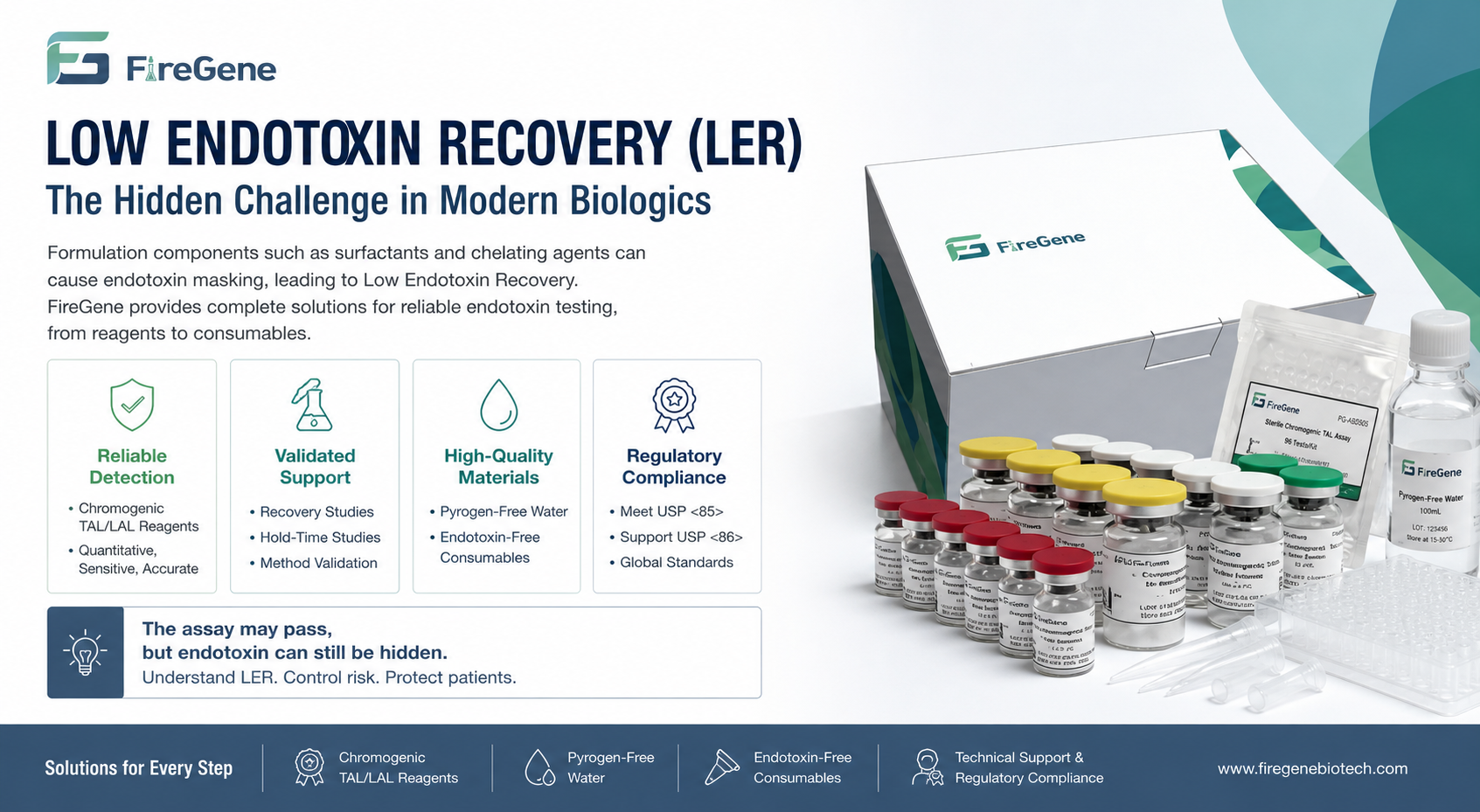
Low Endotoxin Recovery (LER) is primarily caused by endotoxin masking, a phenomenon in which formulation components such as surfactants and chelating agents alter endotoxin structure and reduce its detectability in TAL/LAL Reagent assays.
This phenomenon does not necessarily destroy endotoxin. Instead, it changes how endotoxin interacts with the assay system, resulting in reduced recovery and potential false-negative results.
Because this question is one of the most frequently searched endotoxin testing topics, it is important to understand the underlying mechanisms.
Why LER Has Become a Growing Industry Concern
Twenty years ago, LER was rarely discussed.
Most injectable products contained relatively simple formulations with limited excipient complexity.
Today's products are dramatically different.
Modern therapeutics often include:
- Monoclonal antibodies (mAbs)
- Antibody-drug conjugates (ADCs)
- Cell therapies
- Gene therapies
- Lipid nanoparticle (LNP) formulations
- mRNA therapeutics
- Recombinant proteins
These products frequently contain excipients such as:
- Polysorbate 20
- Polysorbate 80
- Citrate buffer
- Histidine buffer
- Lipid carriers
- Protein stabilizers
- Cryoprotectants
While these components improve therapeutic stability and efficacy, they can also contribute to endotoxin masking.
As pharmaceutical formulations become more sophisticated, Low Endotoxin Recovery has evolved from an occasional laboratory observation into a major industry-wide concern.
What Is Low Endotoxin Recovery (LER)?
Low Endotoxin Recovery refers to the inability to recover a known quantity of endotoxin intentionally added to a sample during method validation or recovery studies.
A typical recovery study involves:
- Spiking a known endotoxin concentration into a product formulation.
- Storing the sample under defined conditions.
- Measuring endotoxin concentration using a TAL/LAL Reagent assay.
- Comparing measured values to expected values.
Under ideal conditions, recovery remains within accepted limits.
During an LER event, measured endotoxin concentrations decrease despite endotoxin remaining physically present in the formulation.
This creates a significant analytical challenge because contamination may go undetected.
Why LER Is Not a TAL/LAL Reagent Failure
One of the most common misconceptions is that Low Endotoxin Recovery indicates poor TAL/LAL Reagent performance.
In reality, most LER investigations demonstrate that the assay itself functions correctly.
| Parameter | Typical Observation |
|---|---|
| Standard Curve | Pass |
| PPC | Pass |
| Instrument Qualification | Pass |
| Chromogenic TAL/LAL Reagent | Pass |
| Endotoxin Recovery | Fail |
This distinction is critical.
LER is generally not caused by:
- Reagent degradation
- Instrument malfunction
- Analyst error
- Poor assay sensitivity
Instead, formulation components alter endotoxin behavior in ways that reduce detectability.
Simply put:
The assay is functioning properly. The endotoxin is becoming harder to detect.
Understanding Endotoxin Structure
To understand endotoxin masking, it is helpful to understand endotoxin itself.
Endotoxin, also known as lipopolysaccharide (LPS), consists of three major regions:
O-Antigen
The outer polysaccharide chain.
Core Polysaccharide
The structural bridge connecting the O-antigen to Lipid A.
Lipid A
The biologically active portion responsible for triggering immune responses and activating Factor C in TAL/LAL Reagents.
Because TAL/LAL Reagents recognize endotoxin primarily through Lipid A, any structural changes affecting Lipid A accessibility can significantly impact recovery.
The Science Behind Endotoxin Masking
Endotoxin masking is widely considered the primary cause of Low Endotoxin Recovery.
Masking occurs when formulation components alter endotoxin aggregation behavior and reduce its interaction with Factor C.
The Two-Component Masking Model
Most documented LER events involve a combination of:
Chelating Agents
Examples include:
- Sodium citrate
- EDTA
- Phosphate-containing systems
Chelators remove divalent cations that help stabilize endotoxin aggregates.
Surfactants
Examples include:
- Polysorbate 20
- Polysorbate 80
- Triton X-100
Surfactants disrupt aggregate structures and change Lipid A presentation.
When these mechanisms act together, endotoxin detectability may decline over time.

FireGene Technical Observation
Based on published industry findings and practical endotoxin testing experience, formulations containing both surfactants and chelating agents are consistently associated with a higher risk of recovery decline than formulations containing either component alone.
This observation aligns with findings discussed throughout industry resources such as PDA Technical Report No. 82 and multiple endotoxin masking studies.
For this reason, FireGene recommends additional recovery studies whenever formulations contain:
- Polysorbate 20
- Polysorbate 80
- Citrate buffers
- EDTA
- Lipid nanoparticle systems
Why Modern Biologics Are Driving More LER Cases
Different product types carry different levels of LER risk.
| Product Category | Relative LER Risk |
|---|---|
| Small Molecule Injectables | Low |
| Recombinant Proteins | Medium |
| Monoclonal Antibodies | Medium |
| ADCs | High |
| Cell Therapies | High |
| Gene Therapies | High |
| mRNA-LNP Products | Very High |
The common factor is formulation complexity.
Modern products often contain multiple ingredients capable of altering endotoxin behavior.
Why Cell and Gene Therapy Products Are Particularly Challenging
Cell and gene therapies introduce unique endotoxin testing challenges.
These products frequently involve:
- Limited sample availability
- Complex biological matrices
- Viral vectors
- Lipid nanoparticles
- High-value manufacturing processes
Examples include:
- CAR-T therapies
- AAV gene therapies
- Stem cell products
- Exosome therapeutics
Because sample availability is often limited, recovery failures can be especially costly.
Case Study: Why a Passing Validation Failed One Week Later
A biotechnology company developing an antibody-drug conjugate performed an endotoxin recovery study using a standard endotoxin spike.
Day 0 Results
| Parameter | Result |
|---|---|
| PPC | Pass |
| Recovery | 92% |
| Endotoxin Test | Pass |
Everything appeared acceptable.
Day 7 Results
| Parameter | Result |
|---|---|
| PPC | Marginal |
| Recovery | 43% |
| Endotoxin Test | Fail |
The investigation found:
- No instrument problems
- No reagent failures
- No analyst errors
The root cause was progressive endotoxin masking caused by a formulation containing Polysorbate 80 and citrate buffer.
This resulted in:
- Method redevelopment
- Additional validation work
- Delayed project timelines
Normal Recovery vs Low Endotoxin Recovery

Why Traditional Spike Recovery Studies May Not Be Enough
One of the most important findings from LER investigations is that endotoxin masking is often time-dependent.
A formulation may pass recovery testing immediately after preparation but fail days later.
| Time Point | Recovery |
|---|---|
| Day 0 | 95% |
| Day 1 | 88% |
| Day 3 | 71% |
| Day 7 | 44% |

This is why hold-time studies are increasingly recommended during validation.
Five Common Mistakes When Investigating Low Endotoxin Recovery
1. Only Evaluating Day 0 Recovery
Many masking effects require time to develop.
2. Assuming PPC Equals Recovery
Passing PPC results do not guarantee acceptable endotoxin recovery.
3. Ignoring Formulation Components
Surfactants and chelators are often major contributors.
4. Neglecting Hold-Time Studies
Time-dependent masking may remain undetected.
5. Using Inconsistent Materials
Water quality and consumables can introduce unnecessary variability.
How Leading Laboratories Investigate LER

Why Chromogenic TAL/LAL Reagents Are Often Preferred for LER Studies
Because LER often manifests as gradual reductions in recovery rather than complete assay failure, quantitative data is essential.
A Chromogenic TAL/LAL Reagent provides:
- Quantitative endotoxin measurements
- Wide dynamic range
- Enhanced sensitivity
- Improved trend analysis
- Better support for recovery investigations
FireGene's Chromogenic TAL/LAL Reagent portfolio is designed to support endotoxin recovery studies, method validation, and routine bacterial endotoxin testing workflows.
For laboratories comparing methodologies, you may also be interested in our article on Gel Clot vs Chromogenic Endotoxin Testing.
Why Pyrogen-Free Water Matters in Recovery Studies
Recovery studies are only as reliable as the materials used during sample preparation.
Using Pyrogen-Free Water helps:
- Minimize variability
- Improve dilution accuracy
- Reduce contamination risk
- Support reproducible recovery studies
FireGene's Pyrogen-Free Water is specifically manufactured for endotoxin testing applications and validation workflows.
Why Endotoxin-Free Consumables Are Critical
Potential sources of variability include:
- Pipette tips
- Tubes
- Reservoirs
- Microplates
- Storage containers
Certified Endotoxin-Free Consumables help improve consistency, reproducibility, and confidence during endotoxin testing.
Low Endotoxin Recovery in the Era of USP <86> and Recombinant Factor C Testing
The publication of USP <86> has accelerated interest in recombinant Factor C (rFC) methods.
As laboratories evaluate alternatives to traditional TAL/LAL Reagents, an important question continues to emerge:
Can Endotoxin Masking Occur in rFC Assays?
Current evidence suggests that recovery performance and matrix interference remain important considerations regardless of assay platform.
Whether using:
- TAL Reagents
- LAL Reagents
- Recombinant Factor C assays
Laboratories should continue evaluating:
- Recovery performance
- Matrix interference
- Hold-time effects
- Product-specific validation requirements
The emergence of USP <86> does not eliminate the need for robust recovery studies.
Frequently Asked Questions About Low Endotoxin Recovery
What recovery percentage indicates LER?
Recovery below established pharmacopeial acceptance criteria may indicate potential LER and should be investigated.
Is endotoxin masking the same as Low Endotoxin Recovery?
Endotoxin masking is generally considered one of the primary causes of LER.
Can LER occur in medical devices?
Yes. Any product matrix capable of altering endotoxin detectability may experience recovery issues.
Does LER affect biologics?
Yes. Biologics are among the most frequently affected product categories.
Does LER affect cell therapies?
Yes. Cell therapies are considered high-risk because of their complex biological matrices.
Can Chromogenic TAL/LAL Reagents eliminate LER?
No. However, they provide quantitative recovery data that greatly improves investigation capabilities.
Does LER affect rFC assays?
Potentially. Recovery assessments remain important regardless of assay platform.
Which formulation components are most associated with endotoxin masking?
Common contributors include:
- Polysorbate 20
- Polysorbate 80
- Citrate buffer
- EDTA
- Lipid nanoparticle systems
Need Support for Endotoxin Recovery Studies?
FireGene provides a complete portfolio of endotoxin testing solutions, including:
- Chromogenic TAL/LAL Reagents
- Pyrogen-Free Water
- Endotoxin-Free Consumables
These products are designed to support:
- Endotoxin recovery studies
- Method validation
- Hold-time investigations
- Routine bacterial endotoxin testing
- Advanced biologics development
Our technical team can help identify suitable solutions for your specific formulation and testing requirements.
Final Thoughts
For decades, endotoxin testing focused primarily on analytical sensitivity.
Today, the challenge is different.
The question is no longer:
Can we detect endotoxin?
The more important question is:
Can we still detect endotoxin after it has interacted with the formulation?
As biologics, ADCs, cell therapies, gene therapies, and mRNA-based therapeutics continue to evolve, Low Endotoxin Recovery will remain one of the most important—and most underestimated—challenges in endotoxin testing.
Organizations that combine robust validation strategies, quantitative Chromogenic TAL/LAL Reagents, high-quality Pyrogen-Free Water, certified Endotoxin-Free Consumables, and formulation-specific recovery studies will be best positioned to ensure reliable endotoxin detection, regulatory compliance, and patient safety.
References
- USP <85> Bacterial Endotoxins Test
- USP <1085.1> Endotoxins and Pyrogen Testing
- PDA Technical Report No. 82: Low Endotoxin Recovery
- FDA Guidance for Industry: Pyrogen and Endotoxins Testing
- European Pharmacopoeia 2.6.14 Bacterial Endotoxins
- Reich J. et al. Low Endotoxin Recovery and Endotoxin Masking in Biopharmaceutical Products
- ICH Q9 Quality Risk Management
FireGene Endotoxin Testing
Ready to run your endotoxin assay?
FireGene offers a complete endotoxin testing toolkit — from TAL reagents and CSE standards to pyrogen-free consumables and LAL reagent water. All products are aligned with USP <85>, EP 2.6.14, and JP 4.01.


