
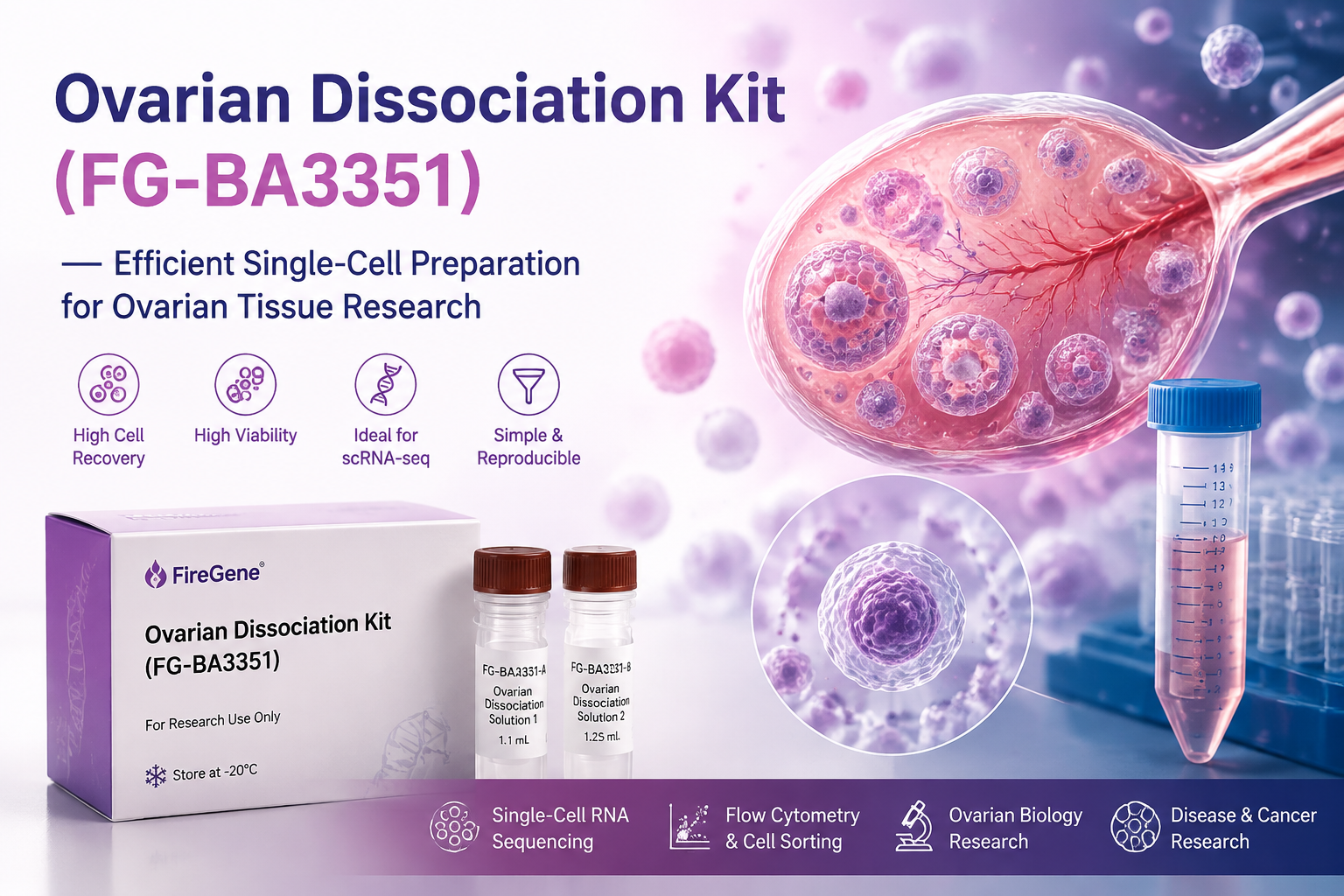
The ovary is a highly complex organ composed of multiple cell populations, including oocytes, granulosa cells, theca cells, stromal cells, endothelial cells, and immune cells. Understanding ovarian development, fertility, aging, and disease mechanisms requires advanced cellular analysis technologies capable of resolving this cellular diversity. Single-cell RNA sequencing (scRNA-seq) has emerged as a powerful approach for investigating ovarian cellular heterogeneity; however, obtaining high-quality single-cell suspensions from ovarian tissue remains a critical challenge.
The FireGene™ Ovarian Dissociation Kit (FG-BA3351) is a specialized enzymatic tissue dissociation solution designed for efficient preparation of single-cell suspensions from ovarian tissue. Through an optimized two-step enzymatic digestion strategy, the kit enables effective extracellular matrix breakdown while maintaining cell viability and integrity. The resulting high-quality cell suspension is suitable for downstream applications including single-cell sequencing, flow cytometry, fluorescence-activated cell sorting (FACS), and primary cell research.
This article introduces the principles of ovarian tissue dissociation, challenges in ovarian single-cell preparation, workflow optimization, and research applications of the Ovarian Dissociation Kit FG-BA3351.
1. Introduction to Ovarian Single-Cell Research
The ovary plays essential roles in reproductive function, hormone regulation, and female health. It contains a highly organized structure composed of follicles, connective tissue, blood vessels, and immune components. Each ovarian compartment contains specialized cell types that contribute to follicle development, hormone production, and tissue maintenance.
Traditional bulk RNA sequencing and biochemical analysis provide valuable molecular information but cannot distinguish differences between individual cell populations. With the development of single-cell RNA sequencing (scRNA-seq) technology, researchers can now analyze gene expression profiles at the individual cell level, allowing detailed characterization of ovarian cellular composition and biological processes.
Ovarian single-cell studies have contributed to discoveries in areas such as:
· Follicular development and maturation
· Oocyte–somatic cell interactions
· Hormonal regulation mechanisms
· Ovarian aging
· Fertility-related disorders
· Ovarian cancer microenvironment analysis
However, successful single-cell analysis depends strongly on the quality of the initial cell suspension. Efficient tissue dissociation is therefore one of the most important steps in the single-cell workflow.
2. Challenges in Ovarian Tissue Dissociation for Single-Cell Preparation
Unlike simple tissues, ovarian tissue presents several challenges during dissociation.
2.1 Complex Tissue Structure
The ovary contains dense extracellular matrix (ECM) components that maintain tissue architecture. These structural proteins connect cells together, making it difficult to release individual cells without damaging them.
Insufficient digestion may result in:
· Low cell recovery
· Large tissue fragments
· Incomplete cell release
Over-digestion may lead to:
· Reduced cell viability
· Damaged surface markers
· Increased cell stress responses
Therefore, optimized enzymatic conditions are essential for generating high-quality single-cell suspensions.
2.2 Diverse Cell Populations with Different Sensitivities
Ovarian tissue contains multiple cell types with different biological characteristics:
· Oocytes: large and fragile cells requiring gentle handling
· Granulosa cells: important follicular support cells
· Stromal cells: involved in hormone production and tissue structure
· Immune cells: sensitive to environmental changes
A suitable dissociation method must efficiently separate cells while preserving cellular characteristics for downstream molecular analysis.
2.3 Maintaining Cell Quality for scRNA-seq
Single-cell sequencing requires:
· High cell viability
· Minimal cell debris
· Reduced cell aggregation
· Preservation of RNA quality
Poor tissue processing can introduce technical bias, affecting sequencing results and reducing the accuracy of cell population identification.
3. FireGene™ Ovarian Dissociation Kit (FG-BA3351) Overview
The FireGene™ Ovarian Dissociation Kit (FG-BA3351) is developed specifically for ovarian tissue single-cell preparation.
The kit utilizes a tissue-optimized enzymatic dissociation approach to efficiently break down ovarian tissue structures while maintaining cellular integrity.
Key advantages include:
· Tissue-specific dissociation formulation
· Efficient release of ovarian cell populations
· Improved single-cell suspension quality
· Compatibility with downstream single-cell analysis platforms
The kit is designed to simplify ovarian tissue processing and improve experimental reproducibility.
4. Principle of Ovarian Tissue Dissociation Using FG-BA3351
The dissociation process is based on controlled enzymatic digestion.

Step 1: Tissue Preparation
Fresh ovarian tissue is first mechanically fragmented into smaller pieces. This increases the surface area exposed to digestive enzymes and improves digestion efficiency.
Step 2: Sequential Enzymatic Digestion
The FG-BA3351 workflow uses a two-step enzymatic digestion strategy.
First Digestion Stage
The initial digestion step helps loosen tissue structure by disrupting extracellular matrix components surrounding ovarian cells.
Second Digestion Stage
The secondary digestion further releases individual cells and improves suspension uniformity.
This sequential approach provides a balance between:
· Effective tissue breakdown
· Reduced cellular stress
· Better preservation of cell characteristics
Step 3: Filtration and Cell Collection
After enzymatic digestion, the cell suspension is filtered to remove undigested tissue fragments and aggregates.
The collected cells can then be:
· Counted
· Evaluated for viability
· Used for sequencing or other downstream applications
5. Applications of Ovarian Dissociation Kit FG-BA3351
5.1 Single-Cell RNA Sequencing (scRNA-seq)
Single-cell RNA sequencing requires high-quality individual cell suspensions. FG-BA3351 supports researchers investigating ovarian cellular landscapes through:
· Cell type identification
· Gene expression profiling
· Cellular communication analysis
· Developmental trajectory studies
By generating representative ovarian cell populations, researchers can better understand complex biological processes at single-cell resolution.
5.2 Ovarian Development and Follicle Biology
The ovary undergoes continuous changes throughout reproductive life. Researchers can use ovarian single-cell preparation to study:
· Follicle formation
· Granulosa cell differentiation
· Oocyte maturation
· Hormonal signaling pathways
Understanding these cellular processes provides insights into reproductive health and fertility regulation.
5.3 Ovarian Cancer Research
Ovarian cancer is characterized by significant cellular heterogeneity. Tumor tissues contain:
· Cancer cells
· Cancer-associated fibroblasts
· Immune cells
· Endothelial cells
Single-cell analysis enables researchers to identify different tumor cell states and investigate interactions within the tumor microenvironment.
FG-BA3351 can support preparation of ovarian tissue-derived single-cell suspensions for cancer-related cellular profiling studies.
5.4 Flow Cytometry and Cell Sorting
High-quality dissociated cells are suitable for flow cytometry-based applications, including:
· Cell population analysis
· Surface marker detection
· Immune cell profiling
· Cell sorting experiments
Maintaining cell integrity during dissociation helps improve the reliability of cytometric analysis.

6. Advantages of FireGene™ Ovarian Dissociation Kit
Compared with traditional mechanical dissociation methods, FG-BA3351 provides several advantages:
Optimized Workflow
The kit provides a standardized dissociation procedure, reducing the need for extensive protocol optimization.
Improved Cell Recovery
Controlled enzymatic digestion improves release of ovarian cell populations from complex tissue structures.
Reduced Cell Damage
Gentle processing helps preserve cell morphology and molecular characteristics.
Suitable for Advanced Applications
The generated single-cell suspension can be integrated into modern analytical platforms, including:
· scRNA-seq
· FACS
· Cell culture
· Molecular profiling
7. Conclusion
High-quality single-cell preparation is a critical foundation for ovarian research. Due to the complex structure and diverse cellular composition of ovarian tissue, conventional dissociation methods often face challenges related to cell recovery, viability, and reproducibility.
The FireGene™ Ovarian Dissociation Kit (FG-BA3351) provides an efficient solution for ovarian tissue dissociation through an optimized enzymatic workflow. By producing high-quality single-cell suspensions, the kit supports researchers in exploring ovarian biology, reproductive mechanisms, disease progression, and cellular heterogeneity.
With increasing adoption of single-cell technologies in biomedical research, reliable tissue dissociation tools such as FG-BA3351 will continue to play an important role in advancing ovarian research and precision biology studies.


