
Introduction
Bacterial endotoxins remain one of the most significant microbiological risks in pharmaceutical manufacturing, particularly for sterile injectable products, biologics, vaccines, cell and gene therapies, and other parenteral medicines. Because endotoxins are heat-stable lipopolysaccharides (LPS) released from the outer membrane of Gram-negative bacteria, they cannot be eliminated simply by sterilization. Once introduced into a manufacturing process, endotoxins may persist throughout production and ultimately compromise product quality and patient safety.
Historically, many pharmaceutical manufacturers viewed bacterial endotoxin testing as a final quality control activity performed immediately before product release. While release testing remains essential, modern regulatory expectations have shifted toward a much broader lifecycle approach. Agencies such as the U.S. FDA, European Medicines Agency (EMA), and PIC/S increasingly expect manufacturers to identify, evaluate, and control endotoxin risks proactively rather than relying solely on end-product testing.
This philosophy is reflected in current guidance documents such as ICH Q9 Quality Risk Management, USP <85> Bacterial Endotoxins Test, USP <1231> Water for Pharmaceutical Purposes, and EU GMP Annex 1, all of which emphasize science-based risk assessment, contamination control, and continuous process monitoring.
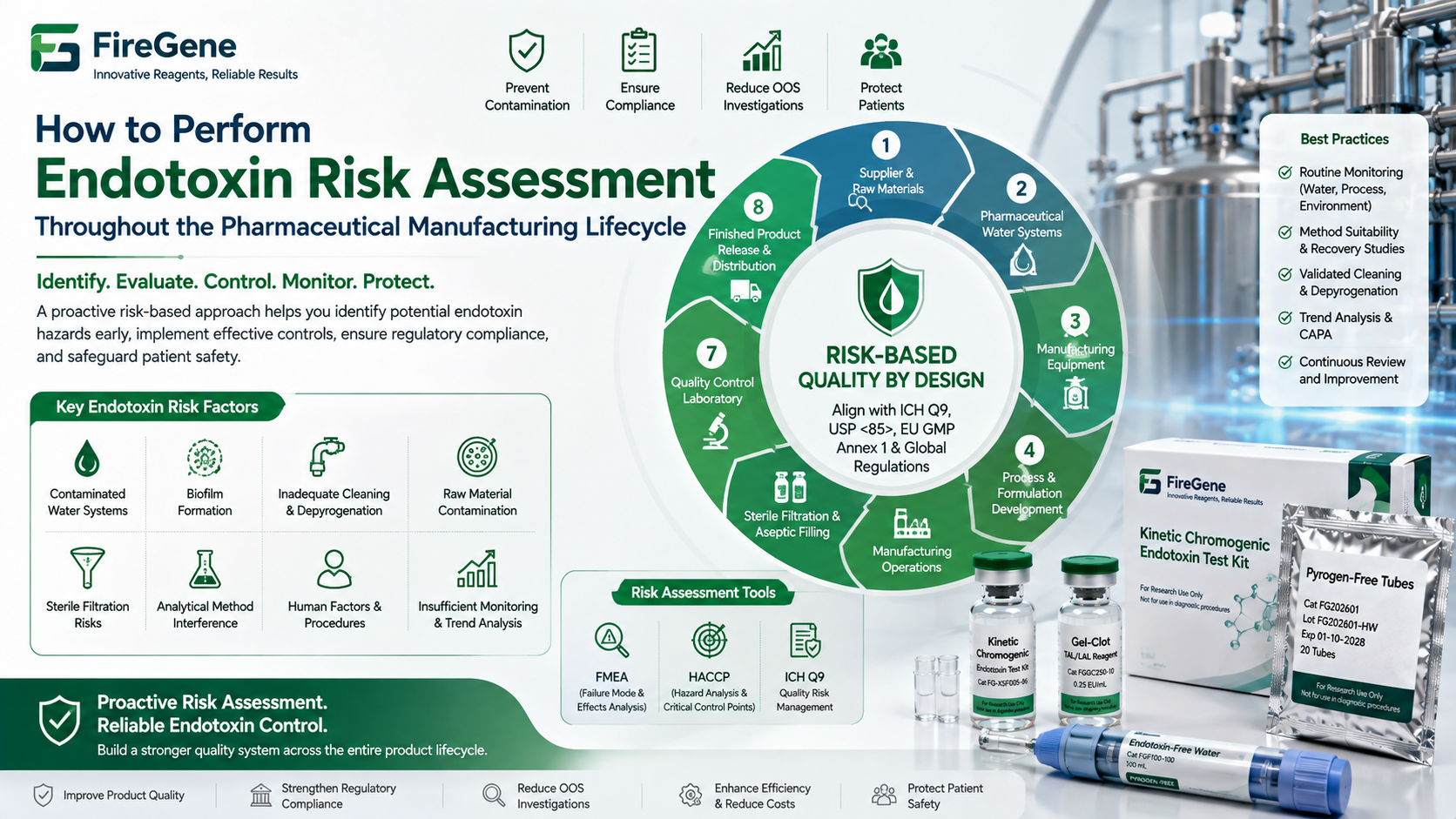
An effective endotoxin risk assessment considers every stage of pharmaceutical manufacturing—from supplier qualification and raw material receipt to pharmaceutical water systems, equipment cleaning, aseptic processing, analytical testing, and final product release. By understanding where endotoxins may be introduced, how they can spread, and which preventive controls are most effective, manufacturers can reduce Out-of-Specification (OOS) investigations, improve operational efficiency, and strengthen regulatory compliance.
In this guide, we explore how to build a comprehensive endotoxin risk assessment program, identify critical control points throughout the pharmaceutical manufacturing lifecycle, and implement practical strategies that support robust quality systems and reliable bacterial endotoxin control.
Why Endotoxin Risk Assessment Matters
Endotoxin contamination is fundamentally different from microbial contamination.
A product may successfully pass sterility testing while still containing unacceptable levels of bacterial endotoxins. Because endotoxins are highly heat stable, conventional sterilization processes do not reliably destroy them.
Consequences of inadequate endotoxin control may include:
- Product recalls
- Out-of-Specification (OOS) investigations
- Batch rejection
- Manufacturing delays
- Regulatory observations
- Increased manufacturing costs
- Risks to patient safety
- Damage to company reputation
Rather than reacting after contamination has occurred, manufacturers should establish preventive risk management programs capable of identifying potential endotoxin hazards before they affect manufacturing.
Applying ICH Q9 to Endotoxin Risk Management
ICH Q9 Quality Risk Management provides a structured framework for identifying, evaluating, controlling, communicating, and reviewing quality risks throughout a product's lifecycle.
Applied to endotoxin control, the process can be summarized in five steps:
1. Risk Identification
Identify where endotoxins could enter the manufacturing process.
Examples include:
- Raw materials
- Pharmaceutical water systems
- Equipment surfaces
- Process intermediates
- Environmental contamination
- Analytical laboratories
- Packaging components
2. Risk Analysis
Evaluate each identified hazard by considering:
- Probability of occurrence
- Potential impact on product quality
- Ability to detect contamination
- Existing process controls
Tools such as Failure Mode and Effects Analysis (FMEA) or Hazard Analysis and Critical Control Points (HACCP) are commonly used to prioritize risks.
3. Risk Evaluation
Compare identified risks against predefined acceptance criteria.
High-risk activities should receive additional monitoring, validation, or engineering controls, while lower-risk activities may be managed through routine GMP procedures.
4. Risk Control
Implement preventive and corrective measures designed to reduce both the likelihood and impact of endotoxin contamination.
Examples include:
- Supplier qualification
- Water system validation
- Equipment cleaning validation
- Method suitability testing
- Environmental monitoring
- Routine endotoxin testing
- Personnel training
5. Risk Review
Risk assessment is not a one-time exercise.
Manufacturers should periodically review risk assessments following:
- Process changes
- Equipment modifications
- Product reformulation
- OOS investigations
- CAPA implementation
- Regulatory inspections
- Annual Product Quality Reviews (APQR)
Continuous review ensures that risk management remains aligned with evolving manufacturing processes and regulatory expectations.
Endotoxin Risk Across the Pharmaceutical Manufacturing Lifecycle
An effective risk assessment evaluates each stage of production, identifying potential contamination sources before they impact product quality.
Stage 1: Supplier Qualification and Raw Materials
The lifecycle begins before manufacturing starts.
Raw materials—including active pharmaceutical ingredients (APIs), excipients, buffers, and processing aids—can introduce endotoxins if supplier controls are inadequate.
Risk mitigation strategies include:
- Supplier audits
- Incoming material testing
- Vendor qualification
- Risk-based supplier classification
- Review of Certificates of Analysis (CoAs)
High-risk materials of biological origin should receive particular attention.
Stage 2: Pharmaceutical Water Systems
Pharmaceutical water is one of the most common sources of endotoxin contamination.
Potential risks include:
- Biofilm formation
- Dead legs
- Poor sanitization
- Storage tank contamination
- Distribution loop failures
- Sampling errors
Routine monitoring of Purified Water (PW) and Water for Injection (WFI), combined with trend analysis and preventive maintenance, forms the foundation of an effective endotoxin control strategy.
Internal Link Suggestion
Naturally link to:
Why Water System Monitoring Is the Foundation of Reliable Endotoxin Testing
Stage 3: Manufacturing Equipment
Processing equipment may accumulate endotoxins if cleaning procedures are ineffective.
Critical considerations include:
- Cleaning validation
- Clean-in-Place (CIP)
- Steam-in-Place (SIP)
- Surface sampling
- Equipment maintenance
- Hygienic design
- Prevention of stagnant product residues
Equipment qualification should demonstrate that validated cleaning processes consistently reduce endotoxin contamination to acceptable levels.
Stage 4: Process Development and Formulation
As pharmaceutical products move from development into manufacturing, formulation design becomes another critical point for endotoxin risk assessment. Every ingredient introduced into a formulation—including buffers, stabilizers, surfactants, preservatives, and excipients—should be evaluated for its potential to introduce or mask endotoxins.
For injectable products, biologics, monoclonal antibodies, vaccines, and peptide therapeutics, formulation components may also influence analytical performance during bacterial endotoxin testing.
Potential risks include:
- Endotoxin contamination from excipients
- Matrix interference during TAL/LAL testing
- Low Endotoxin Recovery (LER)
- Inconsistent spike recovery
- Formulation changes during scale-up
Recommended controls include:
- Product-specific method suitability testing
- Endotoxin recovery studies
- Supplier qualification for excipients
- Formulation change control
- Routine analytical trending
Risk assessments should be updated whenever formulation changes are introduced during development or commercial manufacturing.
Stage 5: Manufacturing Operations
Manufacturing operations represent one of the most complex phases of endotoxin risk management because multiple processes, personnel, utilities, and equipment interact simultaneously.
Potential contamination sources include:
- Open processing steps
- Equipment connections
- Transfer lines
- Mixing vessels
- Holding tanks
- Filters
- Operator interventions
For sterile manufacturing, every process step should be evaluated using a formal risk assessment methodology to identify opportunities for endotoxin introduction.
Typical preventive controls include:
- Closed processing systems
- Validated cleaning procedures
- Hygienic equipment design
- Environmental monitoring
- Personnel qualification
- Preventive maintenance
- Process automation where appropriate
The objective is to minimize both microbial contamination and the subsequent formation of endotoxins throughout manufacturing.
Stage 6: Sterile Filtration and Aseptic Filling
Many manufacturers mistakenly assume sterile filtration eliminates all microbiological risks.
In reality, sterile filters remove viable microorganisms but do not remove bacterial endotoxins.
This distinction is fundamental during endotoxin risk assessment.
Potential risks include:
- Endotoxins entering immediately before filtration
- Contaminated filtration assemblies
- Inadequate depyrogenation of containers
- Environmental contamination during filling
- Poor aseptic technique
Critical preventive controls include:
- Validated depyrogenation processes
- Sterile component preparation
- Environmental monitoring
- Routine filter integrity testing
- Aseptic process simulation (Media Fill)
- Personnel qualification
These controls should form part of the facility's overall Contamination Control Strategy (CCS) as recommended by EU GMP Annex 1.
Stage 7: Quality Control Laboratory
Quality Control laboratories play a dual role.
They detect endotoxin contamination while simultaneously introducing their own analytical risks if laboratory practices are not properly controlled.
Common laboratory risks include:
- Non-pyrogen-free consumables
- Incorrect reagent preparation
- Pipetting variability
- Poor instrument qualification
- Analyst error
- Environmental contamination
- Improper sample storage
Risk mitigation strategies include:
- Validated Standard Operating Procedures (SOPs)
- Regular analyst training
- Qualified pipettes and microplate readers
- Routine system suitability testing
- Positive Product Controls (PPCs)
- Standard curve verification
- Endotoxin-free laboratory consumables
Standardization reduces analytical variability while improving confidence in bacterial endotoxin test results.
Stage 8: Finished Product Release
Before release, every batch should undergo a comprehensive quality review.
Endotoxin testing represents only one element of the overall release decision.
Additional considerations include:
- Sterility testing
- Product identity
- Potency
- Appearance
- Particulate matter
- Stability data
- Manufacturing deviations
- Environmental monitoring review
- Batch record review
A lifecycle-based risk assessment ensures that release decisions consider manufacturing history rather than relying solely on a single analytical result.
Risk Assessment Tools for Endotoxin Control
Several structured risk assessment tools can be applied to bacterial endotoxin management.
Failure Mode and Effects Analysis (FMEA)
FMEA is one of the most widely used tools in pharmaceutical quality systems.
Each potential failure is evaluated according to:
- Severity
- Probability of occurrence
- Detectability
These factors are combined into a Risk Priority Number (RPN), allowing manufacturers to prioritize corrective actions for the highest-risk processes.
For example:
| Process Step | Potential Failure | Possible Consequence | Recommended Control |
|---|---|---|---|
| Pharmaceutical Water | Biofilm formation | Elevated endotoxin levels | Routine monitoring and sanitization |
| Raw Materials | Contaminated excipient | Product contamination | Supplier qualification and incoming testing |
| Equipment Cleaning | Inadequate depyrogenation | Residual endotoxins | Cleaning validation and verification |
| QC Laboratory | Matrix interference | False analytical results | Method suitability testing and recovery studies |
Hazard Analysis and Critical Control Points (HACCP)
HACCP focuses on identifying Critical Control Points (CCPs) where contamination can be prevented before it affects product quality.
Typical endotoxin-related CCPs include:
- Water system monitoring
- Equipment cleaning
- Raw material acceptance
- Final filtration
- Aseptic filling
- Endotoxin testing before release
Both FMEA and HACCP complement ICH Q9 and provide a structured framework for documenting and managing endotoxin risks throughout the manufacturing lifecycle.
Case Study: Using Risk Assessment to Prevent an Endotoxin OOS Investigation
A manufacturer of sterile injectable biologics observed a gradual increase in Positive Product Control (PPC) variability during routine endotoxin testing. Although all batches continued to meet release specifications, the quality team identified an unfavorable trend during monthly performance reviews.
Rather than waiting for an Out-of-Specification (OOS) result, a multidisciplinary team initiated a formal endotoxin risk assessment using the principles of ICH Q9 and an FMEA approach.
The investigation included:
- Reviewing supplier qualification records for recently introduced excipients
- Examining Water for Injection (WFI) monitoring trends
- Assessing equipment cleaning validation data
- Evaluating analyst training records
- Repeating method suitability testing using fresh product samples
- Reviewing calibration records for pipettes and microplate readers
The assessment identified a combination of formulation-specific matrix interference and a gradual decline in recovery performance caused by an updated excipient supplier.
Following additional recovery studies and revalidation of the analytical method, the laboratory established an optimized dilution protocol and strengthened incoming raw material qualification procedures.
As a result, the manufacturer restored consistent PPC recovery, avoided a future OOS investigation, and improved long-term analytical robustness.
This case illustrates that effective endotoxin risk assessment is not simply about identifying failures—it is about detecting emerging risks early enough to prevent them from becoming quality events.
FireGene Endotoxin Testing
Ready to run your endotoxin assay?
FireGene offers a complete endotoxin testing toolkit — from TAL reagents and CSE standards to pyrogen-free consumables and LAL reagent water. All products are aligned with USP <85>, EP 2.6.14, and JP 4.01.


