
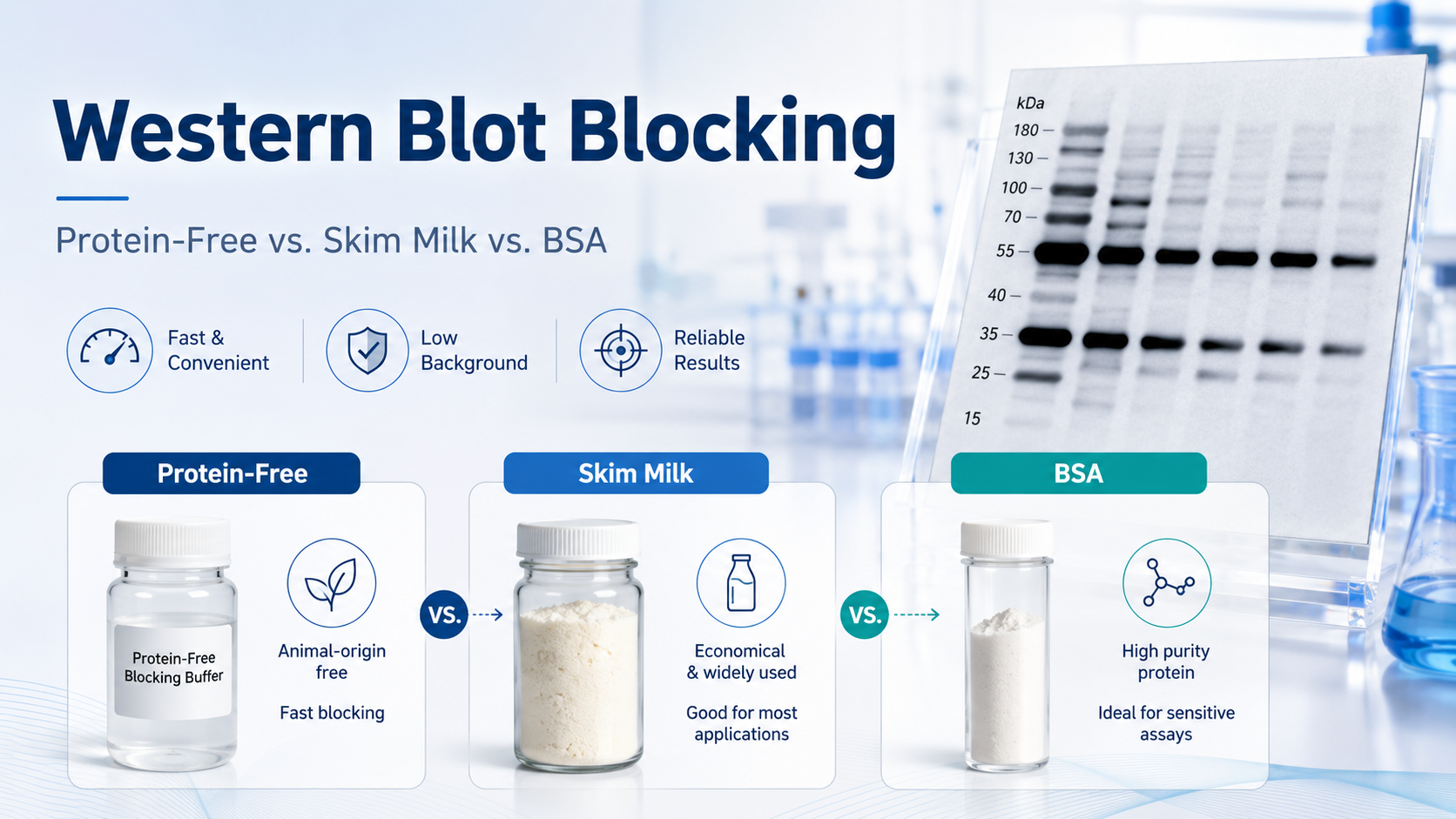
Western blotting is one of the most widely used techniques for protein detection and analysis. Although antibody quality, membrane type, transfer efficiency, and washing conditions all affect the final result, the blocking step is often one of the most underestimated factors. A well-chosen blocking reagent can reduce background, improve signal-to-noise ratio, and make target bands easier to interpret. In contrast, an unsuitable blocker may cause high background, weak signals, nonspecific bands, or inconsistent results.
Among commonly used Western blot blocking reagents, three options are frequently compared: protein-free rapid blocking buffer, skim milk powder, and BSA for blocking. Each has distinct advantages and limitations. Understanding their differences can help researchers select the most appropriate blocking system for routine Western blotting, phosphoprotein detection, low-abundance targets, or experiments requiring cleaner background.
Why Blocking Matters in Western Blot
After protein transfer, the membrane still contains many unoccupied binding sites. If these sites are not blocked properly, antibodies may bind nonspecifically to the membrane, producing high background or false-positive signals. Blocking reagents fill these nonspecific binding sites before primary antibody incubation.
The ideal blocking reagent should reduce nonspecific binding without masking the target protein or interfering with antibody-antigen recognition. However, no single blocking reagent works best for every Western blot. The optimal choice depends on the target protein, antibody type, detection method, and sensitivity requirements.
What Is Protein-Free Rapid Blocking Buffer?
Protein-free rapid blocking buffer is a ready-to-use or diluted blocking solution designed to block membranes quickly without relying on traditional protein-based blockers such as milk or BSA. Depending on the manufacturer, it may contain synthetic polymers, surfactants, or other proprietary non-protein blocking components.
The most notable feature of protein-free rapid blocking buffer is speed. Traditional blocking with milk or BSA often takes 30–60 minutes at room temperature, while many rapid blocking buffers can complete the blocking step in several minutes. This makes them attractive for laboratories that need faster Western blot workflows.
Another important advantage is reduced interference from exogenous proteins. Since the buffer is protein-free, it does not introduce milk proteins, albumin, casein, endogenous biotin, or phosphoproteins into the system. This can be useful when working with antibodies or detection systems that are sensitive to protein-based blocking agents.
Protein-free rapid blocking buffers are often preferred when researchers encounter persistent background problems with milk or BSA. They may also improve reproducibility because commercial formulations are usually more standardized than laboratory-prepared milk solutions.
However, protein-free rapid blocking buffer is usually more expensive than skim milk powder or BSA. Its performance can also vary by brand and formulation. Because the exact composition is often proprietary, researchers may need to test compatibility with their antibody, membrane, and detection system before adopting it as a routine blocker.
What Is Skim Milk Powder?
Skim milk powder is one of the most common and economical blocking reagents in Western blotting. It is usually prepared as a 3–5% solution in TBST or PBST. Its blocking activity mainly comes from milk proteins, especially casein, which effectively occupy nonspecific binding sites on the membrane.
For many routine Western blot experiments, skim milk powder works very well. It provides strong blocking capacity, is inexpensive, easy to prepare, and widely available. It is commonly used for detecting housekeeping proteins such as GAPDH, β-actin, and tubulin, as well as many non-phosphorylated target proteins.
The major advantage of skim milk is cost-effectiveness. For high-throughput laboratories or routine protein detection, milk is often the first choice because it provides good performance at a low cost. It is also forgiving in many standard Western blot protocols.
However, skim milk is not always suitable. Because milk contains a complex mixture of proteins and other biological components, it may introduce interference in certain applications. One of the most important limitations is phosphoprotein detection. Casein, a major milk protein, is itself a phosphoprotein. When using anti-phosphorylation antibodies, milk may increase background or produce nonspecific bands. For this reason, milk is generally not recommended as the first-choice blocker for phosphorylated targets such as p-AKT, p-ERK, p-STAT3, or p-NF-κB.
Skim milk may also contain endogenous biotin, which can interfere with biotin-streptavidin detection systems. In addition, milk powder quality can vary between batches or suppliers, potentially affecting reproducibility.
What Is BSA for Blocking?
BSA, or bovine serum albumin, is another widely used Western blot blocking reagent. Compared with skim milk, BSA is more chemically defined and less complex. It is typically used at 3–5% in TBST or PBST.
BSA is especially useful when detecting phosphorylated proteins. Because it does not contain the same level of phosphoprotein interference as milk, BSA is commonly recommended for Western blots involving phospho-specific antibodies. It often produces cleaner results for signaling pathway studies, kinase activation assays, and post-translational modification analysis.
BSA is also a good option when skim milk causes high background, weak target signal, or unexpected nonspecific bands. Since BSA is a single major protein rather than a complex mixture, it can provide better consistency in sensitive applications.
However, BSA also has limitations. It is more expensive than skim milk powder, especially for laboratories running many blots. In some cases, BSA may provide weaker blocking than milk, leading to higher background if antibody concentrations or washing conditions are not optimized. The purity and grade of BSA can also influence results, so it is important to use a product suitable for immunoassays or Western blot applications.
Key Differences Between the Three Blocking Reagents
The main difference among protein-free rapid blocking buffer, skim milk powder, and BSA lies in composition. Protein-free rapid blocking buffer avoids traditional protein components and is designed for fast, low-interference blocking. Skim milk powder is a complex protein-based blocker rich in casein and other milk proteins. BSA is a more defined protein blocker based primarily on bovine serum albumin.
In terms of speed, protein-free rapid blocking buffer has the strongest advantage. It is designed to shorten the blocking step and support faster Western blot workflows. Skim milk and BSA usually require longer incubation, commonly 30–60 minutes at room temperature.
In terms of cost, skim milk powder is usually the most economical option. BSA is more expensive, while protein-free rapid blocking buffer is typically the highest-cost option among the three.
For routine total protein detection, skim milk powder is often sufficient and cost-effective. For phosphorylated protein detection, BSA is generally preferred because milk may interfere with phospho-specific antibodies. For difficult blots, high-background membranes, low-abundance targets, or time-sensitive workflows, protein-free rapid blocking buffer may be the best choice.
When to Use Protein-Free Rapid Blocking Buffer
Protein-free rapid blocking buffer is suitable when speed and background control are priorities. It can be useful for rapid Western blot protocols, screening experiments, and workflows that require same-day results. It is also worth testing when traditional blockers produce persistent background or inconsistent bands.
Researchers may choose protein-free rapid blocking buffer for low-abundance proteins, highly sensitive chemiluminescent detection, fluorescent Western blotting, or experiments where protein-based blockers create interference. Because it does not contain milk proteins or albumin, it can reduce some sources of nonspecific interaction.
When to Use Skim Milk Powder
Skim milk powder is ideal for routine Western blotting of total proteins. It is commonly used for abundant targets, housekeeping proteins, and general antibody validation. For many standard applications, 5% skim milk in TBST provides strong blocking performance at a low cost.
It is especially suitable when the target is not phosphorylated and when the antibody has already been validated in milk-based blocking conditions. However, if the blot shows high background, multiple nonspecific bands, or weak specific signal, switching to BSA or a protein-free blocking buffer may help.
When to Use BSA for Blocking
BSA is the preferred choice for many phosphoprotein Western blots. It is commonly used in studies of cell signaling, kinase pathways, receptor activation, and post-translational modification. When using phospho-specific primary antibodies, 3–5% BSA in TBST is often a safer starting point than milk.
BSA is also useful when milk causes interference or when the researcher needs a cleaner and more defined blocking environment. Although it costs more than skim milk, the improved specificity can justify the expense in sensitive experiments.
Practical Selection Guide
For routine total protein detection, start with skim milk powder. It is inexpensive, effective, and compatible with many standard Western blot protocols.
For phosphorylated protein detection, start with BSA. It reduces the risk of interference from milk-derived phosphoproteins and is commonly preferred for phospho-specific antibodies.
For fast workflows, difficult targets, or persistent background, test a protein-free rapid blocking buffer. It may provide faster blocking, cleaner background, and better reproducibility, especially when traditional blockers fail.
In all cases, the antibody datasheet should be checked first. Some antibody manufacturers specifically recommend milk, BSA, or a proprietary blocking buffer. When no recommendation is provided, small-scale optimization is the best strategy.
Conclusion
Protein-free rapid blocking buffer, skim milk powder, and BSA each play an important role in Western blot blocking. Skim milk powder is the most economical and practical option for routine total protein detection. BSA is better suited for phosphorylated proteins and applications requiring a more defined blocker. Protein-free rapid blocking buffer offers speed, convenience, and reduced protein-related interference, making it valuable for rapid Western blotting and challenging assays.
Choosing the right blocking reagent is not just a minor protocol detail. It directly affects background, specificity, sensitivity, and reproducibility. By matching the blocking reagent to the target protein and detection system, researchers can obtain clearer bands, more reliable results, and a more efficient Western blot workflow.
FireGene, light your research with passion, innovation, and profession.


