
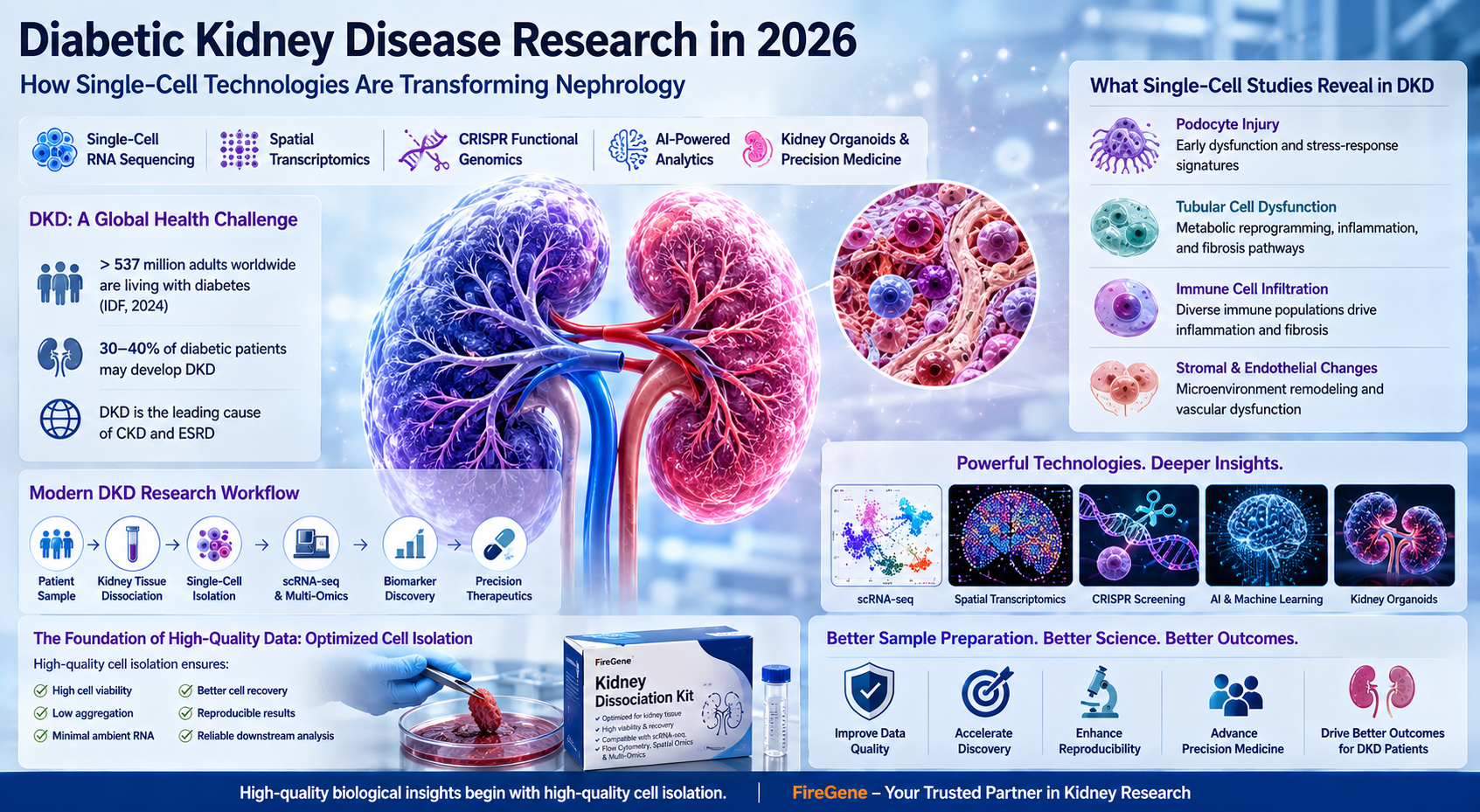
Keywords: Diabetic Kidney Disease Research, Single-Cell RNA Sequencing, Kidney Dissociation Kit, Kidney Cell Isolation Kit, Kidney Tissue Dissociation, Kidney Research Supplier, Spatial Transcriptomics, Precision Medicine, DKD Biomarkers, Renal Cell Isolation
Estimated Reading Time: 12–15 Minutes
Introduction
Diabetic Kidney Disease (DKD) remains one of the most significant unmet medical challenges in modern healthcare.
According to the International Diabetes Federation (IDF), more than 540 million adults worldwide are currently living with diabetes, and approximately 30–40% will eventually develop some degree of diabetic kidney disease. As the leading cause of chronic kidney disease (CKD) and end-stage renal disease (ESRD), DKD continues to drive substantial healthcare costs, dialysis dependence, and mortality worldwide.
Despite decades of research, the biological mechanisms underlying DKD progression remain incompletely understood.
Historically, researchers relied on:
- Animal models
- Histopathology
- Bulk RNA sequencing
- Cell culture systems
- Clinical biomarkers such as eGFR and albuminuria
While these approaches have contributed significantly to our understanding of kidney disease, they often fail to capture the extraordinary cellular complexity of diabetic kidneys.
In 2026, the landscape is changing rapidly.
The convergence of:
- Single-Cell RNA Sequencing (scRNA-seq)
- Spatial Transcriptomics
- Multi-Omics Integration
- CRISPR Functional Genomics
- Kidney Organoids
- Artificial Intelligence (AI)
is transforming nephrology research and enabling scientists to investigate DKD at an unprecedented level of resolution.
However, a critical reality remains unchanged:
The quality of downstream biological insights depends heavily on the quality of the starting cell suspension.
Whether researchers are performing scRNA-seq, flow cytometry, cell sorting, spatial biology, CRISPR screening, or multi-omics analysis, optimized kidney tissue dissociation has become a foundational requirement for success.
Why Diabetic Kidney Disease Remains a Global Research Priority
DKD is far more than a complication of diabetes.
It is a progressive and multifactorial disease involving complex interactions among metabolic dysfunction, inflammation, fibrosis, vascular injury, and immune responses.
For years, DKD was primarily viewed as a glomerular disorder.
Today, researchers recognize that multiple renal cell populations contribute to disease progression.
These include:
- Podocytes
- Mesangial Cells
- Endothelial Cells
- Proximal Tubular Cells
- Distal Tubular Cells
- Collecting Duct Cells
- Fibroblasts
- Macrophages
- T Cells
The challenge is that these cellular populations do not respond uniformly to diabetic stress.
Each cell type may activate unique signaling pathways, exhibit distinct transcriptional programs, and contribute differently to disease progression.
This complexity has made DKD an ideal application for single-cell technologies.
How Single-Cell RNA Sequencing Changed DKD Research
Traditional bulk RNA sequencing averages gene expression across thousands or millions of cells.
As a result, important biological signals can be obscured.
Single-cell RNA sequencing has fundamentally changed this paradigm.
Instead of analyzing tissues as a single population, researchers can now characterize individual cells and identify unique disease-associated states.
scRNA-seq enables researchers to investigate:
- Cellular heterogeneity
- Rare cell populations
- Disease progression pathways
- Cell-to-cell communication
- Drug responses
- Biomarker candidates
Over the past five years, thousands of kidney-focused single-cell studies have been published, generating comprehensive cellular atlases of healthy and diseased kidneys.
These studies have revealed biological mechanisms that were previously impossible to observe using conventional technologies.
What Single-Cell Studies Have Revealed About DKD
Podocyte Injury Begins Earlier Than Expected
Podocytes play a critical role in maintaining glomerular filtration.
Single-cell analyses have demonstrated that diabetic stress triggers:
- Cytoskeletal remodeling
- Oxidative stress pathways
- Mitochondrial dysfunction
- Apoptotic signaling
Importantly, many of these changes occur before substantial declines in kidney function become clinically apparent.
This finding has important implications for early diagnosis and intervention.
Tubular Cells Are Major Drivers of Disease Progression
Historically, tubular injury received less attention than glomerular pathology.
Modern single-cell datasets tell a different story.
Researchers have identified significant alterations in proximal tubular cells, including:
- Metabolic dysregulation
- Inflammatory activation
- Fibrotic signaling
- Cellular senescence
These discoveries have expanded the range of potential therapeutic targets for DKD.
Immune Cells Play a Central Role
One of the most surprising findings from scRNA-seq studies has been the diversity of immune populations present in diabetic kidneys.
Researchers have identified:
- Pro-inflammatory macrophages
- Fibrosis-associated macrophages
- Activated T lymphocytes
- Dendritic cell populations
Understanding these immune interactions may lead to novel immunomodulatory therapies for DKD.
Why Sample Preparation Has Become the Hidden Bottleneck in DKD Research
Most discussions surrounding single-cell sequencing focus on sequencing platforms, bioinformatics pipelines, and computational analysis.
However, many experienced researchers recognize a different reality:
Sample preparation is often the single largest source of variability in single-cell experiments.
Even the most advanced sequencing platform cannot compensate for poor-quality cell suspensions.
In many studies, low-quality tissue dissociation leads to:
Reduced Cell Viability
Damaged cells compromise sequencing quality and reduce data reliability.
Cell Aggregation
Aggregates interfere with droplet-based sequencing platforms such as 10x Genomics Chromium.
Ambient RNA Contamination
Dead cells release RNA that contaminates neighboring droplets.
Population Bias
Fragile renal cell populations may be selectively lost during processing.
Reduced Reproducibility
Variability introduced during dissociation can affect cross-study comparisons.
For this reason, many laboratories are shifting toward standardized Kidney Tissue Dissociation workflows specifically optimized for renal tissue processing.
Researchers conducting scRNA-seq studies frequently adopt a specialized Kidney Dissociation Kit to improve cell recovery and preserve sensitive cell populations during preparation.
Best Practices for Kidney Tissue Dissociation in Single-Cell Research
Successful kidney tissue processing requires balancing efficient dissociation with preservation of cellular integrity.
Key considerations include:
Maximizing Cell Viability
Most researchers aim for:
- Greater than 80% viability
- Minimal cellular debris
- Limited apoptosis
Minimizing Aggregation
Cell aggregates can significantly reduce sequencing efficiency and increase doublet rates.
Preserving Fragile Cell Types
Certain renal populations are highly sensitive to enzymatic digestion and mechanical stress.
Standardizing Workflows
Reducing operator-dependent variability improves reproducibility.
Many laboratories utilize dedicated Kidney Cell Isolation Kits designed specifically for single-cell applications.
Spatial Transcriptomics Is Adding a New Layer of Biological Insight
One of the fastest-growing areas in nephrology research is Spatial Transcriptomics.
While scRNA-seq identifies cellular states, spatial technologies preserve tissue architecture and reveal where cells reside within diseased tissue.
Popular platforms include:
- 10x Genomics Visium HD
- Xenium
- NanoString CosMx
Researchers increasingly combine:
- scRNA-seq
- Spatial Transcriptomics
- Proteomics
- Digital Pathology
to generate comprehensive molecular maps of DKD progression.
Importantly, high-quality single-cell datasets often serve as reference maps for spatial analyses.
As a result, optimized Kidney Tissue Dissociation Solutions have become even more important.
Kidney Organoids and Precision Medicine
Patient-derived kidney organoids are rapidly becoming powerful tools for DKD research.
These systems allow investigators to model:
- Patient-specific disease mechanisms
- Drug responses
- Genetic risk factors
- Therapeutic interventions
Modern precision medicine workflows increasingly follow a path similar to:
Patient Sample
↓
iPSC Generation
↓
Kidney Organoid Development
↓
Single-Cell Characterization
↓
Drug Screening
↓
Biomarker Discovery
↓
Personalized Therapy
Throughout this workflow, reliable single-cell preparation remains essential.
CRISPR Functional Genomics Is Accelerating Target Discovery
CRISPR technologies are transforming kidney disease research.
Applications include:
- Gene Knockout Studies
- CRISPRi
- CRISPRa
- Perturb-seq
- Functional Screening
Researchers can now investigate how specific genes influence:
- Fibrosis
- Inflammation
- Metabolism
- Cellular aging
- Drug responses
Successful CRISPR workflows require high-quality single-cell suspensions compatible with downstream sequencing.
Many laboratories therefore incorporate specialized Single Cell Kidney Tissue Dissociation Kits into their workflows.
AI and Multi-Omics Are Driving the Next Wave of DKD Discovery
Artificial intelligence is becoming increasingly integrated into nephrology research.
AI-powered tools are now used for:
- Cell Annotation
- Biomarker Discovery
- Disease Classification
- Drug Response Prediction
- Multi-Omics Integration
Large-scale kidney datasets generated through scRNA-seq provide ideal training data for machine learning algorithms.
However, poor-quality cell suspensions introduce noise that can negatively affect downstream analyses.
The principle remains simple:
Better cell isolation generates better biological data.
Emerging Trends in DKD Research for 2026
Several technologies are expected to dominate DKD research in the coming years.
Spatial Multi-Omics
Simultaneous analysis of RNA, proteins, and tissue architecture.
AI Foundation Models
Large biological models trained on millions of kidney cells.
Perturb-seq
Combining CRISPR screening with single-cell sequencing.
Digital Pathology
Integrating histology with molecular profiling.
Precision Therapeutics
Personalized treatment strategies based on patient-specific molecular signatures.
These technologies will generate increasingly complex datasets, further emphasizing the importance of standardized sample preparation.
Case Study: Improving Single-Cell Sequencing Outcomes in DKD Research
A nephrology research group investigating diabetic kidney samples encountered several challenges:
- Low cell viability
- High aggregate levels
- Poor sequencing metrics
- Reduced recovery of podocyte populations
Initially, the team suspected sequencing chemistry issues.
However, workflow analysis revealed that tissue dissociation represented the primary bottleneck.
After implementing a more standardized kidney tissue dissociation workflow, the researchers observed:
- Improved viability
- Increased cell recovery
- Reduced aggregation
- Better sequencing performance
- Enhanced detection of rare populations
The sequencing platform remained unchanged.
The quality of cell isolation improved.
This scenario reflects a common challenge encountered across many single-cell kidney research programs.
How to Choose the Right Kidney Research Supplier
When selecting a Kidney Research Supplier, laboratories should evaluate several key criteria.
Tissue-Specific Optimization
Kidney tissue presents unique dissociation challenges.
Reproducibility
Can results be consistently replicated?
Viability Preservation
Can fragile renal populations be maintained?
Downstream Compatibility
Support for:
- scRNA-seq
- Flow Cytometry
- Cell Sorting
- Spatial Biology
- CRISPR Screening
- Organoid Research
Workflow Simplicity
Can protocols be easily implemented across laboratories?
Researchers increasingly prioritize suppliers that provide dedicated kidney-specific dissociation solutions rather than generic tissue digestion reagents.
Frequently Asked Questions
What is diabetic kidney disease?
DKD is a progressive kidney disorder caused by diabetes-related damage to renal tissues.
Why is single-cell RNA sequencing important for DKD research?
It reveals cellular heterogeneity that cannot be observed through bulk sequencing.
What viability is recommended for kidney scRNA-seq?
Most laboratories target viability above 80%.
What causes cell aggregation during kidney tissue processing?
Incomplete dissociation and excessive cellular debris are common causes.
What is ambient RNA contamination?
RNA released from dead or damaged cells that contaminates sequencing libraries.
Why is kidney tissue difficult to dissociate?
Kidney tissue contains complex extracellular matrix structures and multiple fragile cell populations.
Can tissue dissociation affect gene expression?
Yes. Excessive digestion may induce stress-related transcriptional changes.
What is the best kidney dissociation kit for scRNA-seq?
Researchers generally seek kidney-specific dissociation solutions optimized for high viability and low aggregation.
How many cells are required for 10x Genomics workflows?
Requirements vary, but most experiments target thousands to tens of thousands of viable cells.
Which kidney cell populations are most sensitive during dissociation?
Podocytes, endothelial cells, and certain immune populations are particularly vulnerable.
Can kidney organoids be analyzed using scRNA-seq?
Yes. Single-cell sequencing is widely used for organoid characterization.
Why is reproducibility important in DKD research?
Experimental variability can significantly affect biological interpretation and biomarker discovery.
Can CRISPR screening be combined with scRNA-seq?
Yes. Perturb-seq is a rapidly growing application.
Why is spatial transcriptomics important?
It preserves tissue architecture while measuring gene expression.
How can researchers improve cell recovery from kidney tissue?
Optimized tissue dissociation workflows and kidney-specific reagents can significantly improve recovery rates.
Conclusion
Diabetic Kidney Disease research is entering a transformative era.
Single-cell RNA sequencing, spatial transcriptomics, CRISPR functional genomics, kidney organoids, artificial intelligence, and precision medicine are fundamentally changing how researchers investigate kidney biology and therapeutic development.
These technologies are uncovering disease mechanisms that were previously impossible to observe and accelerating biomarker discovery, target identification, and drug development.
Yet regardless of how sophisticated downstream technologies become, one principle remains unchanged:
High-quality biological insights begin with high-quality cell isolation.
As nephrology research continues to evolve throughout 2026 and beyond, laboratories that prioritize optimized kidney tissue dissociation workflows will be best positioned to generate reproducible data, accelerate scientific discoveries, and support the future of precision medicine.
FireGene Single-Cell Sample Prep
Looking for validated dissociation kits?
FireGene's tissue dissociation kits are optimized for specific organ types — brain, tumor, liver, GI, reproductive, and more. Validated for 10x Genomics Chromium and BD Rhapsody workflows.


