
Brain organoid and single-cell sequencing technologies are rapidly reshaping modern neuroscience research. From neurodevelopmental biology to CNS disease modeling, researchers increasingly rely on high-quality neural tissue processing workflows to generate reproducible and biologically meaningful data.
However, one persistent challenge remains common across many laboratories: preparing viable and consistent single-cell suspensions from delicate neural tissues.
Researchers searching for terms such as “Purchase Human Brain Dissociation Kit,” “Brain Organoid Dissociation Supplier,” or “Neural Tissue Processing for scRNA-seq” are often trying to solve practical workflow problems involving:
- Low cell viability
- Excessive tissue debris
- Cell aggregation after filtration
- Inconsistent sequencing QC metrics
- Loss of fragile neuronal populations
- Poor transcriptomic integrity
In many sequencing facilities, these problems appear long before library preparation begins.
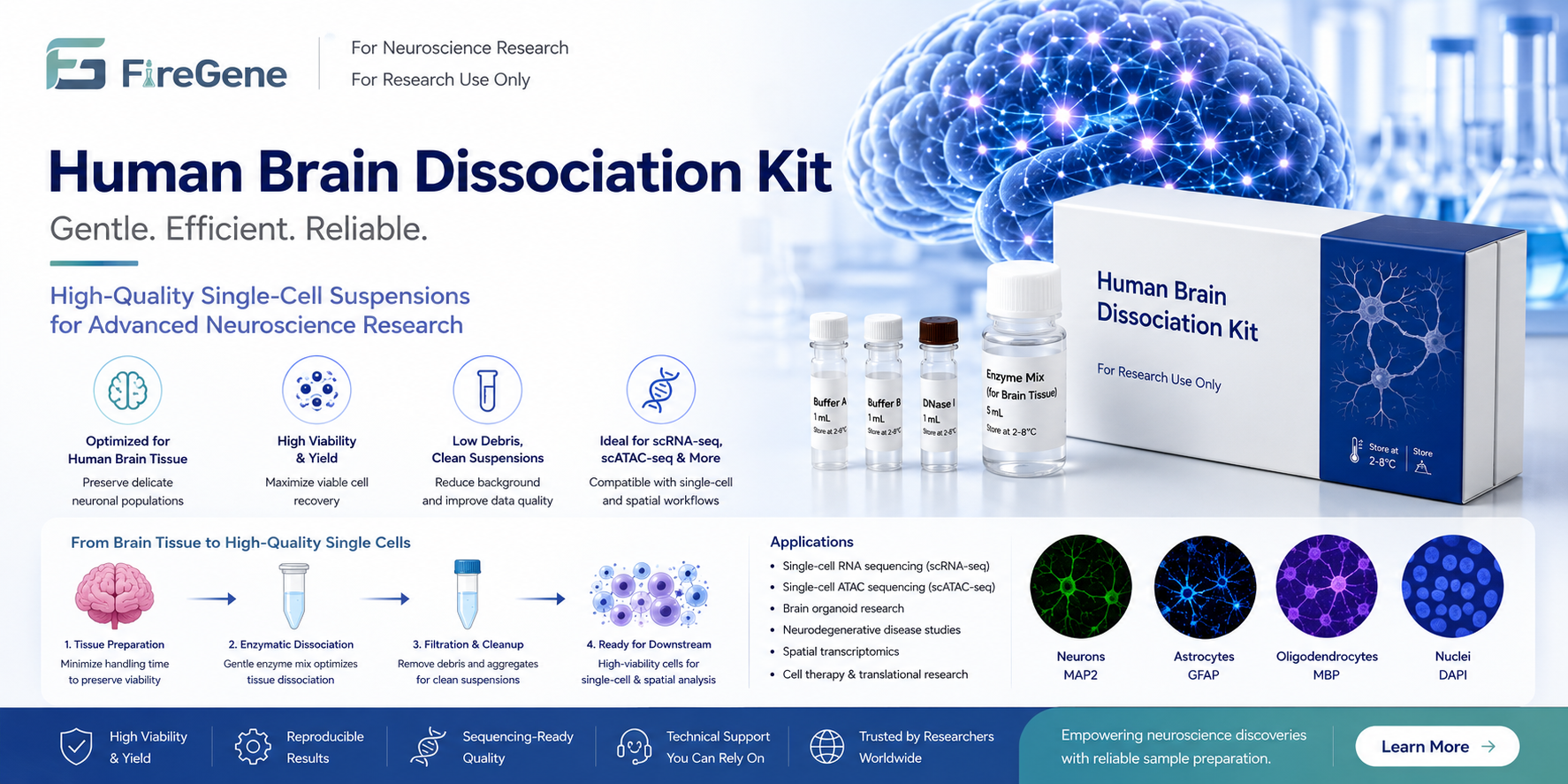
The FireGene Human Brain Dissociation Kit was developed specifically for modern neuroscience applications requiring gentle yet efficient tissue dissociation workflows suitable for:
- Brain organoid research
- Single-cell RNA sequencing
- CNS tumor analysis
- Neurodegenerative disease studies
- Translational neuroscience
- Neural stem cell research
Researchers looking for a more standardized neural tissue processing workflow often explore dedicated solutions such as the FireGene Human Brain Dissociation Kit, particularly for applications involving brain organoids, scRNA-seq preparation, and fragile neural tissue handling.](https://firegene.com/products/human-brain-dissociation-kit-fg-ba3326?variant=47833516474580)
Why Brain Organoid Dissociation Has Become a Major Research Bottleneck
Brain organoids have become one of the most important experimental platforms in neuroscience.
Today, researchers use organoid models to study:
- Alzheimer’s disease
- Parkinson’s disease
- Autism spectrum disorders
- Neurodevelopment
- Viral infection mechanisms
- Drug screening workflows
- Precision neurology
Despite these advances, preparing high-quality single-cell suspensions from organoids remains technically difficult.
Unlike simpler cell cultures, brain organoids contain highly interconnected neural networks and fragile extracellular structures that are easily damaged during digestion.
Many laboratories report that prolonged digestion frequently increases debris levels and reduces viable neuron recovery, while insufficient digestion often leaves aggregates that interfere with droplet-based sequencing platforms.
Interestingly, some sequencing facilities only recognize dissociation-related workflow problems after sequencing QC begins to fail. In many cases, the actual issue originates much earlier during tissue handling and digestion.
Some researchers also report that even relatively short delays between tissue isolation and enzymatic digestion may noticeably affect fragile neuronal populations, particularly in aged cortical tissue or partially frozen clinical specimens.
One commonly overlooked detail is that organoid variability between batches can significantly affect tissue digestion behavior. Some organoids dissociate rapidly, while others require more careful optimization depending on density, maturity, and extracellular matrix composition.
For this reason, neuroscience laboratories increasingly prefer standardized neural tissue processing workflows capable of improving consistency between experiments.
The FireGene Human Brain Dissociation Kit supports brain organoid workflows by combining gentle enzymatic digestion with simplified handling procedures designed for sensitive neural structures.
For laboratories processing multiple organoid batches simultaneously, workflow consistency becomes especially important because differences in digestion timing or mechanical handling can significantly influence downstream transcriptomic quality.
For neuroscience groups scaling organoid-based sequencing projects, optimized brain tissue dissociation systems are increasingly becoming part of routine sample preparation workflows.
Why Tissue Dissociation Quality Directly Affects scRNA-seq Results
Single-cell RNA sequencing has fundamentally changed neuroscience research by enabling detailed analysis of individual neural populations.
However, sequencing quality depends heavily on upstream sample preparation.
In practical workflows, poor tissue dissociation often leads to:
- Increased ambient RNA contamination
- Reduced droplet capture efficiency
- Elevated doublet formation
- High dead-cell contamination
- Loss of rare neuronal populations
- Stress-induced transcriptional artifacts
Many researchers initially assume sequencing platforms are responsible for poor data quality. In reality, inconsistent tissue preparation is frequently the underlying cause.
For example, neurons are highly sensitive to:
- Temperature fluctuations
- Excessive centrifugation
- Overdigestion
- Prolonged room-temperature exposure
- Mechanical stress during filtration
- Repeated pipetting during sample transfer
In sequencing core facilities, maintaining transcriptomic integrity during sample preparation has become increasingly important for generating publication-quality data.
Some laboratories also observe that aggressive dissociation conditions may selectively reduce recovery of sensitive neuronal subtypes while increasing stress-associated transcriptional signatures.
As a result, many neuroscience workflows now place greater emphasis on balancing dissociation efficiency with preservation of biologically meaningful cellular information.
The FireGene Human Brain Dissociation Kit was designed to support cleaner neural tissue dissociation workflows suitable for modern single-cell sequencing applications.
Common Troubleshooting Problems During Neural Tissue Processing
Recent growth in spatial transcriptomics and high-throughput single-cell sequencing workflows has significantly increased demand for cleaner and more reproducible neural tissue preparation methods.
As sequencing throughput increases, many neuroscience laboratories now prioritize tissue dissociation workflows capable of maintaining both viable neuron recovery and transcriptomic integrity across larger sample cohorts.
Even experienced neuroscience laboratories frequently encounter technical problems during brain tissue dissociation.
Common Signs of Overdigestion
- Excessive debris formation
- Cloudy cell suspensions
- Reduced neuron viability
- Increased dead-cell contamination
- Unstable sequencing QC metrics
Excessive Debris During Sequencing QC
Overdigestion often releases large amounts of cellular fragments that interfere with downstream library preparation and sequencing consistency.
Reduced Viability After Filtration
Some laboratories report that viability loss becomes more noticeable after the second filtration or centrifugation step rather than immediately after enzymatic digestion. This is particularly common in fragile adult cortex samples and partially frozen neural tissue specimens.
Fragile neuronal populations may rapidly lose viability during prolonged handling or repeated centrifugation steps.
Common Signs of Incomplete Digestion
- Visible tissue aggregates after filtration
- Reduced droplet capture efficiency
- Inconsistent cell counting results
- Filtration blockage during sample preparation
Cell Aggregation Before Sequencing
In practical workflows, aggregates may not become fully visible until cell counting or droplet loading begins. Researchers working with low-input samples often monitor aggregation carefully because even small clumps can affect downstream capture consistency.
Incomplete tissue digestion frequently results in aggregates that reduce cell capture efficiency.
Common Workflow Mistakes During Neural Tissue Dissociation
- Overmixing during sample transfer
- Delayed filtration after digestion
- Excessive centrifugation speed
- Inconsistent digestion timing between batches
- Leaving neural tissue at room temperature too long
These seemingly minor workflow differences can substantially influence sequencing QC performance and viable neuron recovery.
Inconsistent Results Between Operators
Manual workflows often vary depending on timing, enzyme preparation, and mechanical handling intensity.
Loss of Sensitive Neural Populations
Microglia, astrocytes, oligodendrocytes, and rare neuronal subtypes may be disproportionately affected by harsh dissociation conditions.
Researchers working with translational neuroscience workflows increasingly prioritize standardized processing methods capable of improving reproducibility while reducing workflow complexity.
The FireGene Human Brain Dissociation Kit was developed to help support these research needs while maintaining simplified neural tissue preparation workflows.
Many laboratories therefore prefer integrated neural tissue dissociation workflows that can support cleaner suspensions, improved sequencing consistency, and reduced operator variability across experiments.
Common Recommendations Before Neural Tissue Dissociation
In practical neuroscience workflows, small handling details can significantly affect downstream sequencing quality.
Many laboratories commonly recommend:
- Keeping neural tissue cold before digestion begins
- Minimizing unnecessary centrifugation steps
- Reducing prolonged room-temperature exposure
- Filtering cell suspensions promptly after digestion
- Avoiding excessive mechanical disruption
- Processing fragile cortical tissue as quickly as possible
These workflow adjustments are often used to help preserve viable neuron recovery and improve downstream sequencing consistency.
One detail many researchers overlook is that neural tissue degradation may continue during routine handling steps, particularly when samples remain at room temperature for extended periods before digestion officially begins.
Gentle vs Aggressive Neural Tissue Dissociation: Why Balance Matters
One of the most common challenges in neural tissue processing is balancing digestion efficiency with preservation of sensitive neural populations.
Highly aggressive dissociation conditions may improve short-term tissue breakdown while simultaneously increasing:
- Debris formation
- Stress-associated transcriptional signatures
- Loss of fragile neuronal populations
- Dead-cell contamination
- Reduced transcriptomic quality
On the other hand, insufficient digestion may lead to:
- Persistent tissue aggregates
- Reduced filtration efficiency
- Lower droplet capture consistency
- Incomplete neural cell recovery
For this reason, many neuroscience laboratories increasingly prioritize gentle but standardized tissue dissociation workflows capable of supporting both viability preservation and efficient downstream sequencing preparation.
Why Standardized Dissociation Workflows Are Becoming More Important
Reproducibility remains one of the biggest challenges in modern biological research.
Differences in enzyme preparation, incubation timing, operator handling, and tissue maturity can create major variability between experiments.
This becomes especially important when processing:
- Adult cortical tissue
- Brain organoids
- Tumor-adjacent CNS tissue
- Neuroinflammatory samples
- Low-input clinical specimens
Commercially optimized neural tissue dissociation kits help laboratories reduce these variables by simplifying workflow conditions.
Compared with highly manual dissociation approaches, standardized workflows may help reduce operator-dependent variability while improving reproducibility across larger neuroscience projects.
Advantages commonly include:
- Improved sequencing reproducibility
- Reduced troubleshooting time
- More stable QC performance
- Easier onboarding of laboratory personnel
- Better cross-project comparability
- Reduced optimization burden for new staff
This trend is especially visible among:
- Single-cell sequencing core facilities
- Brain organoid research groups
- Translational neuroscience laboratories
- CNS disease research teams
- Biotechnology startups focused on neurology
For research groups scaling neuroscience projects across multiple studies, standardized tissue processing has become increasingly important.
FAQ: Questions Researchers Commonly Ask About Brain Organoid Dissociation
Why does fresh tissue and partially frozen tissue behave differently during dissociation?
Partially frozen neural tissue often shows increased fragility, higher debris levels, and greater sensitivity to mechanical handling compared with freshly processed samples.
Why does organoid dissociation affect sequencing quality?
Poor tissue preparation can increase debris, reduce viable cell recovery, and alter transcriptional profiles before sequencing begins.
Why do some organoid batches dissociate differently?
Differences in organoid density, maturation stage, and extracellular matrix composition can significantly influence digestion behavior between batches.
Why are neurons difficult to preserve during tissue digestion?
Neurons are highly sensitive to prolonged enzymatic exposure and mechanical stress.
What causes aggregation after organoid dissociation?
Incomplete digestion and extracellular matrix retention commonly contribute to aggregation.
Why does filtration sometimes reduce viable neuron recovery?
Repeated filtration or excessive mechanical stress during sample transfer may damage fragile neuronal populations.
Why is debris a problem for scRNA-seq workflows?
Excessive debris may interfere with droplet generation and downstream sequencing QC metrics.
Why do some researchers prefer gentle dissociation workflows?
Gentler processing conditions may help preserve sensitive neuronal and glial populations while reducing stress-associated transcriptional changes.
Why are standardized dissociation kits becoming more popular?
Standardized workflows help reduce operator variability and improve reproducibility between experiments.
Looking for a Research-Grade Human Brain Dissociation Kit Supplier?
As neuroscience workflows continue evolving, many laboratories are searching for scalable and reproducible neural tissue dissociation solutions suitable for:
- Brain organoid research
- Single-cell sequencing
- Neurodegenerative disease studies
- CNS tumor microenvironment analysis
- Translational neuroscience workflows
FireGene supports research laboratories seeking:
- Research-use-only neural tissue dissociation solutions
- Technical consultation for tissue processing workflows
- Bulk research supply support
- Global research shipping support
- Evaluation opportunities for neuroscience applications
Many neuroscience laboratories now prioritize tissue dissociation systems capable of supporting both routine research workflows and increasingly complex single-cell sequencing applications.
Researchers evaluating neural tissue preparation strategies for single-cell sequencing, brain organoid analysis, or translational neuroscience applications often prioritize workflows designed specifically for delicate CNS tissue processing.
Additional workflow and product information related to the FireGene Human Brain Dissociation Kit can be found on the FireGene research platform.
Related Neuroscience Research Topics
Researchers interested in neural tissue processing workflows also frequently explore topics such as:
- Reducing debris during brain organoid dissociation
- Improving viability before scRNA-seq
- Signs of overdigestion during neural tissue processing
- Neural tissue preparation for spatial transcriptomics
- Adult brain tissue dissociation troubleshooting
- Brain organoid single-cell preparation workflows
As neuroscience sequencing technologies continue evolving, these workflow optimization topics are becoming increasingly important for generating reproducible and publication-quality data.
About FireGene Research Workflows
Prepared by the FireGene Neuroscience Application Team
Research Focus Areas:
- Neural tissue dissociation
- Brain organoid processing
- Single-cell sequencing workflows
- Neuroscience sample preparation
- Research-use-only dissociation technologies
Conclusion
As neuroscience research continues advancing toward single-cell and spatial biology technologies, neural tissue preparation quality has become one of the most important determinants of downstream experimental success.
Whether working with brain organoids, CNS disease models, or translational neuroscience workflows, researchers increasingly require dissociation systems capable of balancing digestion efficiency with cellular preservation.
The FireGene Human Brain Dissociation Kit provides a research-focused solution designed for modern neuroscience laboratories seeking reliable neural tissue processing, improved viability, and more reproducible sequencing workflows.
For laboratories searching for a reliable Human Brain Dissociation Kit supplier or scalable neural tissue processing workflow, FireGene offers a practical solution for advanced neuroscience research applications.


