
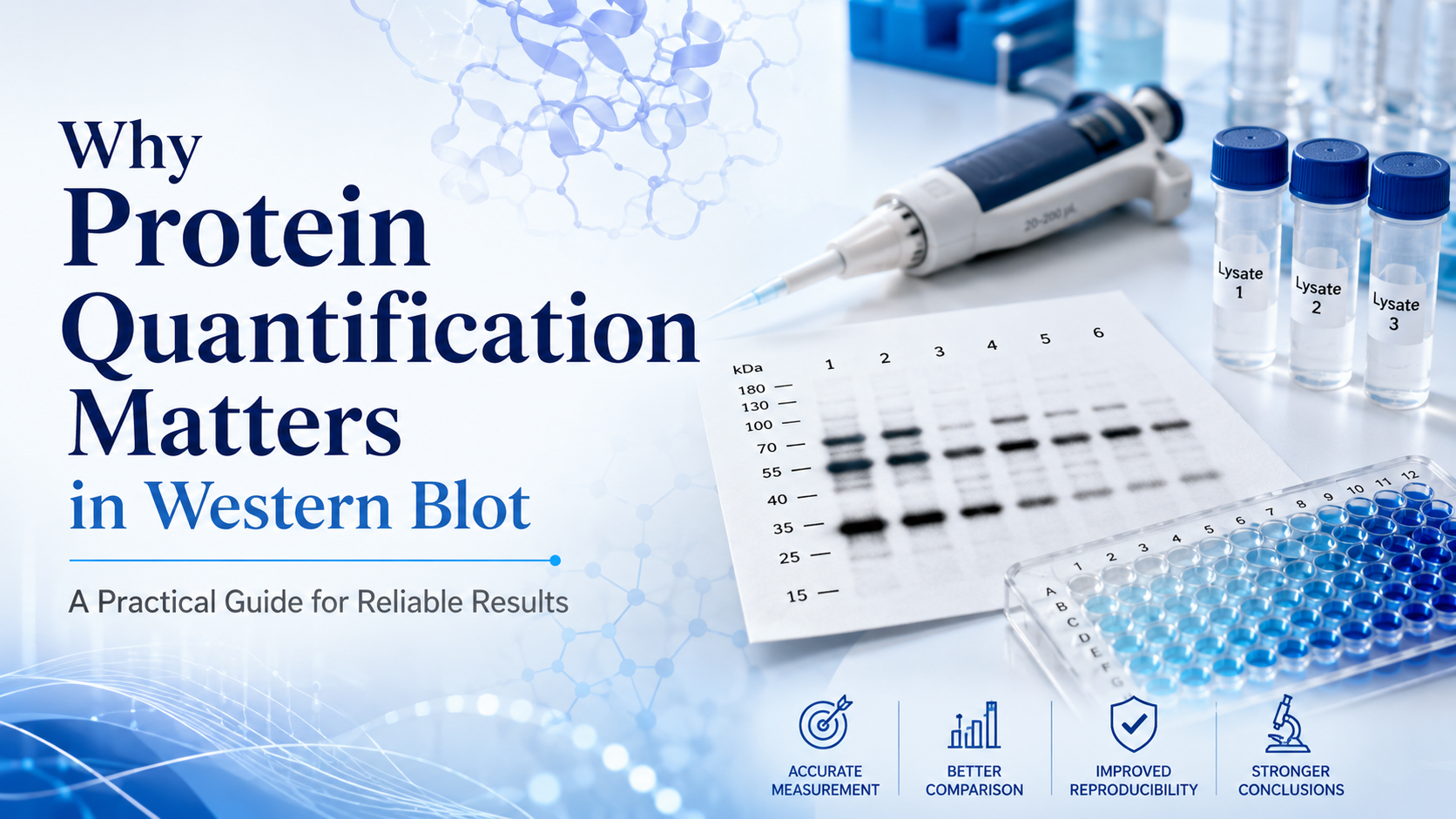
Western Blot remains one of the most widely used techniques for detecting and comparing protein expression in biological research. Whether researchers are studying disease mechanisms, signaling pathways, drug responses, or biomarker expression, Western Blot provides valuable information about the presence and relative abundance of specific proteins. However, the reliability of Western Blot data depends heavily on one critical step: protein quantification.
Protein quantification in Western Blot is not simply a routine preparation step. It is essential for ensuring equal sample loading, improving reproducibility, reducing experimental bias, and supporting meaningful comparison between samples. Without accurate protein quantification, differences in band intensity may reflect unequal loading rather than true biological variation.
This article explains why protein quantification is important in Western Blot, how it is commonly performed, and how researchers can use it to generate more reliable and interpretable results.
What Is Protein Quantification in Western Blot?
Protein quantification refers to the measurement of total protein concentration in a sample before Western Blot analysis. After cells, tissues, or biological fluids are lysed, the resulting protein extract usually contains a mixture of many proteins at different concentrations. Before loading the samples onto an SDS-PAGE gel, researchers need to determine how much total protein is present in each sample.
Common protein quantification methods include:
BCA assay
Bradford assay
Lowry assay
UV absorbance at 280 nm
Among these, the BCA and Bradford assays are especially common in Western Blot workflows. These assays allow researchers to calculate protein concentration, typically expressed as mg/mL or μg/μL. Once the concentration is known, each sample can be diluted or adjusted so that the same amount of total protein is loaded into each lane of the gel.
For example, a Western Blot experiment may require 20 μg or 30 μg of total protein per lane. Protein quantification makes it possible to load this amount consistently across all experimental groups.
Why Is Protein Quantification Important?
The main purpose of protein quantification is to ensure that each lane receives a comparable amount of total protein. Western Blot is often used to compare protein expression between different samples, such as untreated and treated cells, healthy and diseased tissues, or control and knockdown groups. If unequal amounts of total protein are loaded, the results can be misleading. For instance, suppose a target protein appears more abundant in a treatment group than in a control group. Without accurate protein quantification, it may be unclear whether the treatment truly increased protein expression or whether more total protein was simply loaded into that lane.
In other words, protein quantification helps distinguish real biological differences from technical variation.
Equal Loading Improves Data Reliability
Equal protein loading is a foundation of reliable Western Blot analysis. If one lane contains twice as much total protein as another, the target band may appear stronger even if the actual expression level of the protein has not changed. This can lead to false conclusions.
By measuring protein concentration before loading, researchers can normalize sample input. This is especially important when working with samples that naturally vary in protein yield, such as tissue lysates, primary cells, serum samples, or treated cells with altered viability.
Equal loading also supports downstream normalization using housekeeping proteins or total protein staining. While internal controls such as GAPDH, β-actin, or tubulin are widely used, they cannot fully correct for poor sample preparation or large loading errors. Accurate protein quantification provides a stronger starting point for the entire experiment.
Protein Quantification and Western Blot Normalization
Western Blot data are often analyzed by measuring band intensity, also known as densitometry. The intensity of the target protein band is compared across samples after normalization to a loading control.
A typical calculation is:
Target protein band intensity ÷ Loading control band intensity = Relative protein expression
For example, if the target protein is p53 and the loading control is GAPDH, the relative expression may be calculated as p53/GAPDH. This ratio helps correct for minor differences in loading, transfer efficiency, and signal detection.
However, normalization works best when all samples are loaded within a comparable range from the beginning. If the initial protein loading is highly inconsistent, even loading controls may become unreliable. Protein quantification and normalization therefore work together: quantification helps standardize sample input, while normalization helps correct remaining technical variation.
Common Protein Quantification Methods

BCA Assay
The bicinchoninic acid, or BCA, assay is widely used because it is sensitive, relatively stable, and compatible with many common detergents. It is based on the reduction of copper ions by proteins under alkaline conditions, followed by color formation with BCA. The color intensity is measured using a spectrophotometer or microplate reader, usually at 562 nm.
The BCA assay is suitable for many Western Blot applications, particularly when samples contain detergents such as SDS or Triton X-100. However, reducing agents such as DTT or β-mercaptoethanol may interfere with the assay and should be considered when preparing lysis buffers.
Bradford Assay
The Bradford assay is fast and simple. It relies on the binding of Coomassie Brilliant Blue dye to proteins, resulting in a color shift that can be measured at 595 nm. This method is convenient for quick protein concentration measurement and requires only a short incubation time.
However, the Bradford assay can be affected by detergents and may show protein-to-protein variability depending on amino acid composition. It is useful for many routine applications but may require careful validation depending on the sample buffer.
Lowry Assay
The Lowry assay is an older but sensitive method based on copper-protein reactions and Folin reagent reduction. Although it offers good sensitivity, it is more time-consuming and more susceptible to interference from buffer components. For this reason, it is less commonly used in routine Western Blot workflows compared with BCA and Bradford assays.
UV Absorbance
Protein concentration can also be estimated by measuring absorbance at 280 nm. This method is fast and does not require dyes or reagents. However, it depends heavily on the presence of aromatic amino acids, such as tryptophan and tyrosine, and can be affected by nucleic acid contamination. It is generally more useful for purified proteins than for complex cell or tissue lysates.
How Much Protein Should Be Loaded for Western Blot?
The optimal protein loading amount depends on several factors, including the abundance of the target protein, antibody sensitivity, sample type, gel format, and detection method. A common range is 10–50 μg of total protein per lane.
Highly abundant proteins may require less sample, while low-abundance proteins may require more. Loading too little protein can produce weak or undetectable bands. Loading too much protein can cause distorted bands, high background, poor resolution, or signal saturation.
For many cell lysates, 20–30 μg total protein per lane is a practical starting point. Researchers should optimize loading conditions for each target protein and antibody pair.
Avoiding Common Mistakes in Protein Quantification
One common mistake is measuring protein concentration without preparing a proper standard curve. Most colorimetric assays require standards, often made with bovine serum albumin, to generate a calibration curve. Sample concentrations are then calculated based on this curve. Without reliable standards, the concentration results may be inaccurate.
Another mistake is ignoring buffer compatibility. Lysis buffers often contain detergents, salts, reducing agents, protease inhibitors, or phosphatase inhibitors. Some of these components can interfere with protein assays. Researchers should choose a quantification method that is compatible with their buffer composition.
Sample dilution is also important. If a sample is too concentrated or too dilute, it may fall outside the linear range of the assay. In that case, the calculated concentration may not be reliable. Running samples in duplicate or triplicate can help identify pipetting errors and improve confidence in the results.
Finally, researchers should avoid repeated freeze-thaw cycles, which can degrade proteins and affect measurement consistency. Aliquoting lysates after preparation can help preserve sample quality.
Protein Quantification Supports Reproducible Research
Reproducibility is a major concern in biomedical research, and Western Blot experiments are no exception. Small variations in sample preparation, loading, transfer, antibody incubation, and detection can all affect the final result. Protein quantification reduces one major source of variability by ensuring that each sample begins with a defined and comparable amount of total protein.
This is particularly important in experiments involving multiple treatment groups, time-course studies, dose-response analysis, or clinical samples. When protein input is standardized, differences in target protein expression are more likely to reflect true biological changes.
From Band Intensity to Meaningful Data
Western Blot results are often presented as representative images along with quantitative bar graphs. Protein quantification plays a key role in making these graphs meaningful. After equal loading, target protein bands can be analyzed using densitometry software such as ImageJ or other imaging platforms.
The final data are usually expressed as relative protein expression compared with a control group. For example, the control group may be set to 1.0, and treated groups are shown as fold changes relative to control. This approach allows researchers to compare expression patterns across experiments and present data in a clearer, more standardized format.
However, it is important to remember that Western Blot is generally considered a semi-quantitative method. Protein quantification improves accuracy, but results should still be interpreted carefully, especially when signal saturation, weak bands, or variable loading controls are present.
Best Practices for Protein Quantification Before Western Blot
To improve Western Blot reliability, researchers should follow several best practices:
Use freshly prepared or properly stored protein lysates. Select a protein assay compatible with the lysis buffer. Prepare a standard curve for each assay. Measure samples in technical replicates. Keep all samples within the linear detection range. Normalize sample concentrations before loading. Use appropriate loading controls or total protein normalization. Avoid overloading the gel. Document protein concentration, loading amount, and normalization method clearly.
These practices help ensure that Western Blot results are not only visually convincing but also experimentally reliable.
Conclusion
Protein quantification is a critical step in Western Blot analysis. It ensures that each sample is loaded at a consistent total protein amount, reduces technical variation, and supports accurate comparison of target protein expression between experimental groups. Combined with proper normalization and densitometric analysis, protein quantification helps transform Western Blot images into meaningful semi-quantitative data.
For researchers studying cell signaling, disease pathways, drug mechanisms, or biomarker expression, accurate protein quantification is essential. It strengthens data quality, improves reproducibility, and helps ensure that observed differences in protein bands reflect real biological changes rather than experimental artifacts.
In short, successful Western Blot analysis begins before the gel is even loaded. It begins with reliable protein quantification.
FireGene, light your research with passion, innovation, and profession.


