
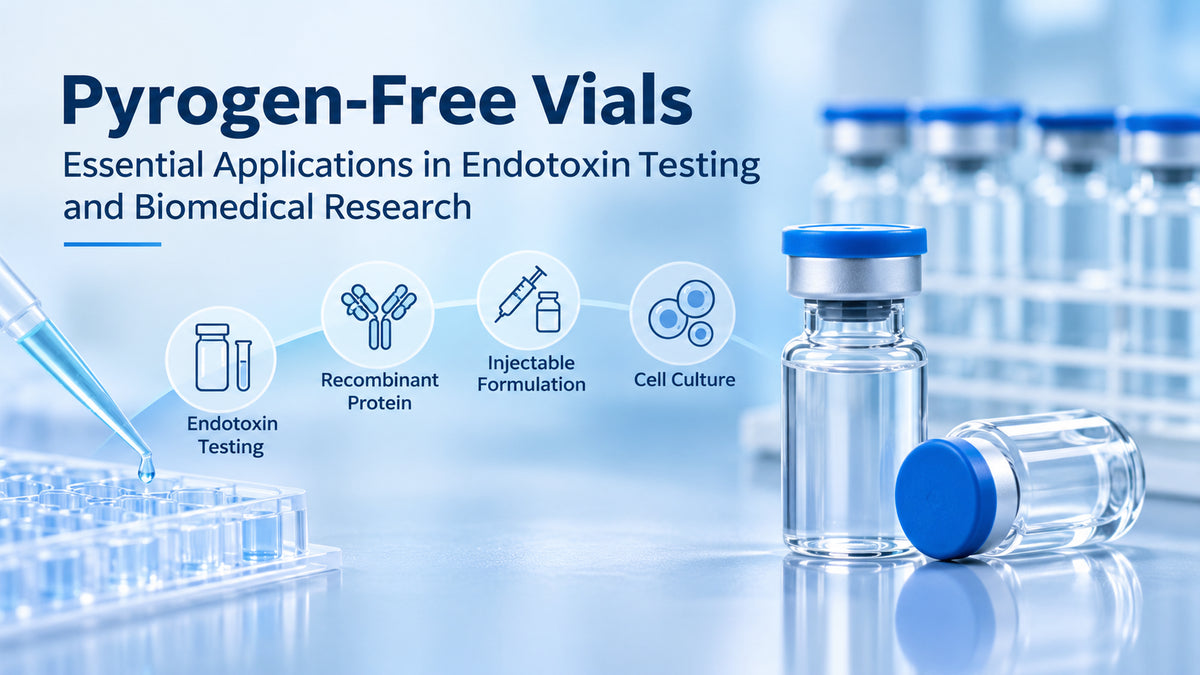
Pyrogen-free vials are specialized laboratory containers designed to minimize the risk of pyrogen contamination during sample preparation, storage, and analytical testing. They are particularly important in bacterial endotoxin testing, pharmaceutical research, recombinant protein development, and sensitive cell-based experiments. Unlike conventional laboratory vials, appropriately qualified pyrogen-free vials undergo controlled processing and quality assessment to support low-endotoxin applications. This article examines seven major applications of pyrogen-free vials, explains their role in contamination control, and outlines essential considerations for selecting suitable containers for laboratory and pharmaceutical workflows.
1. What Are Pyrogen-Free Vials?
Pyrogen-free vials are laboratory containers processed and qualified to minimize the presence of pyrogenic contaminants, particularly bacterial endotoxins.
Pyrogens are substances capable of inducing fever or inflammatory responses under appropriate biological conditions. Bacterial endotoxins, primarily lipopolysaccharides (LPS) associated with the outer membrane of Gram-negative bacteria, are among the most important pyrogens encountered in pharmaceutical manufacturing and biomedical research.
Because endotoxins can remain biologically active even after bacteria have been destroyed, conventional sterilization does not necessarily provide adequate endotoxin control.
Pyrogen-free vials are commonly manufactured from borosilicate glass because of its chemical resistance, thermal stability, and suitability for validated dry-heat depyrogenation processes.
The United States Pharmacopeia provides guidance on depyrogenation and bacterial endotoxin testing, while FDA guidance emphasizes the importance of appropriate contamination control for pharmaceutical containers and laboratory materials.
For research and analytical applications, the principal advantages of appropriately qualified pyrogen-free vials include minimizing external endotoxin contamination, supporting reliable analytical measurements, protecting sensitive biological samples, and improving experimental reproducibility.
2. Seven Major Applications of Pyrogen-Free Vials
2.1 Bacterial Endotoxin Testing (BET)
Bacterial endotoxin testing is one of the most important applications of pyrogen-free vials.
BET methods are widely used to evaluate endotoxin contamination in pharmaceutical products, biological materials, medical devices, and laboratory samples.
During sample preparation, ordinary laboratory containers may introduce unwanted endotoxins, potentially increasing background signals or producing misleading analytical results.
Pyrogen-free vials are used for preparing endotoxin standards, storing test samples, handling endotoxin-free dilution water, and collecting samples for subsequent analysis.
These containers are particularly useful when laboratories perform low-level endotoxin measurements where minor contamination may become analytically significant.
Using qualified containers alongside appropriate controls helps improve confidence in the reliability of bacterial endotoxin test results.
2.2 LAL/TAL Endotoxin Assays
Limulus Amebocyte Lysate (LAL) and Tachypleus Amebocyte Lysate (TAL) assays are widely used for detecting bacterial endotoxins.
Depending on the reagent system and validated method, endotoxin testing may involve gel-clot, chromogenic, or turbidimetric detection.
Pyrogen-free vials play a critical role in several preparatory procedures, including sample dilution, endotoxin standard preparation, positive product control preparation, and reagent-compatible sample handling.
For example, when preparing an endotoxin standard curve, contamination introduced by ordinary glassware can alter measured endotoxin concentrations and compromise quantitative analysis.
Similarly, contaminated sample containers may contribute to false-positive results or unexpected variability between replicate measurements.
Properly qualified pyrogen-free vials can reduce these risks and support consistent testing conditions.
Importantly, container selection must also consider whether the material interferes with the specific analytical method.
2.3 Recombinant Protein and Enzyme Research
Recombinant proteins, enzymes, antibodies, and research peptides are essential tools in modern biotechnology.
However, endotoxin contamination can present significant challenges, particularly for proteins produced using bacterial expression systems such as Escherichia coli.
Even after protein purification, residual endotoxins may remain in the preparation.
When these materials are intended for immunological assays, cell-based experiments, or other sensitive research applications, unintended endotoxin exposure can affect biological responses.
Pyrogen-free vials are useful for holding purified recombinant proteins, preparing enzyme solutions, storing antibody samples, and collecting fractions after endotoxin-removal procedures.
For example, researchers evaluating a recombinant cytokine may need to distinguish the biological activity of the protein from inflammatory responses caused by residual endotoxins.
Using appropriately qualified low-endotoxin containers helps prevent additional contamination during handling and storage.
Nevertheless, pyrogen-free vials do not remove endotoxins already present in protein formulations. Dedicated endotoxin-removal methods and analytical verification may still be required.
2.4 Biopharmaceutical Development
Biopharmaceutical research frequently involves proteins, monoclonal antibodies, peptides, vaccines, and other biologically derived materials.
During formulation development and analytical characterization, controlling endotoxin contamination is important for product quality and reliable experimental assessment.
Pyrogen-free vials can support the preparation of low-endotoxin buffers, handling of formulation intermediates, laboratory-scale stability studies, and sample collection during purification process development.
For instance, researchers developing a monoclonal antibody formulation may use qualified glass vials to minimize contamination during analytical sample preparation.
This is particularly important when comparing formulations with different excipients, pH conditions, or storage characteristics.
Consistent container quality helps prevent avoidable contamination from becoming an uncontrolled variable.
For regulated pharmaceutical applications, however, container suitability must be established through appropriate qualification, compatibility assessments, and process validation.
2.5 Injectable Formulation Research
Injectable pharmaceutical products require strict control of microbial contamination, endotoxins, and other potentially harmful impurities.
Endotoxins can produce adverse inflammatory responses when introduced through parenteral administration.
Accordingly, container and closure systems represent important components of contamination-control strategies.
Depyrogenated glass vials are commonly used in pharmaceutical development and manufacturing processes involving injectable formulations.
Potential research applications include experimental formulation preparation, container compatibility investigations, stability testing, and evaluation of aseptic processing procedures.
In pharmaceutical manufacturing, container preparation may involve validated washing, depyrogenation, sterilization, and controlled handling procedures.
FDA regulations require drug product containers and closures to be suitably clean and, where indicated, sterilized and processed to remove pyrogenic properties through validated processes.
A pyrogen-free designation alone does not establish that a vial is sterile or qualified for direct use as a finished injectable product container.
2.6 Cell Culture and Immunological Research
Endotoxin contamination can substantially influence experiments involving immune cells and other endotoxin-responsive biological systems.
For example, macrophages, monocytes, and certain other cell populations can respond to bacterial LPS through innate immune signaling pathways.
Depending on the experimental model, unintended endotoxin exposure may affect inflammatory cytokine production, gene expression, cellular activation, and downstream biological measurements.
This creates potential difficulties when researchers investigate inflammation, immune signaling, or the biological activity of test compounds.
Pyrogen-free vials can be used to store low-endotoxin reagents, prepare experimental treatments, handle cytokine solutions, and maintain samples for sensitive cellular assays.
For example, a laboratory studying macrophage activation may use qualified containers when preparing recombinant protein treatments to reduce contamination-related background responses.
Such precautions help researchers distinguish treatment-specific effects from responses caused by unintended endotoxin exposure.
However, the complete workflow must also be controlled, including media, water, pipette tips, buffers, and other sample-contact materials.
2.7 Verification of Endotoxin Removal Efficiency
Endotoxin removal is an important purification step for selected recombinant proteins, antibodies, enzymes, and other biological materials.
Common endotoxin-removal approaches include affinity-based adsorbents, specialized chromatography materials, and other validated separation methods.
To evaluate removal efficiency, researchers typically compare endotoxin concentrations before and after treatment.
Pyrogen-free vials are useful for collecting untreated samples, handling purified fractions, preparing analytical dilutions, and storing samples awaiting endotoxin measurement.
If post-purification samples are transferred into contaminated containers, externally introduced endotoxins may distort the apparent effectiveness of the removal process.
For example, a protein purification procedure may achieve substantial endotoxin reduction, but contamination during collection could produce an unexpectedly high post-treatment result.
Using qualified pyrogen-free collection containers helps reduce this source of analytical uncertainty.
Accurate evaluation also requires appropriate sample controls, method suitability assessment, and consideration of possible assay interference.
3. Pyrogen-Free Vials vs. Conventional Laboratory Vials
Although conventional laboratory vials may appear identical to pyrogen-free vials, their quality attributes and intended applications can differ considerably.
|
Feature |
Conventional Laboratory Vials |
Pyrogen-Free Vials |
|
Endotoxin control |
Not necessarily specified |
Defined according to product qualification |
|
Manufacturing treatment |
Standard cleaning |
Controlled cleaning and/or depyrogenation |
|
BET applications |
May introduce contamination |
Suitable when qualified for intended assay |
|
Recombinant protein handling |
General sample storage |
Supports low-endotoxin workflows |
|
Pharmaceutical research |
Depends on product specification |
Useful for contamination-sensitive applications |
|
Sterility assurance |
Product-dependent |
Independently determined |
|
Documentation |
General product specifications |
May include endotoxin testing and batch certification |
It is important to distinguish three commonly used terms.
Sterile describes a product that has met applicable sterility assurance requirements. It does not automatically indicate the absence of endotoxins.
Endotoxin-free generally refers to endotoxin levels below a specified detection or acceptance threshold, rather than an absolute absence of endotoxin.
Pyrogen-free is a broader claim involving pyrogenic substances. In practice, many commercial products are qualified specifically for bacterial endotoxins, and the scope of their certification should be verified.
4. How Are Pyrogen-Free Vials Manufactured?
The production of pyrogen-free glass vials commonly involves controlled cleaning, rinsing, depyrogenation, inspection, and protective packaging.
High-temperature dry-heat treatment is a well-established method for reducing endotoxin contamination on heat-resistant glass materials.
USP guidance describes validated dry-heat depyrogenation for suitable laboratory glassware. A commonly referenced condition is 250°C for at least 30 minutes, although the effectiveness of any specific process must be demonstrated through validation rather than assumed from temperature and time alone.
After processing, appropriate packaging and handling procedures are necessary to minimize recontamination.
Where applicable, manufacturers may verify endotoxin levels using qualified analytical procedures and issue batch-specific documentation.
For capped vials, the closure must also be suitable for the intended low-endotoxin application.
5. How to Choose Suitable Pyrogen-Free Vials
Selecting appropriate pyrogen-free vials requires consideration of analytical requirements, sample properties, and applicable quality standards.
Important selection criteria include:
Material compatibility: Borosilicate glass is widely used for chemically resistant laboratory containers.
Endotoxin specification: Select a documented acceptance limit suitable for the intended application.
Volume and dimensions: Choose an appropriate capacity to minimize sample loss and support efficient handling.
Closure integrity: Confirm that caps or stoppers are compatible with the sample and meet relevant contamination-control requirements.
Sterility requirements: Select separately validated sterile containers when required.
Quality documentation: Request a Certificate of Analysis (COA), product specifications, and relevant batch testing information.
Storage compatibility: Evaluate adsorption, leachables, temperature resistance, and container closure suitability for sensitive biological samples.
Some commercially available endotoxin-testing containers are certified at levels below 0.005 EU/mL under defined testing conditions. However, this is a product-specific specification, not a universal requirement for all pyrogen-free vials.
Laboratories should evaluate the supplier's stated testing conditions before comparing different products.
6. Best Practices for Using Pyrogen-Free Vials
Even qualified pyrogen-free vials can become contaminated through improper laboratory handling.
To minimize contamination risks, laboratories should use qualified endotoxin-controlled water and reagents, maintain clean preparation areas, and avoid unnecessary exposure of open containers.
Disposable pipette tips, transfer equipment, and other sample-contact materials should be suitable for low-endotoxin applications.
Where possible, prepared samples should be stored under conditions validated for their stability and analytical purpose.
For protein-containing samples, particular attention should be given to potential adsorption onto container surfaces, aggregation, and compatibility with storage conditions.
Containers should also remain properly sealed during storage and transportation.
Finally, laboratories should document vial lot numbers, sample preparation procedures, and relevant quality-control information to support traceability and reproducibility.
7. Frequently Asked Questions About Pyrogen-Free Vials
Q1. Are pyrogen-free vials the same as sterile vials?
No. Sterility and pyrogen control address different quality attributes. A sterile vial may still contain bacterial endotoxins, while a depyrogenated vial does not automatically carry a verified sterility claim.
Q2. Can pyrogen-free vials be used for LAL endotoxin testing?
Yes. Appropriately qualified pyrogen-free vials can be used for preparing standards, handling test samples, and performing sample dilution. The assay's specific requirements and container compatibility must be considered.
Q3. Why are pyrogen-free vials important for recombinant proteins?
They help prevent additional endotoxin contamination during protein handling, supporting accurate biological assays and endotoxin measurements.
Q4. Can pyrogen-free vials remove endotoxins from contaminated samples?
No. The vials are intended to minimize contamination from the container. They do not actively remove endotoxins already present in a sample.
Q5. Are pyrogen-free glass vials suitable for sensitive cell culture experiments?
They can be useful when preparing or storing reagents for endotoxin-sensitive experiments, particularly immunological and inflammation-related research.
Q6. What documents should laboratories request when purchasing pyrogen-free vials?
Recommended documents include product specifications, lot-specific COA when available, endotoxin acceptance criteria, and information about the depyrogenation and packaging processes.
8. Conclusion
Pyrogen-free vials are essential laboratory consumables for applications where endotoxin contamination may compromise analytical reliability or experimental outcomes.
Their use extends beyond bacterial endotoxin testing to recombinant protein research, biopharmaceutical development, injectable formulation studies, cell culture, and verification of endotoxin-removal procedures.
By minimizing external endotoxin contamination, appropriately qualified containers can support reproducible experimental conditions and more reliable analytical measurements.
However, selecting a suitable vial requires more than checking a product label. Laboratories should consider endotoxin specifications, material compatibility, sterility requirements, closure performance, and documented product quality.
Integrating pyrogen-free vials into a comprehensive contamination-control strategy can improve confidence in laboratory workflows involving sensitive biological and pharmaceutical materials.


