
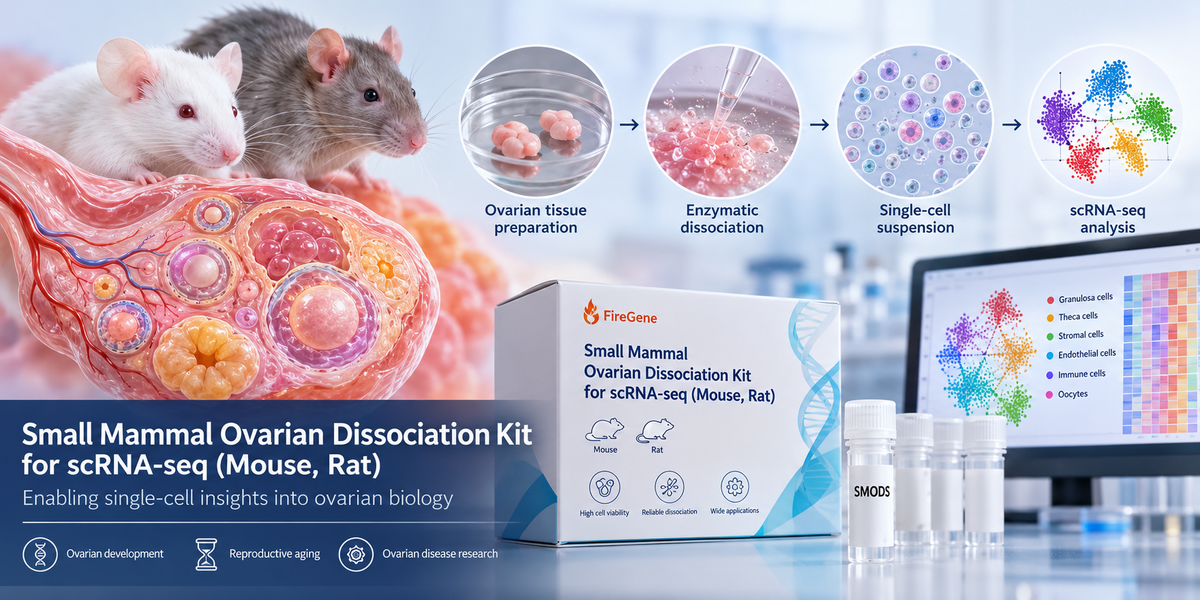
Single-cell RNA sequencing (scRNA-seq) has transformed reproductive biology by enabling researchers to investigate the cellular composition and molecular heterogeneity of ovarian tissues at unprecedented resolution. However, the complex structure of the mammalian ovary presents significant challenges for obtaining high-quality single-cell suspensions. Dense extracellular matrix, heterogeneous cell populations, and variable tissue characteristics can influence dissociation efficiency and downstream sequencing results. The FireGene Small Mammal Ovarian Dissociation Kit for scRNA-seq (Mouse, Rat) provides an enzymatic dissociation workflow designed to prepare ovarian single-cell suspensions. This article discusses the biological challenges of ovarian tissue dissociation, essential considerations for sample preparation, quality-control strategies, and major applications in ovarian development, reproductive aging, and disease research.
1. Understanding the Cellular Complexity of Mammalian Ovarian Tissue
The mammalian ovary is a highly organized reproductive and endocrine organ containing multiple specialized cell populations involved in folliculogenesis, steroid hormone synthesis, ovulation, and tissue remodeling.
Ovarian follicles contain oocytes surrounded by granulosa cells and, at appropriate developmental stages, theca cells. These structures are embedded within stromal tissue containing fibroblast-like cells, vascular endothelial cells, pericytes, and immune cells.
Major ovarian cell populations include:
|
Cell Type |
Biological Function |
Representative Markers |
|
Granulosa cells |
Follicular development and hormone regulation |
FOXL2, AMH, FSHR |
|
Theca cells |
Androgen biosynthesis and follicular support |
CYP17A1, HSD3B1 |
|
Oocytes |
Female germ-cell development |
DDX4, GDF9, ZP3 |
|
Stromal cells |
Extracellular matrix and tissue organization |
COL1A1, DCN |
|
Endothelial cells |
Vascular development and maintenance |
PECAM1, KDR |
|
Immune cells |
Tissue surveillance and inflammatory regulation |
PTPRC, TYROBP |
These markers are illustrative rather than universally exclusive; expression varies with developmental stage and physiological state.
Single-cell transcriptomic studies have demonstrated that ovarian cell populations exhibit substantial molecular diversity during development and reproductive cycling.
For example, a mouse ovarian atlas identified transcriptional changes across more than 34,000 cells, revealing dynamic cellular states associated with estrous cycling and reproductive physiology.
PubMed Central (PMC)
Such findings highlight the importance of preparing representative single-cell suspensions before transcriptomic analysis.
2. Why Is Ovarian Tissue Dissociation Challenging?
Unlike relatively homogeneous cell suspensions, intact ovarian tissue contains follicles at different developmental stages, stromal structures, blood vessels, and extracellular matrix components.
These features create several technical challenges.
2.1 Dense Extracellular Matrix
Ovarian stromal regions contain collagen-rich extracellular matrix that supports tissue architecture and cellular organization.
Effective dissociation requires sufficient disruption of these structural components to release individual cells.
However, excessive enzymatic exposure may compromise membrane integrity, alter cell-surface proteins, or induce transcriptional stress responses.
2.2 Differences in Cellular Size and Fragility
Ovarian cells vary considerably in size and mechanical sensitivity.
Granulosa cells, stromal cells, and leukocytes may respond differently to enzymatic digestion and mechanical manipulation.
Large oocytes and intact follicular structures present additional recovery challenges, especially when filtration is required.
Consequently, no single dissociation condition necessarily preserves every ovarian cell population equally.
2.3 Dissociation-Induced Transcriptional Changes
Tissue processing can alter gene expression before sequencing.
Research has shown that enzymatic and mechanical dissociation may activate immediate-early genes, heat-shock responses, and other stress-associated transcriptional programs.
Such changes can complicate the interpretation of biological differences between experimental groups.
Therefore, an optimized ovarian dissociation workflow should balance cellular recovery, viability, transcriptomic integrity, and processing consistency.
3. FireGene Small Mammal Ovarian Dissociation Kit: Product Overview
The FireGene Small Mammal Ovarian Dissociation Kit for scRNA-seq (Mouse, Rat) is designed to prepare single-cell suspensions from fresh ovarian tissues.
The kit uses enzymatic digestion to facilitate extracellular matrix disruption and cellular release.
Its workflow incorporates tissue processing, enzymatic digestion, filtration, washing, and subsequent quality assessment.
Product Specifications
|
Parameter |
Specification |
|
Brand |
FireGene |
|
Catalog Number |
FG-BA3352 |
|
Species |
Mouse and rat |
|
Sample Type |
Fresh ovarian tissue |
|
Recommended Starting Material |
Approximately 200 mg |
|
Main Reagent |
Small Mammal Ovarian Dissociation Solution (SMODS) |
|
Digestion Conditions |
37°C, approximately 0.5–2 hours |
|
Kit Format |
10 reactions |
|
Storage |
−20°C |
|
Shelf Life |
2 years |
|
Applications |
scRNA-seq, cell culture, cell-based assays |
These specifications describe the manufacturer's intended workflow, not independently established cell-yield or viability performance.
The prepared suspension may support single-cell sequencing workflows when sample-specific quality criteria are satisfied.
4. General Workflow for Ovarian Single-Cell Preparation
Proper sample handling is essential for reducing technical variability and preserving biologically informative cellular populations.
Ovarian tissue dissociation workflow
Figure 1. Conceptual workflow for ovarian single-cell suspension preparation.
Step 1. Tissue Collection and Preparation
Fresh mouse or rat ovarian tissues are collected using appropriate research procedures.
Careful removal of unnecessary surrounding tissue and consistent sample handling may improve the reproducibility of downstream processing.
Tissue size, animal age, estrous stage, and experimental condition should be documented because these variables influence ovarian cellular composition.
Step 2. Enzymatic Digestion
Prepared ovarian tissue is exposed to the dissociation solution under controlled conditions.
The manufacturer's recommended digestion window is approximately 0.5–2 hours at 37°C, with adjustments depending on tissue characteristics.
Digestion duration should be optimized to obtain sufficient cellular release without unnecessary prolonged exposure.
Step 3. Filtration and Washing
Following dissociation, the suspension is filtered to reduce residual tissue fragments and large aggregates.
Washing and centrifugation remove residual processing reagents.
When blood contamination is substantial, an optional red blood cell removal procedure may be considered.
Importantly, filtration may exclude large oocytes or intact multicellular structures, potentially introducing cell-type representation bias.
Step 4. Cell Viability and Quality Assessment
The final suspension should undergo cell counting, viability assessment, and examination for aggregates or debris.
Cell concentration should then be adjusted according to the requirements of the selected downstream platform.
Researchers should follow the current product manual for exact reagent volumes and processing details.
5. Key Quality-Control Considerations for Ovarian scRNA-seq
High-quality single-cell sequencing depends on more than efficient tissue digestion.
Several analytical parameters should be evaluated before library preparation.
Cell viability: Dead or damaged cells may release RNA into the surrounding suspension, contributing to ambient RNA contamination.
Cell aggregation: Aggregates can increase multiplet rates during droplet-based single-cell capture.
Cellular representation: Differential survival or filtration may disproportionately exclude fragile, large, or matrix-associated populations.
Transcriptional integrity: Prolonged processing may induce artifactual stress-associated gene expression.
Experimental reproducibility: Consistent timing, sample handling, and digestion conditions facilitate comparisons between experimental groups.
Post-sequencing quality control should also consider mitochondrial transcript proportions, detected gene counts, ambient RNA, and computational doublet detection.
Importantly, universal quality-control thresholds are inappropriate for every ovarian cell type. Thresholds should be selected according to the platform, biological model, and experimental objectives.
6. Research Applications in Reproductive Biology

6.1 Ovarian Follicular Development
Folliculogenesis involves coordinated interactions among oocytes, granulosa cells, theca cells, and surrounding stromal populations.
Single-cell transcriptomics enables researchers to investigate molecular programs associated with follicular growth, differentiation, and endocrine regulation.
Recent mouse ovarian atlas studies have identified distinct developmental cell populations and transcriptional trajectories across ovarian maturation.
6.2 Ovarian Aging and Reproductive Senescence
Ovarian aging is associated with changes in follicular reserves, stromal organization, inflammatory signaling, and cellular function.
Single-cell RNA sequencing provides opportunities to investigate age-associated alterations in gene expression and cell-state composition.
A 2026 mouse ovarian atlas examined molecular processes associated with aging and senescence during reproductive transition, illustrating the relevance of single-cell methods to this research area.
6.3 Polycystic Ovary Syndrome Research
Experimental models of polycystic ovary syndrome may exhibit altered follicular development, steroidogenesis, metabolic regulation, and inflammatory signaling.
Ovarian single-cell analysis can help investigate transcriptional differences among granulosa cells, theca cells, stromal populations, and immune cells.
Such studies may contribute to understanding disease-associated cellular heterogeneity, although observations from rodent models require careful interpretation before extrapolation to human PCOS.
6.4 Ovarian Immune Microenvironment
Ovarian immune cells contribute to tissue remodeling, ovulation, and inflammatory regulation.
Single-cell sequencing can characterize immune-cell diversity and investigate interactions between immune and nonimmune ovarian populations.
Analysis of myeloid-cell states, cytokine-associated pathways, and intercellular communication may provide insights into reproductive physiology and inflammatory disorders.
6.5 Ovulation and Endocrine Signaling
Ovulation requires coordinated molecular responses across granulosa, cumulus, theca, stromal, and immune cell populations.
A 2025 study integrating single-cell and spatial approaches characterized cellular changes during mouse ovulation, demonstrating the value of transcriptomic methods for investigating ovarian remodeling.
These applications illustrate how ovarian single-cell preparation can support detailed investigations of reproductive biology.
7. Conclusion
Ovarian single-cell RNA sequencing provides a powerful approach for investigating cellular diversity, follicular development, endocrine signaling, reproductive aging, and disease-associated molecular changes.
However, the structural complexity of ovarian tissue makes dissociation a critical experimental step.
The FireGene Small Mammal Ovarian Dissociation Kit for scRNA-seq (Mouse, Rat) offers a dedicated enzymatic workflow for preparing single-cell suspensions from fresh ovarian tissues.
By combining controlled tissue dissociation with appropriate filtration, washing, and quality-control procedures, researchers can prepare samples for downstream cellular and transcriptomic analyses.
Careful optimization remains essential to minimize cellular damage, transcriptional artifacts, and cell-type recovery bias.
For reproductive biology laboratories, a reproducible ovarian dissociation workflow represents an important foundation for generating interpretable single-cell datasets.
Product Information: FireGene Small Mammal Ovarian Dissociation Kit (FG-BA3352)
For research use only. Not intended for diagnostic or therapeutic applications.


