
Introduction
Endotoxin contamination is one of the most critical quality control concerns in the pharmaceutical, biotechnology, and medical device industries. Even trace amounts of bacterial endotoxins, also known as lipopolysaccharides (LPS), can trigger strong immune responses and cause fever, inflammation, or severe adverse reactions in patients. Therefore, accurate and reliable endotoxin testing is an essential step in the development and manufacturing of injectable drugs, vaccines, biologics, and medical devices.
For decades, the Limulus Amebocyte Lysate (LAL) assay has been the gold standard method for endotoxin detection. However, traditional LAL testing depends on horseshoe crab blood-derived components, which creates challenges related to biological resource sustainability, batch-to-batch variation, and potential interference from non-endotoxin substances.
The emergence of the Recombinant Factor C (rFC) endotoxin detection assay provides a next-generation alternative. By using genetically engineered Factor C proteins instead of natural horseshoe crab lysate, rFC technology offers a highly specific, consistent, and animal-friendly solution for bacterial endotoxin testing.
What Is a Recombinant Factor C (rFC) Endotoxin Detection Kit?
A Recombinant Factor C endotoxin detection kit is an in vitro diagnostic reagent system designed to detect and quantify bacterial endotoxins through a fluorescence-based enzymatic reaction.
Unlike traditional LAL assays, which use a complete biological cascade extracted from horseshoe crab blood cells, rFC technology uses a recombinant version of Factor C, the first component activated by endotoxin recognition.
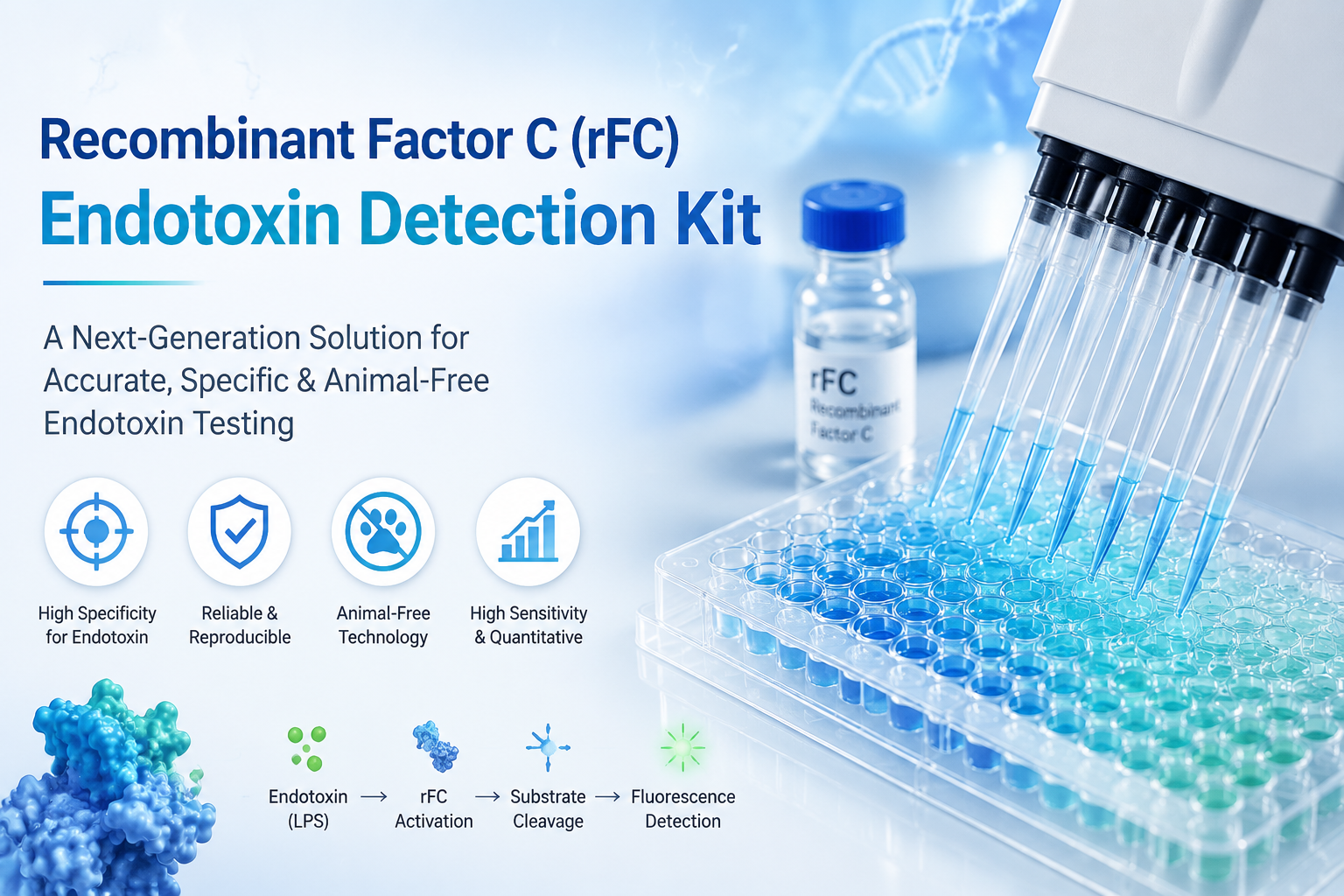
When bacterial endotoxin enters the reaction system, it specifically activates recombinant Factor C. The activated enzyme then cleaves a synthetic fluorescent substrate, generating a measurable fluorescence signal. The intensity of fluorescence is directly proportional to the endotoxin concentration in the sample.
This technology enables sensitive and quantitative endotoxin detection while reducing dependence on animal-derived materials.
Principle of Recombinant Factor C Endotoxin Detection
The working mechanism of an rFC endotoxin assay can be summarized as follows:
1. Endotoxin Recognition
Gram-negative bacteria contain lipopolysaccharides (LPS) in their outer membrane. The lipid A structure of LPS is responsible for endotoxin activity.
When endotoxin is introduced into the rFC reaction system, it binds specifically to recombinant Factor C.
2. Activation of Recombinant Factor C
After binding with endotoxin, inactive recombinant Factor C is converted into an active enzyme form.
This activation step represents the natural first response mechanism of horseshoe crab immune defense.
3. Fluorescent Substrate Cleavage
Activated recombinant Factor C cleaves a synthetic fluorescent substrate, producing a fluorescent compound.
The amount of fluorescence generated corresponds to the amount of endotoxin present.
4. Quantitative Detection
A fluorescence microplate reader measures the signal intensity. By comparing the sample fluorescence value with a standard endotoxin calibration curve, the endotoxin concentration can be calculated.
The final result is typically expressed as:
Endotoxin Units per milliliter (EU/mL)
Key Components of an rFC Endotoxin Detection Kit
A typical recombinant Factor C assay kit contains several essential components:
Recombinant Factor C Enzyme
The core component of the assay. It specifically recognizes bacterial endotoxin and initiates the detection reaction.
Fluorescent Substrate
A synthetic substrate that produces measurable fluorescence after enzymatic cleavage.
Reaction Buffer
Provides optimal conditions, including suitable pH and ionic strength, for Factor C activation.
Endotoxin Standard
Used to generate a calibration curve for quantitative analysis.
Endotoxin-Free Water and Consumables
Specially treated materials are required to prevent background contamination during testing.
Advantages of Recombinant Factor C Endotoxin Assay
1. High Endotoxin Specificity
One major advantage of rFC technology is its high specificity for bacterial endotoxin.
Traditional LAL assays involve multiple enzymatic pathways, including Factor C and Factor G pathways. Factor G activation can sometimes result in false-positive signals caused by β-glucans commonly found in fungal or plant-derived materials.
Because rFC directly targets the endotoxin-triggered Factor C pathway, it significantly reduces β-glucan-related interference.
2. Animal-Free and Sustainable Technology
Traditional LAL testing relies on harvesting horseshoe crab blood to obtain amebocyte lysate.
Although horseshoe crab conservation programs have improved sustainability, increasing demand for endotoxin testing has raised concerns regarding animal welfare and resource availability.
Recombinant Factor C technology eliminates the need for horseshoe crab harvesting by producing Factor C through recombinant expression systems.
This makes rFC a more sustainable and environmentally responsible endotoxin detection method.
3. Excellent Batch-to-Batch Consistency
Biological reagents obtained from animal sources may show natural variation between batches.
In contrast, recombinant Factor C is produced under controlled biotechnology manufacturing conditions, resulting in:
· Improved reproducibility
· Stable performance
· Reduced lot variation
· Better quality control
This consistency is especially important for pharmaceutical manufacturing environments requiring strict regulatory compliance.
4. High Sensitivity and Reliable Quantification
rFC assays provide sensitive detection of very low endotoxin levels.
Depending on the kit design, detection ranges can reach sub-EU/mL levels, making them suitable for:
· Biopharmaceutical quality control
· Vaccine testing
· Cell therapy products
· Injectable drug development
The fluorescence-based format also allows accurate quantitative measurement compared with traditional gel-clot methods.
5. Easy Automation and High-Throughput Testing
Most rFC assays are designed for microplate-based fluorescence detection.
The workflow is compatible with:
· 96-well microplates
· Automated liquid handling systems
· High-throughput screening platforms
· Laboratory information management systems (LIMS)
This makes rFC particularly suitable for modern pharmaceutical manufacturing facilities.
Applications of Recombinant Factor C Endotoxin Testing
Biopharmaceutical Products
The production of biologics requires strict endotoxin control. rFC assays are widely used for testing:
· Monoclonal antibodies
· Recombinant proteins
· Growth factors
· Cytokines
· Cell therapy products
Vaccines
Vaccines are administered directly into the human body, making endotoxin monitoring essential.
rFC testing helps manufacturers evaluate:
· Raw materials
· Intermediate products
· Final vaccine formulations
Pharmaceutical Manufacturing
Endotoxin testing is required throughout pharmaceutical production, including:
· Active pharmaceutical ingredients (APIs)
· Injectable formulations
· Water systems
· Manufacturing equipment
Medical Devices
Medical devices that contact blood or internal tissues must meet endotoxin safety requirements.
Examples include:
· Implantable materials
· Surgical devices
· Dialysis equipment
· Drug delivery systems
rFC Assay vs Traditional LAL Test
|
Feature |
Recombinant Factor C (rFC) |
LAL Assay |
|
Detection target |
Endotoxin-specific Factor C pathway |
Multiple biological pathways |
|
Source |
Recombinant protein |
Horseshoe crab lysate |
|
Animal dependency |
No |
Yes |
|
β-glucan interference |
Low |
Possible |
|
Batch consistency |
High |
Variable |
|
Detection method |
Fluorescence |
Gel-clot, chromogenic, turbidity |
|
Automation |
Excellent |
Good |
|
Sustainability |
High |
Limited |
Future Development of rFC Endotoxin Testing
As global pharmaceutical manufacturing continues to expand, demand for reliable and sustainable endotoxin testing solutions is increasing.
Several trends are driving the adoption of recombinant Factor C technology:
Growing Biologics Market
The rapid growth of monoclonal antibodies, gene therapies, and cell-based medicines requires advanced endotoxin testing platforms with high sensitivity and reproducibility.
Regulatory Acceptance
More international pharmacopoeias and regulatory organizations are recognizing recombinant endotoxin testing technologies as reliable alternatives to traditional methods.
Sustainable Laboratory Practices
The biotechnology industry is increasingly adopting animal-free testing methods to support ethical and environmentally responsible research.
Conclusion
The Recombinant Factor C (rFC) endotoxin detection kit represents a major advancement in bacterial endotoxin testing technology. By replacing horseshoe crab-derived components with recombinant Factor C, rFC assays provide improved specificity, excellent consistency, reduced interference, and a more sustainable approach to endotoxin analysis.
With growing applications in biopharmaceuticals, vaccines, medical devices, and advanced therapies, recombinant Factor C technology is becoming an important tool for modern quality control laboratories.
As the life science industry moves toward more sustainable and precise analytical methods, rFC endotoxin detection is expected to play an increasingly important role in ensuring product safety and regulatory compliance.


