
Introduction
Endotoxin detection is a critical quality control step in the pharmaceutical, biotechnology, medical device, and life science industries. Bacterial endotoxins, also known as lipopolysaccharides (LPS), are components of the outer membrane of Gram-negative bacteria. Even extremely low levels of endotoxin contamination can trigger severe immune responses, including fever, inflammation, and septic shock.
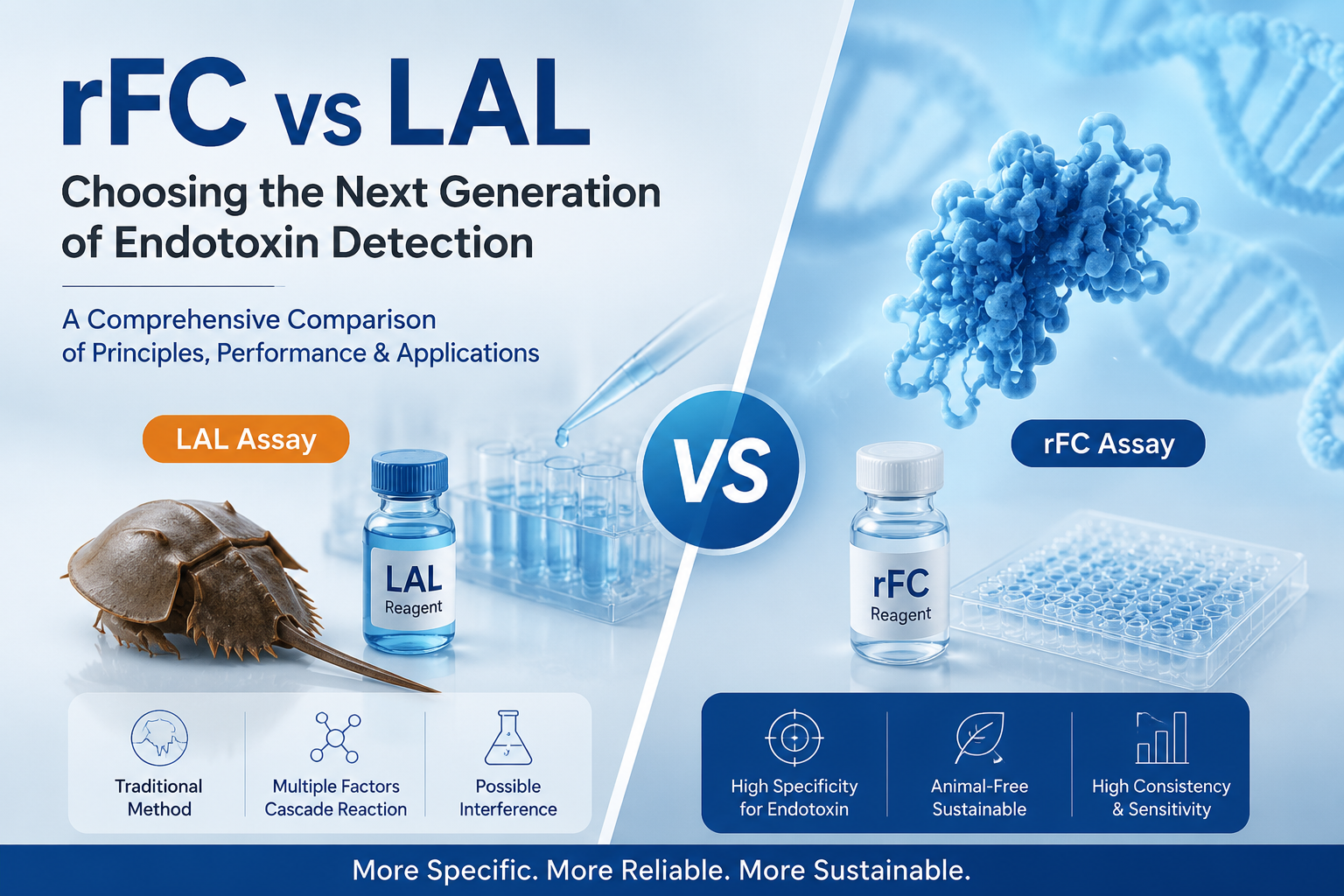
For decades, the Limulus Amebocyte Lysate (LAL) assay has been considered the gold standard method for bacterial endotoxin testing. However, with advances in biotechnology, the recombinant Factor C (rFC) assay has emerged as a next-generation alternative with improved specificity, consistency, and sustainability.
This article provides a detailed comparison of LAL vs rFC endotoxin detection methods, highlighting their principles, advantages, limitations, and applications.
1. Overview of LAL Endotoxin Testing
What Is the LAL Assay?
The Limulus Amebocyte Lysate (LAL) assay is a biological test derived from the blood cells (amebocytes) of horseshoe crabs. It detects endotoxins through a natural enzymatic cascade activated by bacterial lipopolysaccharides.
When endotoxin enters the LAL reaction system, it activates Factor C, which triggers a series of enzymatic reactions involving Factor B and pro-clotting enzymes. The final reaction produces measurable changes, such as gel formation, turbidity, or color development.
The three main types of LAL assays include:
1. Gel-Clot Method
The gel-clot method is the traditional LAL technique.
Advantages:
· Simple operation
· Low equipment requirements
· Suitable for qualitative or semi-quantitative testing
Limitations:
· Lower sensitivity compared with modern methods
· Subjective result interpretation
· Limited quantitative capability
2. Turbidimetric LAL Method
The turbidimetric assay measures the increase in turbidity caused by clot formation.
Advantages:
· Quantitative detection
· Suitable for automated analysis
· Higher throughput compared with gel-clot assays
Limitations:
· Requires specialized instruments
· Can be affected by sample interference
3. Chromogenic LAL Method
The chromogenic assay uses a synthetic substrate that releases a colored compound during enzymatic activation.
Advantages:
· High sensitivity
· Quantitative measurement
· Widely used in pharmaceutical quality control
Limitations:
· Potential interference from β-glucans
· Dependence on biological reagents
2. What Is Recombinant Factor C (rFC) Testing?
Principle of the rFC Assay
The recombinant Factor C (rFC) assay is a synthetic, biotechnology-based endotoxin detection method designed to replicate the first step of the natural horseshoe crab coagulation pathway.
Unlike LAL, rFC contains only the recombinant Factor C protein responsible for endotoxin recognition.

When endotoxin binds to recombinant Factor C, the activated enzyme cleaves a fluorescent substrate, generating a measurable fluorescent signal.
The fluorescence intensity directly correlates with the endotoxin concentration.
3. Key Differences Between rFC and LAL
1. Reaction Mechanism
LAL Method:
LAL relies on a multi-step enzyme cascade:
Endotoxin → Factor C activation → Factor B activation → Clotting enzyme activation → Signal generation
Because multiple biological factors are involved, additional reactions may occur.
rFC Method:
rFC uses a simplified pathway:
Endotoxin → Recombinant Factor C activation → Fluorescent signal
This direct mechanism improves specificity and reduces unnecessary biological reactions.
4. Specificity and Interference
One major limitation of traditional LAL testing is interference caused by substances other than endotoxin.
β-Glucan Interference
LAL contains Factor G, a pathway activated by β-glucans commonly found in fungi and some biological materials.
This may result in:
· False-positive results
· Additional sample preparation
· Reduced testing accuracy
In contrast, rFC does not contain Factor G.
Therefore:
rFC provides improved resistance against β-glucan interference and offers higher endotoxin specificity.
This makes rFC particularly valuable for complex biological products, including:
· Recombinant proteins
· Cell therapy products
· Gene therapy materials
· Biopharmaceutical formulations
5. Animal Sustainability Advantages
LAL Depends on Horseshoe Crab Resources
Traditional LAL production requires harvesting blood from horseshoe crabs.
Although horseshoe crabs are released after blood collection, concerns remain regarding:
· Animal welfare
· Population sustainability
· Long-term reagent supply
rFC Provides an Animal-Free Alternative
Recombinant Factor C is produced using recombinant DNA technology.
Benefits include:
· No horseshoe crab harvesting
· Stable manufacturing process
· Reduced environmental impact
· Sustainable supply chain
As the pharmaceutical industry increasingly focuses on sustainability, rFC has gained significant attention as an environmentally responsible alternative.
6. Sensitivity and Detection Performance
Modern endotoxin detection requires highly sensitive methods.
Typical sensitivity comparison:
|
Method |
Detection Capability |
|
Gel-clot LAL |
0.03–0.25 EU/mL |
|
Turbidimetric LAL |
Around 0.005 EU/mL |
|
Chromogenic LAL |
Around 0.005 EU/mL |
|
Recombinant Factor C |
Around 0.005 EU/mL |
Both advanced LAL methods and rFC can achieve excellent sensitivity.
However, rFC provides additional advantages through:
· Better batch consistency
· Reduced interference
· Defined recombinant components
7. Batch-to-Batch Consistency
Because LAL reagents are extracted from natural biological sources, their composition can vary between batches.
Factors affecting LAL consistency include:
· Horseshoe crab biological variation
· Extraction differences
· Seasonal changes
rFC reagents are produced through controlled recombinant expression systems.
Advantages include:
· Highly standardized production
· Improved reproducibility
· Better lot-to-lot consistency
For regulated industries requiring strict quality control, consistent performance is a major advantage.
8. Applications of rFC Endotoxin Testing
Recombinant Factor C technology is increasingly used in:
Pharmaceutical Manufacturing
Used for endotoxin testing of:
· Injectable drugs
· Vaccines
· Biological medicines
· Monoclonal antibodies
Cell and Gene Therapy
Advanced therapies require highly reliable contamination monitoring.
rFC is suitable for:
· CAR-T cell products
· Viral vectors
· Gene delivery systems
Medical Devices
rFC can support endotoxin evaluation of:
· Implantable devices
· Surgical materials
· Disposable medical products
Research and Biotechnology
Laboratories developing recombinant proteins and biologics can benefit from the high specificity of rFC testing.
9. Regulatory Acceptance of rFC
Historically, LAL dominated endotoxin testing due to extensive regulatory experience.
However, recombinant Factor C methods have gained increasing acceptance worldwide.
Regulatory organizations and pharmacopeias have recognized rFC as a valid alternative when properly validated.
Companies adopting rFC typically perform:
· Method qualification
· Product-specific validation
· Comparison studies with existing LAL methods
10. rFC vs LAL: Which Method Should You Choose?
The choice between rFC and LAL depends on application requirements.
Choose LAL When:
· Existing regulatory workflows are established
· Historical comparison data are required
· Traditional methods are already validated
Choose rFC When:
· High specificity is required
· β-glucan interference is a concern
· Sustainable testing solutions are preferred
· Consistent reagent performance is important
· Working with advanced biological products
Conclusion
Both LAL and recombinant Factor C (rFC) assays are powerful tools for endotoxin detection. LAL remains a widely established method with decades of regulatory experience. However, rFC represents a modern evolution of endotoxin testing by providing a more specific, consistent, and sustainable solution.
With increasing demand for reliable quality control in pharmaceuticals, biotechnology, and advanced therapies, recombinant Factor C testing is becoming an important alternative to traditional LAL assays.
For organizations seeking improved accuracy, reduced interference, and environmentally responsible endotoxin detection, rFC offers a promising next-generation approach.


