
Introduction
In protein analysis, SDS-PAGE (sodium dodecyl sulfate-polyacrylamide gel electrophoresis) is one of the most widely used techniques for separating proteins based on molecular weight. A critical step before electrophoresis is sample preparation, where proteins are mixed with a protein loading buffer (sample buffer) to ensure proper denaturation and migration.
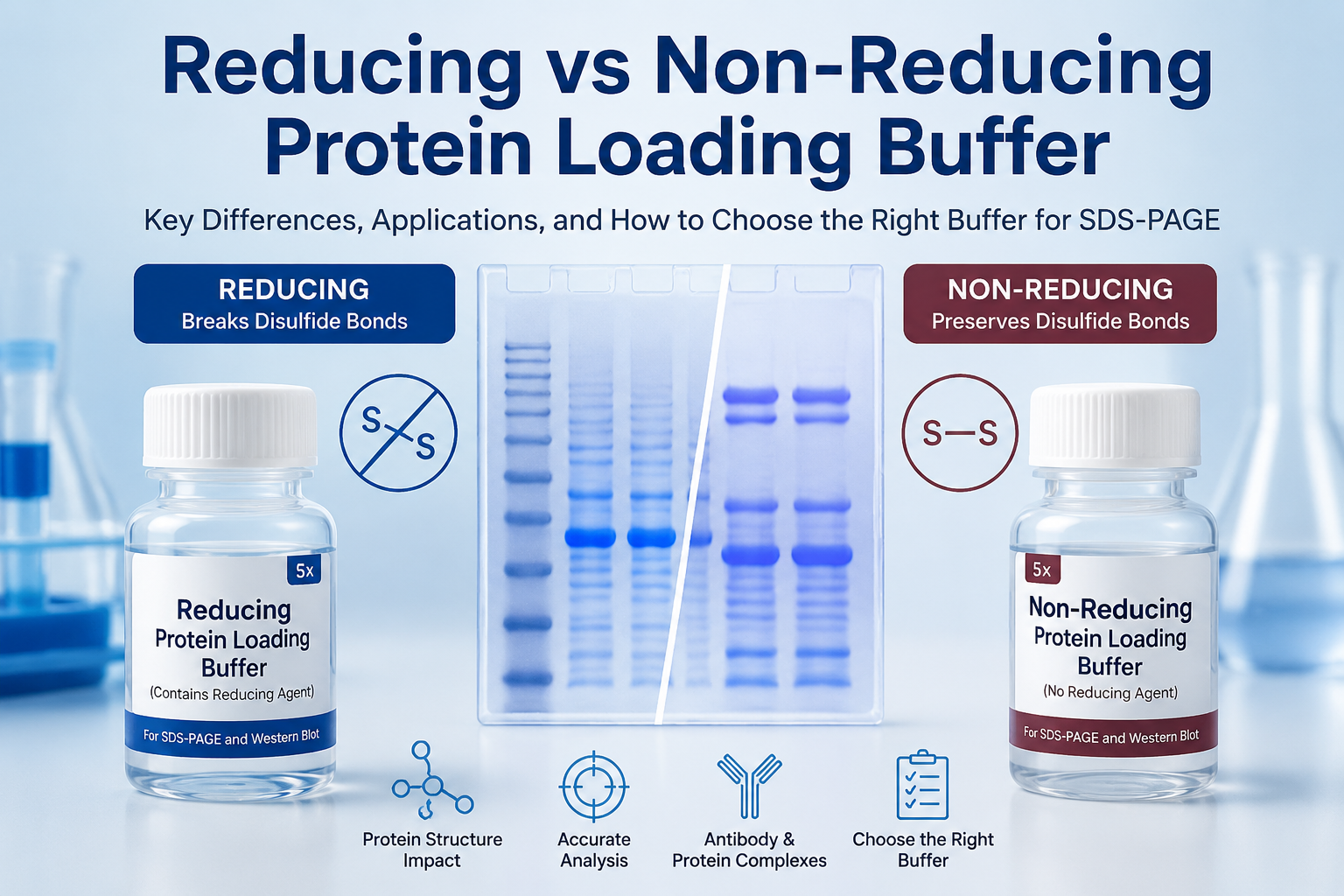
Among different types of protein loading buffers, reducing protein loading buffer and non-reducing protein loading buffer are the two most commonly used formulations. The main difference between them is whether they contain reducing agents that break disulfide bonds within or between protein molecules.
Choosing the correct loading buffer is essential because it directly affects protein structure, electrophoretic mobility, and the accuracy of downstream applications such as Western blotting, protein characterization, and immunodetection.
What Is Protein Loading Buffer?
Protein loading buffer, also known as sample buffer or SDS loading buffer, is a solution used to prepare protein samples before SDS-PAGE analysis. It typically contains several important components:
· SDS (sodium dodecyl sulfate)
SDS is an anionic detergent that binds to proteins and disrupts their native structures. It gives proteins a uniform negative charge, allowing separation primarily according to molecular weight.
· Buffering agents
These maintain a stable pH during sample preparation and electrophoresis.
· Glycerol
Glycerol increases sample density, allowing protein samples to sink smoothly into the wells of the gel.
· Tracking dyes
Dyes such as bromophenol blue help monitor electrophoresis progress.
· Reducing agents (optional)
Reducing buffers contain compounds that break disulfide bonds, while non-reducing buffers do not.
Based on the presence or absence of reducing agents, protein loading buffers are mainly divided into:
1. Reducing Protein Loading Buffer
2. Non-Reducing Protein Loading Buffer
What Is Reducing Protein Loading Buffer?
A reducing protein loading buffer is a denaturing sample buffer containing reducing agents that disrupt disulfide bonds in proteins.
Common reducing agents include:
· Dithiothreitol (DTT)
· β-Mercaptoethanol (β-ME)
· TCEP (tris(2-carboxyethyl)phosphine)
These reducing agents convert disulfide bonds (-S-S-) into free sulfhydryl groups (-SH), causing proteins to become fully unfolded.
Mechanism of Reducing Protein Loading Buffer
The working principle of reducing loading buffer is:
Protein + SDS + Heat + Reducing Agent → Fully Denatured Protein
The reducing agent breaks disulfide bonds, while SDS disrupts non-covalent interactions. After treatment, proteins lose their three-dimensional structures and migrate through the polyacrylamide gel according to their molecular weight.
For example:
A protein complex linked by disulfide bonds:
Protein A — S — S — Protein B
After reduction:
Protein A-SH + Protein B-SH
This allows accurate analysis of individual protein subunits.
Advantages of Reducing Protein Loading Buffer
1. Accurate Molecular Weight Determination
Reducing buffers provide reliable molecular weight estimation because proteins are completely separated into individual polypeptide chains.
This makes reducing SDS-PAGE the standard method for:
· Western blot analysis
· Recombinant protein evaluation
· Antibody characterization
· Protein expression analysis
2. Efficient Protein Denaturation
Reducing conditions remove complex protein structures caused by disulfide bonds. This improves protein migration consistency and reduces unexpected bands caused by protein aggregation.
3. Suitable for Most Routine Western Blot Applications
Most commercially available antibodies and Western blot protocols are optimized for reducing conditions.
Reducing sample preparation is commonly used for detecting:
· Intracellular proteins
· Recombinant proteins
· Enzymes
· Structural proteins
· Many antibody targets
4. Improved Reproducibility
By eliminating differences caused by protein folding and disulfide bond formation, reducing buffers provide more consistent electrophoretic results.
What Is Non-Reducing Protein Loading Buffer?
A non-reducing protein loading buffer is a sample preparation solution that contains SDS but does not include reducing agents.
Unlike reducing buffers, non-reducing buffers preserve disulfide bonds within proteins.
The general principle is:
Protein + SDS + Heat → Denatured Protein with Intact Disulfide Bonds
Although proteins lose their natural structures due to SDS treatment, their disulfide-linked subunits remain connected.
Why Use Non-Reducing Protein Loading Buffer?
1. Preserve Disulfide Bond Information
Many proteins rely on disulfide bonds for structural stability and biological activity.
Non-reducing conditions allow researchers to study:
· Protein oligomerization
· Disulfide-linked complexes
· Protein assembly states
For example, an antibody contains heavy and light chains connected through disulfide bonds. Under non-reducing conditions, the intact antibody structure can be observed.
2. Antibody and Immunoglobulin Analysis
Non-reducing SDS-PAGE is frequently used for antibody characterization.
Typical applications include:
· Monoclonal antibody quality control
· Antibody purity analysis
· Immunoglobulin structure evaluation
· Biopharmaceutical development
Under non-reducing conditions:
· Intact antibodies appear at higher molecular weights
· Disulfide-linked chains remain connected
3. Detection of Protein Complexes
Some proteins form stable complexes through disulfide bonds. Non-reducing buffers help researchers examine these higher-order structures.
Applications include:
· Protein interaction studies
· Membrane protein analysis
· Multimeric protein characterization

Reducing vs Non-Reducing Protein Loading Buffer: Main Differences
|
Feature |
Reducing Loading Buffer |
Non-Reducing Loading Buffer |
|
Reducing agents |
Present (DTT, β-ME, TCEP) |
Absent |
|
Disulfide bonds |
Broken |
Preserved |
|
Protein structure |
Fully disrupted |
Partially preserved |
|
Protein migration |
Based mainly on molecular weight |
Influenced by disulfide-linked structure |
|
Common applications |
Western blot, protein expression analysis |
Antibody analysis, protein complex studies |
|
Typical targets |
Most cellular proteins |
Disulfide-containing proteins |
How to Choose Between Reducing and Non-Reducing Loading Buffer?
The correct choice depends on your research goal.
Choose Reducing Loading Buffer When:
You need to determine the accurate molecular weight of a protein.
Recommended applications:
· Routine SDS-PAGE
· Western blotting
· Recombinant protein analysis
· Protein expression verification
· Enzyme characterization
Choose Non-Reducing Loading Buffer When:
You need to study protein structure or disulfide-linked forms.
Recommended applications:
· Antibody analysis
· Immunoglobulin characterization
· Protein complex detection
· Disulfide bond studies
· Biopharmaceutical quality control
Modern Protein Loading Buffer Formulations
Traditional reducing buffers often contain β-mercaptoethanol or DTT. Although effective, these compounds have several limitations:
· Strong unpleasant odor
· Limited stability
· Sensitivity to oxidation
· Additional handling requirements
Modern protein loading buffers use improved reducing systems that provide:
· Better stability
· Faster preparation
· Reduced odor
· Convenient storage conditions
For example, advanced reducing protein loading buffers can maintain neutral pH, minimize protein degradation, and remain easy to handle after storage at low temperatures.
Conclusion
Reducing protein loading buffer and non-reducing protein loading buffer serve different purposes in protein electrophoresis. Reducing buffers break disulfide bonds and fully denature proteins, making them ideal for routine SDS-PAGE and Western blot analysis. In contrast, non-reducing buffers preserve disulfide bonds, allowing researchers to investigate antibody structures, protein complexes, and higher-order protein organization.
Understanding the difference between these two buffer types helps researchers select the appropriate sample preparation method and obtain more accurate experimental results.
Whether performing routine protein detection, antibody characterization, or advanced protein structure analysis, choosing the right protein loading buffer is a key factor in successful SDS-PAGE experiments.


