
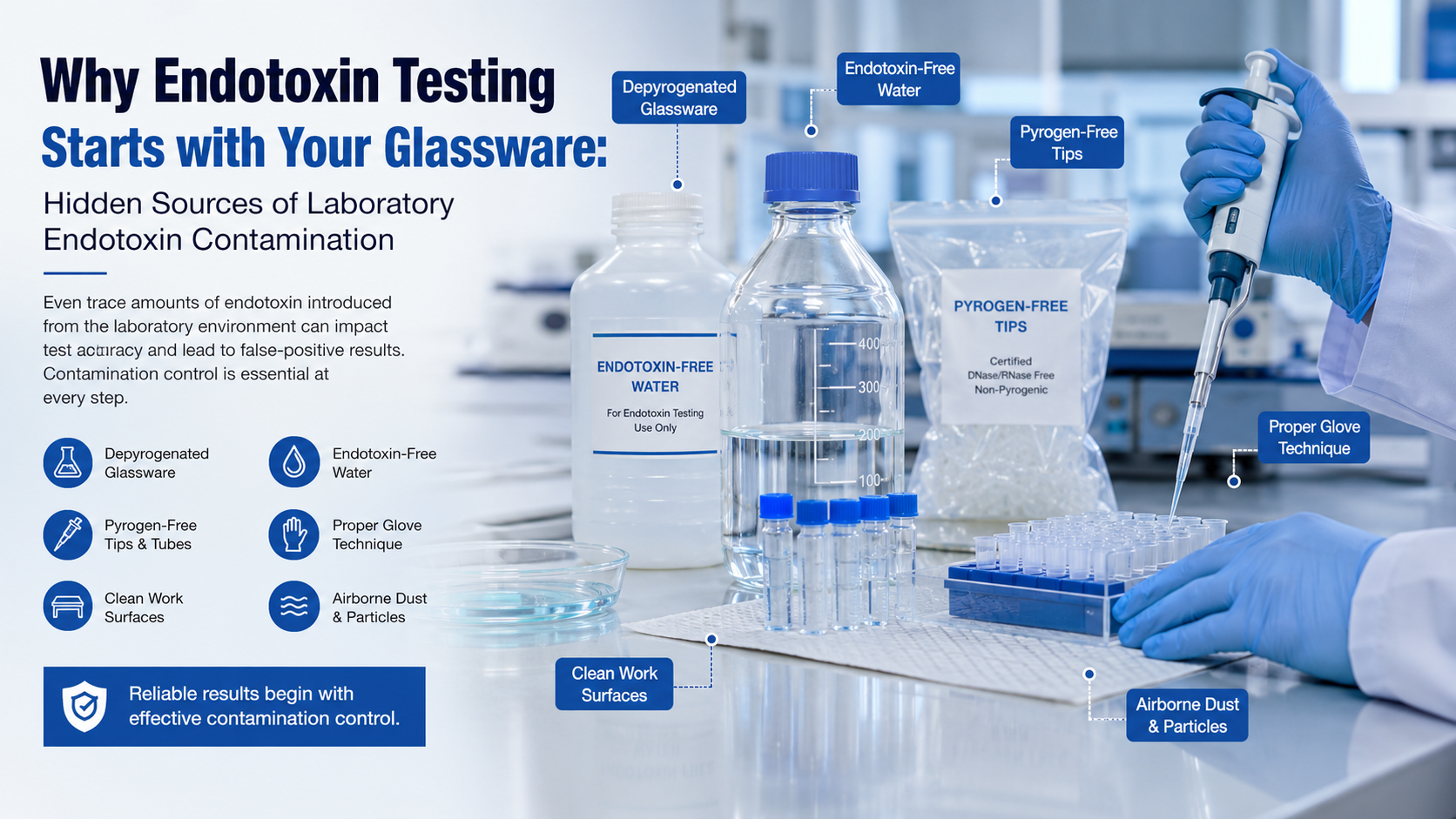
When an endotoxin test produces an unexpected positive result, many laboratories immediately suspect the TAL/LAL reagent, the instrument, or the sample itself. While these factors certainly deserve investigation, one of the most common—and often overlooked—causes of assay failure is much simpler:
The contamination may have been introduced by the laboratory before the test even began.
Every step of an endotoxin testing workflow, from preparing glassware to handling pipette tips, can influence the accuracy of the final result. Even trace amounts of bacterial endotoxin introduced through laboratory consumables or improper handling can trigger false-positive results, increase assay variability, or cause expensive out-of-specification (OOS) investigations.
Unlike many chemical contaminants, endotoxins are remarkably persistent. They are not living microorganisms, so disinfectants that effectively kill bacteria often leave endotoxin molecules largely intact. A laboratory surface may appear perfectly clean while still carrying enough endotoxin to interfere with a highly sensitive bacterial endotoxin test.
This is why experienced quality control laboratories understand an important principle:
Reliable endotoxin testing begins long before the TAL/LAL reagent is reconstituted—it starts with contamination control throughout the entire laboratory workflow.
In this guide, we'll examine the hidden sources of laboratory endotoxin contamination, explain why glassware deserves special attention, and share practical strategies to improve assay reliability while minimizing invalid or false-positive results.
Why Endotoxin Control Is Different from Microbial Control
One of the biggest misconceptions in pharmaceutical laboratories is assuming that sterile equipment is automatically free of endotoxin.
In reality, sterility and endotoxin-free status are two completely different concepts.
Sterility refers to the absence of viable microorganisms. Endotoxin testing, however, focuses on detecting lipopolysaccharides (LPS), structural components of the outer membrane of Gram-negative bacteria. These molecules remain biologically active even after the bacteria have been destroyed.
For example, consider the following situations:
- Glassware sterilized in a standard autoclave may be free of living microorganisms but still contain detectable endotoxin residues.
- Laboratory benches disinfected with 70% ethanol may appear clean while retaining endotoxin molecules capable of triggering a positive assay.
- Ultrapure laboratory water may meet conductivity specifications but still fail endotoxin requirements if it has not been specifically prepared for bacterial endotoxin testing.
Because modern kinetic chromogenic assays can detect endotoxin at extremely low concentrations, even minimal laboratory contamination can significantly affect assay performance.
Consequently, laboratories performing bacterial endotoxin testing must implement contamination control practices that go beyond conventional microbiological techniques.
Why Glassware Is Often the First Hidden Source of Endotoxin
Glassware is used throughout pharmaceutical quality control laboratories, from preparing standard solutions to diluting samples and storing reagents. Although glass is chemically stable and easy to sterilize, it can also become an unexpected reservoir for endotoxin if not properly treated.
Several factors contribute to this risk.
Incomplete Depyrogenation
Many laboratories routinely autoclave reusable glassware before use. While autoclaving effectively destroys microorganisms, it does not reliably eliminate endotoxins.
Removing endotoxin requires a validated depyrogenation process, typically involving dry heat at sufficiently high temperatures for an appropriate exposure time. Without this step, residual endotoxin from previous laboratory work may remain attached to glass surfaces.
This distinction explains why glassware that is microbiologically sterile may still interfere with endotoxin testing.
Repeated Reuse
Unlike disposable pyrogen-free consumables, reusable laboratory glassware undergoes repeated cleaning cycles.
Over time, small imperfections, scratches, or microscopic surface changes can increase the likelihood of retaining contaminants if cleaning procedures are inconsistent.
Even well-maintained laboratory glassware may accumulate trace residues after years of repeated use, particularly in high-throughput quality control laboratories.
For critical endotoxin testing applications, many laboratories therefore reserve dedicated glassware exclusively for bacterial endotoxin assays.
Improper Cleaning Procedures
Cleaning agents themselves may introduce problems.
Common issues include:
- Incomplete removal of laboratory detergents
- Washing with non-endotoxin-free water
- Cross-contamination during drying
- Storage in non-controlled laboratory environments
Residual cleaning chemicals may interfere with assay performance, while contaminated rinse water can reintroduce endotoxin immediately after cleaning.
A validated cleaning protocol should therefore include appropriate rinsing procedures using endotoxin-free water whenever practical.
Environmental Exposure
Even properly depyrogenated glassware can become contaminated after processing.
Examples include:
- Open storage shelves
- Laboratory dust
- Airborne particles
- Contact with contaminated gloves
- Handling on non-depyrogenated benches
Because endotoxin molecules readily adhere to surfaces, unnecessary exposure between depyrogenation and use should always be minimized.
Proper storage using sealed, pyrogen-free containers significantly reduces this risk.
Beyond Glassware: Other Frequently Overlooked Sources of Laboratory Endotoxin
Although glassware is often the first suspect, it is rarely the only contributor to contamination. Modern endotoxin testing requires careful evaluation of every material that comes into contact with samples or reagents.
Pipette Tips
Not all laboratory pipette tips are certified endotoxin-free.
Standard molecular biology consumables may be DNase-free, RNase-free, and sterile, yet still lack endotoxin certification.
For bacterial endotoxin testing, laboratories should use certified pyrogen-free pipette tips supplied by qualified manufacturers.
In addition, touching pipette tip boxes with contaminated gloves or leaving tips exposed for extended periods can compromise even certified consumables.
Plastic Tubes and Sample Containers
Disposable microcentrifuge tubes, centrifuge bottles, and sample containers are another potential contamination source.
Selecting products specifically validated for endotoxin-sensitive applications helps reduce variability, particularly when working near regulatory detection limits.
Many QC laboratories establish approved supplier lists to ensure batch-to-batch consistency for these consumables.
Laboratory Water: One of the Most Critical Factors in Endotoxin Testing
Water is involved in nearly every stage of a bacterial endotoxin test. It is used to reconstitute TAL/LAL reagents, prepare Control Standard Endotoxin (CSE) dilutions, dilute samples, rinse glassware, and occasionally clean laboratory equipment.
Ironically, one of the most common assumptions in the laboratory is also one of the most dangerous:
If the water is ultrapure, it must also be endotoxin-free.
Unfortunately, this is not always true.
Ultrapure Does Not Always Mean Endotoxin-Free
Many laboratories rely on Type I ultrapure water systems because they consistently produce water with excellent resistivity and low levels of ionic and organic contaminants. While these systems are ideal for molecular biology and analytical chemistry, they are not specifically designed to guarantee the absence of bacterial endotoxins.
Endotoxin contamination may occur due to:
- Biofilm formation inside water purification systems
- Improper maintenance of cartridges or filters
- Contaminated storage reservoirs
- Distribution tubing that supports bacterial growth
- Environmental contamination during dispensing
As a result, water that satisfies conductivity specifications may still contain endotoxin levels capable of affecting sensitive TAL/LAL assays.
Why Endotoxin Assay Water Matters
To eliminate this source of variability, pharmacopeias recommend using Endotoxin-Free Water (also called LAL Reagent Water or BET Water) for reagent reconstitution, standard preparation, and sample dilution.
Using dedicated endotoxin assay water offers several advantages:
- Reduces background endotoxin levels
- Improves standard curve consistency
- Minimizes false-positive results
- Enhances assay reproducibility between operators and laboratories
For regulated pharmaceutical testing, substituting general laboratory water for certified endotoxin assay water introduces unnecessary risk that can be easily avoided.
Laboratory Gloves: A Surprisingly Common Source of Contamination
Gloves protect both the analyst and the sample, but they can also become vectors for endotoxin transfer.
The issue is rarely the glove material itself. Instead, contamination occurs during routine laboratory activities.
Consider a typical workflow:
- The analyst opens a refrigerator.
- They type on a computer keyboard.
- They adjust instrument settings.
- They return to handling pyrogen-free consumables.
Although the gloves remain visibly clean, they may have contacted multiple non-controlled surfaces capable of transferring trace endotoxin to laboratory materials.
Because endotoxin molecules readily adhere to surfaces, even brief contact with contaminated equipment can compromise subsequent assay steps.
Best Practices for Glove Use
Quality control laboratories often recommend:
- Changing gloves frequently during critical assay steps
- Avoiding contact between gloved hands and non-sterile surfaces
- Handling pyrogen-free consumables only with clean gloves
- Replacing gloves immediately if contamination is suspected
These simple habits significantly reduce the likelihood of introducing external endotoxin into the assay.
Airborne Dust: The Invisible Contaminant
Laboratory air is often overlooked because endotoxin contamination cannot be seen.
However, airborne particles may contain:
- Fragments of Gram-negative bacteria
- Environmental dust
- Organic debris
- Aerosolized laboratory residues
Unlike viable microorganisms, these particles may not pose a sterility concern while still contributing measurable endotoxin.
The risk increases whenever tubes, reagent bottles, or microplates remain open longer than necessary.
Practical Recommendations
To reduce airborne contamination:
- Open consumables only immediately before use.
- Minimize unnecessary exposure of reagents.
- Keep sample containers closed whenever possible.
- Perform critical assay preparation in a clean laboratory environment.
These practices are especially important for kinetic chromogenic assays, where background endotoxin can affect assay sensitivity and increase variability.
Laboratory Benches: Clean Does Not Always Mean Endotoxin-Free
One of the most persistent misconceptions is that disinfecting a laboratory bench automatically removes endotoxin.
In reality, many common laboratory disinfectants—including 70% ethanol and isopropanol—are excellent at killing microorganisms but have little effect on endotoxin molecules.
This distinction is essential.
Disinfection eliminates viable bacteria.
Depyrogenation removes or destroys endotoxin.
These are not equivalent processes.
Consequently, an apparently clean bench may still transfer endotoxin to tubes, pipettes, or glassware placed directly on its surface.
Recommended Practices
Rather than placing critical consumables directly on laboratory benches:
- Use clean absorbent pads or dedicated pyrogen-free work surfaces.
- Avoid unnecessary contact between consumables and benchtops.
- Organize the workspace before opening reagents.
- Separate endotoxin testing activities from routine microbiological work whenever possible.
Ice Buckets and Cooling Containers
Many laboratories cool reagents or samples using reusable ice buckets.
Although convenient, these containers frequently accumulate moisture, dust, and environmental contamination over time.
Condensation can transport contaminants onto tube surfaces, particularly when tubes remain in the bucket for extended periods.
If cooling is required, laboratories should ensure that containers are cleaned regularly and dedicated to endotoxin-sensitive applications whenever practical.
Microplates: Quality Matters More Than Many Laboratories Realize
For kinetic chromogenic assays, the microplate itself becomes part of the analytical system.
Differences in manufacturing quality may influence:
- Background absorbance
- Surface cleanliness
- Well-to-well consistency
- Assay reproducibility
Using uncertified laboratory plates introduces another variable into an assay that is already designed to detect extremely low endotoxin concentrations.
Whenever possible, laboratories should use validated microplates recommended by the assay manufacturer or demonstrated to be suitable during method validation.
Operator Technique: The Human Factor
Even with validated reagents, certified consumables, and well-maintained instruments, the analyst remains one of the most important variables in endotoxin testing.
Common procedural mistakes include:
- Leaving reagent bottles open longer than necessary
- Preparing standards far in advance of use
- Touching the inside of tubes or caps
- Mixing clean and used consumables
- Using non-dedicated pipettes without proper cleaning
- Performing unnecessary manipulations during assay setup
These errors may seem insignificant individually, but together they can substantially increase the risk of contamination.
For this reason, successful laboratories emphasize standardized operating procedures (SOPs), operator training, and routine competency assessments alongside equipment qualification and method validation.
A Practical Checklist to Prevent Laboratory Endotoxin Contamination
Preventing endotoxin contamination does not necessarily require expensive equipment or major workflow changes. In many cases, assay reliability improves simply by eliminating small but frequent sources of contamination.
Before beginning each bacterial endotoxin test, laboratories should confirm the following:
✔ Only certified pyrogen-free glassware and consumables are used.
✔ TAL/LAL reagents have been stored and reconstituted according to the manufacturer's instructions.
✔ Certified endotoxin assay water is used for reagent preparation and sample dilution.
✔ Pipette tips, tubes, and microplates are endotoxin-free and handled aseptically.
✔ Laboratory benches are organized, clean, and dedicated to endotoxin-sensitive work whenever possible.
✔ Gloves have been changed before handling critical assay materials.
✔ Standard solutions are freshly prepared following validated procedures.
✔ Glassware has undergone validated depyrogenation rather than routine sterilization alone.
✔ Reagents and samples remain covered until immediately before use.
✔ Environmental exposure is minimized throughout the testing process.
Although each checkpoint appears simple, together they significantly reduce the likelihood of false-positive results, assay variability, and unnecessary repeat testing.
Building an Endotoxin-Free Workflow: A Preventive Approach
Many laboratories investigate contamination only after an assay fails. However, high-performing pharmaceutical QC laboratories take the opposite approach—they design workflows that minimize contamination before testing begins.
A robust endotoxin testing workflow typically includes four key stages.
1. Controlled Preparation
All consumables, reagents, and equipment should be prepared before opening TAL/LAL reagents or sample containers.
This minimizes unnecessary handling and reduces environmental exposure during the assay.
2. Dedicated Materials
Where practical, laboratories should dedicate specific glassware, pipettes, tube racks, and accessories exclusively to bacterial endotoxin testing.
Separating BET materials from routine analytical work helps reduce cross-contamination and simplifies laboratory management.
3. Standardized Operating Procedures
Even the highest-quality reagents cannot compensate for inconsistent laboratory practices.
Written SOPs should clearly define procedures for:
- Glassware depyrogenation
- Water selection
- Consumable handling
- Sample preparation
- Environmental controls
- Equipment cleaning
- Documentation requirements
Consistency between analysts is often just as important as analytical sensitivity.
4. Continuous Training
Endotoxin testing is highly sensitive to operator technique.
Regular competency assessments and refresher training help ensure that laboratory personnel consistently follow validated procedures, particularly when introducing new staff or implementing revised testing methods.
A culture of contamination prevention ultimately delivers more reliable analytical results than repeated troubleshooting after failures occur.
How FireGene Supports Reliable Endotoxin Testing
While contamination control depends largely on laboratory practices, selecting high-quality, validated testing materials also plays an essential role in achieving consistent results.
FireGene offers a comprehensive portfolio of endotoxin testing solutions designed to support pharmaceutical manufacturers, biotechnology companies, medical device laboratories, and research institutions.
These include:
- Gel-Clot TAL Assay Kits for qualitative bacterial endotoxin testing in accordance with major pharmacopeial requirements.
- Kinetic Chromogenic TAL Assay Kits for quantitative endotoxin determination with high sensitivity and excellent reproducibility.
- Control Standard Endotoxin (CSE) for routine calibration and method validation.
- Endotoxin Assay Water specifically prepared for bacterial endotoxin testing applications.
- Pyrogen-Free Test Tubes and Laboratory Consumables that help minimize the risk of introducing external endotoxin during sample preparation.
When combined with validated laboratory procedures and appropriate contamination control measures, these products help laboratories improve assay consistency, reduce invalid test results, and support regulatory compliance.
Frequently Asked Questions
Can sterile glassware still contain endotoxin?
Yes.
Sterilization destroys viable microorganisms but does not necessarily remove bacterial endotoxins. Glassware intended for bacterial endotoxin testing should undergo validated depyrogenation or be supplied as certified pyrogen-free.
Does 70% ethanol remove endotoxin?
No.
Ethanol is an effective disinfectant against many microorganisms but does not reliably destroy or remove endotoxin molecules. Depyrogenation requires specialized processes, such as validated dry heat treatment.
Can Type I ultrapure water replace endotoxin assay water?
Not necessarily.
Although ultrapure water meets stringent chemical purity specifications, it is not automatically certified to be endotoxin-free. Laboratories should use endotoxin assay water whenever specified by the assay protocol or applicable pharmacopeial guidance.
Why do endotoxin tests sometimes produce unexpected positive results?
Unexpected positives may result from several factors, including:
- Contaminated glassware
- Non-certified consumables
- Improper reagent handling
- Environmental contamination
- Sample interference
- Inadequate laboratory practices
A systematic investigation should evaluate the entire testing workflow rather than focusing solely on the assay reagent.
How often should reusable glassware be depyrogenated?
The appropriate frequency depends on laboratory procedures, usage patterns, and quality management systems.
However, any reusable glassware intended for bacterial endotoxin testing should undergo validated depyrogenation before use whenever required by the laboratory's SOPs.
Why Endotoxin Contamination Is So Difficult to Detect
One reason laboratory contamination remains a persistent challenge is that endotoxin behaves very differently from most contaminants encountered in pharmaceutical quality control.
Unlike microbial contamination, endotoxin:
- Cannot be identified by visual inspection.
- Does not produce obvious changes in solution appearance.
- Remains biologically active after bacterial death.
- Can adhere strongly to glass, plastics, stainless steel, and rubber surfaces.
- Exists in quantities far below the threshold of human observation.
A laboratory may therefore appear exceptionally clean while still containing sufficient endotoxin to interfere with highly sensitive analytical methods.
This explains why contamination investigations often become lengthy and expensive.
By the time an unexpected result is detected, the original contamination event may have occurred hours—or even days—earlier.
A Risk-Based Approach to Laboratory Contamination Control
Rather than treating every laboratory item equally, many pharmaceutical manufacturers now apply a risk-based strategy similar to the principles outlined in ICH Q9 Quality Risk Management.
Items can generally be classified according to their likelihood of contributing endotoxin contamination.
High-Risk Items
These materials come into direct contact with reagents or samples and therefore require the highest level of control.
Examples include:
- Glass reaction tubes
- Sample containers
- Pipette tips
- Microplates
- Reagent bottles
- Endotoxin assay water
- CSE preparation vessels
Medium-Risk Items
These materials do not always contact samples directly but may indirectly transfer contamination.
Examples include:
- Adjustable pipettes
- Tube racks
- Ice buckets
- Laboratory trays
- Vortex mixer adapters
- Forceps
- Storage boxes
Lower-Risk Items
Although less likely to introduce contamination directly, these environmental factors still influence overall laboratory cleanliness.
Examples include:
- Benchtops
- Computer keyboards
- Laboratory notebooks
- Door handles
- Refrigerators
- Laboratory carts
Developing cleaning frequencies and handling procedures based on risk allows laboratories to allocate resources more effectively while maintaining assay reliability.
The Cost of Ignoring Laboratory Contamination
The consequences of endotoxin contamination extend well beyond a single failed assay.
An unexpected positive result may trigger:
- Repeat testing
- Additional reagent consumption
- Overtime labor
- Delayed batch release
- Manufacturing interruptions
- Quality investigations
- Corrective and preventive actions (CAPA)
- Customer notification
- Regulatory documentation
For pharmaceutical manufacturers operating under GMP, even one invalid bacterial endotoxin test can consume days of investigation and involve personnel from Quality Control, Quality Assurance, Manufacturing, and Regulatory Affairs.
The financial impact often far exceeds the cost of implementing preventive contamination control measures.
This is why leading laboratories increasingly view contamination prevention not as an additional expense, but as an investment in operational efficiency and product quality.
What Do Regulatory Guidelines Expect?
One of the biggest misconceptions in endotoxin testing is that contamination control is solely a matter of laboratory preference. In reality, regulatory expectations extend far beyond the analytical method itself.
Whether a laboratory performs bacterial endotoxin testing using the gel-clot, kinetic chromogenic, or kinetic turbidimetric method, inspectors expect the entire analytical process to be adequately controlled and scientifically justified.
During GMP inspections, auditors rarely focus only on the final endotoxin result. Instead, they evaluate whether the laboratory can demonstrate that every stage of the testing process is capable of producing reliable, reproducible, and traceable data.
This includes:
- Qualification of laboratory equipment
- Validation of analytical methods
- Control of laboratory consumables
- Personnel training records
- Environmental monitoring practices
- Documentation of reagent preparation
- Investigation of atypical or out-of-specification (OOS) results
Although pharmacopeias do not prescribe the exact cleaning procedure for every piece of laboratory equipment, they consistently emphasize that laboratories are responsible for demonstrating that their testing process is suitable for its intended purpose.
In other words:
Reliable endotoxin testing is built on process control—not simply on passing a single assay.
Glassware Qualification: An Often-Overlooked Part of Method Validation
Method validation typically focuses on analytical performance characteristics such as:
- Accuracy
- Precision
- Linearity
- Detection capability
- Specificity
- Robustness
However, these performance characteristics can only be achieved if the laboratory materials themselves are properly controlled.
For example, a perfectly validated kinetic chromogenic assay may still generate inconsistent recovery values if analysts unknowingly use glassware containing residual endotoxin.
For this reason, many pharmaceutical companies include glassware qualification within their broader laboratory quality system.
Typical qualification activities may include:
- Verification of depyrogenation procedures
- Evaluation of cleaning effectiveness
- Documentation of glassware identification
- Dedicated storage following depyrogenation
- Defined maximum reuse cycles where applicable
Although these activities receive less attention than instrument qualification, they contribute directly to long-term assay consistency.
Disposable vs. Reusable Glassware: Which Is Better?
This question is frequently raised by laboratories establishing or expanding endotoxin testing capabilities.
The answer depends on laboratory workload, regulatory requirements, and quality management practices.
Disposable Pyrogen-Free Consumables
Advantages include:
- Eliminates cleaning variability
- No depyrogenation required
- Reduces cross-contamination risk
- Simplifies laboratory workflow
- Ideal for GMP release testing
Potential considerations:
- Higher consumable costs
- Increased laboratory waste
- Supply chain management
Reusable Glassware
Advantages include:
- Lower long-term operating costs
- Environmentally sustainable
- Suitable for high-volume laboratories with validated depyrogenation processes
Potential considerations:
- Requires validated cleaning procedures
- Requires validated depyrogenation
- Greater documentation burden
- Higher operator dependence
For many regulated laboratories, a hybrid approach is often adopted. Disposable pyrogen-free consumables are reserved for critical assay steps, while reusable glassware is used only after validated cleaning and depyrogenation.
Small Habits That Prevent Big Problems
When reviewing contamination investigations, laboratories often discover that failures were not caused by a single major error but rather by several small deviations occurring simultaneously.
Examples include:
- Opening reagent bottles earlier than necessary
- Preparing standards too far in advance
- Reaching across open tubes
- Touching tube caps with contaminated gloves
- Leaving pipette tip boxes uncovered
- Reusing laboratory wipes
- Storing depyrogenated glassware without protective covers
Individually, each action appears insignificant.
Collectively, they can introduce enough endotoxin to compromise highly sensitive assays.
This highlights an important principle of laboratory quality:
Good laboratory practice is built on consistent attention to small details.
Creating a Culture of Contamination Prevention
The most successful pharmaceutical quality control laboratories share one common characteristic.
They do not simply react to contamination—they actively design systems that prevent contamination from occurring in the first place.
This culture extends beyond written SOPs.
It includes:
- Continuous staff training
- Regular workflow reviews
- Preventive equipment maintenance
- Qualification of new consumables
- Trending of assay performance
- Investigation of recurring background signals
- Cross-functional communication between QC, QA, and Manufacturing
Rather than asking, "Why did this assay fail?", high-performing laboratories ask:
"What can we improve today to reduce the likelihood of failure tomorrow?"
This preventive mindset not only improves analytical reliability but also supports operational efficiency, regulatory compliance, and product quality.
Conclusion
Accurate endotoxin testing begins long before a sample is added to a reaction tube.
Every component of the laboratory environment—including glassware, water, consumables, work surfaces, and operator technique—can influence assay performance. Because modern TAL/LAL methods are capable of detecting extremely low concentrations of bacterial endotoxin, even seemingly insignificant contamination can lead to false-positive results, increased variability, costly repeat testing, and unnecessary investigations.
Fortunately, most contamination risks are preventable.
By implementing validated depyrogenation procedures, using certified endotoxin-free materials, maintaining standardized workflows, and reinforcing good laboratory practices, pharmaceutical and biotechnology laboratories can substantially improve the reliability and reproducibility of bacterial endotoxin testing.
Ultimately, successful endotoxin testing is not defined solely by the quality of the assay reagent. It reflects the quality of the entire analytical process—from the moment glassware is prepared to the final interpretation of results.
When contamination control becomes an integral part of laboratory culture rather than a response to failed assays, endotoxin testing becomes more accurate, more efficient, and more dependable.
FireGene Endotoxin Testing
Ready to run your endotoxin assay?
FireGene offers a complete endotoxin testing toolkit — from TAL reagents and CSE standards to pyrogen-free consumables and LAL reagent water. All products are aligned with USP <85>, EP 2.6.14, and JP 4.01.


