
Introduction: What Is Single-Cell Sequencing?
In modern life science research, understanding biological systems at the cellular level has become increasingly important. Traditional sequencing technologies analyze thousands or millions of cells together, providing an average measurement of gene expression or genetic information. However, this approach often hides important differences between individual cells.
Single-cell sequencing is an advanced molecular technology that enables researchers to analyze genetic information from individual cells. By examining each cell separately, scientists can uncover cellular diversity, identify rare cell populations, and understand complex biological processes with unprecedented resolution.
Among various single-cell technologies, single-cell RNA sequencing (scRNA-seq) has become one of the most widely used approaches. It allows researchers to study gene expression patterns in individual cells and provides valuable insights into cell identity, function, and interactions.
How Does Single-Cell Sequencing Work?
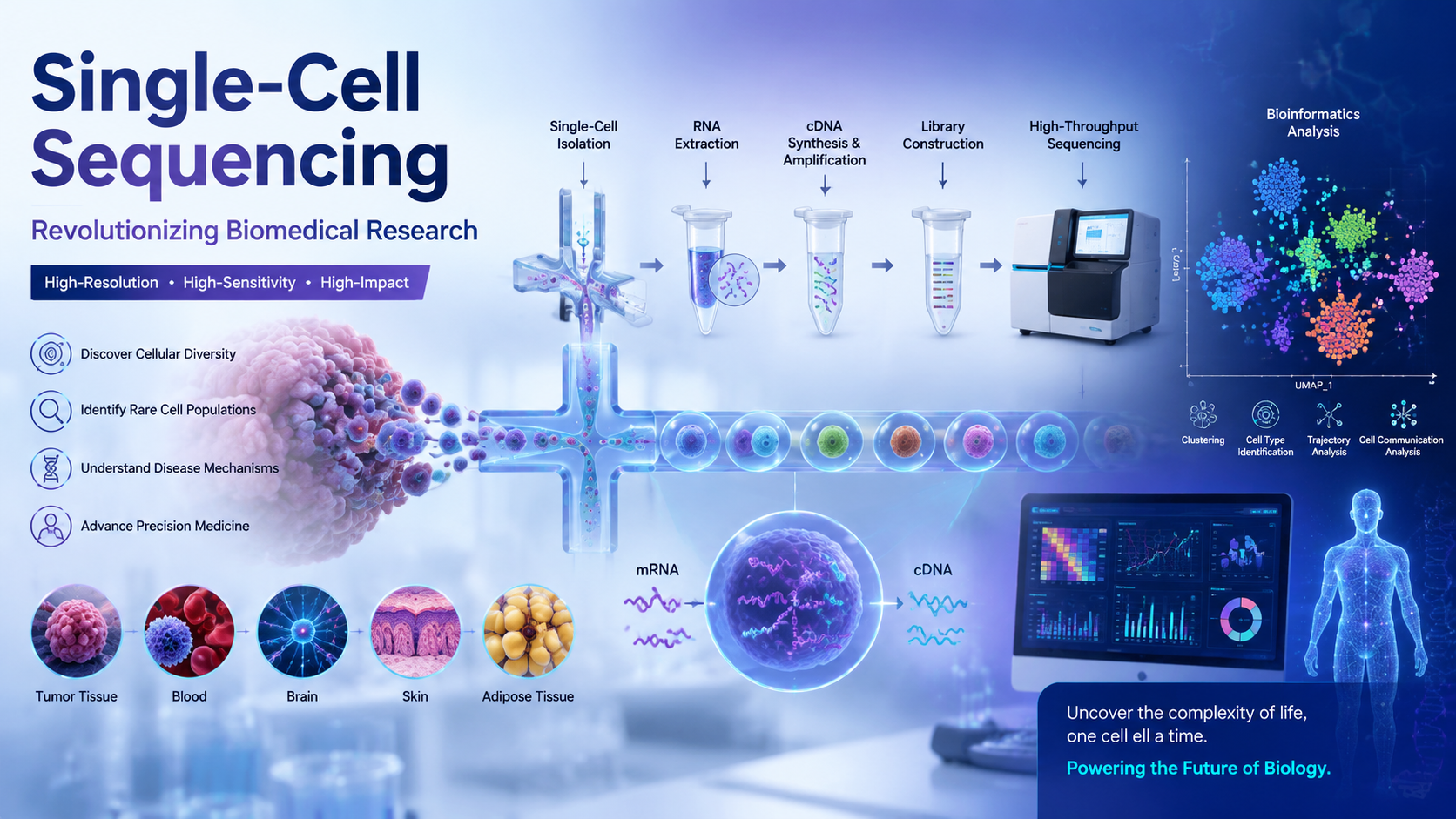
Single-cell sequencing involves several key experimental and analytical steps designed to capture information from individual cells.
1. Single-Cell Isolation
The first step is separating individual cells from a biological sample, such as:
· Tumor tissue
· Blood samples
· Brain tissue
· Skin tissue
· Adipose tissue
· Organoid models
Specialized technologies, including microfluidics and droplet-based systems, are commonly used to isolate individual cells while maintaining their biological characteristics.
2. Nucleic Acid Extraction and Amplification
Each cell contains only a very small amount of DNA or RNA. Therefore, genetic materials must be amplified before sequencing.
For single-cell RNA sequencing, messenger RNA (mRNA) molecules are converted into complementary DNA (cDNA), which can then be amplified and prepared for sequencing.
3. High-Throughput Sequencing
After library preparation, samples are analyzed using next-generation sequencing (NGS) platforms. The resulting sequencing data provides information about:
· Gene expression levels
· Genetic variations
· Cell-specific molecular signatures
4. Bioinformatics Analysis
Because single-cell sequencing generates massive amounts of data, advanced computational tools are required for analysis.
Common analysis methods include:
· Cell clustering
· Cell type identification
· Differential gene expression analysis
· Cell trajectory analysis
· Cell communication analysis
These approaches help researchers understand how individual cells contribute to biological functions.
Single-Cell RNA Sequencing (scRNA-seq): The Most Popular Single-Cell Technology
Among single-cell technologies, single-cell RNA sequencing has gained significant attention because it reveals the active gene expression profile of individual cells.
Unlike traditional RNA sequencing, which provides an average expression profile from a mixture of cells, scRNA-seq can identify:
· Different cell types within the same tissue
· Functional states of individual cells
· Rare cell populations
· Changes during disease progression
For example, a tumor sample may contain cancer cells, immune cells, stromal cells, and endothelial cells. Bulk sequencing may combine all signals together, while scRNA-seq can distinguish each cellular population and reveal their unique molecular characteristics.
Key Applications of Single-Cell Sequencing
1. Cancer Research
Cancer tissues are highly heterogeneous, meaning that different cancer cells can have different genetic profiles and behaviors.
Single-cell sequencing helps researchers investigate:
· Tumor cell diversity
· Cancer evolution
· Drug resistance mechanisms
· Tumor microenvironment
· Immune cell responses
By identifying specific cellular populations, researchers can discover new therapeutic targets and develop more precise cancer treatments.
2. Immunology Research
The immune system contains many specialized cell types, including:
· T cells
· B cells
· Macrophages
· Natural killer (NK) cells
· Dendritic cells
Single-cell sequencing enables detailed analysis of immune cell composition and activation states.
Researchers can use this technology to study:
· Immune responses during infection
· Autoimmune diseases
· Vaccine responses
· Immunotherapy mechanisms 
3. Developmental Biology
Organ development involves highly complex cellular changes over time.
Single-cell sequencing allows scientists to track:
· Cell differentiation pathways
· Developmental trajectories
· Cell fate decisions
· Gene regulation networks
This provides valuable information about how stem cells develop into specialized cell types.
4. Neuroscience Research
The brain contains thousands of different cell populations with unique functions.
Single-cell sequencing has helped identify:
· New neuronal subtypes
· Glial cell populations
· Brain development processes
· Molecular mechanisms of neurological disorders
This technology provides a powerful tool for studying diseases such as Alzheimer's disease, Parkinson's disease, and other neurological conditions.
5. Metabolic Disease Research
Complex metabolic diseases involve interactions among multiple cell types.
Single-cell sequencing is increasingly used in research areas such as:
· Obesity
· Diabetes
· Liver disease
· Cardiovascular disorders
For example, single-cell analysis of adipose tissue can reveal differences among adipocytes, immune cells, and stromal cells, helping researchers understand metabolic regulation and inflammation.
Different Types of Single-Cell Sequencing Technologies
Single-Cell DNA Sequencing (scDNA-seq)
scDNA-seq analyzes genetic variations at the individual cell level.
Applications include:
· Cancer mutation analysis
· Genome evolution studies
· Genetic diversity research
Single-Cell ATAC Sequencing (scATAC-seq)
scATAC-seq studies chromatin accessibility and helps reveal how genes are regulated.
It provides information about:
· Regulatory regions
· Transcription factor activity
· Epigenetic changes
Single-Cell Multi-Omics
Single-cell multi-omics combines multiple molecular measurements from the same cells.
Examples include:
· Transcriptomics
· Genomics
· Epigenomics
· Proteomics
This integrated approach provides a more complete understanding of cellular biology.
Advantages of Single-Cell Sequencing
Compared with traditional sequencing methods, single-cell sequencing offers several major advantages:
High Cellular Resolution
Researchers can analyze individual cells instead of average signals from large cell populations.
Identification of Rare Cell Types
Rare but biologically important cells can be detected and characterized.
Understanding Cellular Heterogeneity
The technology reveals differences between cells within the same tissue or disease environment.
Discovery of New Biological Mechanisms
Single-cell analysis can uncover previously unknown cell states, pathways, and interactions.
Challenges of Single-Cell Sequencing
Although single-cell sequencing provides powerful insights, several challenges remain:
High Data Complexity
Single-cell experiments generate large datasets requiring advanced computational resources and bioinformatics expertise.
Technical Variability
Sample preparation, sequencing depth, and analysis methods can influence results.
Cost Considerations
Compared with traditional sequencing approaches, single-cell sequencing generally requires higher experimental costs.
Sample Quality Requirements
High-quality cell isolation and preservation are essential for reliable results.
Future Perspectives of Single-Cell Sequencing
The future of single-cell sequencing is moving toward more integrated and powerful technologies.
Emerging trends include:
· Spatial single-cell sequencing
· Real-time single-cell analysis
· Artificial intelligence-assisted data interpretation
· Single-cell multi-omics platforms
· Clinical applications in precision medicine
By combining molecular information with spatial and functional data, researchers will gain a deeper understanding of complex biological systems.
Conclusion
Single-cell sequencing represents a major breakthrough in molecular biology by enabling researchers to study individual cells with extraordinary detail. From cancer research and immunology to developmental biology and precision medicine, this technology is transforming how scientists understand cellular functions and disease mechanisms.
As sequencing technologies continue to advance, single-cell analysis will play an increasingly important role in biomedical research, drug discovery, and personalized healthcare.
For researchers seeking high-quality solutions for single-cell experiments, reliable sample preparation products, cell isolation reagents, and molecular biology tools are essential for achieving accurate and reproducible results.


