
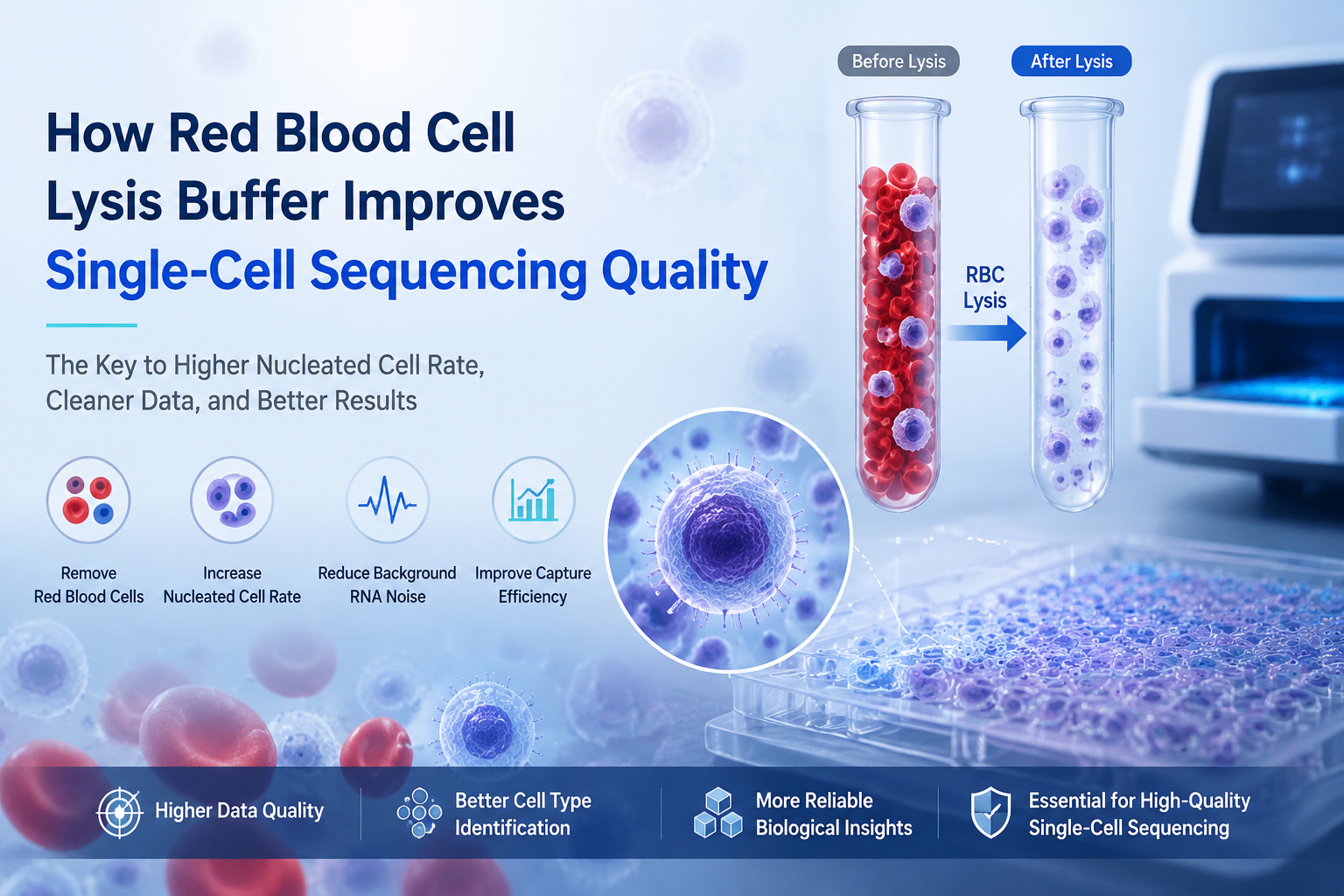
Introduction: The Importance of Sample Preparation in Single-Cell Sequencing
Single-cell sequencing has revolutionized modern biomedical research by enabling researchers to analyze individual cells at unprecedented resolution. Compared with traditional bulk sequencing approaches, single-cell technologies can reveal cellular heterogeneity, identify rare cell populations, characterize immune responses, and uncover complex biological mechanisms in diseases such as cancer, autoimmune disorders, and metabolic diseases.
However, obtaining high-quality single-cell sequencing data depends heavily on the quality of the starting cell suspension. Parameters such as cell viability, cell concentration, nucleated cell rate, and RNA integrity directly influence downstream sequencing performance.
Among these factors, the nucleated cell rate is particularly important. A low nucleated cell rate means that a large proportion of the sample consists of non-target components, especially red blood cells (RBCs). Since mature red blood cells lack nuclei and contain no genomic DNA, they provide little value for most single-cell sequencing applications. Excessive RBC contamination can reduce sequencing efficiency, increase background noise, and compromise accurate cell identification.
To address this challenge, researchers commonly use Red Blood Cell Lysis Buffer (RBC Lysis Buffer) during sample preparation. This reagent selectively removes erythrocytes while preserving nucleated cells, creating a cleaner and higher-quality single-cell suspension.
What Is Red Blood Cell Lysis Buffer?
Red Blood Cell Lysis Buffer is a specialized solution designed to selectively disrupt the membranes of erythrocytes while maintaining the integrity of nucleated cells, including immune cells, stem cells, and tissue-derived cells.
Most RBC lysis buffers work through osmotic mechanisms, commonly using ammonium chloride-based formulations. Red blood cells are highly sensitive to osmotic changes because they lack the structural protection provided by a nucleus and complex cytoskeleton. As a result, they are efficiently lysed, while most nucleated cells remain intact under optimized conditions.
After treatment, unwanted red blood cell debris can be removed through centrifugation and washing steps, leaving a purified single-cell suspension suitable for sequencing platforms.
Why Red Blood Cell Removal Matters in Single-Cell Sequencin
1. Increasing the Nucleated Cell Rate
One of the most important advantages of RBC lysis is improving the proportion of nucleated cells in the sample.
In blood and blood-derived tissues, red blood cells may represent the majority of total cellular components. Because they do not contain nuclei, they cannot contribute meaningful information to many single-cell sequencing workflows.
High RBC contamination can result in:
· Lower effective cell numbers
· Reduced target cell enrichment
· Inaccurate cell counting
· Poor sample utilization
By removing excessive erythrocytes, RBC lysis buffer increases the percentage of valuable nucleated cells, improving the quality and reliability of downstream sequencing analysis.
2. Reducing Background RNA Contamination
In single-cell RNA sequencing (scRNA-seq), background RNA contamination is a major challenge.
Although red blood cells lack nuclei, they contain abundant hemoglobin-associated transcripts, including:
· HBA1
· HBA2
· HBB
When excessive red blood cells remain in a sample, these hemoglobin transcripts can dominate sequencing reads. This may interfere with gene expression analysis and make it difficult to accurately identify cell populations.
RBC lysis helps reduce:
· Hemoglobin gene contamination
· Ambient RNA signals
· False expression patterns
As a result, researchers can obtain cleaner transcriptomic profiles and improve cell clustering accuracy.
3. Improving Single-Cell Capture Efficiency
Modern single-cell sequencing platforms rely on precise cell capture technologies, including droplet-based microfluidic systems.
The presence of large amounts of red blood cells can negatively affect the capture process by:
· Increasing non-informative particles
· Reducing effective cell recovery
· Disturbing cell concentration calculations
· Increasing empty droplets
After RBC removal, researchers can more accurately determine the concentration of target cells and optimize sample loading conditions.
This leads to:
· Higher usable cell recovery
· Better sequencing efficiency
· More reliable experimental results
4. Enhancing Cell-Type Identification and Bioinformatics Analysis
Single-cell sequencing relies on gene expression patterns to distinguish different cell populations.
However, excessive RBC contamination can introduce technical noise and reduce the accuracy of cell classification.
For example, in peripheral blood mononuclear cell (PBMC) sequencing, incomplete red blood cell removal may obscure important immune cell populations, including:
· T cells
· B cells
· Natural killer (NK) cells
· Monocytes
By reducing RBC interference, researchers can achieve:
· More accurate clustering
· Better identification of rare cell populations
· Improved interpretation of biological pathways
This is especially important in immunology and disease research where subtle cellular differences are biologically meaningful.
5. Maintaining Cell Viability and RNA Quality
Although RBC removal is beneficial, the quality of the lysis process is critical.
An ideal RBC lysis buffer should remove erythrocytes efficiently while maintaining:
· High cell viability
· Intact cell membranes
· Minimal cellular stress
· Preserved RNA quality
Overexposure to harsh lysis conditions may cause:
· Damage to nucleated cells
· Reduced cell recovery
· Increased cell debris
· RNA degradation
Therefore, optimized RBC lysis reagents are designed to provide rapid red blood cell removal with minimal impact on target cells.
Applications of RBC Lysis Buffer in Single-Cell Research
Blood Single-Cell Sequencing
Blood samples naturally contain large numbers of erythrocytes. RBC lysis is commonly used before:
· scRNA-seq
· scATAC-seq
· CITE-seq
· Single-cell immune profiling
It improves the detection of immune cell populations and enhances sequencing quality.
Cancer Research
Tumor samples, especially blood-derived cancer samples, may contain high levels of red blood cells due to bleeding or vascularization.
RBC removal helps researchers study:
· Tumor immune microenvironment
· Circulating tumor cells
· Immune cell activation states
· Cancer progression mechanisms
Tissue-Derived Single-Cell Analysis
Some tissues, including spleen, liver, and bone marrow, contain abundant erythrocytes.
RBC lysis improves the preparation of single-cell suspensions for:
· Developmental biology studies
· Stem cell research
· Regenerative medicine
· Immunological investigations
RBC Lysis Buffer in Multi-Omics Applications
Beyond single-cell RNA sequencing, RBC removal also benefits other single-cell technologies.
Single-Cell ATAC Sequencing (scATAC-seq)
Because red blood cells lack nuclei, they contribute little useful chromatin information. Removing them increases the proportion of informative nuclei and improves assay efficiency.
CITE-seq and Multiome Analysis
In integrated RNA and protein analysis, RBC contamination can interfere with antibody labeling and cellular classification. Efficient erythrocyte removal improves multi-dimensional data integration.
Key Features of an Effective Red Blood Cell Lysis Buffer
A high-quality RBC lysis solution should provide:
✔ Efficient removal of red blood cells
✔ High recovery of nucleated cells
✔ Excellent cell viability preservation
✔ Reduced background RNA contamination
✔ Compatibility with single-cell sequencing workflows
✔ Easy operation and reproducible performance
These characteristics are essential for generating reliable sequencing libraries and accurate biological conclusions.
Conclusion
Red Blood Cell Lysis Buffer is a critical tool for preparing high-quality single-cell sequencing samples. By selectively eliminating non-nucleated erythrocytes, it improves nucleated cell ratios, reduces hemoglobin RNA contamination, enhances cell capture efficiency, and supports accurate downstream bioinformatics analysis.
For researchers working with blood, bone marrow, spleen, or other RBC-rich samples, effective red blood cell removal is an essential step toward obtaining cleaner single-cell suspensions and more reliable sequencing results.
As single-cell technologies continue to expand in biomedical research, optimized RBC lysis strategies will remain an important component in achieving high-quality, reproducible single-cell sequencing data.


