
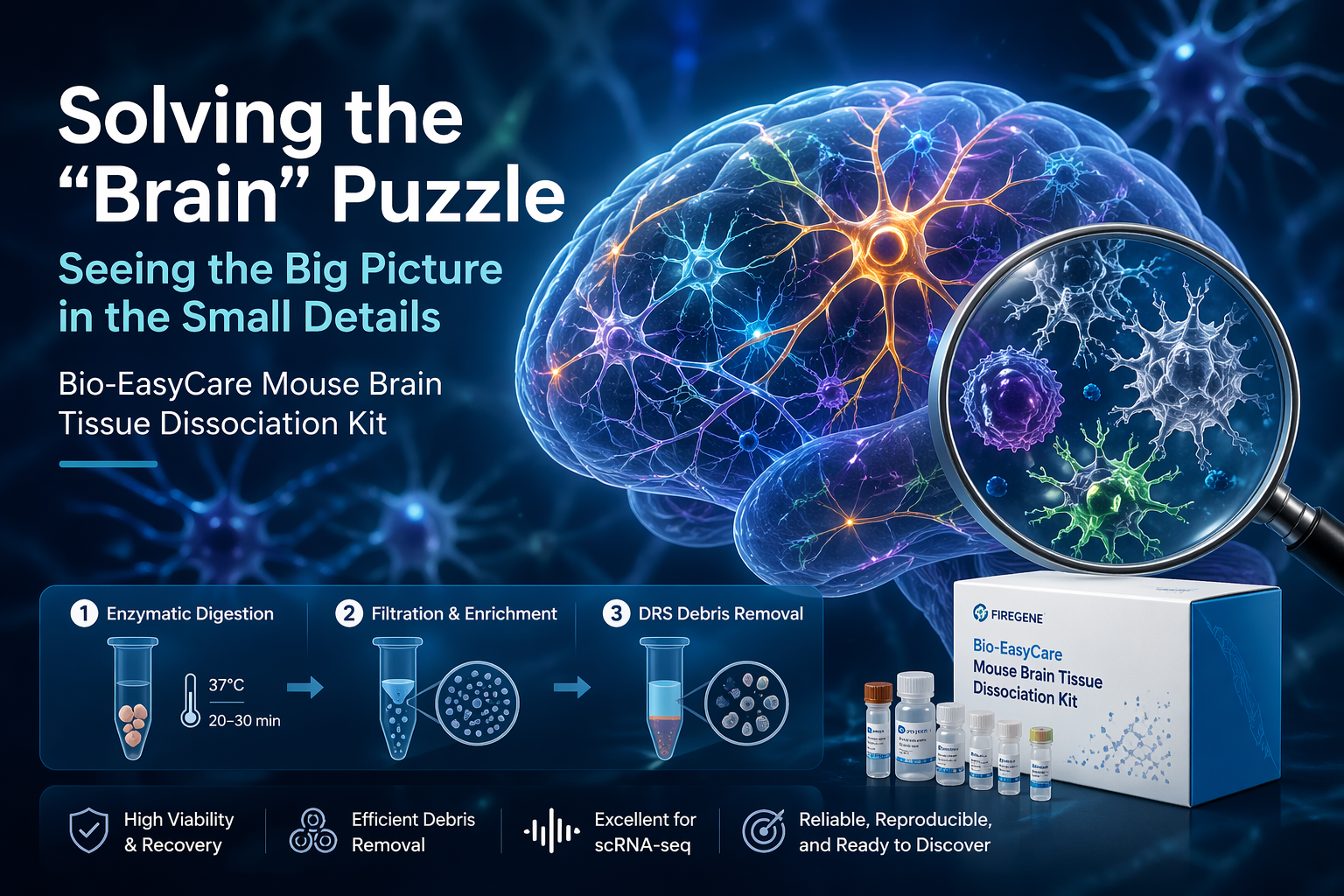
Mouse brain tissue presents a highly complex “microscopic maze,” composed not only of delicate and heterogeneous cell populations—including neurons, microglia, and astrocytes—but also densely interspersed with myelin debris and residual red blood cells. This structural complexity makes efficient tissue dissociation particularly challenging. Conventional approaches, such as mechanical trituration or single-enzyme digestion, frequently result in a triple limitation: low cell recovery, compromised cell viability, and significant interference from debris.
Achieving gentle yet effective dissociation is therefore critical for downstream single-cell applications. The Firegene Mouse Brain Tissue Dissociation Kit addresses this challenge with an optimized enzymatic formulation and standardized workflow, enabling efficient one-step processing. By minimizing mechanical stress while enhancing digestion specificity, it supports the generation of high-quality single-cell suspensions suitable for advanced neural research, including single-cell sequencing and functional assays.
I. A Formula Specifically Designed for Neural Single-Cell Research, Suitable for Diverse Downstream Studies
Engineered for neural single-cell applications, this kit combines gentle enzymatic digestion with an advanced debris removal strategy. Its optimized multi-enzyme system, paired with a proprietary DRS debris removal buffer, enables precise degradation of extracellular matrix components while minimizing cellular stress.
Under controlled conditions at 37°C, intact cells are efficiently released within 20–30 minutes, preserving cell membrane protein integrity and maintaining transcriptomic fidelity. This approach significantly reduces mechanical damage and limits contamination from myelin and cellular debris.
The resulting single-cell suspension exhibits high viability and low background interference, ensuring compatibility with a wide range of downstream applications, including single-cell RNA sequencing (scRNA-seq), primary cell culture, and flow cytometry. It provides a reliable foundation for high-resolution neuroscience research.
II. Three standardized steps for consistently obtaining high-quality single cells.

Illustration of fresh brain tissue sampling (approximately 200 mg, about the size of a soybean).
1. Precise Enzymatic Digestion and Gentle Cell Release: Prepare the enzymatic digestion system according to the instructions using a 5 mL centrifuge tube. After thorough mixing, place the shredded brain tissue into the system. Incubate at 37°C for 20 to 30 minutes, gently inverting the tube every 35 minutes to avoid shear damage. If using a hybridization oven, set the rotation speed to 20 to 30 rpm. During incubation, samples can be taken for quality control, and the digestion process can be terminated flexibly according to the cell condition.
2. Filtration and Enrichment for Preliminary Purification: After digestion, gently filter the sample through a 70 μm cell sieve into a 15 mL centrifuge tube. Rinse the tube wall with 3 mL of 1640 medium, and combine the wash solution with the filtrate. Then centrifuge at 300 × g for 5 minutes at 4°C, gently discarding the supernatant and retaining the cell pellet at the bottom of the tube.
 3. Use DRS to remove impurities and improve purity. Resuspend the pellet in 2 mL of PBS containing 5% FBS, add 1 mL of DRS, and gently pipette to mix (do not vortex!). Slowly add 3 mL of PBS along the tube wall to form a clear interface. Be sure to use a horizontal centrifuge, set to center acceleration and deceleration, and centrifuge at 4°C and 3000 ×g for 20 min. After centrifugation, the system will separate into three layers. Gently aspirate the supernatant containing debris, retaining the cell pellet at the bottom. Further wash with erythrocyte lysis buffer (FG-BA3311) as needed, and resuspend for later use.
I. Core Advantages: Ultimate Performance Based on Data
Firegene's solutions have undergone rigorous internal quality control and extensive testing and validation in numerous customer projects.
Data Performance of Mouse Brain Tissue After Dissociation in Some Actual Projects

 Single-Cell Sequencing Data Results of Mouse Brain Tissue After Dissociation in Some Actual Projects
Firegene's Mouse Brain Tissue Dissociation Kit directly addresses the industry's pain points in neural tissue dissociation. With its core advantages of "gentle enzymatic digestion + targeted impurity removal," it breaks through the limitations of traditional dissociation methods, providing a stable and reliable solution for single-cell research in mouse brain tissue. This helps researchers unravel the mysteries of the neural "microscopic labyrinth," explore the secrets of brain science more accurately, and make single-cell neural research more efficient and worry-free.
FireGene, light your research with passion, innovation, and profession.
FireGene Single-Cell Sample Prep
Looking for validated dissociation kits?
FireGene's tissue dissociation kits are optimized for specific organ types — brain, tumor, liver, GI, reproductive, and more. Validated for 10x Genomics Chromium and BD Rhapsody workflows.


