
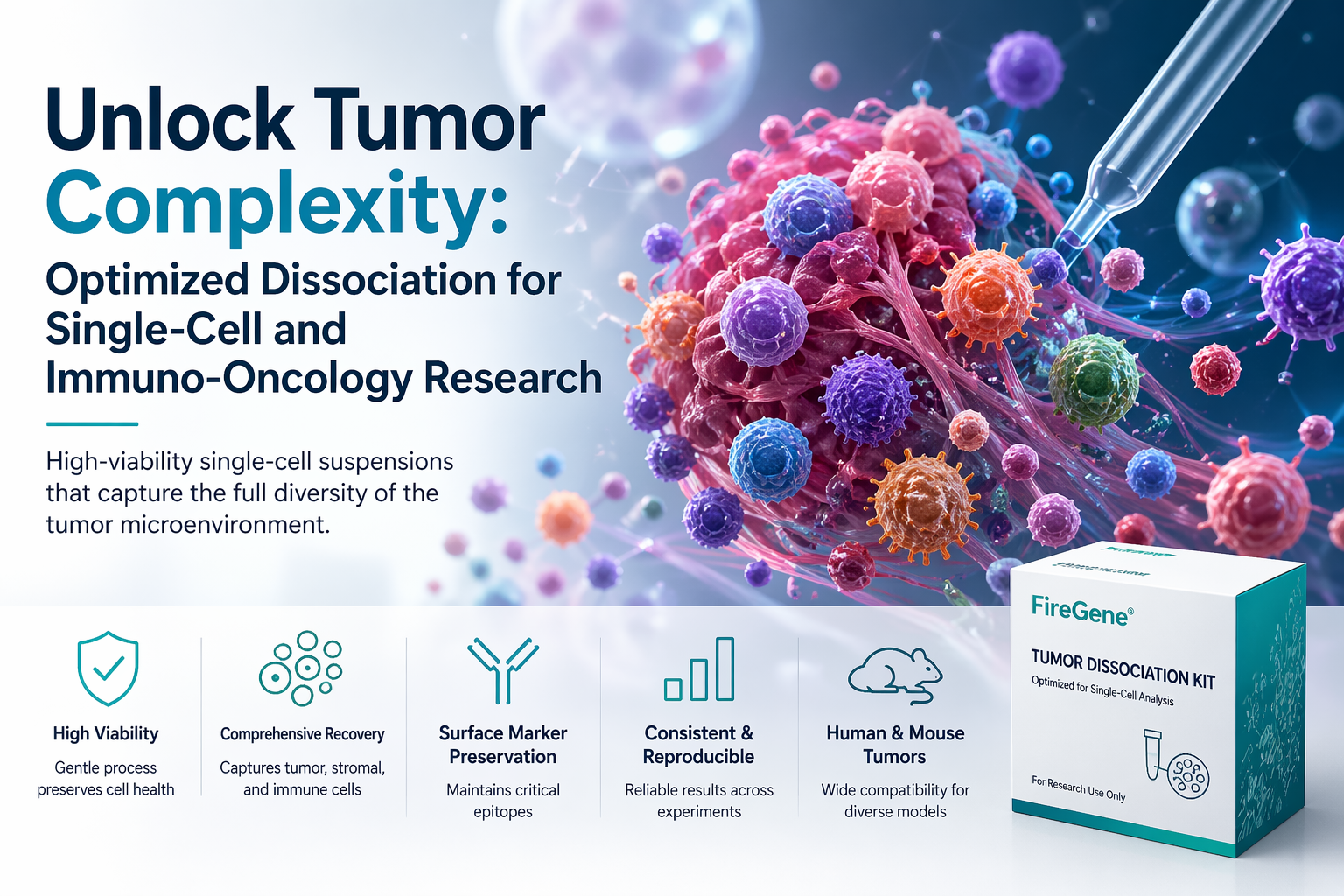
Abstract:The FireGene Tumor Dissociation Kit provides an optimized solution for generating high-quality single-cell suspensions from complex tumor tissues. By combining gentle enzymatic digestion with controlled mechanical dissociation, the kit preserves cell viability and surface markers, enabling accurate profiling of tumor cells, stromal cells, and tumor-infiltrating lymphocytes. It supports diverse applications, including single-cell RNA sequencing, flow cytometry, immunophenotyping, and drug discovery studies. Suitable for both human and mouse tumors, the kit ensures reproducible results and captures the true heterogeneity of the tumor microenvironment. Optimized tissue dissociation is essential for reliable research outcomes and translational cancer studies.
Key Words: Tumor dissociation kit; Tumor microenvironment; Single-cell sequencing; Immune profiling; Cell viability
Introduction – Why Tumor Dissociation Matters
Tumor tissue presents a unique challenge for researchers due to its high cellular complexity and the intricate interactions within the tumor microenvironment (TME). Unlike normal tissue, a tumor is composed of not only cancer cells but also a variety of stromal and immune cells, including T cells, macrophages, and fibroblasts. These diverse populations interact dynamically, influencing tumor growth, immune evasion, and therapeutic response. Understanding these interactions is critical for advancing cancer research, yet isolating individual cells without altering their characteristics remains a major technical hurdle.
Traditional tissue dissociation methods often fall short in preserving the viability and integrity of all cell types. Harsh enzymatic treatments or mechanical disruption can damage delicate cells, destroy surface markers, and selectively bias the recovery of certain populations. This can compromise downstream analyses, such as flow cytometry, single-cell RNA sequencing, or immunophenotyping, leading to incomplete or misleading data.
An optimized tumor dissociation kit addresses these challenges by combining gentle enzymatic digestion with controlled mechanical processing. Such a kit is designed to efficiently dissociate tumor tissue while maintaining cell viability and preserving critical surface markers. By generating high-quality single-cell suspensions, researchers can accurately study tumor heterogeneity, immune infiltration, and cell–cell interactions within the TME. Investing in the right dissociation approach is therefore the first essential step in obtaining reliable and reproducible data, paving the way for breakthroughs in cancer biology, immuno-oncology, and therapeutic development.
Target Audience – Who Needs a Tumor Dissociation Kit
The FireGene Tumor Dissociation Kit is specifically designed for researchers who require high-quality single-cell suspensions from complex tumor tissues. Its applications span several key areas in cancer research and biotechnology, making it highly relevant for a defined scientific audience.
Primary users include cancer biologists and tumor microenvironment (TME) researchers. These scientists focus on understanding the interactions between tumor cells, immune cells, and stromal components. For them, preserving cell viability and surface markers during tissue dissociation is critical to accurately profiling cellular populations and deciphering the mechanisms that drive tumor progression and therapy resistance.
Single-cell sequencing laboratories represent another major audience. Techniques such as scRNA-seq and snRNA-seq demand intact, viable cells to generate reliable transcriptomic data. Any damage or loss of rare cell populations during tissue preparation can severely compromise downstream analyses, making an optimized dissociation kit an essential tool.
Immuno-oncology teams also benefit from this technology, particularly those studying tumor-infiltrating lymphocytes (TILs) or developing cell-based therapies like CAR-T. In these cases, maintaining the full spectrum of immune cell types is crucial for evaluating immune responses or therapy efficacy.
Additionally, pharmaceutical and biotech companies involved in drug development and biomarker discovery are key users. Flow cytometry and cell sorting laboratories also rely on kits that protect delicate surface epitopes to ensure accurate phenotyping.
By understanding the diverse needs of these audiences, the FireGene Tumor Dissociation Kit can support a wide range of studies, from fundamental cancer biology to translational research and therapeutic development.
Key Applications in Research and Industry
The FireGene Tumor Dissociation Kit has a broad range of applications across cancer research, single-cell analysis, and translational studies, making it a versatile tool for both academic and industry settings.
Single-cell sequencing is one of the most prominent applications. High-quality single-cell suspensions are essential for accurate scRNA-seq and snRNA-seq analyses. By preserving cell viability and maintaining the integrity of surface markers, the kit ensures that rare and fragile cell populations are recovered effectively, enabling researchers to capture the true heterogeneity of the tumor microenvironment.
In tumor microenvironment studies, the kit allows scientists to analyze interactions between tumor cells, stromal cells, and immune populations. This is critical for understanding mechanisms of tumor progression, immune evasion, and therapeutic resistance. Researchers can profile immune infiltration, stromal composition, and signaling pathways with higher confidence due to the quality of the dissociated cells.
The kit is also valuable in immuno-oncology and cell therapy research, where isolating tumor-infiltrating lymphocytes (TILs) and other immune populations is vital for evaluating immunotherapies or developing CAR-T approaches.
For drug discovery and biomarker development, the ability to obtain consistent, reproducible single-cell suspensions allows pharmaceutical and biotech teams to assess drug responses, identify predictive biomarkers, and study cellular heterogeneity in preclinical models.
Overall, the FireGene Tumor Dissociation Kit bridges the gap between complex tumor tissues and downstream analytical techniques, supporting a wide spectrum of studies from fundamental cancer biology to translational and clinical research.
Technical Advantages of an Optimized Kit
The FireGene Tumor Dissociation Kit stands out for its technical design, which balances efficiency with cell preservation. Tumor tissues are notoriously difficult to process due to their dense extracellular matrix, heterogeneous cell populations, and fragile immune components. Standard dissociation methods often compromise cell viability or damage surface markers, which can lead to biased results or failed downstream experiments.
The kit addresses these challenges through a gentle yet highly effective enzymatic formulation. The proprietary enzyme cocktail is tailored to break down the extracellular matrix without over-digesting delicate cells, ensuring that both tumor cells and stromal or immune populations remain intact. This optimized enzymatic process is complemented by carefully controlled mechanical dissociation, which further enhances cell recovery while minimizing stress-induced damage.
One of the kit’s key advantages is its ability to preserve cell surface markers (epitopes). This is critical for applications such as flow cytometry, immunophenotyping, and single-cell sequencing, where accurate detection of surface proteins is essential.
Additionally, the kit is compatible with a variety of tumor types, from solid human tumors to mouse models, offering versatility for different research needs. Its workflow is designed for reproducibility and efficiency, producing high-quality single-cell suspensions suitable for immediate downstream applications, including scRNA-seq, cell culture, and immune profiling.
By combining optimized enzymatic digestion, mechanical dissociation, and epitope preservation, the FireGene Tumor Dissociation Kit provides researchers with a reliable tool to generate high-quality samples, ensuring reproducible and accurate results across a wide range of experimental applications.
Conclusion – Better Samples Enable Better Tumor Research
High-quality tumor dissociation is the foundation of reliable cancer research. The FireGene Tumor Dissociation Kit enables researchers to obtain viable, intact single-cell suspensions from complex tumor tissues, ensuring that every cell type in the tumor microenvironment is preserved. This is essential for accurate analysis of tumor heterogeneity, immune infiltration, and stromal interactions, which are critical for understanding cancer biology and developing effective therapies.
By maintaining cell viability and protecting surface markers, the kit supports a wide range of downstream applications, including single-cell RNA sequencing, flow cytometry, immunophenotyping, and cell culture. Researchers can confidently analyze tumor-infiltrating lymphocytes, stromal populations, and tumor cells without worrying about loss or bias introduced during sample preparation.
The advantages of optimized tissue dissociation extend beyond fundamental research. In immuno-oncology and drug discovery, the ability to capture the full spectrum of cell types enables better evaluation of therapeutic responses and more accurate identification of biomarkers. For translational and preclinical studies, this translates into reproducible results, reduced experimental variability, and more meaningful insights.
Ultimately, investing in an optimized tumor dissociation strategy is an investment in data quality. By starting with high-quality samples, researchers can unlock the full potential of single-cell analysis and tumor microenvironment studies. Choosing the right dissociation kit ensures that your research captures the true complexity of tumors, paving the way for breakthroughs in cancer biology, immunotherapy, and precision medicine.
FireGene, light your research with passion, innovation, and profession.
FireGene Single-Cell Sample Prep
Looking for validated dissociation kits?
FireGene's tissue dissociation kits are optimized for specific organ types — brain, tumor, liver, GI, reproductive, and more. Validated for 10x Genomics Chromium and BD Rhapsody workflows.


