
Introduction
Single-cell research has rapidly become one of the most transformative technologies in modern life sciences. From cancer immunology and autoimmune disease studies to vaccine development and regenerative medicine, researchers are increasingly relying on high-quality single-cell suspensions to generate reproducible and biologically meaningful data.
Among all immune-related organs, the spleen remains one of the most important tissues for immunology, hematology, inflammation, and infectious disease research. However, preparing viable and debris-free splenocyte suspensions remains a major technical challenge, especially when researchers need high cell recovery, low stress response, and compatibility with downstream single-cell RNA sequencing (scRNA-seq), flow cytometry, cell sorting, organoid culture, or spatial biology workflows.
This is exactly why more laboratories are searching for a reliable Spleen Dissociation Kit supplier that can provide standardized tissue dissociation solutions for advanced biomedical research.
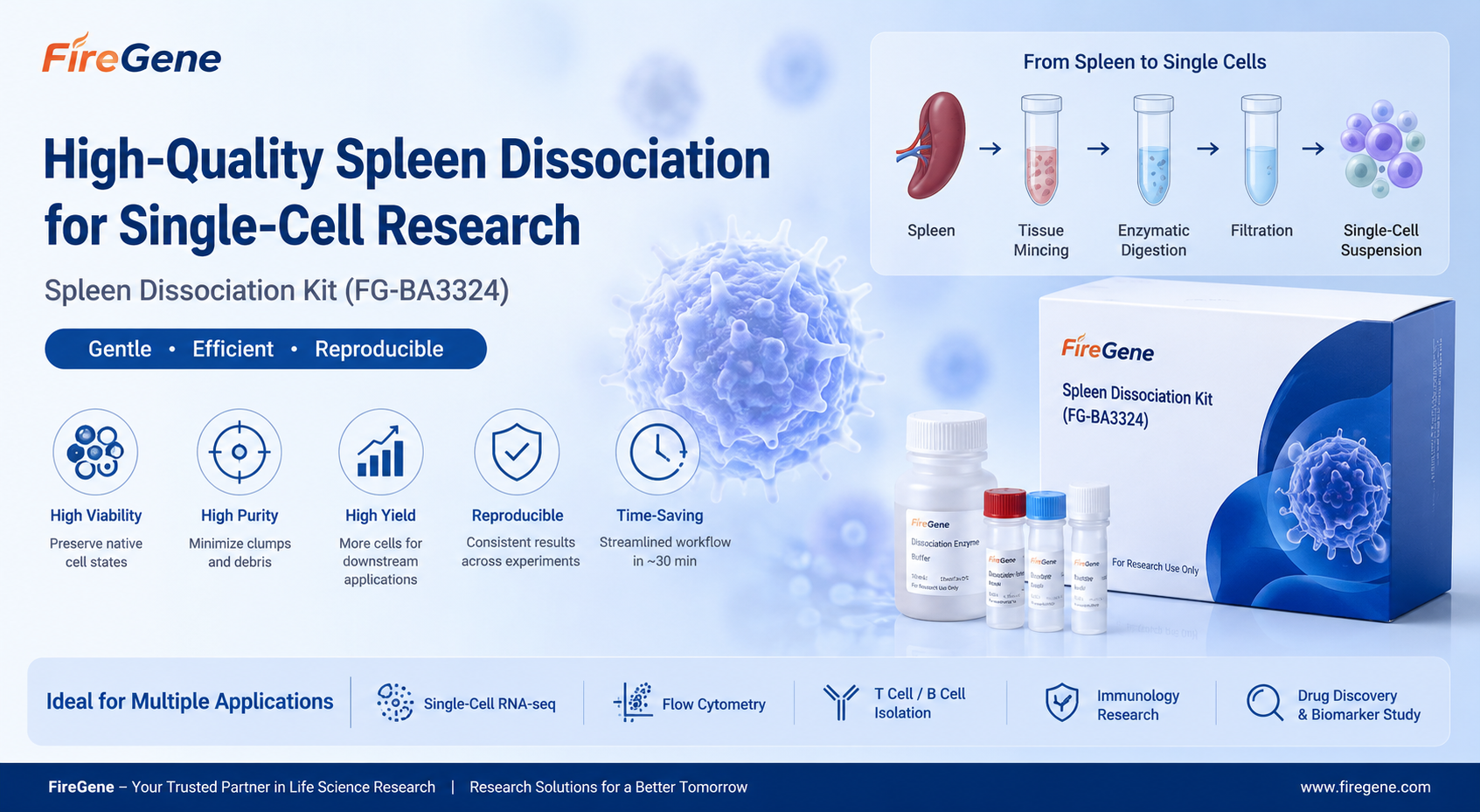
The FireGene Spleen Dissociation Kit was developed specifically to address these challenges by providing optimized enzymatic and mechanical dissociation performance for research laboratories working with mouse, rat, and other mammalian spleen tissues.
In this article, we explore why spleen dissociation quality directly impacts downstream experimental success, how tissue processing affects single-cell sequencing data integrity, and why optimized spleen dissociation reagents have become essential tools in modern immunology research.
Why Spleen Tissue Processing Matters in Modern Research
The spleen is a highly heterogeneous immune organ containing T cells, B cells, macrophages, dendritic cells, NK cells, stromal cells, erythrocytes, and multiple rare immune populations.
For decades, researchers relied on manual grinding methods or simple mesh filtration techniques to isolate splenocytes. While these approaches may work for basic assays, they often produce inconsistent results, including:
- Low cell viability
- Excessive red blood cell contamination
- High cellular stress responses
- Aggregation and debris formation
- Reduced recovery of fragile immune populations
- Poor reproducibility between operators
These limitations become especially problematic in modern applications such as:
- Single-cell transcriptomics
- TCR/BCR sequencing
- Multi-omics studies
- High-parameter flow cytometry
- CAR-T research
- Spatial transcriptomics validation
- Immune microenvironment analysis
Today, even small variations during tissue dissociation can dramatically alter downstream sequencing quality and immune cell representation.
For this reason, many research institutions are transitioning from manual dissociation methods toward standardized spleen dissociation reagent systems from professional research suppliers.
The Growing Demand for Standardized Single-Cell Preparation
The rise of single-cell technologies has fundamentally changed expectations for tissue preparation quality.
Researchers no longer simply need “cells.” They need:
- High viability single-cell suspensions
- Minimal doublets
- Low ambient RNA contamination
- Preserved surface epitopes
- Reduced stress-induced transcriptional artifacts
- Consistent inter-sample reproducibility
Recent publications in immunology and oncology increasingly emphasize that poor tissue dissociation can distort biological conclusions.
For example, over-aggressive enzymatic digestion may:
- Cleave surface markers used for flow cytometry
- Activate inflammatory pathways artificially
- Induce apoptosis-related transcription signatures
- Reduce rare cell population recovery
- Bias cell composition analysis
On the other hand, insufficient dissociation leads to:
- Cell clumping
- Reduced capture efficiency
- High debris levels
- Instrument clogging
- Poor sequencing library complexity
This is why optimized spleen dissociation protocols have become essential in translational immunology research.
FireGene Spleen Dissociation Kit: Designed for Advanced Research Applications
The FireGene Spleen Dissociation Kit was developed as a research-grade solution for efficient tissue dissociation while maintaining cell integrity and viability.
Unlike traditional manual dissociation approaches, this kit combines optimized enzymatic digestion chemistry with standardized workflow compatibility to improve reproducibility between experiments.
Key Research Advantages
1. High Cell Viability
Maintaining viable immune cells is essential for downstream sequencing and functional assays.
The FireGene Spleen Dissociation Kit helps minimize mechanical stress and over-digestion, supporting:
- Improved viable cell yield
- Better sequencing performance
- Enhanced immune cell integrity
- Reduced apoptotic signatures
2. Improved Recovery of Fragile Immune Populations
Certain immune subsets are highly sensitive to dissociation conditions.
Optimized enzymatic balance helps preserve:
- Dendritic cells
- Activated T cells
- Macrophages
- Stromal populations
- Rare immune subsets
This is particularly valuable for tumor immunology and autoimmune disease research.
3. Compatibility with Single-Cell Sequencing
Modern scRNA-seq workflows require highly uniform single-cell suspensions.
The FireGene kit supports:
- Reduced aggregates
- Lower debris levels
- Better microfluidic compatibility
- Improved library quality
- Enhanced sequencing consistency
4. Reproducible Research Workflow
Research reproducibility has become a major concern across biomedical sciences.
Standardized dissociation kits help reduce:
- Operator variability
- Batch-to-batch inconsistency
- Protocol deviations
- Experimental noise
This is especially important for multi-center studies and translational research collaborations.
Applications of Spleen Dissociation in Immunology Research
Cancer Immunology Research
The spleen plays a central role in systemic immune responses during cancer progression.
Researchers frequently isolate splenocytes to evaluate:
- T-cell activation
- Immune checkpoint signaling
- CAR-T functionality
- Cytokine production
- Anti-tumor immunity
- Myeloid-derived suppressor cells (MDSCs)
High-quality spleen dissociation is essential for generating reliable immune profiling data.
Vaccine Development
Vaccine studies often rely on splenocyte analysis to evaluate antigen-specific immune responses.
Applications include:
- ELISpot assays
- Intracellular cytokine staining
- Flow cytometry analysis
- T-cell memory characterization
- Neutralizing antibody studies
Poor tissue dissociation can compromise assay sensitivity and downstream data interpretation.
Autoimmune Disease Research
Researchers studying autoimmune disorders such as lupus, rheumatoid arthritis, or inflammatory bowel disease frequently analyze splenic immune populations.
Optimized dissociation workflows help preserve sensitive immune subsets that may otherwise be lost during processing.
Infectious Disease Studies
Spleen immune profiling remains central to:
- Viral infection studies
- Bacterial pathogenesis research
- Host-pathogen interaction analysis
- Sepsis models
- Inflammation research
Single-cell analysis has become increasingly important for understanding immune heterogeneity during infection.
Why Research Labs Are Moving Away from Manual Tissue Grinding
Traditional spleen processing methods often involve manually crushing tissues through cell strainers using syringe plungers or glass slides.
Although inexpensive, these methods introduce several major limitations:
| Traditional Manual Method | Standardized Dissociation Kit |
|---|---|
| High operator variability | Consistent workflow |
| Mechanical stress damage | Controlled dissociation |
| Lower reproducibility | Standardized results |
| High debris contamination | Cleaner suspensions |
| Reduced rare cell recovery | Better population preservation |
| Limited scalability | High-throughput compatibility |
As multi-omics and single-cell studies continue expanding, reproducibility requirements are becoming increasingly strict.
Research laboratories now prioritize standardized tissue dissociation solutions from trusted life science suppliers.
The Role of Tissue Dissociation in Single-Cell Sequencing Quality
Researchers often focus heavily on sequencing platforms and bioinformatics pipelines while underestimating the importance of upstream tissue processing.
However, tissue dissociation quality directly affects:
- Sequencing depth
- Cell capture efficiency
- Doublet rates
- Ambient RNA levels
- Gene expression artifacts
- Cluster resolution
- Cell type annotation accuracy
Poor-quality suspensions can lead to misleading biological interpretations.
For example:
- Excessive stress responses may artificially elevate inflammatory genes
- Damaged cells contribute ambient RNA contamination
- Cell aggregates increase doublet formation
- Low viability reduces library quality
Optimized dissociation workflows therefore represent a critical foundation for successful single-cell research.
How FireGene Supports Modern Translational Research
Modern translational research requires more than just reagents. Laboratories increasingly seek reliable research suppliers capable of supporting advanced workflows.
FireGene focuses on delivering research-grade products designed for:
- Immunology research
- Cell biology studies
- Single-cell sequencing workflows
- Molecular biology applications
- Translational medicine
- Biotechnology development
The FireGene Spleen Dissociation Kit reflects this commitment by providing a practical and reproducible solution for high-quality spleen tissue processing.
Tips for Optimizing Spleen Dissociation Workflows
Even with optimized kits, researchers should follow best practices to maximize cell quality.
Use Fresh Tissue Whenever Possible
Fresh samples generally produce higher viability and lower debris levels compared to prolonged storage.
Minimize Processing Time
Extended handling times can activate stress pathways and reduce immune cell integrity.
Maintain Appropriate Temperature Control
Temperature fluctuations may affect enzymatic activity and cell viability.
Optimize Cell Filtration
Proper filtration helps reduce aggregates and improve downstream instrument compatibility.
Validate Downstream Compatibility
Researchers should confirm compatibility with:
- Flow cytometry panels
- Single-cell platforms
- Surface marker analysis
- Functional assays
Future Trends in Tissue Dissociation Research
As biomedical technologies continue advancing, tissue dissociation workflows are becoming increasingly sophisticated.
Emerging trends include:
- AI-assisted cell analysis
- Spatial transcriptomics integration
- Multi-omics workflows
- Automated tissue processing systems
- Clinical-grade cell preparation
- Standardized translational protocols
The demand for reliable single-cell preparation tools will continue growing as precision medicine expands.
Research laboratories now recognize that high-quality tissue dissociation is no longer a minor preparatory step — it is a critical determinant of experimental success.
Conclusion
The quality of spleen tissue dissociation directly influences the success of modern immunology and single-cell research.
As technologies such as scRNA-seq, spatial biology, and multi-omics become mainstream, researchers increasingly require standardized and reproducible tissue processing solutions.
The FireGene Spleen Dissociation Kit provides an optimized workflow for generating high-quality single-cell suspensions while preserving viability, immune cell integrity, and downstream assay compatibility.
For laboratories seeking a reliable spleen dissociation kit supplier for immunology research, translational medicine, or single-cell sequencing workflows, standardized dissociation reagents are becoming essential tools for achieving reproducible and publication-quality results.
FireGene, light your research with passion, innovation, and profession.


