
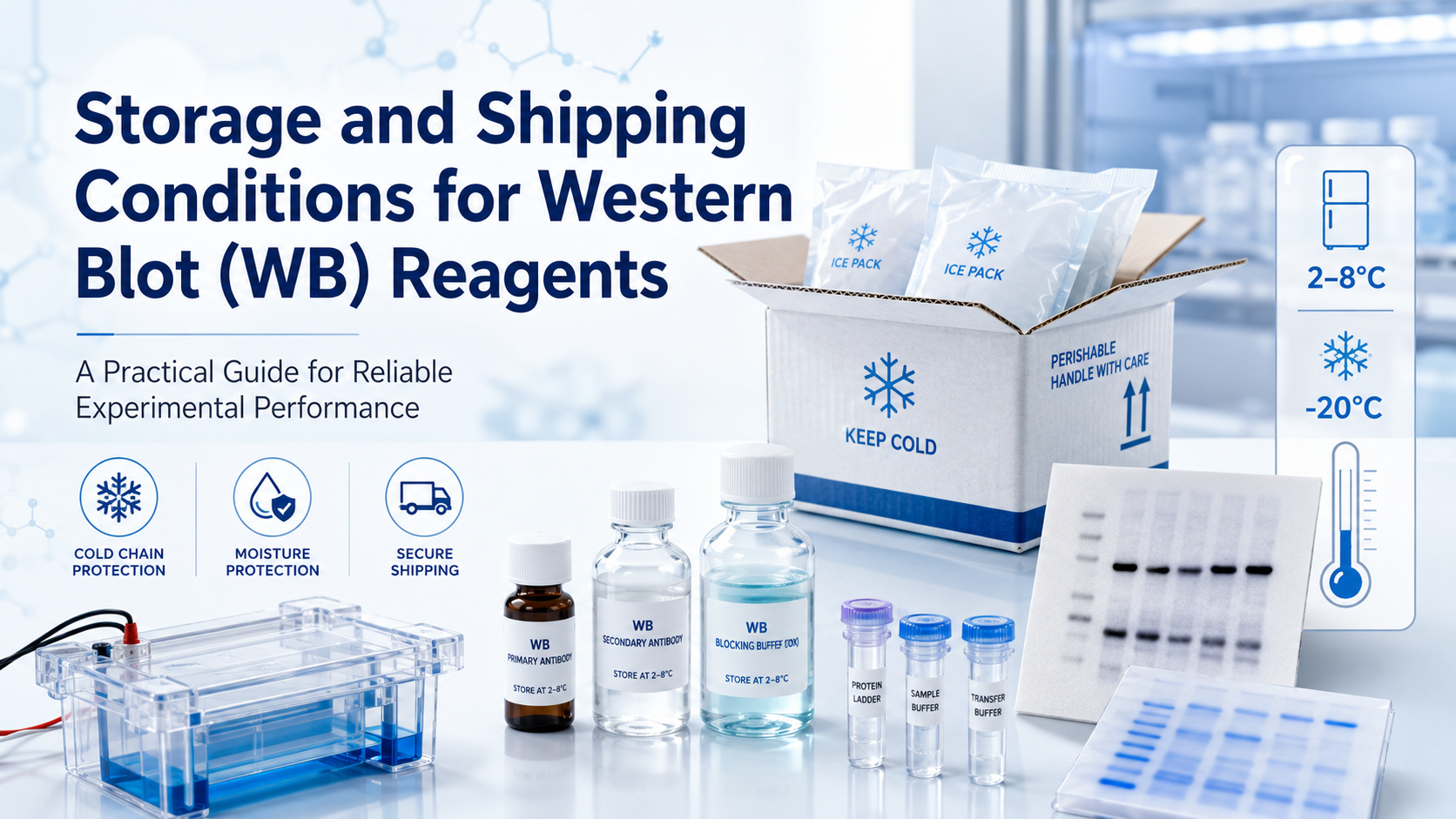
Western blotting (WB) is a multi-step analytical workflow that is highly sensitive to reagent stability. Even minor deviations in storage or transport conditions can significantly affect protein integrity, antibody activity, membrane binding efficiency, and ultimately band clarity and reproducibility.
For laboratories using a full WB workflow system—including lysis buffers, protein quantification kits, electrophoresis reagents, transfer buffers, blocking solutions, and antibody diluents—proper storage and shipping practices are essential to maintain consistency across experiments.
This guide summarizes best-practice storage and transportation conditions for commonly used WB reagents and explains how to avoid performance degradation.
1. General Principles for WB Reagent Storage and Transport
Across most Western blot reagents, three core environmental factors determine stability:
· Temperature control (room temperature, 4°C, or -20°C depending on formulation)
· Moisture protection (especially for lyophilized powders and buffer salts)
· Microbial contamination prevention (critical for protein-based solutions)

In general:
· Buffers and salts are relatively stable at room temperature when dry or concentrated
· Enzyme inhibitors, antibodies, and protein-based reagents require refrigeration or freezing
· Ready-to-use biological reagents should always be stored at 2–8°C unless specified otherwise
During shipping:
· Short-distance transport: 2–8°C cold chain preferred
· Long-distance or international shipping: dry ice (-20°C to -80°C) for sensitive reagents
· Lyophilized products: ambient temperature is acceptable if moisture-proof packaging is intact
2. Cell Lysis and Protein Extraction Reagents
RIPA Lysis Buffer
· Storage: 2–8°C (short term), -20°C (long term optional for extended stability)
· Shipping: Ambient or 2–8°C; no freezing required if stable formulation
· Notes: Avoid repeated freeze-thaw cycles if protease inhibitors are pre-added
Protease & Phosphatase Inhibitor Cocktail (100×, EDTA-free)
· Storage: -20°C (recommended)
· Shipping: Dry ice strongly recommended
· Notes: Sensitive to temperature; aliquoting recommended to avoid repeated thawing
3. Protein Quantification Reagents
Omni-Easy™ BCA Protein Assay Kit
· Storage: 2–8°C (do not freeze reagents A/B)
· Shipping: 2–8°C cold chain recommended
· Notes: Reagent A and B must be protected from light and contamination; stable if unopened
4. Sample Preparation Reagents
Omni-Easy™ Ready-to-Use Sample Loading Buffer (5×, denaturing/reducing)
· Storage: 2–8°C for short term; -20°C for long term stability
· Shipping: Ambient or cold pack depending on season
· Notes: Reducing agents may degrade at high temperature; avoid prolonged heat exposure
5. Gel Electrophoresis Systems and Buffers
Rapid PAGE Gel Preparation Kits / One-Step Gel Systems
· Storage: 2–8°C (avoid freezing pre-mixed acrylamide components)
· Shipping: Cold chain recommended
· Notes: Temperature fluctuations may affect polymerization efficiency
Tris-Glycine-SDS Running Buffer (10×) / Fast-Dissolving Powders
· Storage: Room temperature (RT), dry conditions
· Shipping: Ambient temperature acceptable
· Notes: Hygroscopic; keep tightly sealed
6. Protein Markers
Pre-stained Protein Markers (Multiple Range Types)
· Storage: -20°C (preferred), short-term 4°C acceptable
· Shipping: Dry ice recommended
· Notes: Avoid repeated freeze-thaw cycles; aliquot after first thaw
7. Transfer Buffers and Blotting Systems
Omni-Flash™ Fast Transfer Buffer (10×, Ice-Free Transfer System)
· Storage: RT or 2–8°C depending on formulation
· Shipping: Ambient or cold pack
· Notes: Stable salt-based formulation; ensure complete dissolution before use
Transfer Buffer Powders / 10× Concentrates
· Storage: RT, dry environment
· Shipping: Ambient
· Notes: Moisture protection is critical to prevent caking
8. Blocking Reagents
Non-Protein Rapid Blocking Buffer
· Storage: 2–8°C
· Shipping: Cold chain preferred
· Notes: Preservatives maintain stability; avoid contamination
Skim Milk Powder (Blocking Grade)
· Storage: RT, dry and sealed
· Shipping: Ambient
· Notes: Hygroscopic; store in moisture-proof container
BSA (Blocking Grade)
· Storage: 2–8°C or RT (depending on formulation purity)
· Shipping: Ambient or cold pack
· Notes: Avoid humidity exposure to prevent aggregation
9. Washing Buffers (TBS/PBS Systems)
TBS/Tween, PBS/Tween (10×), TBS (10×)
· Storage: RT
· Shipping: Ambient
· Notes: Extremely stable; only risk is microbial contamination after dilution
Fast-Dissolving Buffer Salts
· Storage: RT, dry environment
· Shipping: Ambient
· Notes: Hygroscopic; keep sealed
10. Antibody Handling and Dilution Reagents
WB Primary Antibody Dilution Buffer
WB Secondary Antibody Dilution Buffer
General Antibody Dilution Buffer
· Storage: 2–8°C
· Shipping: Cold pack recommended
· Notes: Contains stabilizers and preservatives; avoid contamination
Primary and Secondary Antibodies
· Storage: 2–8°C (short term), -20°C (long term for some antibodies)
· Shipping: Dry ice or cold chain depending on sensitivity
· Notes: Light-sensitive in some cases; avoid freeze-thaw cycles
11. Stripping Buffer (Antibody Stripping Solution)
· Storage: 2–8°C
· Shipping: Cold chain recommended
· Notes: Strong chemical formulation; ensure secure sealing during transport
12. Best Practices for Maintaining WB Reagent Integrity
To ensure consistent Western blot results across batches and experiments:
· Avoid repeated freeze–thaw cycles by aliquoting reagents upon first use
· Maintain cold chain consistency for protein-sensitive reagents (enzymes, antibodies, inhibitors)
· Protect lyophilized buffers from humidity using desiccated storage
· Label opening dates clearly to track reagent lifespan
· Do not mix storage temperatures arbitrarily (e.g., switching between RT and -20°C frequently)
· Use validated shipping packaging with ice packs or dry ice depending on reagent sensitivity

Conclusion
Western blot performance is not determined solely by experimental technique—it is also highly dependent on reagent stability throughout storage and transportation. A well-designed WB reagent system, combined with correct handling conditions, ensures reproducible protein detection, reduced background noise, and higher experimental reliability.
By standardizing storage and shipping protocols across the entire WB workflow—from lysis buffers to antibody systems—laboratories can significantly reduce variability and improve data confidence.
FireGene, light your research with passion, innovation, and profession.


