
Introduction
As pharmaceutical manufacturing continues to evolve toward increasingly complex biologics, cell and gene therapies (CGTs), mRNA therapeutics, and highly sensitive injectable products, endotoxin control has become one of the most critical aspects of quality assurance.
The consequences of endotoxin contamination can be severe. Even trace levels of bacterial endotoxins can trigger fever, inflammation, immune responses, product recalls, regulatory observations, and significant financial losses. As a result, pharmaceutical manufacturers, contract development and manufacturing organizations (CDMOs), research laboratories, and quality control departments are placing unprecedented emphasis on endotoxin testing and depyrogenation validation.
While sterilization effectively destroys microorganisms, it does not necessarily eliminate bacterial endotoxins. These highly heat-stable lipopolysaccharides (LPS) can remain on glassware, filling components, pharmaceutical containers, and manufacturing equipment long after microbial contamination has been removed.
This challenge has made dry heat depyrogenation validation a fundamental requirement for pharmaceutical manufacturing.
At the center of this validation process is the Endotoxin Challenge Vial (ECV), a specialized endotoxin indicator used to demonstrate endotoxin destruction under validated dry heat conditions.
For organizations seeking a reliable Endotoxin Challenge Vial supplier, FireGene provides validated challenge materials specifically designed for depyrogenation validation studies:
https://firegene.com/products/endotoxin-challenge-vial-ecv

Why Endotoxin Control Is More Important Than Ever
The pharmaceutical industry of 2026 looks dramatically different from that of a decade ago.
Several emerging trends have increased the importance of endotoxin validation.
Growth of Injectable Biologics
The global biologics market continues to expand rapidly.
Products such as:
- Monoclonal antibodies
- Recombinant proteins
- Fusion proteins
- Antibody-drug conjugates
- GLP-1 receptor agonists
are frequently administered through injection and therefore require stringent endotoxin control.
Because these therapies often target vulnerable patient populations, manufacturers must ensure that primary packaging components remain pyrogen-free throughout production.
Expansion of Cell and Gene Therapy Manufacturing
Cell and gene therapies represent one of the fastest-growing segments of the pharmaceutical industry.
Unlike traditional small molecules, living-cell products are particularly sensitive to endotoxin contamination.
Even low endotoxin concentrations may:
- Alter cellular metabolism
- Change gene expression profiles
- Trigger inflammatory signaling pathways
- Reduce therapeutic efficacy
- Increase manufacturing failure rates
Consequently, endotoxin testing and depyrogenation validation have become integral components of CGT manufacturing strategies.
Increased Regulatory Expectations
Regulatory agencies worldwide continue to place greater emphasis on process validation and scientific evidence.
Modern inspectors increasingly expect manufacturers to demonstrate:
- Data integrity
- Process reproducibility
- Scientific justification
- Risk mitigation
Temperature monitoring alone is no longer sufficient.
Facilities must provide objective evidence that endotoxins have been destroyed.
This requirement has driven growing adoption of Endotoxin Challenge Vials across the pharmaceutical industry.
What Is an Endotoxin Challenge Vial?
An Endotoxin Challenge Vial (ECV) is a standardized endotoxin indicator containing a precisely controlled quantity of bacterial endotoxin.
The vial is intentionally exposed to a depyrogenation process to evaluate the effectiveness of endotoxin destruction.
The primary purpose of an ECV is to answer a critical validation question:
Can the depyrogenation process consistently achieve the required endotoxin reduction under worst-case conditions?
Because the initial endotoxin concentration is known, validation engineers can accurately determine process performance by measuring residual endotoxin after treatment.
This approach provides a reproducible and scientifically defensible method for depyrogenation validation.
Many pharmaceutical manufacturers and research laboratories use validated challenge materials such as the FireGene Endotoxin Challenge Vial:
https://firegene.com/products/endotoxin-challenge-vial-ecv
Sterilization and Depyrogenation Are Not the Same
One of the most common misconceptions among manufacturing professionals is assuming that sterilization automatically removes endotoxins.
In reality, these are two entirely different processes.
Sterilization
Primary objective:
- Destroy microorganisms
- Eliminate viable bacteria
- Achieve sterility assurance
Common methods:
- Autoclaving
- Gamma irradiation
- Ethylene oxide
- Filtration
Depyrogenation
Primary objective:
- Destroy bacterial endotoxins
- Reduce pyrogenic risk
- Protect patient safety
Common methods:
- Dry heat depyrogenation
- Chemical treatment (limited applications)
Because endotoxins are significantly more resistant than many microorganisms, dedicated depyrogenation validation is necessary.
The Science Behind Endotoxin Destruction
One area frequently overlooked in depyrogenation discussions is the underlying scientific mechanism.
Understanding how endotoxins are destroyed helps explain why Endotoxin Challenge Vials are so valuable.
What Is Endotoxin?
Endotoxin is primarily composed of lipopolysaccharide (LPS), a structural component found in the outer membrane of Gram-negative bacteria.
The biologically active portion of endotoxin is known as Lipid A.
Lipid A is responsible for:
- Fever induction
- Cytokine release
- Inflammatory responses
- Septic shock reactions
Its remarkable thermal stability explains why conventional sterilization methods often fail to eliminate pyrogenic activity.
How Dry Heat Destroys Endotoxin
Under elevated temperatures, several degradation mechanisms occur:
Structural Breakdown
The Lipid A region undergoes molecular degradation.
Oxidative Reactions
High temperatures promote oxidation of endotoxin components.
Molecular Rearrangement
Thermal exposure alters endotoxin conformation and biological activity.
Aggregation Disruption
Large endotoxin aggregates break apart and lose pyrogenic potential.
Collectively, these mechanisms reduce endotoxin activity and allow validated depyrogenation processes to achieve significant endotoxin reduction.
Typical Dry Heat Depyrogenation Validation Workflow
The validation process generally follows a structured pathway.
Prepare Endotoxin Challenge Vials
            ↓
Verify Initial Endotoxin Load
            ↓
Place ECVs in Tunnel or Oven
            ↓
Run Depyrogenation Cycle
            ↓
Recover Residual Endotoxin
            ↓
Perform TAL/LAL Endotoxin Test
            ↓
Calculate Log Reduction
            ↓
Generate Validation Report
Regulatory Expectations for Depyrogenation Validation
Regulatory guidance consistently emphasizes scientific validation of depyrogenation processes.
USP <1228.1>
USP identifies dry heat depyrogenation as the preferred method for depyrogenating heat-stable materials.
The chapter discusses process validation strategies and endotoxin reduction expectations.
PDA Technical Report No. 3
The PDA guidance remains one of the industry's most widely referenced resources for depyrogenation process validation.
It provides recommendations regarding:
- Endotoxin indicators
- Tunnel qualification
- Temperature mapping
- Challenge studies
FDA Guidance for Sterile Drug Products
FDA guidance documents emphasize scientific process validation and appropriate challenge studies for aseptic manufacturing systems.
Endotoxin indicators play a critical role in demonstrating process effectiveness.
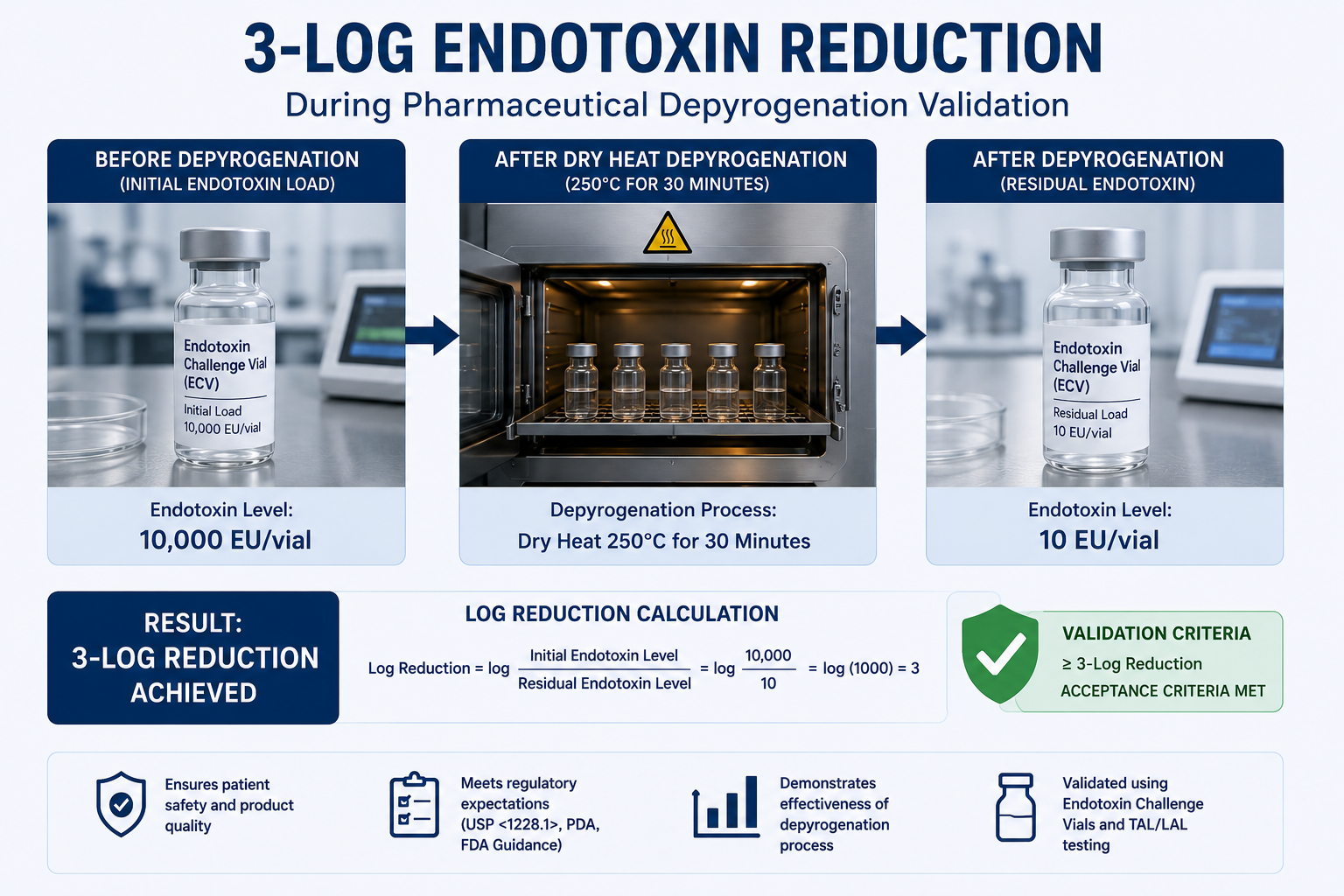
Understanding the 3-Log Reduction Requirement
One of the most important concepts in endotoxin validation is the 3-log reduction requirement.
A logarithmic reduction represents a ten-fold decrease.
| Log Reduction | Reduction Percentage |
|---|---|
| 1 Log | 90% |
| 2 Log | 99% |
| 3 Log | 99.9% |
| 4 Log | 99.99% |
Example:
Initial Endotoxin Load:
10,000 EU
Residual Endotoxin:
10 EU
Result:
3-Log Reduction
Status:
Pass
Because regulatory guidance often references a minimum 3-log reduction, Endotoxin Challenge Vials are specifically designed to support these validation objectives.
Typical Endotoxin Reduction Performance at Different Temperatures
Although actual performance depends on equipment design, airflow patterns, heat distribution, load configuration, and validation conditions, industry studies have consistently shown that higher temperatures significantly improve endotoxin destruction efficiency.
The table below summarizes commonly reported depyrogenation performance trends observed in pharmaceutical manufacturing environments.
| Temperature | Exposure Time | Typical Endotoxin Reduction |
|---|---|---|
| 180°C | 2–3 Hours | Partial Reduction |
| 200°C | 1–2 Hours | Moderate Reduction |
| 220°C | 60 Minutes | Significant Reduction |
| 250°C | 30 Minutes | Typically >3 Log Reduction |
| 250°C | 45 Minutes | Consistently >3 Log Reduction |
| 300°C+ | Short Exposure | Rapid Endotoxin Destruction |
It is important to note that temperature alone does not guarantee successful depyrogenation.
Factors such as:
- Heat penetration
- Airflow uniformity
- Load configuration
- Cold spots
- Equipment performance
can all influence final results.
This is why validation engineers rely on Endotoxin Challenge Vials rather than temperature measurements alone.
By directly measuring endotoxin destruction, ECVs provide objective evidence that the process is functioning as intended.
Additional information about FireGene Endotoxin Challenge Vials can be found here:
https://firegene.com/products/endotoxin-challenge-vial-ecv
Why Research Laboratories Prefer Standardized Endotoxin Challenge Vials
Historically, many pharmaceutical research laboratories prepared endotoxin indicators internally.
While this approach may appear cost-effective, it often introduces significant variability.
Common challenges include:
Inconsistent Endotoxin Loading
Variations in preparation techniques can result in inconsistent challenge levels.
Reduced Reproducibility
Different operators may generate different results.
Documentation Challenges
Audit preparation becomes more difficult when challenge materials are prepared internally.
Increased Validation Risk
Variability can lead to questionable conclusions and potential regulatory concerns.
For these reasons, pharmaceutical research laboratories, CROs, CDMOs, and GMP facilities increasingly prefer standardized Endotoxin Challenge Vials supplied by specialized research suppliers.
Benefits include:
- Consistent endotoxin concentrations
- Improved reproducibility
- Simplified documentation
- Enhanced regulatory confidence
- Better data integrity
Endotoxin Challenge Vials vs Self-Prepared Endotoxin Indicators
A common question during validation planning is whether commercially manufactured ECVs provide advantages over self-prepared challenge materials.
The answer is generally yes.
| Parameter | Endotoxin Challenge Vial | Self-Prepared Indicator |
| Endotoxin Consistency | Excellent | Variable |
| Reproducibility | High | Moderate |
| Documentation | Complete | User Generated |
| Audit Readiness | Excellent | Variable |
| Validation Confidence | High | Moderate |
| Preparation Time | Minimal | Significant |
| Regulatory Defensibility | Strong | Limited |
While self-prepared indicators may appear flexible, most GMP facilities prefer standardized solutions because they significantly reduce uncertainty during inspections and audits.
The Critical Role of TAL/LAL Reagent in Endotoxin Validation
Following depyrogenation, residual endotoxin must be accurately quantified.
This is where TAL/LAL Reagent becomes essential.
The TAL/LAL endotoxin test remains one of the most widely accepted methods for bacterial endotoxin testing throughout the pharmaceutical industry.
The assay works through activation of a protease cascade triggered by endotoxin, ultimately generating a measurable endpoint.
In depyrogenation studies, the workflow typically follows this sequence:
Depyrogenated ECV
         ↓
Endotoxin Extraction
         ↓
TAL/LAL Reaction
         ↓
Optical Measurement
         ↓
EU Calculation
         ↓
Log Reduction Analysis
Without reliable endotoxin testing, there is no scientific way to verify depyrogenation performance.
This relationship explains why Endotoxin Challenge Vials and TAL/LAL Reagent are often used together during validation programs.
Applications of Endotoxin Challenge Vials
The use of ECVs extends far beyond tunnel qualification.
Today, Endotoxin Challenge Vials are widely used in:
Pharmaceutical Manufacturing
Validation of depyrogenation tunnels used for glass vials, ampoules, and containers.
Biotechnology Facilities
Verification of endotoxin control programs supporting biologics manufacturing.
Cell and Gene Therapy Production
Assessment of endotoxin reduction processes used in sensitive therapeutic workflows.
Medical Device Manufacturing
Qualification of depyrogenation processes for implantable and injectable devices.
Research Laboratories
Development of new depyrogenation methods and validation protocols.
Contract Research Organizations (CROs)
Execution of endotoxin validation studies for pharmaceutical clients.
Because of this broad applicability, Endotoxin Challenge Vials have become a standard validation tool across multiple industries.
Common Mistakes During Depyrogenation Validation
Even experienced validation teams occasionally make mistakes that compromise study quality.
Mistake #1: Relying Only on Temperature Data
Temperature mapping is important but does not directly measure endotoxin destruction.
Biological challenge studies remain necessary.
Mistake #2: Using Unqualified Challenge Materials
Non-standardized endotoxin sources can introduce variability and reduce confidence in study results.
Mistake #3: Ignoring Worst-Case Locations
Cold spots frequently represent the greatest validation risk.
ECVs should be strategically distributed throughout the system.
Mistake #4: Inadequate Endotoxin Recovery
Poor recovery methods can underestimate residual endotoxin levels.
Recovery procedures should always be validated.
Mistake #5: Insufficient Documentation
Incomplete records can create significant regulatory concerns during inspections.
Why Choose FireGene as Your Endotoxin Challenge Vial Supplier?
Selecting the right Endotoxin Challenge Vial supplier is critical to the success of any validation program.
FireGene supports pharmaceutical manufacturers, research laboratories, CROs, CDMOs, and biotechnology companies worldwide with high-quality endotoxin validation solutions.
Consistent Endotoxin Loading
Designed to provide reproducible challenge levels for validation studies.
Validation-Oriented Design
Developed specifically for depyrogenation qualification and endotoxin reduction testing.
TAL/LAL Compatibility
Optimized for downstream endotoxin recovery and TAL/LAL endotoxin testing workflows.
Research and GMP Applications
Suitable for both research laboratory studies and regulated pharmaceutical manufacturing environments.
Global Supply Support
Serving customers involved in biologics, vaccines, cell therapy, injectable drugs, and sterile manufacturing.
Learn more about FireGene Endotoxin Challenge Vials:
https://firegene.com/products/endotoxin-challenge-vial-ecv
Frequently Asked Questions (FAQ)
What is an Endotoxin Challenge Vial?
An Endotoxin Challenge Vial is a standardized endotoxin indicator used to validate depyrogenation processes by measuring endotoxin destruction under controlled conditions.
Why is a 3-log reduction important?
A 3-log reduction corresponds to a 99.9% reduction in endotoxin concentration and is commonly recognized as a benchmark for successful depyrogenation validation.
Can Endotoxin Challenge Vials be used in depyrogenation tunnels?
Yes. ECVs are routinely used for depyrogenation tunnel qualification, oven validation, and process verification studies.
What endotoxin test is performed after depyrogenation?
Most laboratories use TAL/LAL Reagent to measure residual endotoxin and calculate log reduction.
Who uses Endotoxin Challenge Vials?
Typical users include:
- Pharmaceutical manufacturers
- Biotechnology companies
- Research laboratories
- CROs
- CDMOs
- Validation engineers
- Quality assurance professionals
How should Endotoxin Challenge Vials be stored?
Storage conditions should follow the manufacturer's recommendations to maintain challenge integrity and ensure reliable validation performance.
Future Trends in Endotoxin Validation
Several industry developments are expected to influence endotoxin validation beyond 2026.
Expansion of Biologics Manufacturing
The increasing number of injectable biologics will continue driving demand for validated endotoxin control strategies.
Growth of Cell and Gene Therapy
Sensitive CGT products require increasingly sophisticated endotoxin management programs.
Increased Regulatory Expectations
Data-driven validation approaches will become even more important.
Greater Adoption of Standardized Challenge Materials
More organizations are replacing internally prepared indicators with commercially manufactured Endotoxin Challenge Vials.
Conclusion
As pharmaceutical manufacturing continues to advance, endotoxin control remains a critical factor in ensuring patient safety, product quality, and regulatory compliance.
Dry heat depyrogenation remains the industry-standard approach for removing endotoxins from heat-resistant materials, but successful implementation requires scientific validation rather than assumptions based solely on temperature measurements.
Endotoxin Challenge Vials provide the objective evidence needed to demonstrate endotoxin destruction, verify process performance, and support regulatory expectations.
For pharmaceutical manufacturers, biotechnology companies, research laboratories, CROs, and validation professionals, standardized Endotoxin Challenge Vials represent one of the most reliable tools available for modern depyrogenation validation programs.
Whether your goal is tunnel qualification, endotoxin reduction studies, GMP compliance, or research applications, choosing a trusted Endotoxin Challenge Vial supplier can significantly improve validation confidence and study reproducibility.
Explore FireGene Endotoxin Challenge Vials:
https://firegene.com/products/endotoxin-challenge-vial-ecv
FireGene Endotoxin Testing
Ready to run your endotoxin assay?
FireGene offers a complete endotoxin testing toolkit — from TAL reagents and CSE standards to pyrogen-free consumables and LAL reagent water. All products are aligned with USP <85>, EP 2.6.14, and JP 4.01.


