
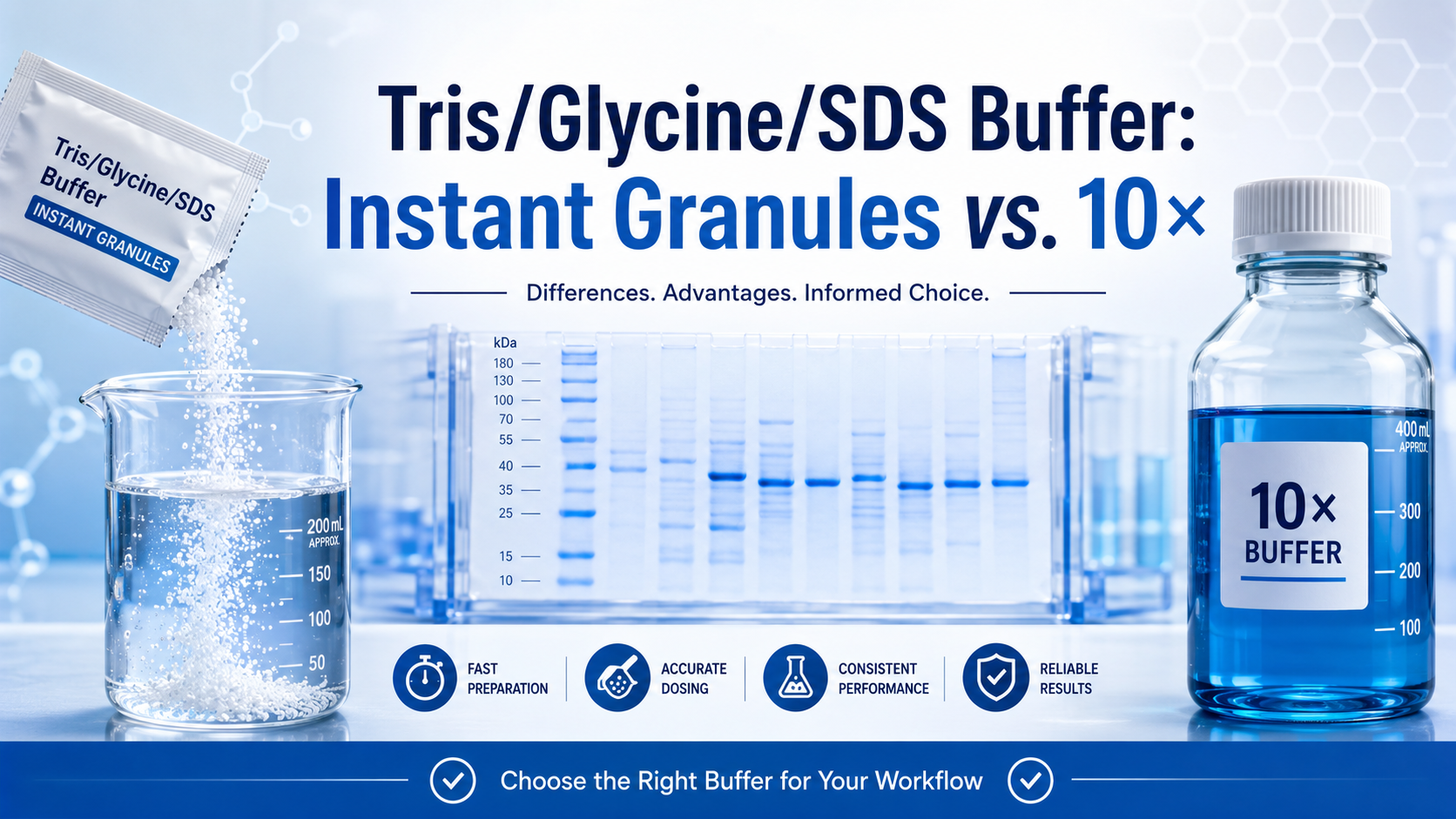
In protein electrophoresis, buffer quality directly affects band resolution, migration stability, reproducibility, and overall workflow efficiency. Among the most commonly used running buffers for SDS-PAGE is Tris/Glycine/SDS electrophoresis buffer, a classic formulation designed to support protein separation under denaturing conditions. Traditionally, many laboratories use Tris/Glycine/SDS Electrophoresis Buffer (10×), which is diluted with purified water before use. In recent years, Tris/Glycine/SDS Electrophoresis Buffer Instant Granules have become an increasingly convenient alternative.
Although both products are designed for the same core application—preparing Tris/Glycine/SDS running buffer for SDS-PAGE—they differ significantly in physical form, preparation method, storage convenience, transportation efficiency, and user experience. Understanding these differences can help laboratories choose the most suitable format for routine electrophoresis experiments.
What Is Tris/Glycine/SDS Electrophoresis Buffer?
Tris/Glycine/SDS electrophoresis buffer is a widely used running buffer for SDS-PAGE. It typically contains Tris base, glycine, and sodium dodecyl sulfate (SDS). Tris helps maintain the appropriate buffering environment, glycine participates in the electrophoretic ion system, and SDS denatures proteins while giving them a uniform negative charge. This allows proteins to migrate primarily according to molecular weight.
Because SDS-PAGE is frequently used in protein research, western blot sample preparation, recombinant protein analysis, purity evaluation, and molecular biology workflows, the running buffer must be reliable and consistent. Even small errors in dilution, concentration, or preparation can affect electrophoresis performance. For this reason, ready-to-use or easy-to-prepare buffer products are preferred by many laboratories.
What Is Tris/Glycine/SDS Electrophoresis Buffer (10×)?
Tris/Glycine/SDS Electrophoresis Buffer (10×) is a concentrated liquid buffer. Before use, it must be diluted, usually at a ratio of 1:9 with deionized or distilled water, to prepare a 1× working solution. For example, 100 mL of 10× buffer can be diluted with 900 mL of water to prepare 1 L of 1× running buffer.
The main advantage of the 10× liquid format is that it is familiar and straightforward. Researchers only need to dilute the concentrate before use, without weighing individual reagents. This makes it much easier than preparing the buffer from raw Tris, glycine, and SDS powders. However, as a liquid product, the 10× format has certain limitations, especially in storage, shipping, handling, and long-term stability.
What Are Tris/Glycine/SDS Electrophoresis Buffer Instant Granules?
Tris/Glycine/SDS Electrophoresis Buffer Instant Granules are pre-formulated dry granules containing the required buffer components in optimized proportions. Instead of measuring each chemical separately or diluting a liquid concentrate, users simply dissolve the granules in a specified volume of purified water to obtain the working buffer.
The granule format is designed to simplify buffer preparation while improving storage stability and reducing transport weight. Because the product is dry, it is less prone to leakage, microbial contamination, or degradation associated with liquid storage. It is especially suitable for laboratories that value operational efficiency, clean handling, batch-to-batch consistency, and space-saving inventory management.
Key Difference 1: Physical Form
The most obvious difference between the two products is their physical form.
Tris/Glycine/SDS Electrophoresis Buffer (10×) is supplied as a liquid concentrate. It contains dissolved buffer components and must be diluted before use. Because it is already in liquid form, it can be convenient for users who are accustomed to preparing 1× buffer through simple dilution.
By contrast, Tris/Glycine/SDS Electrophoresis Buffer Instant Granules are supplied as dry particles. The user adds the granules to purified water and mixes until fully dissolved. This dry format makes the product more compact and easier to store. It also avoids problems such as bottle leakage, liquid crystallization during low-temperature shipping, or accidental spills during handling.
From a practical perspective, the granule format offers greater convenience in transportation and storage, while the 10× liquid format offers familiarity and direct dilution.
Key Difference 2: Preparation Method
The 10× liquid buffer requires dilution. Users must accurately measure the concentrate and water to obtain the correct final concentration. If the dilution ratio is incorrect, the ionic strength and SDS concentration may be affected, which can influence electrophoresis results.
Instant granules are prepared by dissolving a pre-measured amount into a defined volume of water. This reduces the need for pipetting viscous or foaming SDS-containing liquid concentrates. It also minimizes errors caused by inaccurate measurement of liquid concentrate.
For laboratories performing frequent SDS-PAGE experiments, instant granules can simplify daily preparation. They are particularly useful when multiple users share the same electrophoresis platform, because each preparation follows the same standardized procedure.
Key Difference 3: Storage Stability
Storage stability is one of the main advantages of instant granules.
Liquid 10× buffer may require more careful storage conditions. Over time, liquid buffers can be affected by microbial contamination, precipitation, temperature fluctuation, or evaporation after repeated opening. Although commercially prepared 10× buffers are generally stable when stored properly, they still occupy more space and may have a shorter practical shelf life once opened.
Dry instant granules usually offer better stability because the components are stored in a low-moisture state. The dry format helps reduce microbial growth and chemical degradation. It also allows users to prepare fresh buffer only when needed, which can improve confidence in buffer quality.
For labs that do not run SDS-PAGE every day, granules are especially useful because they reduce the concern of storing opened liquid concentrate for long periods.
Key Difference 4: Transportation and Inventory Management
Liquid buffers are heavier and bulkier because they contain water. Shipping large volumes of 10× buffer can increase transport costs and storage burden. There is also a risk of leakage or bottle damage during transportation.
Instant granules are lighter, more compact, and easier to ship. Since the water is added by the user at the point of use, the product occupies less warehouse and laboratory shelf space. This is a practical advantage for distributors, research institutes, teaching laboratories, and companies that need efficient inventory management.
For international shipping or bulk purchasing, the dry granule format may provide significant logistical benefits.
Key Difference 5: Handling Safety and Cleanliness
SDS-containing buffers can foam easily and may cause irritation if spilled or splashed. When handling 10× liquid buffer, users must pour or pipette the concentrate carefully. Spills can create slippery surfaces and require cleanup.
Instant granules reduce the need to handle concentrated liquid buffer. The user simply transfers the dry granules into water and dissolves them. This can make routine preparation cleaner and more controlled. In shared laboratory environments, reducing liquid spills and bottle contamination is a practical benefit.
Although users should still follow proper laboratory safety procedures, the granule format can improve handling convenience and reduce mess during buffer preparation.
Key Difference 6: Experimental Consistency
Both products are designed to provide consistent Tris/Glycine/SDS buffer composition when prepared correctly. However, instant granules may reduce user-dependent variation because the formulation is pre-measured and portioned. This helps avoid common mistakes such as using the wrong dilution ratio, adding insufficient water, or repeatedly opening and contaminating a liquid bottle.
For quality control laboratories, teaching laboratories, and high-throughput research workflows, consistency is highly valuable. Standardized buffer preparation can support more reproducible electrophoresis performance and reduce troubleshooting time.
Advantages of Tris/Glycine/SDS Electrophoresis Buffer Instant Granules
The main advantages of instant granules include ease of preparation, improved storage stability, reduced shipping weight, cleaner handling, and better workflow standardization. Users do not need to dilute a concentrated liquid or prepare the buffer from raw chemicals. They only need to dissolve the granules in the recommended volume of purified water.
This format is ideal for laboratories that want to save preparation time, reduce buffer preparation errors, avoid storing bulky liquid bottles, and prepare fresh working buffer as needed. It is also suitable for teaching labs, multi-user platforms, and facilities that require simple and reliable buffer preparation.

Advantages of Tris/Glycine/SDS Electrophoresis Buffer (10×)
The 10× liquid format also has clear advantages. It is familiar to most researchers, easy to dilute, and immediately ready for preparation of 1× running buffer. For laboratories that perform SDS-PAGE frequently and consume large volumes of buffer quickly, 10× liquid concentrate can be economical and efficient.
Because the buffer components are already dissolved, users do not need to wait for granules to dissolve completely. For labs with established workflows based on 10× liquid buffer, this format remains a practical choice.
Which Format Should You Choose?
The best choice depends on laboratory workflow and usage frequency.
Choose Tris/Glycine/SDS Electrophoresis Buffer Instant Granules if your laboratory values long-term storage stability, compact packaging, easy transportation, reduced leakage risk, cleaner handling, and standardized preparation. This format is particularly suitable for users who prepare buffer occasionally or want to avoid maintaining large bottles of liquid concentrate.
Choose Tris/Glycine/SDS Electrophoresis Buffer (10×) if your laboratory already has a stable routine for liquid buffer dilution, consumes buffer quickly, and prefers a familiar liquid concentrate format. It is a convenient option for high-frequency SDS-PAGE users who prepare running buffer in large batches.
Conclusion
Tris/Glycine/SDS Electrophoresis Buffer Instant Granules and Tris/Glycine/SDS Electrophoresis Buffer (10×) are designed for the same SDS-PAGE running buffer application, but they offer different user experiences. The 10× liquid buffer is a traditional and familiar concentrated solution that requires dilution before use. Instant granules are a dry, pre-formulated alternative that only needs to be dissolved in water.
Compared with 10× liquid buffer, instant granules offer several practical advantages, including easier storage, lighter shipping, reduced leakage risk, improved stability, cleaner handling, and more standardized preparation. For modern laboratories seeking efficient and reliable electrophoresis workflows, instant granules provide a convenient upgrade to traditional liquid buffer formats.
At the same time, 10× liquid buffer remains a dependable choice for laboratories with established dilution procedures and high routine consumption. By understanding the differences between these two formats, researchers can select the buffer product that best matches their experimental needs, storage conditions, and laboratory workflow.
FireGene, light your research with passion, innovation, and profession.


