
Introduction
The rapid development of single-cell technologies has revolutionized cancer research by allowing scientists to study tumor tissues at unprecedented resolution. Unlike traditional bulk sequencing methods, single-cell RNA sequencing (scRNA-seq), single-cell ATAC sequencing, and multi-omics approaches can reveal individual cellular identities, molecular states, and interactions within complex tumor ecosystems.
However, obtaining high-quality single-cell suspensions from solid tumors remains one of the most challenging steps in single-cell workflows. Tumor tissues contain diverse cell populations embedded within a dense extracellular matrix (ECM), including cancer cells, immune cells, fibroblasts, endothelial cells, and other stromal components. Inefficient tissue dissociation can lead to low cell recovery, reduced viability, increased cell debris, and biased representation of tumor populations.
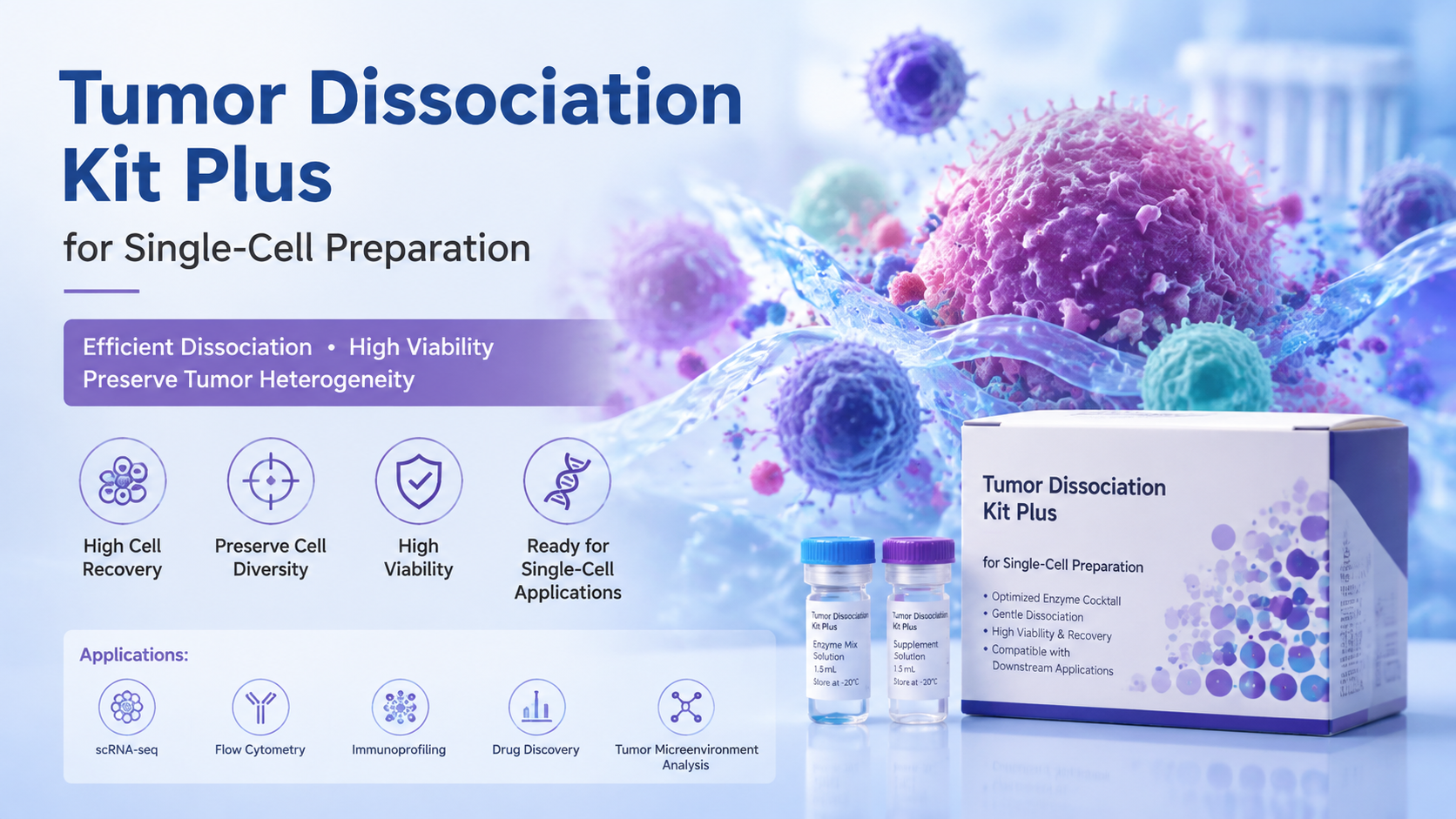
The Tumor Dissociation Kit Plus for Single-Cell Preparation provides an optimized solution for researchers who need reliable tumor tissue dissociation and high-quality single-cell suspensions. By combining efficient enzymatic digestion with gentle processing conditions, this type of tumor dissociation solution supports downstream applications such as single-cell sequencing, flow cytometry, cell sorting, and tumor microenvironment studies.
Why Tumor Tissue Dissociation Is Critical for Single-Cell Research
Solid tumors are highly heterogeneous biological systems. A single tumor sample may contain multiple cancer cell clones, immune infiltrating cells, and supporting stromal populations. Understanding these cellular components is essential for studying:
· Tumor progression
· Metastasis mechanisms
· Immune escape
· Drug resistance
· Cancer biomarkers
· Therapeutic targets
Before performing single-cell analysis, tumor tissues must be converted into individual cell suspensions. The quality of this preparation directly affects downstream data quality.
Poor tumor dissociation can cause:
· Loss of fragile cell populations
· Low viable cell numbers
· Artificial changes in gene expression
· Excessive cell aggregation
· Increased mitochondrial gene expression
· Reduced single-cell sequencing quality
Therefore, an optimized tumor dissociation protocol is a key factor in successful single-cell experiments.
Challenges of Tumor Tissue Dissociation

1. Complex Extracellular Matrix Structure
Tumor tissues contain abundant extracellular matrix components, including:
· Collagen
· Fibronectin
· Laminin
· Proteoglycans
These structures provide mechanical support for tumor cells but also make cell isolation difficult.
Strong mechanical disruption may release cells but can damage membranes and reduce viability. Therefore, enzymatic digestion must efficiently break down tissue structures while preserving cellular integrity.
2. Tumor Heterogeneity
Unlike many normal tissues, tumors contain highly diverse cell populations.
For example, a tumor sample may include:
Cancer Cells
· Different genetic subclones
· Cancer stem-like cells
· Drug-resistant populations
Immune Cells
· T lymphocytes
· B lymphocytes
· Natural killer (NK) cells
· Macrophages
· Dendritic cells
Stromal Cells
· Cancer-associated fibroblasts (CAFs)
· Endothelial cells
· Mesenchymal cells
An effective tumor dissociation method should recover these populations as evenly as possible to accurately represent the tumor microenvironment.
3. Maintaining Cell Viability and Surface Markers
Many downstream applications require intact and functional cells.
For single-cell sequencing and flow cytometry, researchers need:
· High cell viability
· Preserved cell morphology
· Intact surface proteins
· Minimal cellular stress
Over-digestion can destroy surface markers or alter cellular states, affecting experimental accuracy.
Principle of Tumor Dissociation Kit Plus
The Tumor Dissociation Kit Plus for Single-Cell Preparation is designed around optimized enzymatic tissue dissociation technology.
The workflow typically involves controlled digestion of tumor tissues using specialized enzyme combinations that target extracellular matrix components.
The main principles include:
Efficient ECM Breakdown
Enzymatic components help degrade structural proteins surrounding tumor cells, allowing individual cells to be released from tissue fragments.
Gentle Cell Release
Optimized digestion conditions reduce excessive stress and help maintain cellular characteristics.
Improved Single-Cell Suspension Quality
After digestion and filtration, researchers can obtain cleaner single-cell preparations suitable for advanced analysis.
This balanced approach helps maximize cell recovery while preserving biological information.
Key Benefits of Tumor Dissociation Kit Plus
1. High-Quality Single-Cell Suspension Preparation
A successful single-cell experiment starts with a high-quality sample.
Tumor Dissociation Kit Plus helps researchers generate:
· Uniform cell suspensions
· Reduced tissue debris
· Improved cell recovery
· Suitable cell concentrations for sequencing
High-quality preparation improves the reliability of downstream analysis.
2. Supports Tumor Microenvironment Research
The tumor microenvironment plays an important role in cancer development and treatment response.
Single-cell analysis after tumor dissociation allows researchers to investigate:
· Immune infiltration patterns
· Stromal remodeling
· Cancer cell evolution
· Cell-cell communication networks
By preserving multiple cell types, researchers can obtain a more complete view of tumor biology.
3. Compatible with Single-Cell RNA Sequencing
Single-cell RNA sequencing requires high-quality individual cells.
Tumor Dissociation Kit Plus supports workflows involving:
· Cell type identification
· Gene expression profiling
· Biomarker discovery
· Cell trajectory analysis
· Molecular pathway studies
Researchers can analyze differences between tumor cell populations and identify previously unknown cellular states.
4. Improved Immune Cell Recovery
Immune cells within tumors are often fragile and sensitive to processing conditions.
Optimized tumor dissociation helps preserve immune populations such as:
· Tumor-infiltrating lymphocytes (TILs)
· Macrophages
· NK cells
· Antigen-presenting cells
This is particularly valuable for cancer immunology and immunotherapy research.
Applications of Tumor Dissociation Kit Plus
1. Cancer Single-Cell Sequencing Research
Single-cell sequencing has become a powerful tool for understanding tumor complexity.
Applications include:
· Tumor classification
· Identification of rare cell populations
· Cancer evolution studies
· Resistance mechanism analysis
High-quality tumor dissociation improves the accuracy of single-cell datasets.
2. Immunotherapy Development
Modern cancer therapies increasingly focus on immune regulation.
Tumor dissociation enables researchers to study:
· Immune checkpoint pathways
· T-cell activation states
· Tumor immune suppression
· Immune response biomarkers
These studies support the development of new immunotherapeutic strategies.
3. Flow Cytometry Analysis
Flow cytometry requires well-prepared single-cell suspensions.
Tumor Dissociation Kit Plus can support:
· Immune profiling
· Cell population analysis
· Surface marker detection
· Cell sorting experiments
Preserving antigen expression is essential for accurate flow cytometry results.
4. Drug Discovery and Precision Medicine
Tumor heterogeneity is one of the major challenges in cancer treatment.
Single-cell approaches help researchers identify:
· Drug-resistant populations
· Therapeutic targets
· Patient-specific molecular patterns
· Treatment response mechanisms
Reliable tumor dissociation provides the foundation for these discoveries.
Tumor Dissociation Kit Plus Workflow
A typical tumor single-cell preparation workflow includes:
Step 1: Tissue Collection
Fresh tumor samples are collected and processed according to experimental requirements.
Step 2: Tissue Preparation
Tumor tissues are mechanically minced into smaller fragments to increase enzyme accessibility.
Step 3: Enzymatic Digestion
Tumor fragments are treated with dissociation reagents to release individual cells.
Step 4: Filtration and Washing
The cell suspension is filtered to remove remaining tissue fragments and debris.
Step 5: Downstream Analysis
Prepared cells can be used for:
· scRNA-seq
· Flow cytometry
· Cell sorting
· Functional assays
· Molecular profiling
How to Choose the Right Tumor Dissociation Solution
When selecting a tumor dissociation reagent, researchers should consider:
Tumor Type
Different tumors have different ECM compositions and require optimized digestion conditions.
Downstream Application
The requirements for sequencing, flow cytometry, and cell culture may differ.
Cell Population of Interest
Researchers studying immune cells may prioritize gentle conditions that preserve fragile populations.
Sample Quality
Fresh, frozen, and preserved tissues may require different processing strategies.
Conclusion
The Tumor Dissociation Kit Plus for Single-Cell Preparation provides researchers with an effective approach for generating high-quality tumor single-cell suspensions. By optimizing extracellular matrix digestion and maintaining cellular integrity, it supports accurate analysis of tumor heterogeneity and microenvironment interactions.
From single-cell RNA sequencing and immune profiling to cancer drug discovery and precision medicine research, reliable tumor dissociation is the foundation for obtaining meaningful biological insights.
As single-cell technologies continue to advance, high-performance tumor dissociation solutions will remain essential tools for exploring cancer biology and developing next-generation therapies.


