I. Introduction: A New Regulatory Era
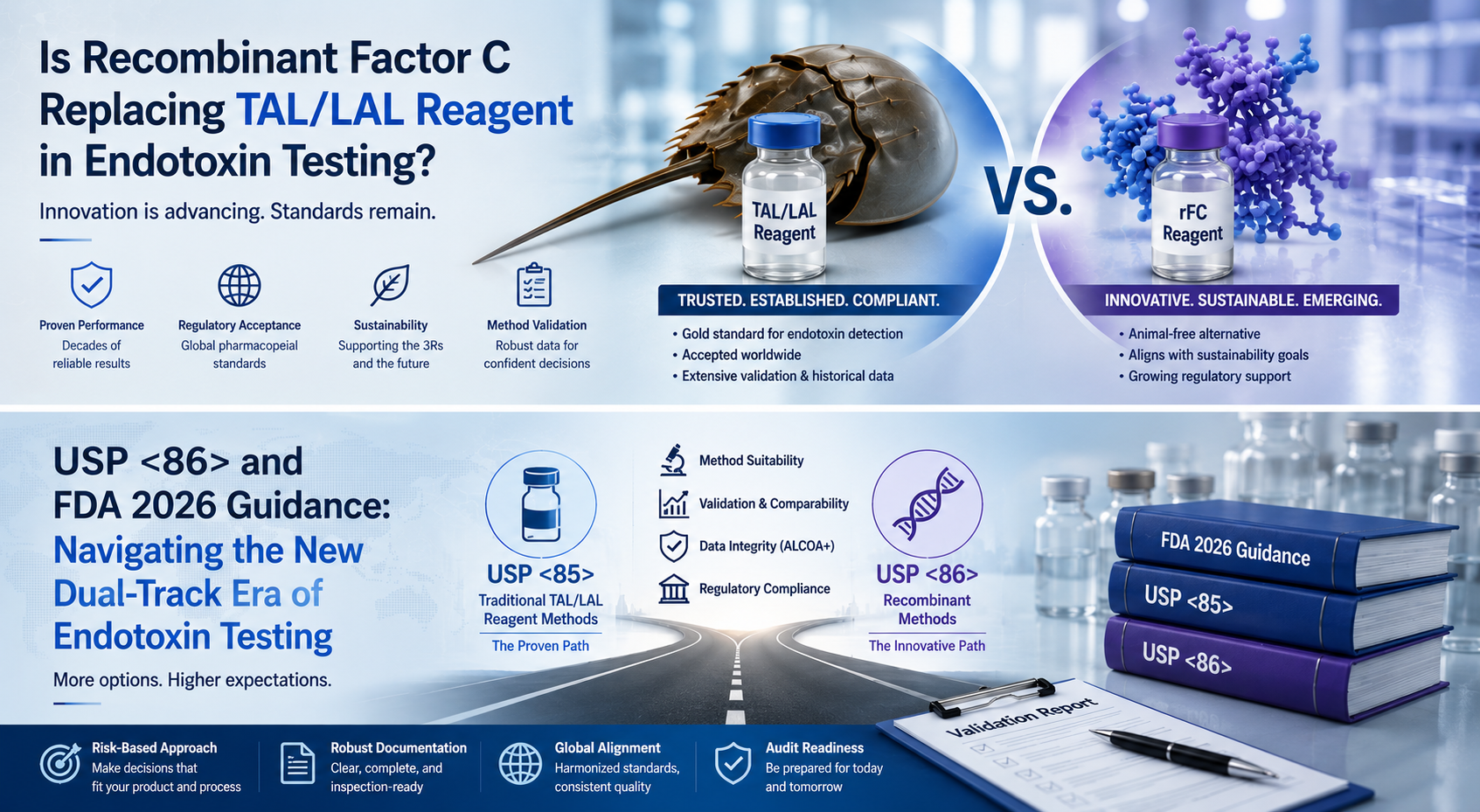
The regulatory landscape for endotoxin testing is undergoing a significant transformation. With the introduction of USP <86> and updated FDA guidance in 2026, laboratories are now operating in what can be described as a dual-track regulatory system.
This shift allows both traditional TAL/LAL Reagent–based methods and recombinant technologies to coexist — but it also introduces new challenges in validation, compliance, and audit readiness.
II. Understanding the Dual-Track System
1. USP <85> vs. USP <86>
- USP <85>: Traditional Bacterial Endotoxin Test using TAL/LAL Reagent
- USP <86>: New chapter supporting recombinant methods
Rather than replacing existing standards, USP <86> expands the toolbox available to laboratories.
2. FDA’s Flexible but Strict Approach
The FDA now allows methodological flexibility but emphasizes:
- Scientific justification
- Method suitability
- Data integrity
- Validation rigor
Flexibility does not reduce compliance expectations — it increases them.
III. What Has Actually Changed?
1. Method Choice Is Now Broader
Laboratories can choose between:
- TAL/LAL Reagent methods
- Recombinant assays
However, the responsibility for proving suitability lies entirely with the user.
2. Validation Requirements Are More Critical Than Ever
Switching or implementing a method requires:
- Accuracy and precision studies
- Recovery rate validation (typically 50–200%)
- Interference testing
- Robust documentation
3. Data Integrity Is Under the Spotlight
Regulators are focusing heavily on:
- Electronic records
- Audit trails
- ALCOA+ principles
IV. Key Compliance Challenges for Laboratories
1. Increased Validation Burden
Every method must be justified and documented — there is no “default accepted” shortcut.
2. Audit Complexity
Inspectors now evaluate:
- Why a method was chosen
- How it was validated
- Whether it is consistently controlled
3. Global Regulatory Alignment
Different regions may interpret recombinant acceptance differently, complicating global submissions.
V. Why TAL/LAL Reagent Remains Critical in This New Era
Even within a dual-track system, TAL/LAL Reagent continues to provide:
- Regulatory certainty
- Established acceptance worldwide
- Lower validation risk
- Reliable historical data
For many companies, it serves as the primary or reference method.
VI. FireGene: Helping You Stay Audit-Ready
FireGene supports laboratories navigating regulatory change with compliance-driven TAL/LAL Reagent solutions.
Our offerings are designed to simplify:
- Method validation
- Documentation preparation
- Lot traceability
- Audit readiness
🔗 Explore solutions: https://firegene.com/products/kinetic-chromogenic-endotoxin-test-kit
With consistent reagent performance and strong technical support, FireGene helps reduce uncertainty in a complex regulatory environment.
VII. Best Practices for Thriving in the Dual-Track System
1. Keep TAL/LAL Reagent as a Benchmark
Even if adopting recombinant methods, maintain TAL/LAL systems as a reference.
2. Strengthen Validation Frameworks
Develop standardized protocols for:
- Method transfer
- Comparability studies
- Revalidation
3. Focus on Documentation Excellence
Ensure all testing activities are:
- Fully traceable
- Time-stamped
- Audit-ready
4. Monitor Regulatory Updates Continuously
Stay informed about:
- USP revisions
- FDA guidance updates
- Regional regulatory expectations
VIII. Strategic Insight: Compliance Over Trend
While new technologies attract attention, regulatory success depends on:
- Scientific rigor
- Documentation quality
- Method reliability
Not simply adopting the latest method.
IX. Conclusion: Mastering the New Regulatory Reality
The introduction of USP <86> and updated FDA guidance marks a major shift in endotoxin testing — but it does not eliminate the importance of traditional methods.
Instead, laboratories must now operate within a more flexible yet more demanding framework, where:
- Multiple methods are allowed
- Validation is mandatory
- Documentation is critical
In this environment, TAL/LAL Reagent remains a cornerstone of compliant endotoxin testing, providing stability in an increasingly complex regulatory world.
With the right strategy — and the right partner like FireGene — laboratories can confidently navigate this dual-track era while maintaining quality, compliance, and efficiency.
FireGene, light your research with passion, innovation, and profession.


