
Introduction
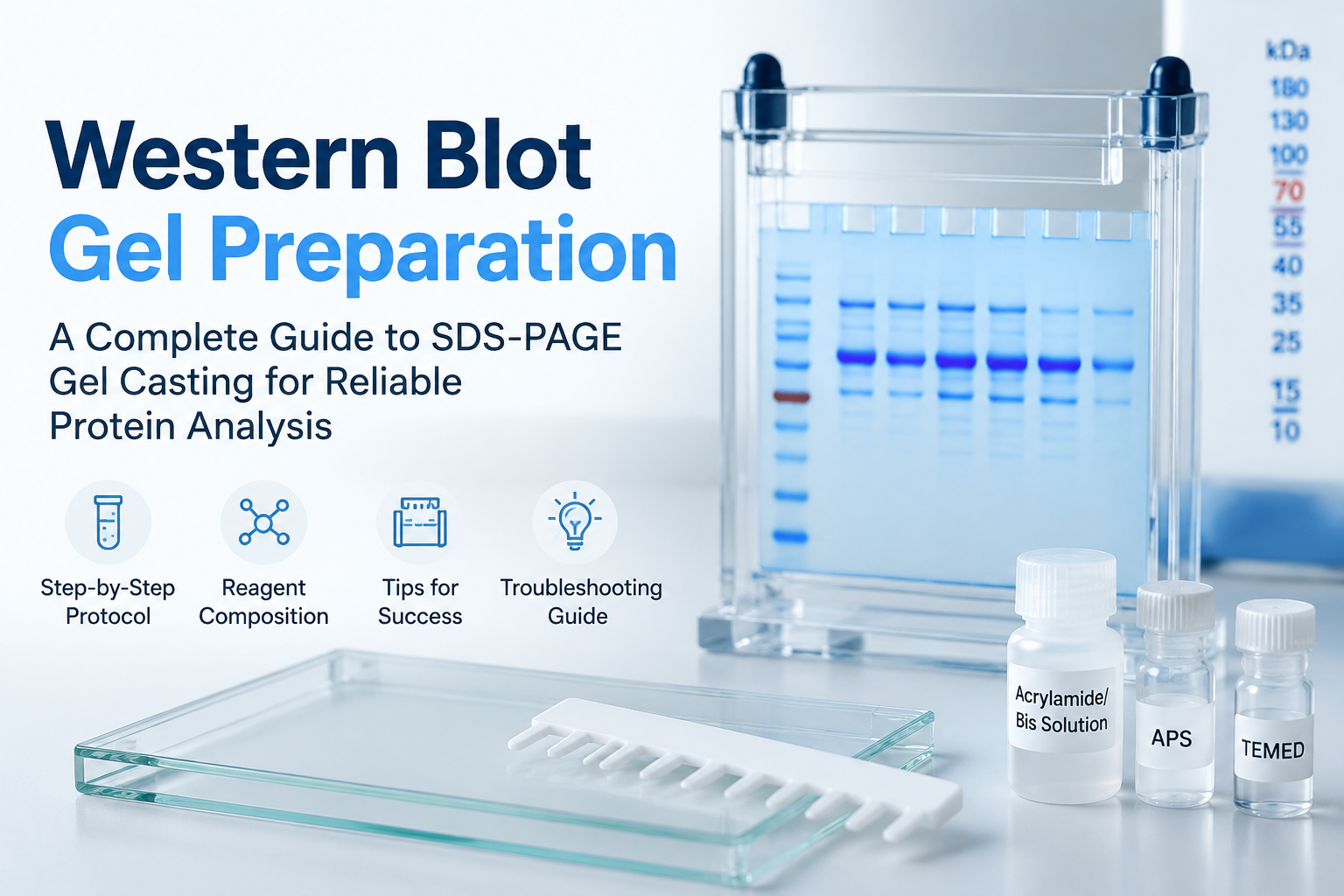
Western blotting (WB) is one of the most widely used techniques in molecular biology and biomedical research for detecting and analyzing specific proteins in complex biological samples. The success of a Western blot experiment depends on multiple factors, including protein extraction quality, antibody specificity, transfer efficiency, and detection sensitivity. Among these critical steps, gel preparation for SDS-PAGE plays a fundamental role because it determines the quality of protein separation and ultimately affects the clarity and accuracy of Western blot results.
A properly prepared polyacrylamide gel provides a consistent molecular sieving environment, allowing proteins to migrate according to their molecular weight during electrophoresis. Poor gel preparation can lead to common problems such as distorted bands, uneven migration, low resolution, and inaccurate protein size estimation.
This article provides a comprehensive overview of Western blot gel preparation, including gel composition, gel concentration selection, preparation procedures, common troubleshooting strategies, and optimization tips for obtaining high-quality Western blot results.
What Is the Role of Gel Preparation in Western Blotting?
In a typical Western blot workflow, proteins are first separated by SDS-polyacrylamide gel electrophoresis (SDS-PAGE) before being transferred onto a membrane for antibody-based detection.
The SDS-PAGE gel acts as a molecular filter. Smaller proteins migrate faster through the gel matrix, while larger proteins move more slowly. The quality of the gel directly affects:
· Protein separation resolution
· Band sharpness
· Molecular weight accuracy
· Transfer efficiency
· Reproducibility between experiments
A well-prepared gel ensures that target proteins are separated clearly, making downstream detection more reliable.
Components of a Western Blot SDS-PAGE Gel
A standard SDS-PAGE gel consists of two layers:
1. Resolving Gel (Separating Gel)
The resolving gel is the lower portion of the SDS-PAGE gel and is responsible for separating proteins based on molecular size.
The pore size of the resolving gel depends mainly on the acrylamide concentration. Higher acrylamide concentrations create smaller pores, which are suitable for separating small proteins. Lower concentrations produce larger pores for large proteins.
Common resolving gel concentrations include:
|
Protein Size |
Recommended Gel Percentage |
|
>150 kDa |
6–8% gel |
|
80–150 kDa |
8–10% gel |
|
20–80 kDa |
10–12% gel |
|
<20 kDa |
12–15% gel |
For many routine Western blot experiments, 10% SDS-PAGE gels are commonly used because they provide good separation for a wide range of proteins.
2. Stacking Gel
The stacking gel forms the upper layer of the SDS-PAGE system. Unlike the resolving gel, its purpose is not protein separation but protein concentration.
During electrophoresis, proteins are compressed into a narrow band before entering the resolving gel. This process improves band sharpness and increases resolution.
Most stacking gels contain approximately:
· 4–5% acrylamide
· Tris-HCl buffer at pH 6.8
· SDS
· APS and TEMED for polymerization
Key Reagents Used for SDS-PAGE Gel Preparation
Understanding the function of each component is essential for successful gel preparation.
Acrylamide/Bis-acrylamide
Acrylamide forms the gel matrix, while bis-acrylamide creates cross-links between polymer chains. Together, they determine the pore size of the gel.
Higher acrylamide concentrations:
· Smaller pores
· Better separation of small proteins
Lower acrylamide concentrations:
· Larger pores
· Better separation of large proteins
Tris-HCl Buffer
Tris-HCl maintains the appropriate pH environment.
Two different pH systems are used:
· Resolving gel: pH 8.8
· Stacking gel: pH 6.8
The difference in pH allows proteins to concentrate efficiently before separation.
SDS (Sodium Dodecyl Sulfate)
SDS is an ionic detergent that denatures proteins and gives them a uniform negative charge.
This allows proteins to migrate primarily according to molecular weight rather than their natural structure or charge.
APS and TEMED
Ammonium persulfate (APS) and TEMED initiate acrylamide polymerization.
· APS generates free radicals
· TEMED accelerates polymerization
Fresh APS is essential because degraded APS can result in incomplete or uneven gel formation.
Step-by-Step Procedure for Western Blot Gel Preparation
Step 1: Prepare Glass Plates
Before casting the gel:
1. Clean glass plates thoroughly.
2. Assemble plates with spacers.
3. Ensure there are no leaks.
4. Place the gel cassette on a stable surface.
Any leakage during casting can affect gel thickness and quality.
Step 2: Prepare the Resolving Gel
The resolving gel mixture is prepared first.
A typical 10% resolving gel contains:
· Acrylamide/Bis-acrylamide solution
· Tris-HCl buffer (pH 8.8)
· SDS
· Distilled water
· APS
· TEMED
APS and TEMED should be added last because polymerization begins immediately after mixing.
The gel solution should be poured quickly between the glass plates.
Step 3: Allow the Resolving Gel to Polymerize
After pouring the resolving gel:
· Add a thin layer of isopropanol or ethanol on top.
· Allow the gel to polymerize for approximately 20–40 minutes.
The alcohol layer prevents oxygen exposure and creates a flat gel surface.
Step 4: Prepare the Stacking Gel
After the resolving gel has polymerized:
1. Remove the alcohol layer.
2. Rinse gently with distilled water.
3. Add stacking gel solution.
4. Insert the comb carefully.
5. Allow polymerization for approximately 20–30 minutes.
The wells formed by the comb will hold protein samples during electrophoresis.
Common Problems During Gel Preparation and Solutions
1. Gel Does Not Polymerize
Possible causes:
· Old APS solution
· Insufficient TEMED
· Incorrect reagent concentrations
· Low temperature
Solutions:
· Prepare fresh APS solution
· Confirm reagent quality
· Optimize APS/TEMED concentration
2. Uneven Gel Surface
Possible causes:
· Incomplete removal of alcohol layer
· Incorrect casting technique
· Air bubbles trapped during pouring
Solutions:
· Carefully remove the alcohol layer
· Pour gel slowly
· Avoid introducing bubbles
3. Poor Protein Separation
Possible causes:
· Incorrect gel percentage
· Excessive protein loading
· Improper polymerization
Solutions:
· Select appropriate gel concentration
· Reduce sample loading amount
· Prepare fresh gel reagents
4. Smearing or Distorted Bands
Potential causes include:
· Protein degradation
· Poor sample preparation
· Overloaded wells
· Damaged gel structure
Optimizing sample handling and gel preparation conditions can significantly improve results.
Tips for Optimizing Western Blot Gel Preparation
Select the Correct Gel Percentage
Choosing the correct acrylamide concentration is one of the most important optimization steps. For example:
· High molecular weight proteins often require lower percentage gels.
· Small peptides require higher percentage gels.
Use Fresh Polymerization Reagents
APS and TEMED directly influence gel quality. Fresh solutions improve polymerization consistency and reduce experimental variation.
Maintain Accurate Measurements
Small differences in reagent volumes can affect:
· Gel density
· Migration speed
· Band resolution
Accurate pipetting is essential for reproducible results.
Avoid Oxygen Exposure
Oxygen inhibits acrylamide polymerization. Proper handling during casting helps ensure complete gel formation.
Conclusion
Western blot gel preparation is a critical foundation for successful protein analysis. A properly prepared SDS-PAGE gel provides efficient protein separation, sharper bands, and more reliable downstream detection.
By selecting the appropriate gel concentration, preparing reagents accurately, controlling polymerization conditions, and following standardized casting procedures, researchers can significantly improve Western blot performance.
Whether performing routine protein expression analysis, antibody validation, or advanced molecular biology research, mastering SDS-PAGE gel preparation is an essential skill for achieving consistent and high-quality Western blot results.


