
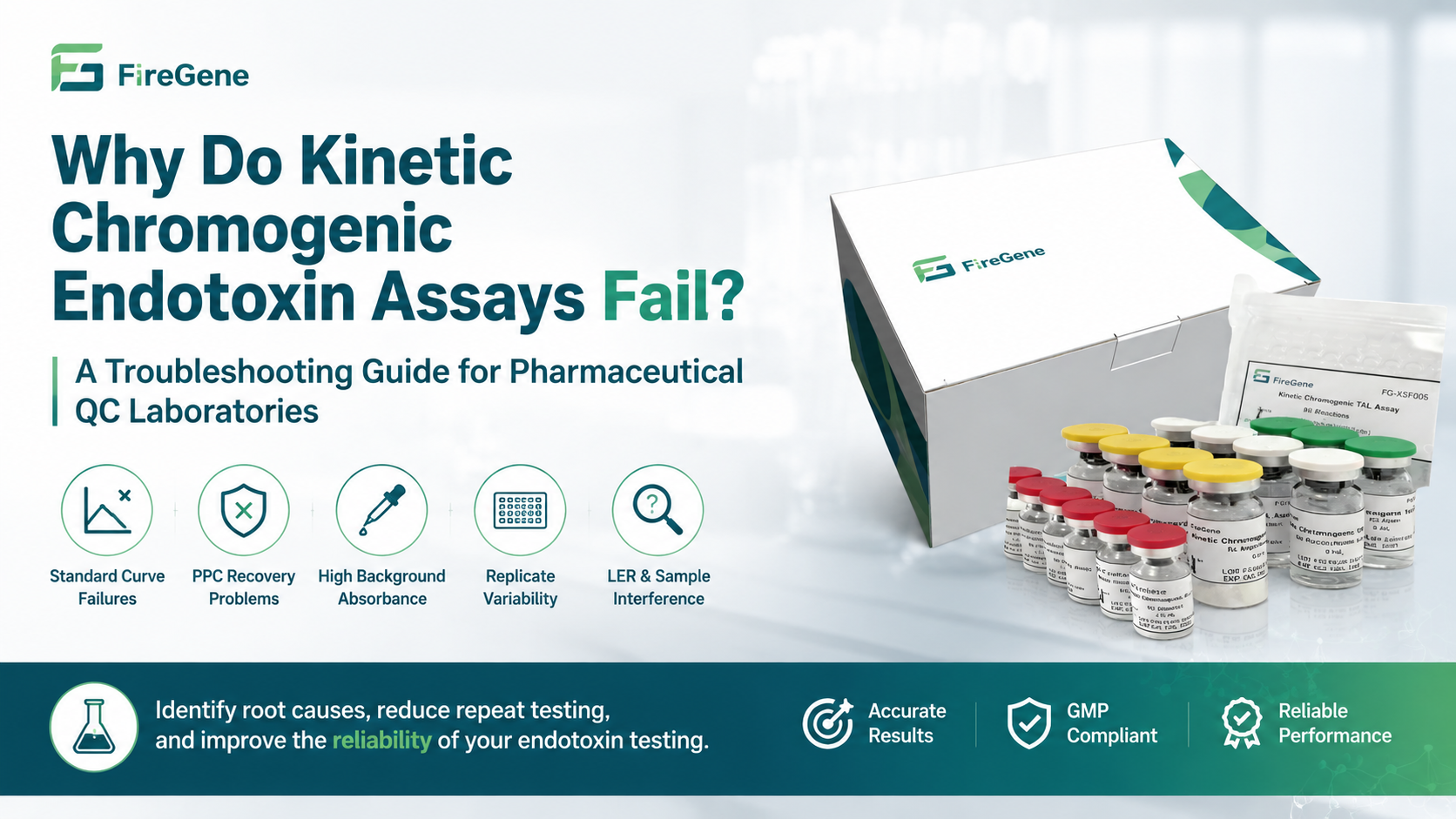
Why Do Kinetic Chromogenic Endotoxin Assays Fail? A Troubleshooting Guide for Pharmaceutical QC Laboratories
Kinetic chromogenic endotoxin testing has become one of the most widely adopted quantitative methods for bacterial endotoxin detection in pharmaceutical manufacturing. Compared with the traditional gel clot method, kinetic chromogenic assays provide higher sensitivity, a broader quantitative range, automated data analysis, and excellent compatibility with modern microplate readers.
However, many pharmaceutical QC laboratories occasionally encounter unexpected assay failures—even when following the standard operating procedure (SOP). Typical issues include:
- Standard curves that fail acceptance criteria
- Poor spike recovery (PPC failure)
- High background absorbance
- Unexpected positive or negative results
- Large variation between replicates
- Invalid assay runs
When these problems occur repeatedly, they can delay product release, increase investigation costs, and raise compliance concerns during GMP inspections.
This article explains why kinetic chromogenic endotoxin assays fail, identifies the most common root causes, and provides practical troubleshooting strategies that can help QC laboratories improve assay reliability.
Understanding How the Kinetic Chromogenic Assay Works
Unlike gel clot assays that rely on clot formation, the kinetic chromogenic method measures enzyme activity over time.
The endotoxin-triggered Limulus (or Tachypleus) coagulation cascade activates a chromogenic substrate, releasing p-nitroaniline (pNA). The liberated pNA absorbs light at 405 nm, allowing the instrument to monitor color development continuously.
The higher the endotoxin concentration:
- the faster Factor C activation occurs,
- the faster chromogenic substrate cleavage proceeds,
- the shorter the reaction time required to reach a predefined absorbance threshold.
Because the assay measures reaction kinetics rather than simply endpoint color intensity, it is extremely sensitive to changes in reaction conditions.
Even small deviations in temperature, pipetting accuracy, reagent quality, or sample composition can significantly influence results.
Common Failure #1: Standard Curve Does Not Meet Acceptance Criteria
A failed calibration curve is one of the most frequent reasons for rejecting an assay.
Typical symptoms include:
- Low correlation coefficient (R²)
- Irregular dilution pattern
- Nonlinear curve
- Wide replicate variation
- Unexpected slope changes
Possible causes
Incorrect preparation of endotoxin standards
Many laboratories prepare standards too quickly or skip proper vortex mixing between serial dilutions.
Even slight concentration errors become magnified across multiple dilution steps.
Best practices include:
- Prepare standards immediately before use.
- Perform stepwise serial dilutions.
- Vortex each dilution thoroughly.
- Use fresh endotoxin-free pipette tips for every dilution.
Expired or improperly stored CSE
Control Standard Endotoxin (CSE) gradually loses performance if exposed to repeated freeze-thaw cycles or prolonged storage after reconstitution.
Always:
- follow the manufacturer's storage recommendations,
- avoid repeated thawing,
- discard expired reconstituted standards.
Plate reader calibration issues
Incorrect wavelength calibration or inconsistent optical performance may distort absorbance measurements.
Routine verification of:
- wavelength accuracy,
- temperature control,
- kinetic timing,
- optical uniformity
is recommended for GMP laboratories.
Common Failure #2: Positive Product Control (PPC) Recovery Failure
Perhaps the most frustrating problem is acceptable standards but failed spike recovery.
Typical acceptance criteria require spike recovery between 50% and 200%.
Low recovery generally indicates sample interference rather than reagent failure.
Cause 1: Product inhibition
Many pharmaceutical formulations inhibit the LAL/TAL enzymatic cascade.
Common interfering substances include:
- surfactants
- chelating agents
- preservatives
- high salt concentrations
- extreme pH
- organic solvents
- high protein concentrations
These substances reduce enzyme activity, causing artificially low endotoxin recovery.
Cause 2: Low Endotoxin Recovery (LER)
LER remains one of the biggest challenges in endotoxin testing.
Formulations containing surfactants and chelators may gradually mask endotoxin, making it biologically active yet analytically undetectable.
This phenomenon commonly affects:
- monoclonal antibodies
- recombinant proteins
- vaccines
- gene therapy products
- cell therapy formulations
If LER is suspected, laboratories should investigate product-specific validation rather than assuming reagent failure.
Cause 3: Incorrect sample dilution
Insufficient dilution allows inhibitors to remain active.
Excessive dilution may reduce endotoxin concentration below the assay detection limit.
Finding the validated Minimum Valid Dilution (MVD) is essential for reliable recovery.
Common Failure #3: High Background Absorbance
Sometimes negative controls exhibit unexpectedly high absorbance before significant color development.
Possible causes include:
Contaminated water
Endotoxin-free water is essential.
Using ordinary laboratory water—even ultrapure water intended for molecular biology—may introduce trace endotoxin contamination.
Dirty microplates
Residual dust, fingerprints, manufacturing residues, or scratches may increase baseline absorbance.
Always use certified endotoxin-free microplates recommended by the kit manufacturer.
Instrument contamination
Optical contamination inside the microplate reader may also elevate background signals.
Routine cleaning and preventive maintenance should be incorporated into instrument qualification programs.
Common Failure #4: Large Differences Between Replicates
High coefficient of variation (CV) often indicates procedural inconsistency.
Potential causes include:
Pipetting errors
Small pipetting inaccuracies become amplified in kinetic assays.
Recommended practices:
- calibrated pipettes
- reverse pipetting when appropriate
- pre-wetting tips
- consistent dispensing angle
- avoiding bubbles
Inconsistent mixing
Incomplete mixing results in uneven endotoxin distribution.
Every reagent addition should be followed by gentle but sufficient mixing.
Delayed reagent addition
When multiple wells are loaded manually, timing differences may affect reaction initiation.
Many laboratories improve reproducibility by:
- using multichannel pipettes,
- automated liquid handlers,
- standardized plate loading sequences.
Common Failure #5: Unexpected Positive Results
Occasionally products repeatedly test above specification despite previous compliant batches.
Possible explanations include:
Environmental endotoxin contamination
Potential contamination sources include:
- gloves
- laboratory benches
- pipette shafts
- reagent bottles
- airborne dust
- improperly cleaned equipment
Because endotoxin is highly stable, routine laboratory cleaning may not completely eliminate contamination.
Cross-contamination during pipetting
Splashing or aerosol generation during pipetting may contaminate adjacent wells.
Changing pipette tips between every transfer is essential.
Contaminated consumables
Not every laboratory-grade plastic product is certified endotoxin-free.
Only validated consumables should be used for bacterial endotoxin testing.
Common Failure #6: No Color Development
If neither standards nor samples generate measurable absorbance, consider:
- incorrect reagent reconstitution
- expired TAL/LAL reagent
- incorrect incubation temperature
- inactive chromogenic substrate
- instrument failure
- incorrect wavelength selection
- improper software setup
Verifying each component individually often identifies the root cause quickly.
Common Failure #7: Assay Passes Validation but Gives Inconsistent Results Over Time
Some laboratories experience excellent validation performance yet observe increasing variability months later.
Possible reasons include:
- pipette calibration drift
- new reagent lots
- instrument aging
- operator variability
- environmental temperature fluctuations
- humidity changes
- laboratory workflow changes
Trend analysis using control charts can identify gradual performance deterioration before assay failures become frequent.
A Practical Troubleshooting Workflow
When a kinetic chromogenic assay fails, avoid immediately repeating the test without identifying the root cause.
Instead, investigate systematically:
Step 1: Verify instrument performance
- Temperature
- Wavelength
- Calibration
- Reader software
↓
Step 2: Confirm reagent integrity
- Storage conditions
- Expiration dates
- Reconstitution records
↓
Step 3: Review standard preparation
- Serial dilution accuracy
- Mixing procedure
- Fresh preparation
↓
Step 4: Evaluate sample interference
- PPC recovery
- MVD verification
- Product inhibition
- Possible LER
↓
Step 5: Examine laboratory technique
- Pipetting consistency
- Plate loading sequence
- Mixing
- Environmental contamination
A structured troubleshooting approach reduces unnecessary repeat testing and shortens investigation time.
Preventive Measures for Reliable Endotoxin Testing
Rather than reacting to failures, successful pharmaceutical QC laboratories focus on prevention.
Recommended practices include:
- Regular pipette calibration
- Routine microplate reader qualification
- Strict environmental monitoring
- Proper reagent storage
- Certified endotoxin-free consumables
- Comprehensive analyst training
- Trending historical assay performance
- Product-specific inhibition/interference validation
- Periodic review of standard preparation techniques
Preventive quality systems significantly improve assay consistency while reducing out-of-specification (OOS) investigations.
Choosing High-Quality TAL/LAL Reagents Matters
Although operator technique is critical, reagent quality also plays an essential role in assay reliability.
High-quality kinetic chromogenic TAL/LAL Reagents should provide:
- Excellent lot-to-lot consistency
- High sensitivity across a broad detection range
- Stable chromogenic substrate performance
- Robust standard curve linearity
- Low background reactivity
- Compatibility with major kinetic microplate readers
- Comprehensive technical documentation for GMP validation
Reliable reagent performance helps laboratories distinguish true sample-related issues from assay variability, improving confidence in endotoxin testing results.
FireGene's Kinetic Chromogenic TAL/LAL Assay is designed for pharmaceutical, biotechnology, and medical device laboratories requiring accurate, reproducible, and GMP-compatible quantitative endotoxin testing. The kit delivers excellent sensitivity, robust standard curve performance, and compatibility with standard 96-well kinetic microplate readers, making it suitable for routine QC testing and method validation.
Frequently Asked Questions (FAQ)
Why does my standard curve pass but PPC recovery fail?
This usually indicates sample-specific inhibition or enhancement rather than reagent failure. Investigate formulation components, verify the Minimum Valid Dilution (MVD), and assess the potential for Low Endotoxin Recovery (LER).
Why are kinetic chromogenic assays more sensitive to pipetting errors?
The assay measures reaction kinetics, not just endpoint color intensity. Small differences in reagent volume or timing can alter the reaction rate, leading to increased variability.
Can expired TAL/LAL reagents affect assay results?
Yes. Improper storage, repeated freeze-thaw cycles, or using expired reagents can reduce enzyme activity and compromise assay performance. Always follow the manufacturer's storage and handling recommendations.
How can laboratories reduce assay failures?
Routine instrument qualification, calibrated pipettes, proper reagent storage, validated sample preparation, certified endotoxin-free consumables, and ongoing analyst training are all essential for maintaining reliable performance.
Conclusion
Kinetic chromogenic endotoxin assays are among the most powerful tools available for quantitative bacterial endotoxin testing, but their sensitivity also makes them susceptible to procedural, instrumental, and sample-related variables.
Most assay failures stem not from the TAL/LAL reagent itself, but from issues such as improper standard preparation, sample interference, Low Endotoxin Recovery, pipetting inconsistencies, environmental contamination, or inadequate instrument maintenance. By adopting a systematic troubleshooting workflow and implementing robust preventive quality practices, pharmaceutical QC laboratories can minimize invalid assays, reduce investigation time, and ensure reliable endotoxin testing that meets GMP expectations.
For laboratories seeking consistent performance, selecting high-quality TAL/LAL reagents and validating methods for each product matrix remain key steps toward generating accurate, reproducible, and regulatory-compliant endotoxin testing results.
FireGene Endotoxin Testing
Ready to run your endotoxin assay?
FireGene offers a complete endotoxin testing toolkit — from TAL reagents and CSE standards to pyrogen-free consumables and LAL reagent water. All products are aligned with USP <85>, EP 2.6.14, and JP 4.01.


