
Introduction
Bacterial endotoxin testing is a critical quality-control step for many pharmaceutical, biopharmaceutical, medical device, and laboratory applications. Because modern endotoxin assays can detect extremely low levels of endotoxin, controlling every potential source of contamination is essential. One often-overlooked component is the water used during the assay.
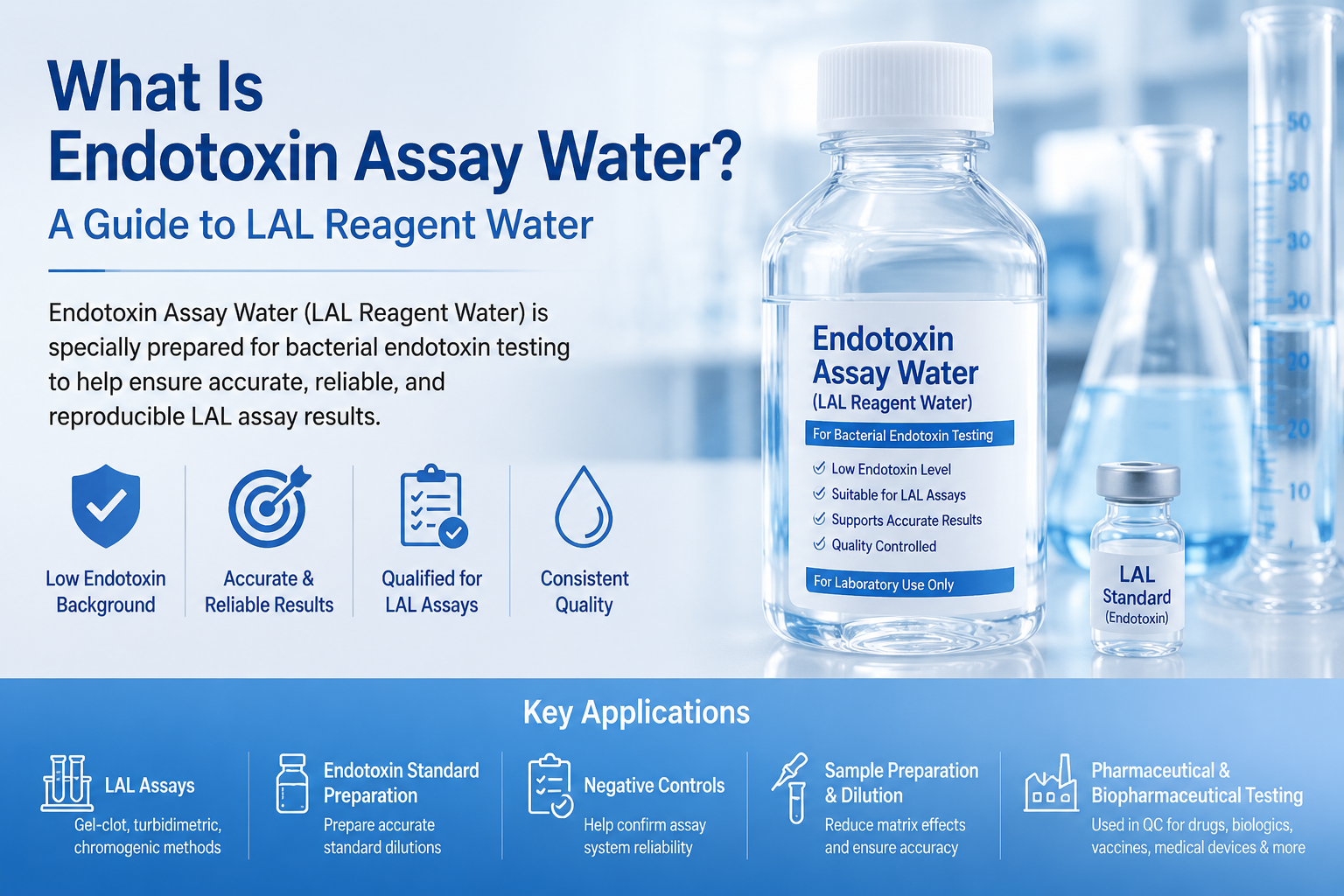
Endotoxin Assay Water, commonly called LAL Reagent Water (LRW), is specially prepared for use in bacterial endotoxin testing. Unlike ordinary laboratory water, it is selected and qualified to minimize endotoxin background and help prevent the water itself from affecting assay results.
Whether used to prepare endotoxin standards, dilute samples, prepare controls, or support LAL testing, high-quality assay water helps laboratories maintain reliable and reproducible analytical conditions.
This article explains what Endotoxin Assay Water is, why it is important, how it is used, and what to consider when selecting and handling LAL Reagent Water.
1. What Is Endotoxin Assay Water?
Endotoxin Assay Water is water specifically intended for bacterial endotoxin testing. It is commonly used in Limulus Amebocyte Lysate (LAL) assays and related endotoxin detection workflows.
The main purpose of this specialized water is to provide a low-endotoxin background for analytical procedures. This is important because water that contains detectable endotoxin may contribute to the assay signal and potentially interfere with the interpretation of results.
Endotoxin Assay Water may also be described using terms such as:
· LAL Reagent Water
· LAL water
· Endotoxin-free water
· Water for bacterial endotoxins testing
· Water for LAL testing
· Low-endotoxin assay water
Although terminology can vary between manufacturers and laboratories, users should always verify the product's specifications and intended application.
Importantly, low endotoxin content is not necessarily the same as general chemical purity or sterility. Water intended for endotoxin testing should be appropriately qualified for that specific purpose.
2. Why Is LAL Reagent Water Important?
The sensitivity of bacterial endotoxin assays makes contamination control particularly important.
A typical endotoxin testing workflow may involve preparing a standard endotoxin solution, performing serial dilutions, preparing negative controls, and testing a sample across multiple concentrations. Water can be involved in several of these steps.
If the water contains endotoxin, it can introduce an additional signal into the assay.
Reducing Background Endotoxin
Using appropriately qualified LAL Reagent Water helps minimize the possibility that the water contributes significant endotoxin to the test system.
Supporting Accurate Dilutions
Endotoxin standards are often prepared at different concentrations. A suitable dilution medium helps maintain consistency throughout the dilution process.
Improving Reproducibility
Consistent water quality can contribute to more consistent preparation of standards, controls, and samples between experiments and testing runs.
Supporting Quality Control
In pharmaceutical and biopharmaceutical laboratories, reliable endotoxin testing is part of a broader quality-control system. Controlling water quality is therefore an important element of the overall analytical workflow.
3. Endotoxin Assay Water vs. Ordinary Laboratory Water
One common misconception is that any highly purified water can be used for endotoxin testing.
This is not necessarily true.
Water can have excellent chemical purity while still requiring specific qualification for endotoxin analysis. Chemical purity, microbiological quality, sterility, and endotoxin level are different quality characteristics.
|
Water Type |
Typical Application |
Endotoxin Testing Suitability |
|
Tap Water |
General laboratory use |
Not suitable |
|
General Purified Water |
Routine laboratory applications |
Requires qualification |
|
Ultrapure Water |
Sensitive analytical applications |
Requires endotoxin qualification |
|
Endotoxin Assay Water |
LAL and bacterial endotoxin testing |
Specifically intended for this application |
For sensitive endotoxin assays, laboratories should select water based on its documented suitability rather than assuming that a general laboratory water product is appropriate.
4. Applications of Water for Bacterial Endotoxins Test
Endotoxin Assay Water has several important applications in bacterial endotoxin testing.

4.1 LAL Endotoxin Assays
The most common application is in LAL-based bacterial endotoxin testing.
LAL assays can be performed using different detection formats, including:
· Gel-clot LAL
· Kinetic turbidimetric LAL
· Kinetic chromogenic LAL
· Endpoint chromogenic LAL
Depending on the specific validated procedure, assay water may be used for dilution, standard preparation, control preparation, or other analytical steps.
4.2 Endotoxin Standard Preparation
Known endotoxin standards may need to be diluted to generate a series of concentrations for quantitative testing.
Using suitable LAL Reagent Water as the dilution medium can help laboratories maintain consistent preparation conditions.
This is particularly important when establishing or evaluating a standard curve.
4.3 Negative Controls
Negative controls are used to help demonstrate that the assay system does not generate an unexpected response in the absence of endotoxin.
Appropriately qualified assay water can help minimize the risk of introducing endotoxin through the dilution medium itself.
4.4 Sample Preparation
Some samples require dilution before endotoxin testing. When permitted by the validated test method, Endotoxin Assay Water may be used to prepare sample dilutions.
This is especially relevant for samples that require dilution to reduce matrix effects or bring endotoxin concentrations into the validated measurement range.
4.5 Pharmaceutical and Biopharmaceutical Testing
Endotoxin testing is commonly incorporated into quality-control workflows for products such as:
· Injectable pharmaceuticals
· Biologics
· Vaccines
· Parenteral preparations
· Medical devices
· Pharmaceutical raw materials
· Bioprocessing materials
In these applications, appropriately qualified water helps support controlled and reproducible testing.
5. How to Select the Right LAL Reagent Water
Choosing Endotoxin Assay Water requires consideration of several factors.
5.1 Endotoxin Specification
The first factor to review is the product's specified endotoxin level or acceptance criterion.
The water should have sufficiently low endotoxin levels for the sensitivity and requirements of the intended assay.
Always review the manufacturer's current product specification and applicable testing procedure.
5.2 Assay Compatibility
Different endotoxin detection methods may have different requirements. Before purchasing LAL Reagent Water, confirm compatibility with the intended application, such as:
· Gel-clot LAL
· Chromogenic LAL
· Turbidimetric LAL
· Kinetic endotoxin testing
· Recombinant Factor C testing
The manufacturer's instructions should be followed when determining suitability.
5.3 Certificate of Analysis
For quality-controlled laboratory applications, documentation is important.
A Certificate of Analysis may provide information such as:
· Product name
· Lot number
· Endotoxin test result
· Specification
· Manufacturing date
· Expiration date
· Storage conditions
Lot-specific documentation can help laboratories maintain traceability.
5.4 Packaging and Storage
Packaging is another important consideration. Even appropriately qualified low-endotoxin water can be affected by improper handling after opening.
Users should follow the manufacturer's recommended storage conditions and minimize unnecessary exposure to the laboratory environment.
6. Best Practices for Handling Endotoxin-Free Water
Proper handling is essential to preserve the quality of LAL Reagent Water.
Keep the container closed
The container should remain closed whenever water is not actively being used.
Use suitable laboratory consumables
Pipette tips, tubes, containers, and other materials that contact assay water should be appropriate for endotoxin testing.
Avoid cross-contamination
Do not introduce equipment that has contacted samples, standards, or other potentially contaminated materials into the original water container.
Use clean pipetting practices
Fresh, suitable pipette tips should be used for different solutions to reduce the possibility of cross-contamination.
Follow storage instructions
Storage temperature, shelf life, and other manufacturer recommendations should be followed carefully.
Maintain lot traceability
For regulated or quality-critical testing, record the lot number of the Endotoxin Assay Water used during the assay.
7. Endotoxin Assay Water in Modern Endotoxin Testing
While LAL remains one of the most widely recognized methods for bacterial endotoxin detection, alternative technologies such as recombinant Factor C (rFC) are also used in modern endotoxin testing.
Regardless of the detection technology, contamination control remains fundamental.
The analytical system needs to distinguish endotoxin originating from the test sample from background contamination introduced by reagents, water, laboratory equipment, or handling.
Therefore, using appropriately qualified assay water is an important part of establishing a controlled endotoxin testing workflow.
It is also important to remember that Endotoxin Assay Water is not simply purified water. It is a specialized laboratory material intended to support sensitive endotoxin analysis.
8. Frequently Asked Questions
Is Endotoxin Assay Water the same as LAL Reagent Water?
In many applications, the terms are used interchangeably for water intended for bacterial endotoxin testing. However, users should confirm the specific manufacturer's definition, specifications, and intended use.
Can distilled water be used for an LAL test?
Not necessarily. Distilled water may be chemically suitable for some laboratory applications but is not automatically qualified for sensitive endotoxin testing. Water should be specifically evaluated or supplied as suitable for the intended endotoxin assay.
Is LAL Reagent Water sterile?
Sterility and endotoxin level are different specifications. A water product should not be assumed to be sterile simply because it is described as low-endotoxin or endotoxin-free. Check the manufacturer's product documentation.
Can Endotoxin Assay Water be used to dilute endotoxin standards?
Yes, when the applicable assay procedure or manufacturer's instructions specify its use as a dilution medium. It is commonly used for preparing endotoxin standard dilutions and controls.
Why is endotoxin-free water necessary?
Because endotoxin assays are highly sensitive, endotoxin present in the water can potentially contribute to the measured response. Appropriately qualified water helps minimize this source of background contamination.
Conclusion
Endotoxin Assay Water, LAL Reagent Water, and Water for Bacterial Endotoxins Test are essential supporting materials for reliable endotoxin analysis. By providing a controlled, low-endotoxin aqueous medium, these products help laboratories prepare standards, controls, samples, and dilutions while minimizing potential background contamination.
When selecting LAL Reagent Water, laboratories should evaluate endotoxin specifications, assay compatibility, quality documentation, packaging, storage conditions, and handling requirements.
For pharmaceutical, biopharmaceutical, medical-device, and research laboratories, choosing appropriately qualified Endotoxin Assay Water can help establish a more consistent and reproducible bacterial endotoxin testing workflow.


