
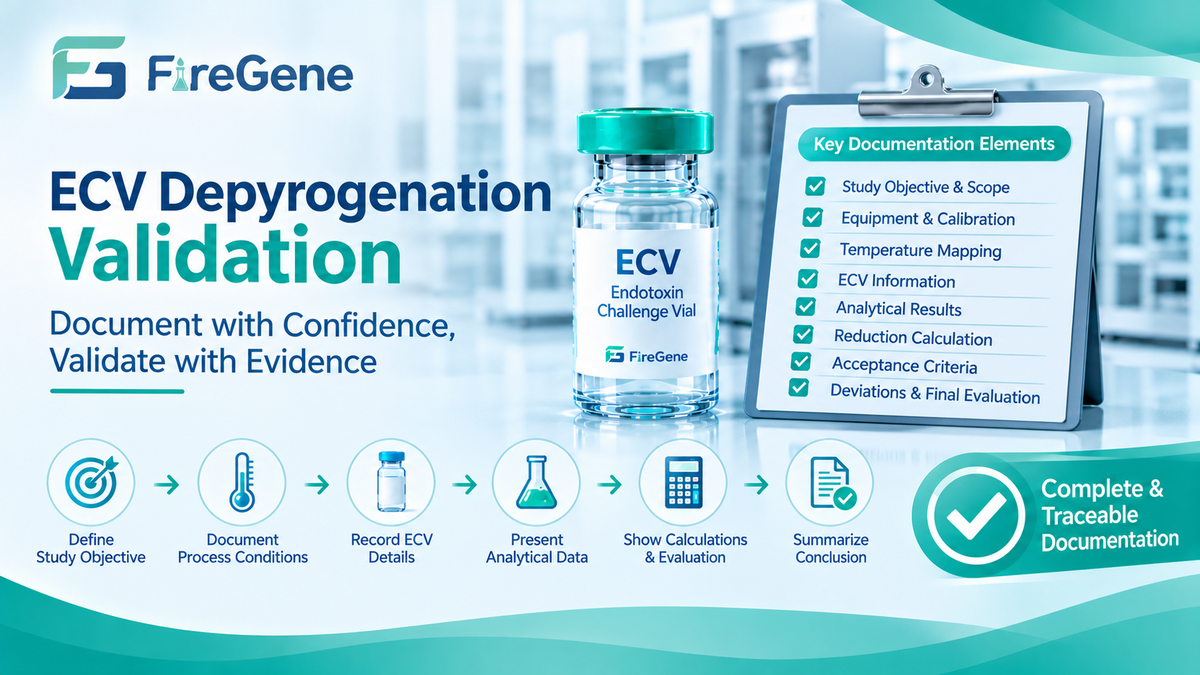
I. Why Documentation Is Essential
A depyrogenation validation study generates several types of information.
These may include equipment records, temperature profiles, load configurations, ECV information, analytical results, calculations, and deviation investigations.
Without organized documentation, it can be difficult to reconstruct what happened during the study or determine whether the results support the intended validation objective.
A well-prepared ECV validation report should clearly connect the study objective, process conditions, challenge locations, analytical results, and final conclusion.
The report should also allow another qualified reviewer to understand how the results were obtained.
II. Begin With the Study Objective and Scope
The report should clearly identify why the study was conducted.
Include:
-
Study title and identification number
-
Facility or department
-
Equipment identification
-
Study date
-
Protocol reference
-
Responsible personnel
-
Materials or components being evaluated
-
Intended depyrogenation application
-
Defined acceptance criteria
The scope should explain whether the study applies to a batch oven, continuous depyrogenation tunnel, or another dry-heat system.
It should also identify the load configuration and operating conditions covered by the study.
III. Document Equipment and Calibration Information
Equipment information is necessary to establish which system was evaluated.
Relevant documentation may include:
-
Equipment name and identification number
-
Manufacturer and model
-
Chamber or tunnel configuration
-
Qualification status
-
Temperature controller information
-
Temperature sensor identification
-
Data logger identification
-
Calibration status and relevant certificates
Where applicable, the report should identify the temperature monitoring locations and the instruments used to record the process profile.
Calibration records should be traceable to the instruments used during the study.
IV. Include Empty- and Loaded-Chamber Mapping Results
Temperature mapping records provide important evidence of thermal conditions.
The report should distinguish empty-chamber results from loaded-chamber results.
For each study, include:
-
Mapping date
-
Sensor identification
-
Sensor placement diagram
-
Load configuration, where applicable
-
Temperature recording data
-
Temperature profile
-
Relevant heating and cooling information
-
Identified locations requiring attention
-
Evaluation against predefined criteria
For loaded studies, the report should describe the actual load arrangement.
A diagram or photograph can help reviewers understand the relationship between the load and sensor positions.
V. Record ECV Product and Lot Information
The ECV is a critical challenge material in the study and should be traceable.
Document the following information:
-
Product name
-
Catalog number
-
Lot number
-
Labeled endotoxin potency
-
Expiration date
-
Storage conditions
-
Number of vials used
-
Challenge location for each vial
The report should also identify whether initial potency was based on the assigned product value or an independently established baseline result.
Do not treat a potency range as an exact measured value unless the applicable procedure justifies that approach.
For FireGene ECV product information, visit:
https://firegene.com/products/endotoxin-challenge-vial-ecv?variant=48118964650196
VI. Include ECV Placement and Process Execution Records
ECV placement should be traceable to the heat distribution and validation strategy.
The report should identify:
-
ECV identification number or vial reference
-
Chamber location
-
Load position
-
Relationship to relevant temperature sensors
-
Number of ECVs at each location
-
Reason for selecting the challenge locations
Process execution records should document the actual cycle conditions.
For a batch oven, this may include cycle start and end times, temperature settings, and recorded temperature profiles.
For a continuous tunnel, relevant information may include conveyor speed, heating-zone conditions, and the applicable exposure period.
Any deviation from the approved protocol should be documented and evaluated.
VII. Present Endotoxin Testing Data Clearly
The analytical section should provide sufficient information to understand how the initial and residual endotoxin activities were determined.
Include:
-
Analytical method
-
Test reagent information
-
Reagent lot numbers
-
Assay sensitivity or validated range
-
Sample preparation procedure
-
Reconstitution details
-
Dilution scheme
-
Control results
-
Replicate results
-
Raw data
-
Final reported activity
If a Gel-Clot method is used, document the relevant dilution series, endpoint interpretation, and controls.
If a photometric method is used, document the analytical system, standard curve or calculation approach, and results within the validated measurement range.
The method should be suitable for the intended residual endotoxin assessment.
VIII. Show the Reduction Calculation
The report should make the calculation transparent and reproducible.
A commonly used log reduction calculation is:
LRV = log10 (Initial endotoxin activity / Residual endotoxin activity)
For example:
Initial activity = 5,000 EU
Residual activity = 5 EU
LRV = log10 (5,000 / 5)
LRV = log10 (1,000) = 3
The calculated result represents a 1,000-fold reduction in endotoxin activity.
The report should clearly state the units and measurement basis used.
If the residual result is below the analytical detection or quantification limit, the report should describe the limitation appropriately rather than assigning a residual value of zero.
IX. Document Acceptance Criteria and Final Evaluation
Acceptance criteria should be established in the approved protocol before the study is performed.
The report should compare actual results with those predefined requirements.
A commonly referenced benchmark is a 3-log reduction, equivalent to a 1,000-fold reduction in endotoxin activity.
However, the required acceptance criteria depend on the intended process and applicable requirements.
The final evaluation should address:
-
Whether the specified criteria were met
-
Whether all relevant challenge locations passed
-
Whether control results were acceptable
-
Whether analytical method limitations affected interpretation
-
Whether any deviations remain unresolved
A single favorable result should not override an unresolved failure at another relevant challenge location.
X. Include Deviations and Investigation Records
Unexpected results should be documented and investigated.
Examples include:
-
Abnormal temperature profiles
-
Damaged or leaking ECVs
-
Inconsistent initial potency
-
Unexpectedly low or variable recovery
-
Failed analytical controls
-
Inconsistent results between replicate vials
-
Deviations from the approved loading configuration
The investigation should describe the observed issue, potential impact, supporting evidence, and final disposition.
Repeat testing, when justified, should be documented with a clear scientific rationale.
XI. Suggested ECV Validation Report Structure
A practical report can be organized as follows:
-
Study title, objective, and scope
-
Equipment and calibration information
-
Empty-chamber mapping results
-
Loaded-chamber mapping results
-
Load configuration and ECV placement diagram
-
ECV product and lot information
-
Process execution records
-
Analytical method and sample preparation
-
Raw endotoxin test results
-
Reduction calculations
-
Acceptance criteria assessment
-
Deviations and investigations
-
Final conclusion and approval
-
Supporting appendices and attachments
This structure can be adapted to the organization's quality system and approved validation procedures.
XII. Conclusion
An ECV depyrogenation validation report should do more than state whether a process passed or failed.
It should provide a traceable explanation of the study design, equipment conditions, endotoxin challenge, analytical results, and final evaluation.
Clear documentation supports technical review, reproducibility, and ongoing process oversight.
By maintaining complete ECV records and linking them to temperature mapping and analytical data, manufacturers can build a stronger evidence base for dry-heat depyrogenation validation.
Learn more about FireGene Endotoxin Challenge Vials:
https://firegene.com/products/endotoxin-challenge-vial-ecv?variant=48118964650196
References
-
USP General Chapter <1228>, Depyrogenation: https://doi.org/10.31003/USPNF_M8097_03_01
-
USP General Chapter <1228.1>, Dry Heat Depyrogenation: https://doi.org/10.31003/USPNF_M8098_01_01
-
USP General Chapter <1228.5>, Endotoxin Indicators for Depyrogenation: https://doi.org/10.31003/USPNF_M10256_01_01
-
FDA, Pyrogen and Endotoxins Testing: Questions and Answers, March 2026: https://www.fda.gov/regulatory-information/search-fda-guidance-documents/pyrogen-and-endotoxins-testing-questions-and-answers
FireGene Endotoxin Testing
Ready to run your endotoxin assay?
FireGene offers a complete endotoxin testing toolkit — from TAL reagents and CSE standards to pyrogen-free consumables and LAL reagent water. All products are aligned with USP <85>, EP 2.6.14, and JP 4.01.


