
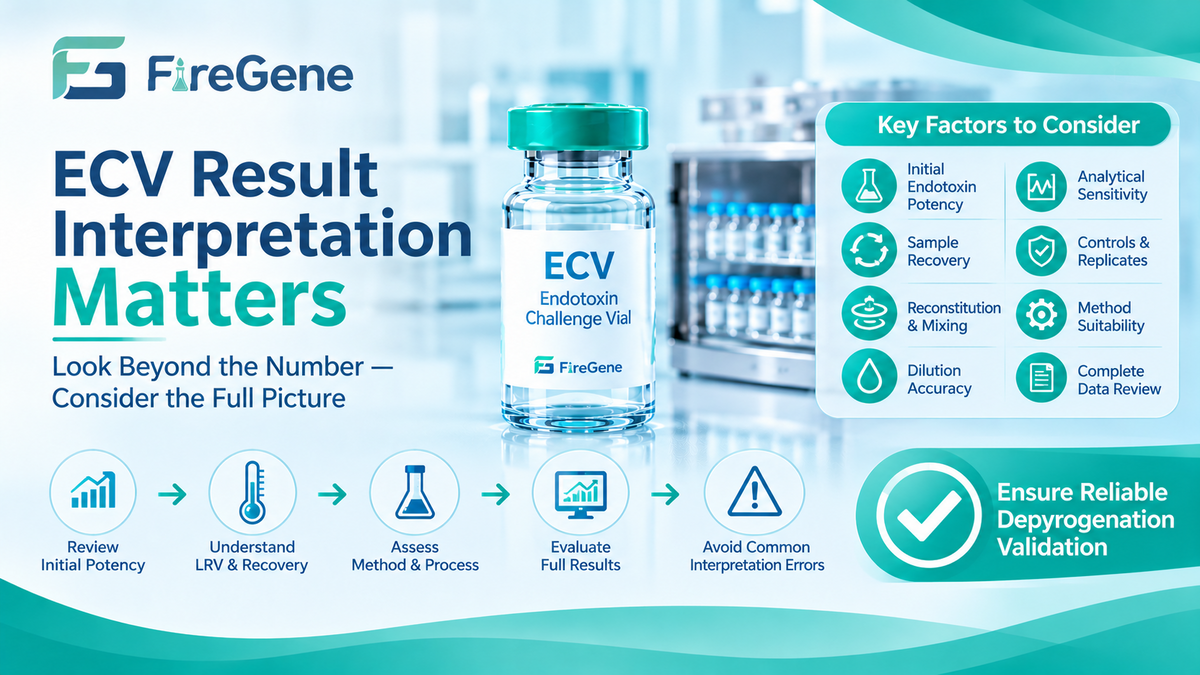
I. Why ECV Result Interpretation Matters
An Endotoxin Challenge Vial (ECV) is used to evaluate endotoxin reduction during depyrogenation studies.
However, obtaining a test result is only one part of the validation process.
The result must be interpreted in the context of the initial endotoxin activity, sample preparation, analytical method, and process conditions.
A low residual endotoxin result may indicate effective depyrogenation. It may also reflect analytical limitations, incomplete sample recovery, or other issues that require investigation.
Understanding these factors helps prevent incorrect conclusions.
II. Start With the Initial Endotoxin Potency
The initial endotoxin potency represents the starting activity used to evaluate the depyrogenation challenge.
For an ECV study, this information may come from the product's assigned potency or from an appropriate baseline measurement, depending on the approved protocol.
Before calculating endotoxin reduction, confirm:
-
The ECV product and lot number
-
The assigned or measured initial potency
-
The potency units
-
The reconstitution procedure
-
The dilution scheme
-
The analytical method used
Do not automatically substitute an assumed midpoint for the labeled potency range.
If the product documentation provides a potency range, the actual value used in the calculation should be justified by the applicable procedure.
III. Understand the Difference Between Initial and Residual Activity
The initial activity represents the endotoxin challenge before processing.
Residual activity represents the endotoxin activity measured after the depyrogenation cycle.
The relationship between these two values is used to evaluate the reduction achieved.
A commonly used calculation is:
Log Reduction Value (LRV)
LRV = log10 (Initial endotoxin activity / Residual endotoxin activity)
For example, if the initial activity is 5,000 EU and the residual activity is 5 EU:
LRV = log10 (5,000 / 5)
LRV = log10 (1,000)
LRV = 3
This represents a 1,000-fold reduction, or 99.9% reduction in measured endotoxin activity.
The comparison must use compatible units and an appropriate measurement basis.
IV. What Is Endotoxin Recovery?
Endotoxin recovery describes how much endotoxin activity can be detected after a sample has undergone preparation and testing.
In an ECV study, recovery can be influenced by several factors:
1. Reconstitution
Incomplete reconstitution may result in inconsistent measured activity.
The specified volume of BET water and mixing procedure should be followed.
2. Mixing
Insufficient mixing may cause uneven distribution of endotoxin activity in the sample.
Follow the product-specific or validated protocol for vortexing time and dilution preparation.
3. Sample Handling
Delays, inappropriate containers, and handling conditions may affect sample consistency.
Heated samples should be tested according to the approved procedure.
4. Dilution Accuracy
Incorrect dilution calculations or pipetting errors can significantly affect the final result.
Use calibrated pipettes and verify the dilution scheme before testing.
5. Analytical Interference
The sample matrix or testing conditions may interfere with the analytical method.
Method suitability should be demonstrated under the intended conditions.
V. Why a Low Residual Result Does Not Always Mean Successful Depyrogenation
A low result may be encouraging, but it should not be interpreted without considering method capability.
For example, a result below the assay's detection or quantification limit does not establish that endotoxin activity is zero.
It means that the activity could not be reliably quantified under the applied method conditions.
When residual activity is near or below the method's capability, the validation team should evaluate whether the assay has sufficient sensitivity for the intended reduction objective.
Potential considerations include:
-
Initial ECV potency
-
Required reduction factor
-
Assay sensitivity
-
Sample dilution
-
Validated analytical range
-
Controls and replicates
-
Method suitability
A more sensitive or otherwise appropriate validated analytical approach may be needed.
VI. Gel-Clot and Photometric Methods
Different analytical methods may be used to evaluate residual endotoxin activity.
Gel-Clot Method
The Gel-Clot method is based on the formation of a gel in response to endotoxin under defined test conditions.
The endpoint is determined using a series of dilutions and appropriate controls.
The method is relatively straightforward, but the result depends on the lysate sensitivity, dilution design, and proper execution.
Photometric Methods
Photometric methods include kinetic turbidimetric and kinetic chromogenic approaches.
These methods monitor a measurable response over time and can provide quantitative results within the validated analytical range.
The selected method should be suitable for the expected residual endotoxin concentration.
For more information about quantitative endotoxin testing, explore FireGene's Kinetic Chromogenic Endotoxin Test Kit:
https://firegene.com/products/kinetic-chromogenic-endotoxin-test-kit-tal-assay
VII. Evaluate the Complete Result, Not Just One Number
A reliable ECV study should consider the full set of data.
Important elements include:
-
Initial endotoxin activity
-
Unheated control results
-
Heated ECV results
-
Reconstitution records
-
Dilution calculations
-
Analytical controls
-
Replicate consistency
-
Results by challenge location
-
Deviations and investigations
If ECVs from the same location produce substantially different results, the difference should be investigated rather than averaged away without explanation.
Possible causes may include uneven thermal exposure, inconsistent reconstitution, or analytical variability.
VIII. Common Interpretation Errors
Treating the labeled potency range as an exact measured value
Use the potency value specified or justified by the approved protocol.
Ignoring assay sensitivity
The method must be capable of evaluating the expected residual activity.
Reporting below-detection results as zero
Below detection does not mean absence of endotoxin.
Comparing results with inconsistent units
Ensure that initial and residual values are expressed on a compatible basis.
Ignoring control results
Control data are essential for evaluating whether the test results are meaningful.
IX. Conclusion
Interpreting ECV results requires more than calculating a log reduction.
Initial potency, sample recovery, reconstitution, dilution accuracy, analytical sensitivity, and control performance all influence the reliability of the final result.
A scientifically justified interpretation should explain what the data demonstrate, what limitations remain, and whether the predefined acceptance criteria have been met.
For dependable depyrogenation validation, use an appropriate ECV, a suitable analytical method, and a documented testing procedure.
Explore FireGene ECV solutions:
https://firegene.com/products/endotoxin-challenge-vial-ecv?variant=48118964650196
References
-
USP General Chapter <1228.5>, Endotoxin Indicators for Depyrogenation: https://doi.org/10.31003/USPNF_M10256_01_01
-
USP General Chapter <85>, Bacterial Endotoxins Test
-
FDA, Pyrogen and Endotoxins Testing: Questions and Answers, March 2026: https://www.fda.gov/regulatory-information/search-fda-guidance-documents/pyrogen-and-endotoxins-testing-questions-and-answers
FireGene Endotoxin Testing
Ready to run your endotoxin assay?
FireGene offers a complete endotoxin testing toolkit — from TAL reagents and CSE standards to pyrogen-free consumables and LAL reagent water. All products are aligned with USP <85>, EP 2.6.14, and JP 4.01.


