
Introduction
The Kinetic Chromogenic Endotoxin Test is widely used to quantitatively detect bacterial endotoxins in pharmaceutical products, biological materials, peptide samples, recombinant proteins, raw materials, buffers, and other laboratory samples. The method measures color development generated through an endotoxin-dependent lysate reaction and relates the kinetic signal to endotoxin concentration through a standard curve.
However, obtaining a numerical endotoxin result is only part of the analytical process. Researchers must also demonstrate that the sample itself does not interfere with the assay.
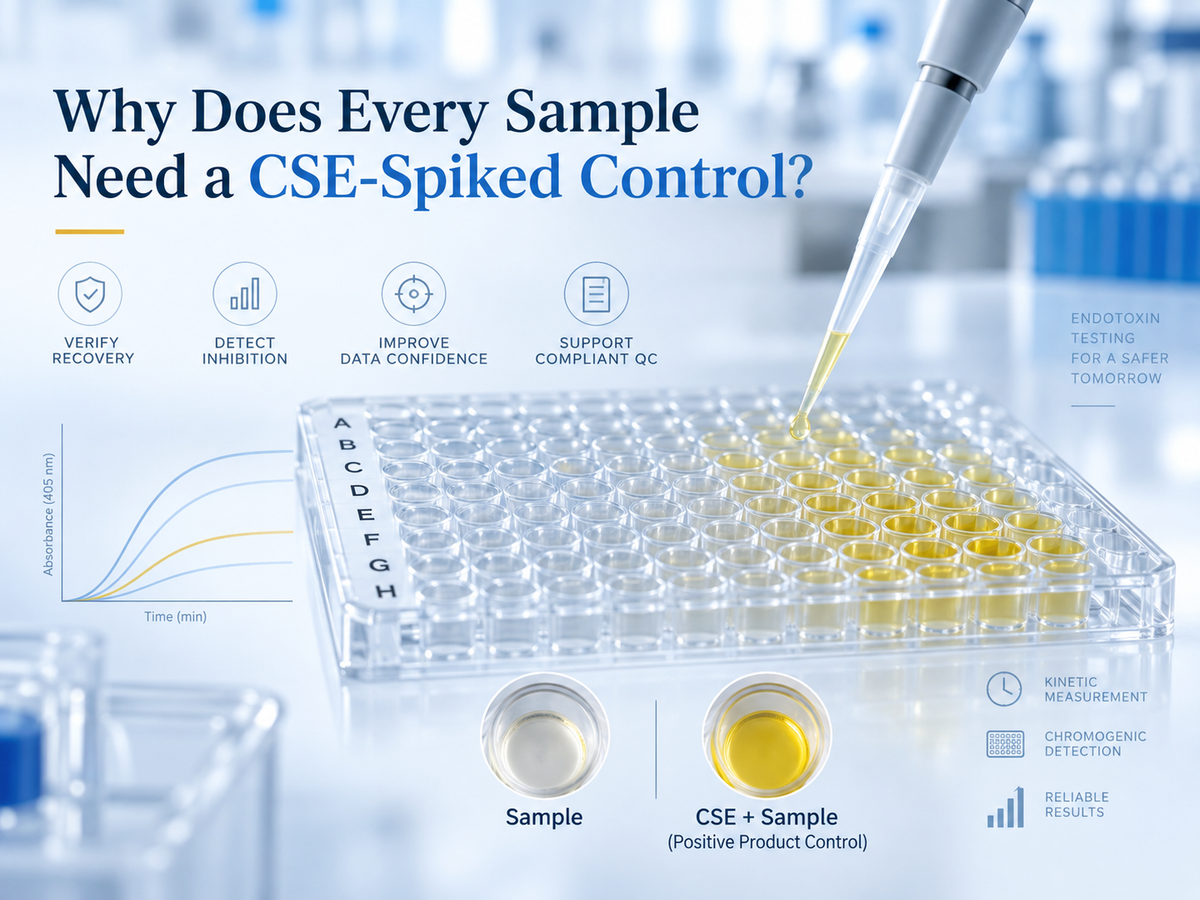
For this reason, laboratories commonly test both the original sample and a corresponding CSE-spiked sample. CSE refers to Control Standard Endotoxin, a standardized endotoxin preparation used in bacterial endotoxin testing.
The CSE-spiked sample is generally used as a Positive Product Control (PPC). Its primary purpose is not to measure additional endotoxin in the product but to determine whether the sample matrix inhibits or enhances the endotoxin detection reaction.
Understanding this control is particularly important when testing complex matrices such as proteins, peptides, APIs, cell culture reagents, buffers, and formulation intermediates.
1. What Is a CSE-Spiked Sample?
A CSE-spiked sample is prepared by adding a known amount of Control Standard Endotoxin to the sample being tested.
A typical kinetic chromogenic endotoxin assay may therefore include:
|
Test Component |
Main Purpose |
|
Sample |
Determine endotoxin concentration in the sample |
|
CSE + Sample |
Evaluate inhibition or enhancement caused by the sample matrix |
|
Endotoxin Standards |
Generate the standard curve |
|
Negative Control |
Confirm that background contamination is adequately controlled |
The principle is straightforward.
If a known quantity of endotoxin is deliberately added to a sample, the analytical system should be capable of recovering that endotoxin within an acceptable range.
For example:
Sample + Known CSE Spike → Kinetic Chromogenic Reaction → Measured Endotoxin Recovery
If the expected amount of endotoxin cannot be recovered, the sample may be interfering with the test.
The CSE-spiked sample therefore acts as an internal analytical challenge.
Rather than asking only:
“How much endotoxin is present?”
the PPC also asks:
“Can this analytical system accurately detect endotoxin in this particular sample matrix?”
This distinction is fundamental to reliable bacterial endotoxin testing.
2. Why Can Samples Interfere With the Endotoxin Assay?
Kinetic chromogenic endotoxin detection depends on a biochemical reaction cascade. Components in the sample can interact with the lysate reagents, endotoxin molecules, enzymes, chromogenic substrate, or optical measurement.
Consequently, two samples containing exactly the same amount of endotoxin may generate different analytical responses if their matrices differ.
Potential interfering factors include:
extreme pH;
high ionic strength;
proteins;
peptides;
chelating agents;
detergents;
surfactants;
organic solvents;
formulation excipients;
highly concentrated active ingredients;
colored substances;
turbidity;
viscosity; and
substances capable of binding endotoxin.
FDA materials also note that chemical and physical factors can interfere with LAL-based endotoxin detection. Examples include chelation of divalent cations, unsuitable pH, adsorption of endotoxin, and sample viscosity.
Such interference generally appears as either inhibition or enhancement.
3. What Is Inhibition in an Endotoxin Test?
Inhibition occurs when the sample matrix suppresses the expected endotoxin-dependent reaction.
Imagine that a sample actually contains:
1.0 EU/mL endotoxin
but matrix interference causes the analytical system to report:
0.25 EU/mL
The apparent endotoxin concentration is much lower than the actual concentration.
This situation is especially important because a low numerical result could incorrectly be interpreted as evidence of low endotoxin contamination.
A CSE-spiked control can reveal this problem.
For example:
Added CSE: 0.50 EU/mL
Expected recovery: approximately 0.50 EU/mL
Observed incremental recovery: 0.15 EU/mL
The recovery would be:
0.150.50×100=30%\frac{0.15}{0.50}\times100 = 30\%
A 30% recovery indicates substantial inhibition under these test conditions.
Therefore, even if the original sample produces a very low endotoxin reading, that result should not automatically be considered reliable.
4. What Is Enhancement?
Enhancement is essentially the opposite problem.
Instead of suppressing the assay response, the sample matrix causes the system to produce a stronger response than expected.
For example, researchers might add:
0.50 EU/mL CSE
but obtain an apparent incremental endotoxin response corresponding to:
1.20 EU/mL
The calculated spike recovery would be:
1.200.50×100=240%\frac{1.20}{0.50}\times100 = 240\%
Such a result suggests that the matrix is enhancing the assay response.
Enhancement can cause endotoxin concentrations to appear higher than they actually are.
Therefore, CSE-spiked controls protect the analytical process from both directions of error:
Inhibition → artificially low endotoxin result
Enhancement → artificially high endotoxin result
5. How Is CSE Spike Recovery Calculated?
Spike recovery is commonly calculated by subtracting the endotoxin concentration detected in the unspiked sample from that detected in the spiked sample.
A simplified equation is:
Spike Recovery (%)=Spiked Sample Result - Sample ResultAdded Endotoxin Concentration×100\text{Spike Recovery (\%)} = \frac{\text{Spiked Sample Result - Sample Result}} {\text{Added Endotoxin Concentration}} \times100
Consider the following example:
Sample result: 0.10 EU/mL
CSE spike: 0.50 EU/mL
Spiked sample result: 0.55 EU/mL
The recovered spike is:
0.55−0.10=0.45 EU/mL0.55 - 0.10 = 0.45\ EU/mL
Therefore:
0.450.50×100=90%\frac{0.45}{0.50}\times100 = 90\%
The spike recovery is 90%.
In harmonized bacterial endotoxin testing guidance, recovery of the added endotoxin between 50% and 200% is commonly used as the criterion indicating that the sample solution is free from significant interfering factors under the conditions tested.
Laboratories should nevertheless follow the acceptance criteria specified by the applicable pharmacopoeial chapter, kit instructions, validated method, and internal SOP.
6. Why Does Every Sample Need Its Own CSE-Spiked Control?
One of the most important concepts in endotoxin analysis is that matrix interference is sample-dependent.
Consider four different laboratory samples:
|
Sample |
Matrix Characteristic |
Possible Effect |
|
Peptide solution |
High peptide concentration |
Endotoxin binding or reaction interference |
|
Protein solution |
High protein concentration |
Adsorption or inhibition |
|
Buffer |
High salt concentration |
Altered reaction environment |
|
Formulated API |
Surfactants/excipients |
Inhibition or enhancement |
Even samples analyzed on the same microplate may behave differently.
A PPC that works correctly for Sample A does not automatically prove that Sample B, C, or D is free of interference.
This is why laboratories often include a CSE-spiked condition corresponding to each sample or each validated sample matrix.
The PPC provides evidence that the endotoxin result generated from that specific test condition is analytically meaningful.

Without this control, a laboratory could obtain an endotoxin concentration but lack evidence that the sample matrix allowed the assay to function correctly.
7. What Happens When CSE Recovery Fails?
When spike recovery falls outside the established acceptance range, the sample is considered to contain interfering factors under the current assay conditions.
A common approach is to increase the sample dilution.
For example:
Undiluted → 1:10 → 1:20 → 1:40 → 1:80
Dilution reduces the concentration of interfering substances while endotoxin may remain detectable.
FDA guidance notes that when product interference is encountered, laboratories should determine a dilution that neutralizes the interfering condition rather than automatically performing routine analysis at the maximum possible dilution.
A conceptual workflow may therefore be:
Sample Preparation
↓
Test Sample + CSE-Spiked Sample
↓
Calculate Spike Recovery
↓
Recovery Acceptable?
↓
Yes → Report Valid Endotoxin Result
or
No → Investigate Matrix Interference
↓
Adjust Dilution / Validated Sample Treatment
↓
Repeat PPC Evaluation
This process is particularly important for concentrated peptide solutions, protein preparations, complex APIs, formulation samples, and biologics.
8. The Relationship Between Dilution and MVD
Sample dilution cannot be increased indefinitely.
The analyst must consider the Maximum Valid Dilution (MVD).
MVD represents the maximum dilution at which the applicable endotoxin limit can still be reliably evaluated using the sensitivity of the selected assay.
Conceptually:
MVD=Endotoxin Limit × Sample ConcentrationAssay Sensitivity\text{MVD} = \frac{\text{Endotoxin Limit × Sample Concentration}} {\text{Assay Sensitivity}}
The precise calculation depends on how the endotoxin limit and product concentration are expressed.
The analytical objective is therefore to identify a dilution that satisfies two conditions:
Matrix interference is sufficiently reduced
while simultaneously
the dilution does not exceed the applicable MVD.
The optimal working dilution is not necessarily the highest allowable dilution.
In practice, analysts generally seek an appropriate validated dilution that removes inhibition or enhancement while retaining adequate analytical sensitivity.
9. Why Is the PPC Especially Important for Peptides and Proteins?
Peptide and protein samples frequently require careful interference evaluation because their physicochemical characteristics vary considerably.
Important variables include:
amino acid composition;
molecular weight;
net charge;
hydrophobicity;
concentration;
aggregation
buffer composition
counterions;
formulation excipients; and
interactions with bacterial lipopolysaccharides.
Some peptides may interact directly or indirectly with endotoxin, while highly concentrated proteins can influence assay behavior through adsorption, viscosity, or other matrix effects.
Therefore, simply transferring an endotoxin testing condition from one peptide or protein to another may not be appropriate without verification.
For research peptide testing, a useful experimental sequence may be:
Peptide Sample → Preliminary Dilution → Endotoxin Measurement + PPC → Recovery Evaluation → Dilution Optimization → Final Quantification
This strategy provides substantially more information than an unspiked sample measurement alone.
10. CSE-Spiked Samples Are a Validity Control, Not an Extra Endotoxin Measurement
A frequent misunderstanding is that CSE + sample represents a second measurement of the product's endotoxin concentration.
Its function is different.
The unspiked sample answers:
How much detectable endotoxin is present in this sample?
The CSE-spiked sample answers:
Can the assay detect a known endotoxin challenge accurately in this sample matrix?
The combination of these measurements provides both a quantitative result and evidence regarding the validity of that result.
This distinction is central to kinetic chromogenic endotoxin testing.
A result such as:
<0.05 EU/mL
may appear satisfactory.
However, if the corresponding PPC recovery is only 20%, the low endotoxin result may reflect strong assay inhibition rather than truly low endotoxin contamination.
Conversely, acceptable CSE recovery provides evidence that the assay is functioning appropriately in the tested matrix under the selected analytical conditions.
Conclusion
The CSE-spiked sample, commonly used as a Positive Product Control, is one of the most important controls in a Kinetic Chromogenic Endotoxin Test.
Its purpose is to identify sample-specific inhibition or enhancement and confirm that endotoxin can be recovered appropriately from the test matrix.
Because peptides, proteins, APIs, intermediates, buffers, biologics, and other laboratory materials can interact differently with the endotoxin detection system, matrix suitability cannot always be assumed from the performance of another sample.
By evaluating CSE spike recovery, researchers can determine whether the assay conditions are appropriate or whether additional dilution or validated sample treatment is required.
In practical terms:
Sample = measures endotoxin
CSE + Sample = verifies whether the endotoxin result is trustworthy
Together with the standard curve, negative control, appropriate dilution, and MVD assessment, the PPC helps establish a robust analytical framework for quantitative bacterial endotoxin testing.
Frequently Asked Questions
1. What does CSE mean in an endotoxin test?
CSE stands for Control Standard Endotoxin. It is a standardized endotoxin preparation used for calibration, control, and recovery studies in bacterial endotoxin testing.
2. What is the purpose of adding CSE to a sample?
Adding a known amount of CSE allows researchers to determine whether the sample matrix inhibits or enhances the endotoxin detection reaction.
3. What is a Positive Product Control?
A Positive Product Control (PPC) is generally a product or sample preparation containing a known endotoxin spike. It is used to demonstrate that the analytical system can recover endotoxin in the presence of the sample matrix.
4. What does low CSE recovery indicate?
Low recovery generally suggests assay inhibition. Additional dilution or another validated approach may be needed to reduce matrix interference.
5. Why is sample dilution important in kinetic chromogenic endotoxin testing?
Dilution can reduce interfering substances such as proteins, peptides, salts, excipients, or other matrix components. However, the dilution must remain within the applicable Maximum Valid Dilution (MVD).


