
Introduction
Method suitability testing is one of the most important—but also one of the most misunderstood—steps in bacterial endotoxin testing (BET). While laboratories often focus on the final endotoxin result, experienced analysts know that a reliable assay begins long before routine sample testing. Before an analytical method can be used for product release, it must first demonstrate that the product itself does not interfere with the endotoxin detection system.
This verification process, commonly referred to as method suitability testing, is required by major pharmacopeias, including USP <85>, EP 2.6.14, and JP 4.01. Its purpose is straightforward: to confirm that the chosen endotoxin test method accurately detects bacterial endotoxins in the presence of the product matrix.
In practice, however, method suitability studies frequently become one of the most challenging aspects of endotoxin testing. Laboratories may observe poor Positive Product Control (PPC) recovery, inconsistent standard curves, unexpected inhibition, or apparent enhancement of endotoxin activity. These failures often lead to repeated testing, delayed method validation, extended investigations, and postponed batch release.
Importantly, a failed method suitability test does not necessarily indicate that the product contains excessive endotoxin. More often, it reveals that the sample matrix is influencing the TAL/LAL reaction in a way that prevents accurate measurement.
Understanding why these failures occur—and how to resolve them—is essential for pharmaceutical quality control laboratories working with injectable drugs, biologics, vaccines, medical devices, and advanced therapies.
In this guide, we explore the scientific principles behind method suitability testing, explain the mechanisms of inhibition, enhancement, and matrix interference, and provide practical recommendations for improving analytical performance while maintaining compliance with USP <85> and other global regulatory expectations.
What Is Method Suitability Testing?
Method suitability testing is performed before routine endotoxin analysis to demonstrate that a product can be accurately tested using a specific bacterial endotoxin assay.
Unlike standard endotoxin testing, which determines whether a product meets its endotoxin limit, method suitability evaluates whether the analytical method itself is appropriate for the sample matrix.
Many pharmaceutical formulations contain ingredients that interact with TAL/LAL reagents. Proteins, surfactants, preservatives, salts, chelating agents, buffers, lipids, and complex biological molecules may alter the enzymatic cascade responsible for endotoxin detection. If these effects are not identified during method suitability, routine testing may produce misleading results—even when the assay appears to run normally.
For this reason, pharmacopeial guidance requires manufacturers to verify that the product neither suppresses nor exaggerates endotoxin recovery before the method is used for quality control.
Method suitability therefore serves two critical objectives:
- Demonstrating that the product matrix does not interfere with endotoxin detection.
- Confirming that the selected assay can accurately recover a known amount of endotoxin added to the sample.
Without this verification, laboratories cannot confidently interpret routine endotoxin results.
Why USP <85> Requires Method Suitability Testing
Regulatory authorities recognize that pharmaceutical products vary enormously in composition. A method that performs perfectly for Water for Injection (WFI) may not be suitable for a monoclonal antibody, lipid nanoparticle formulation, vaccine, or protein therapeutic.
USP <85> therefore requires manufacturers to establish that the analytical procedure is suitable for the product being tested before routine analysis begins.
Method suitability studies are typically conducted during method development, product validation, significant formulation changes, or manufacturing process modifications. They may also need to be repeated if changes to raw materials, equipment, or manufacturing conditions could influence assay performance.
A successful study provides evidence that:
- The assay accurately detects endotoxin in the product matrix.
- Positive Product Controls (PPCs) recover within acceptable limits.
- The selected dilution adequately minimizes matrix interference.
- Routine analytical results can be interpreted with confidence.
Rather than viewing method suitability as an additional regulatory burden, laboratories should consider it a critical risk-management tool that prevents inaccurate endotoxin testing and reduces future Out-of-Specification (OOS) investigations.
Understanding Positive Product Controls (PPC)
One of the most important indicators of successful method suitability is the Positive Product Control (PPC).
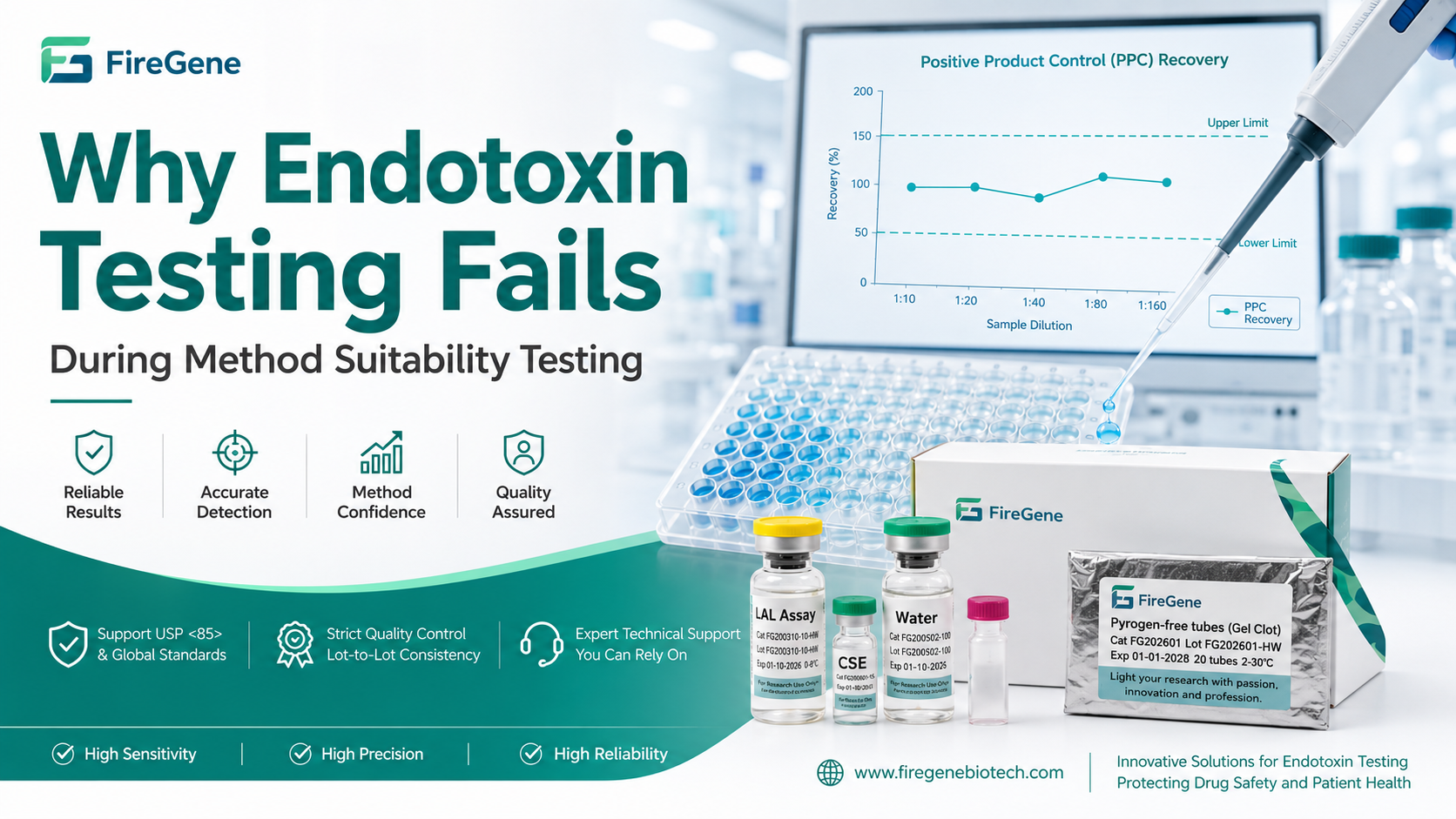
A PPC is prepared by adding a known concentration of Control Standard Endotoxin (CSE) directly into the product sample. The laboratory then evaluates whether the analytical method can recover this known endotoxin concentration despite the presence of the product matrix.
If recovery falls within the pharmacopeial acceptance criteria, the method is considered suitable for that sample under the tested conditions.
Conversely, poor PPC recovery often indicates that the product matrix is interfering with the TAL/LAL reaction.
Monitoring PPC recovery provides several important benefits:
- Confirms assay suitability.
- Detects matrix interference before routine testing.
- Supports method validation documentation.
- Increases confidence in product release decisions.
- Reduces the likelihood of false-negative or false-positive results.
Because PPC performance reflects the interaction between the assay and the product matrix, it often provides the earliest indication that additional method optimization may be required.
Understanding Inhibition: When Endotoxin Is Hidden
Inhibition is one of the most common reasons method suitability testing fails.
In an inhibited sample, endotoxin is present, but the product matrix suppresses the TAL/LAL reaction, causing the assay to underestimate or completely miss the actual endotoxin concentration.
This phenomenon creates a potentially dangerous situation because contaminated products may appear to meet release specifications.
Common causes of inhibition include:
- High protein concentrations
- Chelating agents that bind essential reaction ions
- Extreme pH conditions
- High salt concentrations
- Certain preservatives
- Detergents and surfactants
- Highly viscous formulations
Biological products are particularly susceptible because their complex molecular composition can interfere with the enzymatic cascade responsible for endotoxin detection.
Fortunately, inhibition can often be reduced through scientifically justified method optimization.
Common approaches include:
- Appropriate sample dilution
- pH adjustment within validated limits
- Optimization of buffer composition
- Evaluation of alternative assay formats
- Verification using repeated PPC studies
The goal is always to minimize matrix effects without compromising the assay's ability to detect clinically relevant endotoxin concentrations.
Understanding Enhancement: When Endotoxin Appears Higher Than It Really Is
While inhibition is often the primary concern in endotoxin testing, enhancement can be equally problematic. Instead of suppressing the TAL/LAL reaction, certain product components amplify the assay response, making endotoxin concentrations appear higher than they actually are.
Enhancement may trigger unnecessary Out-of-Specification (OOS) results, repeated testing, product release delays, and lengthy laboratory investigations—even when the product itself complies with endotoxin specifications.
Unlike true endotoxin contamination, enhancement is an analytical artifact caused by interactions between the product matrix and the enzymatic reaction within the TAL/LAL reagent.
Several formulation characteristics have been associated with enhanced endotoxin recovery, including:
- Certain surfactants and detergents
- High concentrations of divalent cations
- Formulation excipients that accelerate the enzymatic cascade
- Changes in ionic strength
- Specific buffer systems
Because enhancement artificially increases the measured endotoxin concentration, laboratories may mistakenly conclude that a manufacturing process has introduced contamination when the apparent increase is actually caused by the sample matrix.
This highlights why Positive Product Controls (PPCs) are so valuable. By comparing the recovery of a known endotoxin spike in the presence of the product, analysts can determine whether the matrix is influencing assay performance before routine testing begins.
Matrix Interference: The Most Common Challenge in Modern Biopharmaceuticals
Method suitability failures are frequently described as "matrix interference," but this term encompasses a wide range of interactions rather than a single analytical problem.
The matrix refers to everything in the sample other than endotoxin itself. Depending on the product, this may include proteins, antibodies, lipids, sugars, preservatives, salts, polymers, stabilizers, or other formulation ingredients.
These components can influence endotoxin testing through several mechanisms:
- Inhibiting the TAL/LAL enzymatic cascade
- Enhancing enzyme activity
- Binding endotoxins and reducing their availability
- Altering sample viscosity
- Changing pH beyond the assay's optimal range
- Increasing turbidity or optical interference in kinetic assays
Modern biologics present particularly complex matrices because they often contain high protein concentrations and sophisticated formulations designed to stabilize therapeutic molecules.
Cell and gene therapies introduce additional analytical challenges. Viral vectors, lipid nanoparticles, and novel excipients may behave differently from traditional injectable products, requiring careful method development and extensive suitability studies.
Rather than assuming that a validated method can be universally applied to every product, laboratories should evaluate each formulation individually and document that the selected analytical conditions remain appropriate.
Why Method Suitability Testing Fails
Although every product is unique, most failed method suitability studies can be traced to a relatively small number of root causes.
1. Inappropriate Sample Dilution
Dilution is one of the simplest ways to reduce matrix interference. However, excessive dilution may lower endotoxin concentrations below the assay's detection capability, while insufficient dilution may leave inhibitory substances at levels that continue to affect the reaction.
Determining an appropriate dilution factor requires balancing analytical sensitivity with interference reduction, while remaining within the product's Maximum Valid Dilution (MVD).
2. Product Formulation Changes
Even small modifications to a formulation can alter matrix behavior.
Changes involving:
- Buffer composition
- Stabilizers
- Surfactants
- Preservatives
- Protein concentration
- Manufacturing processes
may require repeating method suitability studies to verify continued assay performance.
3. Improper Reagent Handling
Biological reagents require careful storage and preparation.
Common errors include:
- Incorrect storage temperatures
- Using expired TAL/LAL reagents
- Improper reconstitution procedures
- Repeated freeze-thaw cycles
- Cross-contamination during preparation
Standardized laboratory procedures help minimize these avoidable variables.
4. Environmental Contamination
Laboratory contamination remains a frequent cause of inconsistent endotoxin testing.
Potential sources include:
- Non-pyrogen-free consumables
- Laboratory dust
- Pipette contamination
- Glassware
- Water quality
- Improper sample handling
Maintaining a controlled testing environment is essential for reliable analytical performance.
5. Inadequate Method Development
Sometimes the analytical method simply has not been sufficiently optimized for the product.
Insufficient evaluation of:
- Sample dilution
- Buffer selection
- Incubation conditions
- Instrument parameters
- Product characteristics
can lead to repeated suitability failures until appropriate adjustments are made.
Practical Troubleshooting Strategies
When method suitability fails, repeating the assay without understanding the underlying cause rarely solves the problem.
Instead, laboratories should adopt a systematic troubleshooting approach.
Review Positive Product Control Recovery
PPC results often provide the first indication of inhibition or enhancement. Comparing recoveries across multiple dilutions may reveal whether matrix effects decrease as the sample becomes more diluted.
Evaluate Sample Characteristics
Assess factors such as:
- pH
- Protein concentration
- Turbidity
- Viscosity
- Ionic strength
These characteristics frequently explain unexpected analytical behavior.
Verify Reagent Integrity
Confirm that TAL/LAL reagents, Control Standard Endotoxin (CSE), endotoxin-free water, and other materials were prepared, stored, and used according to manufacturer recommendations.
Review Instrument Performance
For kinetic assays, ensure that:
- Incubation temperature remains stable
- Microplate reader calibration is current
- Pipettes are qualified
- Timing between wells is consistent
Document Every Investigation
Detailed documentation supports regulatory compliance while helping laboratories identify recurring analytical trends over time.
Choosing the Right TAL/LAL Reagent for Method Suitability Studies
Successful method suitability testing depends not only on laboratory technique but also on the consistency of analytical reagents.
When selecting endotoxin testing reagents, laboratories should consider:
- Lot-to-lot consistency
- Comprehensive technical documentation
- Reliable Positive Product Control performance
- Compatibility with validated methods
- Technical support for troubleshooting
- Compliance with pharmacopeial requirements
FireGene provides a complete range of endotoxin testing solutions to support method development, validation, and routine quality control, including:
- Gel-Clot TAL/LAL Reagents
- Kinetic Chromogenic Endotoxin Test Kits
- Control Standard Endotoxin (CSE)
- Endotoxin-Free Water
-
Pyrogen-Free Consumables
Conclusion
Method suitability testing is much more than a regulatory requirement—it is the foundation of reliable bacterial endotoxin testing. Before laboratories can confidently interpret routine BET results, they must demonstrate that the analytical method performs accurately within the specific product matrix.
Failures during method suitability testing are often caused by inhibition, enhancement, or other forms of matrix interference rather than true endotoxin contamination. Recognizing these mechanisms allows laboratories to optimize analytical conditions, improve Positive Product Control recovery, and avoid unnecessary repeat testing or delayed product release.
As pharmaceutical formulations become increasingly sophisticated, especially in biologics, vaccines, and advanced therapies, matrix-related challenges will continue to grow. Laboratories that invest in robust method development, scientifically justified suitability studies, standardized procedures, and high-quality TAL/LAL reagents will be better equipped to generate accurate, reproducible, and regulatory-compliant endotoxin data.
Ultimately, successful endotoxin testing begins long before the first routine sample is analyzed. By understanding the causes of method suitability failures and implementing proactive troubleshooting strategies, manufacturers can strengthen quality control, improve operational efficiency, and ensure that every batch released meets the highest standards of patient safety.
Case Study: Resolving Matrix Interference During Method Suitability Testing
A pharmaceutical company developing a recombinant protein injectable encountered repeated failures during endotoxin method suitability testing. Although routine system suitability checks met all acceptance criteria, the Positive Product Control (PPC) recovery consistently fell below the pharmacopeial acceptance range, preventing completion of method validation.
Initial investigations focused on reagent quality, instrument calibration, and analyst technique. All laboratory controls performed as expected, indicating that the analytical system itself was functioning correctly.
The quality control team then expanded the investigation to evaluate the product formulation. The recombinant protein contained a relatively high concentration of stabilizing excipients and surfactants intended to maintain protein integrity during storage. These formulation components were suspected of suppressing the enzymatic cascade of the TAL/LAL assay.
Rather than repeating the same procedure, the laboratory systematically optimized the analytical method by evaluating multiple sample dilutions while remaining within the product's Maximum Valid Dilution (MVD). Additional assessments confirmed that sample pH remained within the recommended analytical range and that reagent preparation procedures were fully standardized across analysts.
Following optimization, PPC recovery returned to acceptable limits, allowing the laboratory to complete method suitability successfully. The validated procedure was subsequently implemented for routine batch release testing with consistent analytical performance.
This example illustrates an important lesson for pharmaceutical laboratories: method suitability failures often reflect matrix interference rather than product contamination. A structured, science-based investigation is far more effective than repeated testing without understanding the underlying cause.
Frequently Asked Questions (FAQ)
1. What is method suitability testing in bacterial endotoxin testing?
Method suitability testing demonstrates that a specific pharmaceutical product can be accurately analyzed using a chosen bacterial endotoxin test method. It confirms that the product matrix does not inhibit or enhance the TAL/LAL reaction and that the analytical procedure is appropriate for routine quality control.
2. Why does USP <85> require method suitability testing?
USP <85> recognizes that pharmaceutical formulations differ significantly in composition. Proteins, lipids, buffers, surfactants, preservatives, and excipients may all influence endotoxin detection. Method suitability studies verify that these components do not interfere with accurate endotoxin recovery before routine testing begins.
3. What is Positive Product Control (PPC)?
A Positive Product Control is prepared by adding a known amount of Control Standard Endotoxin (CSE) to the product sample. The recovered endotoxin demonstrates whether the sample matrix interferes with the analytical method. PPC recovery is one of the most important indicators of successful method suitability.
4. What causes endotoxin inhibition?
Inhibition occurs when components within the product matrix suppress the TAL/LAL enzymatic reaction, causing the assay to underestimate endotoxin concentrations. Common causes include high protein concentrations, chelating agents, extreme pH values, surfactants, preservatives, and high salt levels.
5. What is enhancement in endotoxin testing?
Enhancement occurs when the sample matrix artificially increases the assay response, making endotoxin concentrations appear higher than they actually are. Although less common than inhibition, enhancement may lead to unnecessary OOS investigations and delayed product release.
6. What is matrix interference?
Matrix interference refers to any interaction between the pharmaceutical formulation and the endotoxin assay that affects analytical performance. Matrix effects may cause inhibition, enhancement, altered reaction kinetics, or optical interference depending on product composition.
7. How can laboratories reduce matrix interference?
Several approaches may improve analytical performance:
- Optimize sample dilution
- Verify pH within acceptable limits
- Use validated endotoxin-free reagents
- Standardize reagent preparation
- Perform comprehensive method development
- Evaluate multiple dilution factors during method suitability
Any optimization should remain scientifically justified and comply with pharmacopeial guidance.
8. When should method suitability studies be repeated?
Method suitability should be reassessed whenever significant changes occur that could affect assay performance, including:
- New formulations
- Manufacturing process changes
- Raw material modifications
- Changes in analytical equipment
- Introduction of new TAL/LAL reagent lots (when required by internal procedures)
- Major process validation updates
Routine periodic review also helps ensure continued analytical reliability.
9. Which endotoxin testing method is best for products with complex matrices?
There is no universal answer. Gel-Clot assays remain highly reliable for many applications, while Kinetic Chromogenic assays provide quantitative data and greater flexibility for method optimization. The most appropriate method depends on the product, regulatory requirements, and laboratory workflow.
10. How can FireGene help with method suitability testing?
FireGene provides a comprehensive portfolio of endotoxin testing solutions—including Gel-Clot TAL/LAL Reagents, Kinetic Chromogenic Endotoxin Test Kits, Control Standard Endotoxin (CSE), Endotoxin-Free Water, and Pyrogen-Free Consumables—to support method development, validation, routine endotoxin testing, and pharmaceutical quality control. When combined with robust analytical procedures and properly designed suitability studies, these products help laboratories improve testing consistency, reduce matrix-related variability, and support compliance with USP <85>.
Key Takeaways
Method suitability testing is the foundation of reliable bacterial endotoxin testing and should never be viewed as a routine administrative requirement. Instead, it is a scientific evaluation that demonstrates whether an analytical method can accurately measure endotoxins within a specific pharmaceutical formulation.
The most important lessons from this guide include:
- Method suitability verifies the compatibility between the assay and the product matrix, not simply the performance of the analytical system.
- Inhibition and enhancement are the two primary mechanisms of analytical interference, both of which can lead to inaccurate endotoxin results if left unresolved.
- Positive Product Controls (PPCs) provide critical evidence that the method can recover endotoxin accurately in the presence of the product.
- Matrix interference is increasingly common in modern biologics, vaccines, and advanced therapies, making robust method development more important than ever.
- A systematic troubleshooting approach—including evaluation of sample dilution, pH, reagent integrity, and instrument performance—is more effective than simply repeating failed assays.
- High-quality TAL/LAL reagents, validated analytical procedures, and standardized laboratory practices help laboratories achieve consistent, reproducible, and regulatory-compliant endotoxin testing.
By understanding the science behind method suitability testing and proactively addressing matrix-related challenges, pharmaceutical manufacturers can reduce analytical variability, minimize unnecessary investigations, accelerate batch release, and maintain the highest standards of product quality and patient safety.
FireGene Endotoxin Testing
Ready to run your endotoxin assay?
FireGene offers a complete endotoxin testing toolkit — from TAL reagents and CSE standards to pyrogen-free consumables and LAL reagent water. All products are aligned with USP <85>, EP 2.6.14, and JP 4.01.


