
Single-cell and single-nucleus sequencing technologies have transformed biomedical research by enabling scientists to study gene expression at unprecedented resolution. However, obtaining high-quality nuclei from blood vessel tissues remains one of the greatest challenges in vascular biology. Dense extracellular matrices, tightly connected endothelial cells, and delicate smooth muscle cells often make traditional cell dissociation inefficient and damaging.
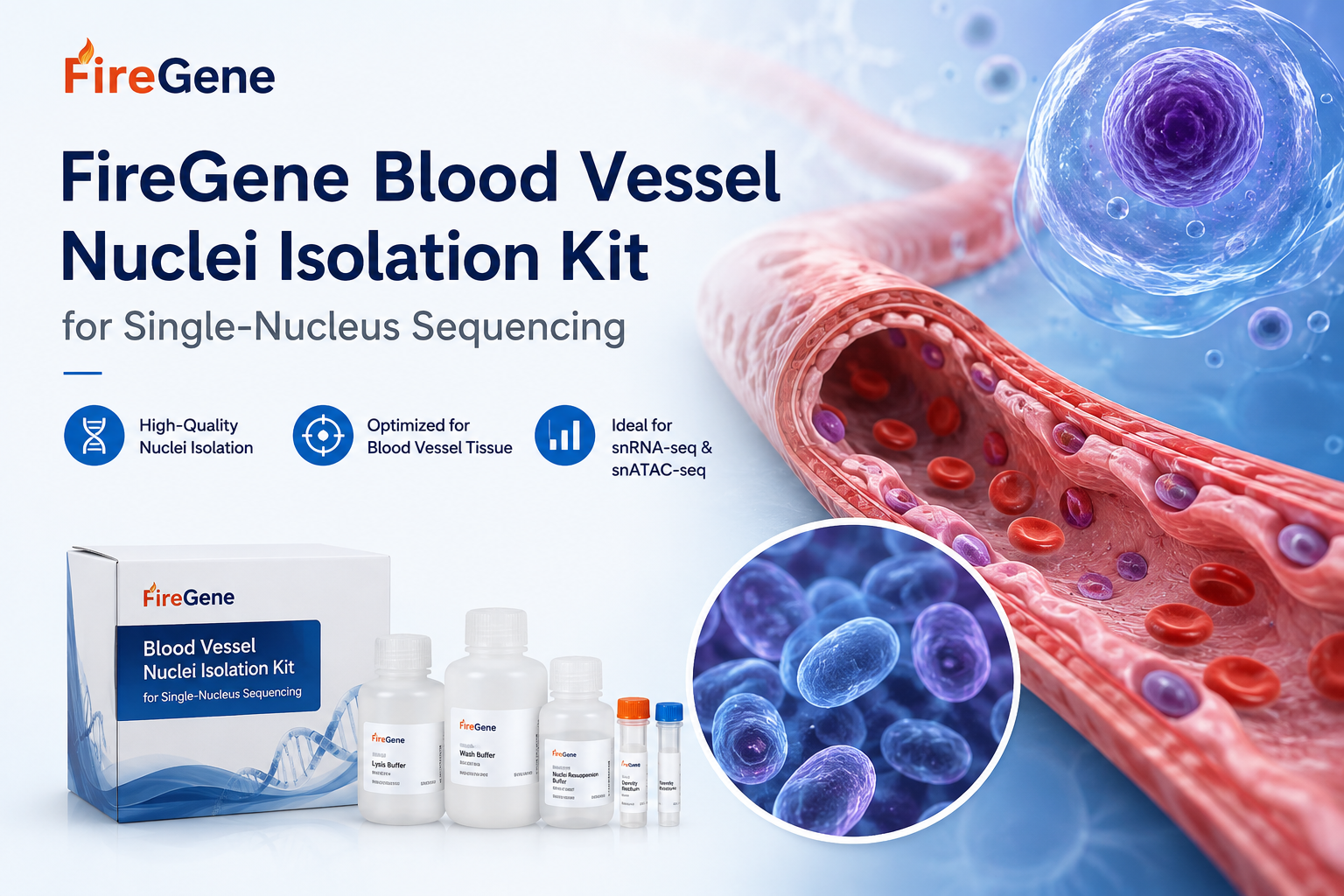
The FireGene Blood Vessel Nuclei Isolation Kit for Single-Nucleus Sequencing is specifically designed to overcome these obstacles. By providing an optimized nuclei isolation workflow for vascular tissues, the kit helps researchers generate high-quality nuclei suitable for downstream single-nucleus RNA sequencing (snRNA-seq) and single-nucleus ATAC sequencing (snATAC-seq).
In this article, we'll explore why nuclei isolation is essential for vascular research, how the FireGene kit works, its key advantages, and its applications in cardiovascular and translational research.
Why Is Blood Vessel Tissue Difficult to Analyze?
Unlike soft tissues, blood vessels are composed of multiple tightly integrated cell types surrounded by abundant extracellular matrix proteins such as collagen and elastin. These structural features provide mechanical strength but create significant challenges during sample preparation.
Traditional enzymatic dissociation often results in:
· Low cell recovery
· Cell membrane damage
· Loss of fragile cell populations
· Stress-induced changes in gene expression
· Reduced sequencing quality
For many vascular studies, especially those involving frozen or archived samples, obtaining intact single cells is nearly impossible.
This is where single-nucleus sequencing provides an important advantage.
What Is Single-Nucleus Sequencing?
Single-nucleus sequencing (SNS) analyzes isolated nuclei rather than intact whole cells.
Instead of separating complete cells, researchers isolate nuclei while preserving nuclear RNA and chromatin structure. This approach is especially valuable for tissues that are difficult to dissociate or contain fragile cell types.
Common single-nucleus technologies include:
· Single-Nucleus RNA Sequencing (snRNA-seq)
· Single-Nucleus ATAC Sequencing (snATAC-seq)
· Single-nucleus multiomics
· Nuclear transcriptome profiling
· Chromatin accessibility analysis
Because nuclei are more resistant to mechanical stress than intact cells, researchers can often obtain higher-quality sequencing data from complex tissues.
Why Choose the FireGene Blood Vessel Nuclei Isolation Kit?
The FireGene Blood Vessel Nuclei Isolation Kit for Single-Nucleus Sequencing is specifically optimized for vascular tissues, providing an efficient workflow that minimizes sample damage while maximizing nuclei recovery.
Rather than relying on generic nuclei extraction methods, this kit is designed to address the unique characteristics of blood vessel samples.
Its optimized chemistry supports:
· Efficient cell membrane lysis
· Preservation of nuclear integrity
· High RNA quality
· Removal of tissue debris
· Reduced nuclei aggregation
· Improved compatibility with downstream sequencing workflows
The result is a clean, high-quality nuclei suspension ready for library preparation.
Key Features of the FireGene Blood Vessel Nuclei Isolation Kit
Researchers benefit from several important features:
Optimized for Blood Vessel Tissue
The kit is specifically developed for vascular tissues rather than general-purpose nuclei isolation.
Supports Multiple Sample Types
The workflow is compatible with:
· Fresh blood vessel tissue
· Frozen vascular tissue
· Cryopreserved tissue
· Vascular cell suspensions
This flexibility makes it suitable for both prospective studies and archived specimen collections.
Gentle Nuclei Isolation
The optimized lysis buffer selectively disrupts cell membranes while preserving intact nuclei, minimizing RNA degradation.
Density Gradient Purification
Following lysis, density-gradient purification removes:
· Cell debris
· Membrane fragments
· Extracellular contaminants
· Dead cell material
This purification step improves nuclei purity and sequencing performance.
RNA Preservation
The workflow is performed under cold conditions to maintain RNA integrity throughout the isolation process.
FireGene Blood Vessel Nuclei Isolation Workflow
The kit follows a straightforward protocol suitable for research laboratories.
Step 1. Tissue Collection
Fresh or frozen vascular tissue is collected and maintained under cold conditions.
Step 2. Mechanical Homogenization
The tissue is gently homogenized to release cellular contents while minimizing nuclear damage.
Step 3. Cell Membrane Lysis
Specialized lysis reagents selectively remove plasma membranes without disrupting nuclei.
Step 4. Filtration
The sample is filtered to eliminate large tissue fragments and aggregates.
Step 5. Density Gradient Centrifugation
Density-gradient purification enriches intact nuclei and removes contaminants.
Step 6. Washing
Purified nuclei are washed to remove residual reagents.
Step 7. Quality Assessment
Researchers evaluate nuclei concentration, morphology, and viability before sequencing library preparation.
The streamlined workflow helps produce consistent results across multiple experiments.
Applications in Vascular Research
The FireGene Blood Vessel Nuclei Isolation Kit supports numerous research areas.

1. Atherosclerosis Research
Single-nucleus sequencing enables researchers to identify cellular changes that occur during plaque formation and progression.
Scientists can investigate:
· Endothelial dysfunction
· Smooth muscle cell phenotypes
· Immune cell infiltration
· Plaque heterogeneity
These insights may contribute to the development of targeted cardiovascular therapies.
2. Cardiovascular Disease Studies
Researchers studying cardiovascular diseases can examine gene expression patterns across individual vascular cell populations.
Applications include:
· Hypertension
· Coronary artery disease
· Peripheral artery disease
· Vascular remodeling
Understanding cell-specific transcriptional changes provides valuable mechanistic insights.
3. Angiogenesis Research
Blood vessel formation plays an essential role in:
· Wound healing
· Tissue regeneration
· Cancer progression
· Diabetic complications
High-quality nuclei isolation enables detailed investigation of endothelial cell biology during angiogenesis.
4. Vascular Inflammation
Inflammatory responses involve interactions among endothelial cells, immune cells, and smooth muscle cells.
Single-nucleus sequencing allows researchers to characterize these cellular interactions at high resolution.
5. Fibrosis and Tissue Remodeling
Fibrotic remodeling alters vascular structure in many chronic diseases.
The kit supports studies of:
· Fibroblast activation
· Extracellular matrix remodeling
· Cellular signaling pathways
· Disease progression
Compatible Downstream Technologies
The isolated nuclei are suitable for multiple advanced sequencing applications, including:
· Single-Nucleus RNA Sequencing (snRNA-seq)
· Single-Nucleus ATAC Sequencing (snATAC-seq)
· Multiomic sequencing
· Nuclear transcriptomics
· Epigenomic profiling
· Chromatin accessibility studies
· Gene regulatory network analysis
Researchers can integrate these datasets to gain a comprehensive understanding of vascular biology.
Advantages Over Traditional Cell Dissociation
Compared with conventional enzymatic digestion, nuclei isolation offers several important advantages.
|
Traditional Cell Isolation |
FireGene Nuclei Isolation |
|
Difficult for fibrous tissues |
Optimized for vascular tissue |
|
Cell stress alters gene expression |
Reduced dissociation-induced artifacts |
|
Lower recovery of fragile cells |
Higher nuclei recovery |
|
Limited frozen tissue compatibility |
Supports frozen samples |
|
Higher cell damage |
Preserves nuclear integrity |
|
More debris and aggregates |
Cleaner nuclei preparations |
These advantages make nuclei isolation an increasingly preferred strategy for challenging tissue types.
Best Practices for Successful Nuclei Isolation
To achieve optimal results, researchers should follow several recommendations:
· Keep all reagents and samples cold throughout the procedure.
· Process tissues as quickly as possible after collection.
· Use RNase-free consumables and reagents.
· Avoid excessive homogenization that may damage nuclei.
· Filter samples thoroughly to remove tissue fragments.
· Evaluate nuclei quality before sequencing.
· Add RNase inhibitors when preparing samples for RNA-based applications.
Careful sample handling helps maximize sequencing quality and reproducibility.
Conclusion
As single-nucleus sequencing continues to expand across cardiovascular and translational research, reliable sample preparation has become more important than ever. Blood vessel tissues present unique challenges due to their dense extracellular matrix and complex cellular architecture, making conventional single-cell isolation methods less effective.
The FireGene Blood Vessel Nuclei Isolation Kit for Single-Nucleus Sequencing provides a specialized solution for isolating high-quality nuclei from vascular tissues while preserving nuclear integrity and RNA quality. With an optimized workflow, compatibility with fresh and frozen samples, and support for leading applications such as snRNA-seq and snATAC-seq, the kit enables researchers to generate robust, reproducible data for studies of vascular biology, cardiovascular disease, angiogenesis, inflammation, and tissue remodeling.
For laboratories seeking reliable nuclei isolation from challenging blood vessel specimens, the FireGene kit offers an efficient and reproducible foundation for high-resolution single-nucleus sequencing workflows.


