
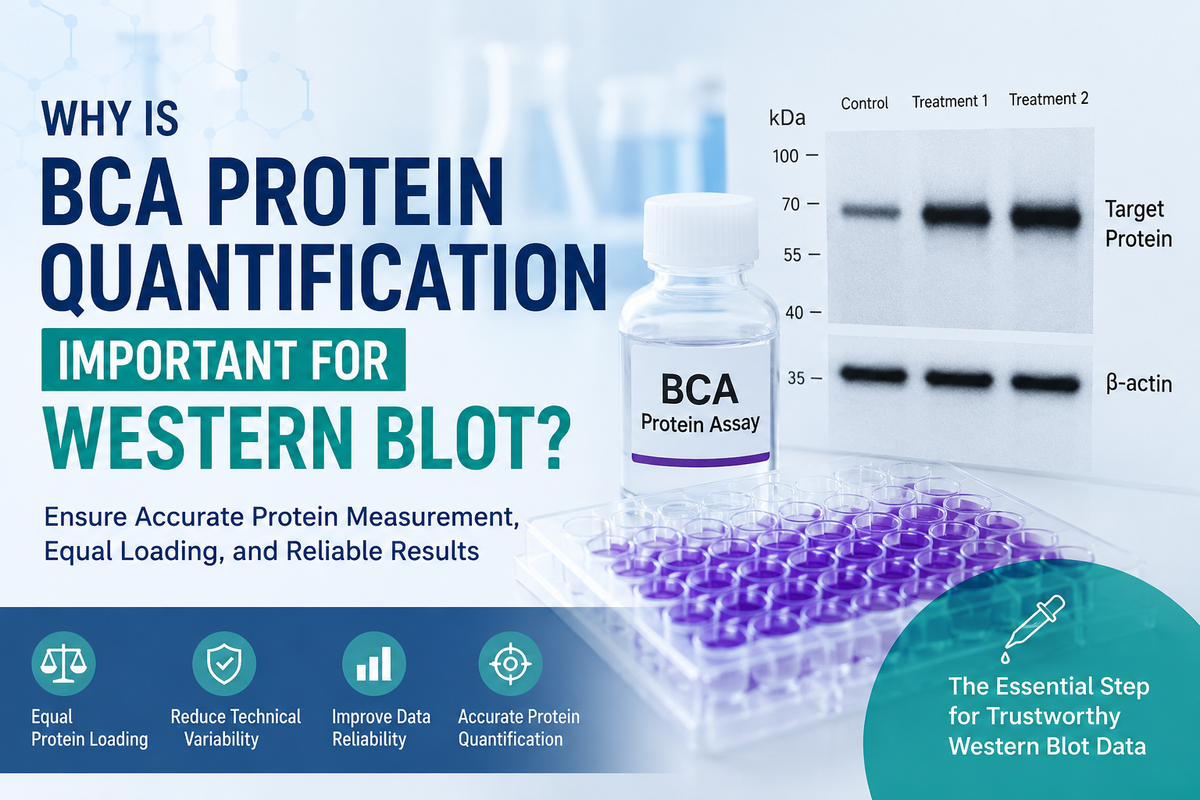
Western blot (WB) is one of the most widely used techniques for detecting and analyzing specific proteins in biological samples. However, obtaining reliable Western blot results depends on more than electrophoresis, antibody selection, and membrane transfer. Accurate protein quantification before Western blotting is an essential step for achieving consistent and interpretable results.
Among the available protein assays, the BCA protein assay is frequently used to determine the total protein concentration of cell lysates, tissue extracts, and other biological samples before Western blot analysis.
But why is BCA protein quantification so important for Western blot? The main reason is simple: BCA quantification helps researchers load an equivalent amount of total protein from each sample, allowing differences in target protein expression to be interpreted more reliably.
What Is BCA Protein Quantification?
The Bicinchoninic Acid (BCA) assay is a colorimetric method used to determine the total protein concentration in a sample.
The principle of the BCA assay is based on the reduction of Cu²⁺ to Cu⁺ by proteins under alkaline conditions. The resulting Cu⁺ ions react with bicinchoninic acid to form a purple-colored complex. The intensity of the purple color is proportional to the amount of protein present in the sample.
The absorbance is typically measured using a microplate reader or spectrophotometer, commonly at approximately 562 nm.
A standard curve is generated using known concentrations of a protein standard, often bovine serum albumin (BSA). The protein concentration of unknown samples can then be calculated from the standard curve.
For example, BCA analysis may show:
|
Sample |
Protein Concentration |
|
Control |
2.0 mg/mL |
|
Treatment A |
1.0 mg/mL |
|
Treatment B |
0.5 mg/mL |
Although these samples may have been prepared using the same extraction procedure, their final protein concentrations can be substantially different.
This difference becomes important when preparing samples for Western blotting.
Why Is Protein Quantification Important Before Western Blot?
The fundamental purpose of protein quantification before WB is to achieve equal protein loading.
Suppose a researcher wants to load 20 μg of total protein per lane.
If the control sample has a concentration of 2 mg/mL, the required volume is:
20 μg ÷ 2 μg/μL = 10 μL
If the treatment sample has a concentration of 1 mg/mL:
20 μg ÷ 1 μg/μL = 20 μL
Therefore, different volumes of the two samples must be loaded to obtain the same total protein amount.
Without protein quantification, a researcher might simply load the same volume of every sample. However, equal volume does not necessarily mean equal protein.
For example:
Control: 10 μL × 2 μg/μL = 20 μg protein
Treatment: 10 μL × 1 μg/μL = 10 μg protein
Although both lanes receive 10 μL, the actual protein amounts are different.
Consequently, differences in Western blot band intensity may reflect unequal protein loading rather than genuine changes in protein expression.
BCA Protein Assay Helps Reduce Loading-Related Variability
Western blot analysis is often used to compare protein expression between different experimental groups.
For example, researchers may compare:
Control vs. drug-treated cells
Normal vs. disease tissues
Wild-type vs. mutant cells
Untreated vs. stimulated cells
Different time points
Different treatment concentrations
In these experiments, the goal is usually to determine whether the experimental condition increases or decreases the expression of a specific protein.

If the amount of total protein loaded into each lane is inconsistent, however, interpretation becomes more difficult.
Imagine that the target protein appears significantly stronger in the treatment group. There are at least two possible explanations:
The treatment genuinely increased target protein expression.
More total protein was loaded into the treatment lane.
BCA protein quantification helps address the second possibility by allowing researchers to normalize samples before electrophoresis.
Thus, accurate protein quantification improves the comparability of Western blot samples and reduces technical variation associated with unequal loading.
BCA Quantification and Western Blot Sample Preparation
A typical workflow for quantitative Western blotting can be summarized as:
Sample collection → Protein extraction → BCA protein assay → Protein concentration adjustment → Equal protein loading → SDS-PAGE → Transfer → Antibody incubation → Detection → Quantification
After determining protein concentrations, samples can be diluted or concentrated to achieve a similar protein concentration across experimental groups.
The researcher then calculates the volume required to obtain the desired amount of protein for each lane.
For example, if the target loading amount is 20 μg per lane, the appropriate sample volume is calculated based on the BCA-determined concentration.
After adjusting the samples, an appropriate amount of SDS-PAGE sample buffer or loading buffer is added according to the experimental protocol. Samples are then prepared for electrophoresis.
This process makes the initial protein input more consistent across samples.
Is BCA Enough? The Role of Loading Controls
An important point is that BCA protein quantification and Western blot loading controls serve different purposes.
BCA determines the approximate total protein concentration before electrophoresis. A loading control is used during Western blot analysis to help assess whether comparable amounts of protein were loaded and transferred.
Common loading control proteins include:
β-actin
GAPDH
α-tubulin
Other validated housekeeping or normalization proteins
For example, a researcher may measure a target protein and β-actin in the same set of samples.
If the target protein increases while the loading control remains relatively consistent, the result provides stronger evidence that the observed change is associated with the experimental treatment rather than a major loading difference.
Therefore, a common strategy is:
BCA quantification → equal protein loading → loading-control normalization → target protein quantification
These steps complement each other rather than replace one another.
Why Equal Protein Loading Matters for Western Blot Quantification
Western blot is frequently used not only for qualitative detection but also for semi-quantitative or quantitative analysis.
Researchers may measure band intensity using image analysis software and compare normalized protein expression between experimental groups.
For example:
Relative target protein expression = Target protein signal / Loading control signal
If BCA quantification is not performed properly, differences in total protein input can introduce systematic errors into the calculation.
Unequal loading may result in:
Artificially stronger bands
Artificially weaker bands
Increased experimental variability
Poor reproducibility
Misinterpretation of treatment effects
Less reliable statistical analysis
This is particularly important when the expected biological difference between experimental groups is relatively small.
Limitations of BCA Protein Quantification
Although BCA is convenient and widely used, it is not completely free from limitations.
The BCA assay can be affected by certain substances commonly present in protein extraction buffers, including some reducing agents, chelating agents, and detergents. Therefore, the compatibility between the BCA assay and the sample buffer should be considered before performing the assay.
In addition, protein-to-protein differences in chemical composition can influence the response of colorimetric protein assays. For this reason, BSA is commonly used as the calibration standard, although the response of the actual sample proteins may differ from BSA.
Researchers should also ensure that the samples and standards are handled consistently and that the standard curve is appropriate for the concentration range being measured.
BCA vs. Simply Loading the Same Sample Volume
One of the most common misconceptions in Western blotting is that the same sample volume should be loaded into every lane.
In reality:
Equal volume does not necessarily mean equal protein.
Two samples can have completely different protein concentrations even when they originate from the same type of biological material.
BCA quantification allows researchers to calculate the appropriate volume required to achieve equal protein loading.
Therefore, if the goal is to compare protein expression accurately, measuring protein concentration before WB is generally much more reliable than simply loading an identical volume of every sample.
Best Practices for BCA Protein Quantification Before WB
To obtain reproducible results, several factors should be carefully controlled.
1. Use a consistent protein extraction procedure
Samples should be processed using comparable extraction conditions to minimize technical variability.
2. Prepare an appropriate standard curve
Protein standards should cover the expected concentration range of the unknown samples.
3. Consider buffer compatibility
Check whether the lysis buffer contains substances that may interfere with the BCA assay.
4. Measure samples consistently
Incubation time, temperature, reagent ratio, and absorbance measurement conditions should be consistent across samples.
5. Normalize protein concentrations
After determining protein concentrations, adjust samples so that an equivalent amount of total protein can be loaded into each lane.
6. Use an appropriate loading control
β-actin, GAPDH, tubulin, or another validated normalization strategy can provide additional confidence in Western blot analysis.
Conclusion
BCA protein quantification is an important preparatory step for Western blotting because it enables researchers to determine protein concentrations and achieve more consistent protein loading across samples.
Without protein quantification, equal sample volumes may contain very different amounts of total protein, making differences in Western blot band intensity difficult to interpret.
A reliable workflow therefore combines BCA protein assay, equal protein loading, appropriate loading controls, and normalization of target protein signals.
In practical terms, BCA helps answer a fundamental question before starting Western blotting:
“How much protein am I actually loading into each lane?”
By controlling this variable, researchers can reduce technical variation and obtain more reliable, reproducible, and scientifically meaningful Western blot results.


