
Introduction
Radiopharmaceuticals are becoming increasingly important in modern medicine.
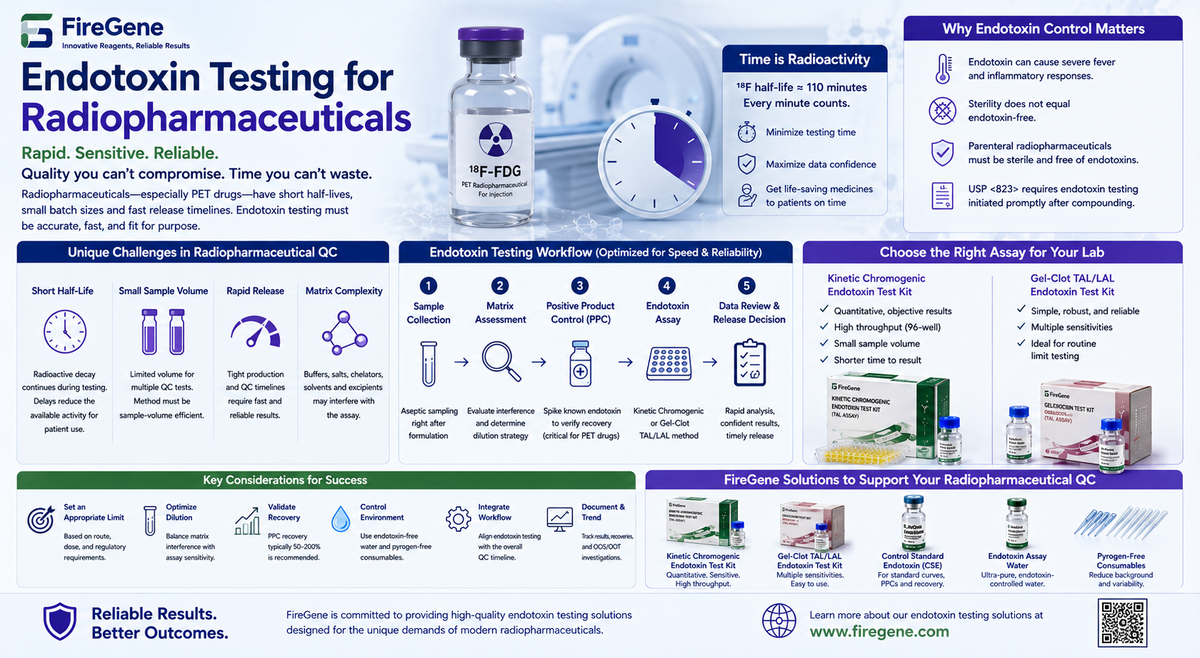
From diagnostic positron emission tomography (PET) agents to therapeutic radiopharmaceuticals used in oncology, these products combine pharmaceutical science with nuclear medicine.
However, this combination creates a unique quality-control challenge.
A conventional injectable drug may have a relatively long shelf life, substantial sample volume, and sufficient time for multiple QC tests.
A radiopharmaceutical may have:
- A very short radioactive half-life
- Extremely small batch sizes
- Limited sample volume
- Rapid release requirements
- Complex synthesis and purification workflows
- Strict sterility requirements
- Strict endotoxin control requirements
This creates an unusual situation for QC laboratories:
The endotoxin test must be reliable—but it may also need to fit into a very narrow operational window.
For PET radiopharmaceuticals in particular, delaying release for an extended endotoxin testing procedure may significantly reduce the practical value of the product because radioactive decay continues throughout the QC process.
USP materials concerning PET radiopharmaceuticals state that sterile PET radiopharmaceutical products for parenteral administration must be sterile and free of endotoxins, with endotoxin testing initiated promptly after compounding.
At the same time, FDA's revised March 2026 Pyrogen and Endotoxins Testing: Questions and Answers provides updated recommendations concerning bacterial endotoxin testing, including gel-clot, photometric, and kinetic methods.
For manufacturers and radiopharmacy laboratories, this makes rapid, sensitive, and product-specific endotoxin testing an increasingly important part of the overall QC strategy.
1. What Are Radiopharmaceuticals?
Radiopharmaceuticals are medicinal products that contain a radioactive isotope and are used for diagnostic or therapeutic purposes.
They can broadly be divided into two categories.
Diagnostic Radiopharmaceuticals
These are used to visualize biological processes.
PET radiopharmaceuticals are one important example.
They can help clinicians evaluate:
- Tumor metabolism
- Organ function
- Blood flow
- Receptor expression
- Neurological activity
- Other physiological processes
Therapeutic Radiopharmaceuticals
These deliver radiation directly to targeted tissues.
They are increasingly being explored and used for cancer treatment, including targeted radionuclide therapies.
Regardless of the intended application, many radiopharmaceuticals are administered parenterally.
That means endotoxin control remains a critical quality consideration.
2. Why Endotoxin Testing Is Critical for Radiopharmaceuticals
Endotoxin is primarily composed of lipopolysaccharide (LPS) from the outer membrane of Gram-negative bacteria.
Even very small quantities can produce significant biological effects when introduced into the body.
This is particularly important for parenteral radiopharmaceuticals.
USP materials for PET radiopharmaceuticals explicitly state that finished PET radiopharmaceuticals intended for parenteral administration should be sterile and free of endotoxins.
The key point is:
Sterility and endotoxin control address different risks.
A product can be:
- Sterile
- Free of detectable viable microorganisms
and still contain:
- Bacterial endotoxin
Therefore:
Sterility testing cannot replace endotoxin testing.
3. Why Radiopharmaceutical Endotoxin Testing Is Different
The biggest difference is not necessarily the endotoxin assay itself.
It is the operational environment surrounding the assay.
Radiopharmaceutical production often involves:
Synthesis
↓
Purification
↓
Formulation
↓
Sterile filtration
↓
QC testing
↓
Patient administration
All of these steps can occur within a very limited time window.
For a conventional pharmaceutical product, an endotoxin test may be one component of a longer release process.
For a short-lived radiopharmaceutical, the QC laboratory may need to generate reliable results quickly enough to support clinical use.
This creates several unique challenges.
4. Short Radioactive Half-Life Changes the QC Strategy
Many PET radiopharmaceuticals have relatively short radioactive half-lives.
For example, fluorine-18 has a physical half-life of approximately 110 minutes.
That means the radioactive activity decreases continuously while the product is being tested.
Consider a simplified workflow:
Production
↓
Sterile filtration
↓
Endotoxin testing
↓
Sterility-related QC
↓
Release
↓
Administration
If the QC process takes too long, a significant proportion of the radioactive activity may be lost before administration.
Therefore, the laboratory has to balance:
Analytical reliability
with
Time-to-release
This is one of the most important differences between radiopharmaceutical QC and conventional pharmaceutical QC.
5. Rapid Testing Does Not Mean Lower Testing Standards
A common misconception is:
“Because the product has a short half-life, the endotoxin test can be simplified.”
The correct approach is different.
The method should be efficient without compromising analytical suitability.
That means the laboratory should still evaluate:
- Endotoxin limit
- Assay sensitivity
- Sample interference
- Positive Product Control
- Standard curve
- Dilution
- Recovery
- Controls
- Instrument performance
The objective is not simply to obtain a result faster.
The objective is to obtain a reliable result within the available product-use window.
6. Small Sample Volumes Create Another Challenge
Radiopharmaceutical batches may be relatively small compared with conventional pharmaceutical manufacturing batches.
This can result in limited sample availability.
The laboratory may have only a small volume available for:
- Endotoxin testing
- Sterility-related testing
- Radiochemical purity
- Chemical purity
- Identity
- Other QC assays
This creates a practical requirement:
The endotoxin method should use sample volume efficiently.
Kinetic chromogenic assays can be useful in this context because microplate-based workflows can support multiple standards, controls, dilutions, and samples within a single analytical run.
FireGene's Kinetic Chromogenic Endotoxin Test Kit uses a 96-well format and kinetic absorbance detection at 405 nm. The manufacturer's current product information specifies a stated detection range of 0.005–10 EU/mL and compatibility with standard microplate readers capable of 405 nm absorbance measurement.
7. Why Kinetic Chromogenic Testing Can Be Attractive
Kinetic chromogenic endotoxin testing measures the development of a chromogenic signal over time.
The general workflow is:
Endotoxin
↓
Factor C activation
↓
Enzymatic cascade
↓
Chromogenic substrate cleavage
↓
Color development
↓
405 nm kinetic measurement
↓
Standard curve
↓
EU/mL result
Compared with a simple visual endpoint, this approach provides quantitative information.
For radiopharmaceutical QC laboratories, potential advantages include:
- Quantitative endotoxin concentration
- Automated optical detection
- Reduced subjective interpretation
- Multiple samples per plate
- Efficient use of small sample volumes
- Easier data recording
- Potential integration with electronic QC workflows
However, the method still needs to be demonstrated as suitable for the specific radiopharmaceutical matrix.
8. Gel-Clot Testing Still Has Practical Value
Kinetic chromogenic testing is not automatically the best solution for every radiopharmaceutical laboratory.
Gel-Clot TAL/LAL testing remains a straightforward approach when the laboratory needs a limit-test format.
The method is based on formation of a stable gel in the presence of endotoxin above the assay sensitivity.
FireGene offers Gel-Clot TAL/LAL Reagent in several sensitivity levels, including:
- 0.03 EU/mL
- 0.06 EU/mL
- 0.125 EU/mL
- 0.25 EU/mL
- 0.5 EU/mL
FireGene Gel-Clot TAL/LAL Endotoxin Test Kit
The appropriate method depends on:
- Product endotoxin limit
- Sample volume
- Required sensitivity
- Matrix behavior
- Laboratory equipment
- Validated procedure
- Release timeline
9. Sample Matrix Can Complicate Radiopharmaceutical Endotoxin Testing
Radiopharmaceutical formulations can vary significantly.
Depending on the product, the formulation may contain:
- Salts
- Buffers
- Organic compounds
- Chelating agents
- Stabilizers
- Alcohols
- Sugars
- Other excipients
These components can potentially affect the endotoxin reaction.
Possible effects include:
- Inhibition
- Enhancement
- Nonlinear response
- Poor recovery
- Unexpected assay variability
This is why the endotoxin test should not be treated as a simple “plug-and-play” assay.
10. Why Positive Product Control Is Essential
A Positive Product Control, or PPC, is designed to determine whether endotoxin can be recovered appropriately from the actual product matrix.
The principle is:
Radiopharmaceutical sample
Known endotoxin spike
↓
Endotoxin assay
↓
Recovery calculation
If the spiked endotoxin is recovered appropriately, this provides evidence that the sample matrix does not significantly interfere with the assay under the tested conditions.
If recovery is unacceptable, the laboratory may need to investigate:
- Sample dilution
- pH
- Formulation components
- Assay conditions
- Reagent compatibility
- Sample preparation
FireGene's Control Standard Endotoxin (CSE) is intended for lysate sensitivity confirmation, interference testing, and positive-control applications in both Gel-Clot and chromogenic endotoxin testing.
11. Why a Passing Standard Curve Is Not Enough
This is one of the most important concepts in endotoxin testing.
A laboratory may obtain:
Excellent standard curve
Acceptable controls
Stable instrument performance
and still have an unsuitable product result.
Why?
Because the standard curve evaluates the response of the assay to known endotoxin standards.
It does not automatically demonstrate that the radiopharmaceutical matrix allows endotoxin to be detected correctly.
Therefore:
Standard curve performance
PPC recovery
Appropriate controls
Validated sample preparation
are all important components of method suitability.
FireGene's recent guide on How to Choose the Right Sensitivity and Dilution for Kinetic Chromogenic Endotoxin Testing discusses this balance between assay sensitivity, dilution, matrix interference, and MVD in greater detail.
12. Dilution Is a Balance Between Interference and Sensitivity
If a radiopharmaceutical matrix interferes with the assay, dilution may reduce the interference.
For example:
Original sample
↓
1:2 dilution
↓
1:4 dilution
↓
1:8 dilution
↓
1:16 dilution
As dilution increases, matrix components become less concentrated.
But endotoxin concentration also decreases.
This creates a fundamental balance:
Dilute enough to reduce interference—but not so much that endotoxin becomes difficult to detect.
This is particularly important for radiopharmaceuticals because the available sample volume may be limited.
13. Maximum Valid Dilution Still Matters
The Maximum Valid Dilution (MVD) provides an upper boundary for sample dilution under the applicable endotoxin-testing framework.
The basic relationship is:
MVD = Endotoxin Limit / λ
where:
- MVD = Maximum Valid Dilution
- Endotoxin Limit = applicable product limit
- λ = labeled assay sensitivity
For example, if:
Endotoxin Limit = 5 EU/mL
and:
λ = 0.05 EU/mL
then:
MVD = 5 / 0.05 = 100
The laboratory should not simply dilute the product beyond the scientifically justified and validated range in order to make the assay behave better.
FireGene's Endotoxin Testing Sample Preparation Guide provides a broader discussion of dilution, interference, recovery, and sample preparation.
14. Endotoxin Assay Water Is Especially Important for Low-Level Testing
Radiopharmaceutical endotoxin testing may operate at very low endotoxin concentrations.
That makes background contamination increasingly important.
Potential sources include:
- Water
- Pipette tips
- Tubes
- Vials
- Microplates
- Sample containers
Ordinary laboratory water should not automatically be assumed to be suitable for endotoxin testing.
FireGene's Endotoxin Assay Water is designed specifically for bacterial endotoxin testing and can be used for sample dilution, CSE preparation, negative controls, and reagent workflows. The product information states an endotoxin specification below 0.005 EU/mL.
This becomes particularly important when:
- Endotoxin limits are low
- Sample volume is limited
- Dilution is restricted
- Small background contamination could materially affect the result
15. Pyrogen-Free Consumables Matter
The assay itself may be extremely sensitive.
That means the laboratory must control the entire analytical environment.
Potential contamination sources include:
- Pipette tips
- Tubes
- Reservoirs
- Microplates
- Sample vials
A small amount of environmental endotoxin can potentially produce:
- False-positive results
- Elevated negative controls
- Unexpected variability
Therefore, endotoxin-free or appropriately controlled consumables should be incorporated into the validated workflow.
16. Radiopharmaceuticals Require Efficient QC Workflow Design
The endotoxin test should not be viewed in isolation.
The complete QC workflow may include:
Radiochemical identity
↓
Radiochemical purity
↓
Chemical purity
↓
pH
↓
Sterility-related controls
↓
Endotoxin
↓
Final release
The exact sequence and requirements depend on the product and applicable regulatory framework.
The key challenge is that the radioactive clock continues to run.
Therefore, QC laboratories should consider:
- Sample transportation time
- Assay setup time
- Incubation time
- Instrument availability
- Data review
- Result reporting
- Batch release procedures
The fastest assay is not necessarily the best assay.
The best assay is one that produces reliable data within the validated operational window.
17. Why Automation Can Improve Radiopharmaceutical Endotoxin QC
Automation can reduce manual handling and improve consistency.
For kinetic chromogenic testing, automation may include:
- Automated pipetting
- Microplate-based reaction setup
- Automated kinetic reading
- Software-based standard-curve calculation
- Automated result reporting
- Electronic data transfer
This can help laboratories reduce:
- Manual calculation errors
- Transcription errors
- Operator-to-operator variability
- Plate setup variability
FireGene's kinetic chromogenic platform is designed for standard microplate readers with 405 nm absorbance capability rather than requiring a dedicated endotoxin reader.
For laboratories already equipped with compatible readers, this can simplify implementation.
18. Instrument Compatibility Matters
A kinetic chromogenic assay requires an appropriate optical detection system.
The laboratory should verify:
- 405 nm absorbance capability
- Kinetic reading capability
- Temperature control
- Plate compatibility
- Software functionality
- Data export
FireGene states that its kinetic chromogenic kit is compatible with standard microplate readers capable of absorbance measurement at 405 nm and does not require a dedicated endotoxin reader.
However, compatibility with an instrument does not automatically establish method validation.
The complete analytical system still needs to be qualified and validated for its intended use.
19. What About Radioactive Samples and the Endotoxin Assay?
An important practical consideration is whether the radioactive nature of the sample itself affects the endotoxin assay.
In many workflows, the main challenge is not that the radioisotope directly disrupts the enzymatic endotoxin reaction.
Instead, laboratories must consider:
- Radiation-safety procedures
- Sample handling
- Equipment location
- Operator exposure
- Timing
- Waste handling
- Sample volume
- Decay during testing
The endotoxin method should therefore be integrated into the radiopharmaceutical laboratory's existing radiation-safety and QC procedures.
20. Endotoxin Testing Should Be Designed Around the Product
There is no universal endotoxin procedure that should simply be copied from one radiopharmaceutical to another.
Different products can have different:
- Formulations
- Endotoxin limits
- Sample volumes
- Radioisotopes
- Half-lives
- Matrix effects
- Manufacturing processes
Therefore, method development should begin with product characterization.
A practical approach is:
Product
↓
Endotoxin limit
↓
Sample volume
↓
Matrix evaluation
↓
Assay sensitivity
↓
Dilution
↓
PPC recovery
↓
Validated procedure
This product-specific approach is consistent with the broader direction of current endotoxin guidance.
FDA's March 2026 guidance states that firms should consider the appropriate testing recommendations and acceptance criteria under USP <85>, USP <161>, and related frameworks, while also emphasizing method suitability.
21. Recombinant Endotoxin Testing Is Also Part of the 2026 Landscape
Another important development is the increasing availability of recombinant-reagent approaches.
USP <86> provides a framework for bacterial endotoxin testing using recombinant reagents.
In March 2026, FDA highlighted that its revised endotoxin guidance removes certain LAL-specific references to accommodate a broader scope of recombinant reagents. FDA also emphasizes that sponsors using recombinant reagents should verify that the method is suitable for its intended purpose.
This is particularly relevant for laboratories evaluating future endotoxin-testing strategies.
However, the same principle applies:
Changing the reagent technology does not eliminate the need for product-specific method suitability.
Whether using:
- LAL
- TAL
- Recombinant Factor C
- Other validated recombinant approaches
the laboratory still needs to demonstrate that the method performs appropriately for the specific product.
22. A Practical Endotoxin Testing Workflow for Radiopharmaceuticals
A practical workflow can be structured as follows.
Step 1 — Define the Product
Identify:
- Radiopharmaceutical
- Radioisotope
- Route of administration
- Formulation
- Intended use
↓
Step 2 — Establish the Endotoxin Limit
Determine the applicable product specification.
↓
Step 3 — Determine Available Sample Volume
Evaluate how much material can realistically be allocated to endotoxin testing.
↓
Step 4 — Select the Assay
Consider:
- Gel-Clot
- Kinetic Chromogenic
- Other validated approaches
↓
Step 5 — Evaluate Matrix Interference
Perform appropriate inhibition/enhancement or recovery studies.
↓
Step 6 — Establish Sample Dilution
Balance:
Matrix interference
against
Sensitivity
and
MVD
↓
Step 7 — Establish PPC Recovery
Demonstrate acceptable endotoxin recovery in the actual product matrix.
↓
Step 8 — Optimize the QC Timeline
Evaluate:
- Sample preparation
- Incubation
- Instrument availability
- Data analysis
- Result reporting
↓
Step 9 — Validate the Method
Document:
- Accuracy/recovery
- Precision
- Range
- Controls
- Suitability
- Acceptance criteria
↓
Step 10 — Implement Routine Testing
Trend:
- Endotoxin results
- PPC recovery
- Control performance
- Batch variability
23. Common Endotoxin Testing Mistakes in Radiopharmaceutical QC
Mistake 1: Treating Radiopharmaceuticals Like Conventional Injectables
Short half-life and limited sample volume fundamentally change QC logistics.
Mistake 2: Optimizing Only for Speed
A fast but poorly validated assay is not a reliable assay.
Mistake 3: Ignoring Sample Volume
Every microliter may matter when the batch is small.
Mistake 4: Diluting Too Much
Excessive dilution can push the endotoxin concentration below the useful assay range.
Mistake 5: Ignoring PPC Recovery
A good standard curve does not prove matrix suitability.
Mistake 6: Using Ordinary Laboratory Water
Background endotoxin can become significant at low detection levels.
Mistake 7: Assuming Sterility Means Endotoxin-Free
Sterility and endotoxin are separate quality attributes.
Mistake 8: Ignoring the Product's Radioactive Half-Life
The QC timeline must account for radioactive decay.
Mistake 9: Selecting an Assay Solely Because It Is More Sensitive
Higher sensitivity does not automatically mean better performance.
Mistake 10: Treating the Endotoxin Test as an Isolated QC Step
The endotoxin assay needs to fit into the complete radiopharmaceutical manufacturing and release workflow.
24. How FireGene Can Support Radiopharmaceutical Endotoxin Testing
FireGene provides several endotoxin-testing components that can support method development and routine laboratory workflows.
Kinetic Chromogenic Endotoxin Test Kit
The FireGene Kinetic Chromogenic Endotoxin Test Kit provides quantitative endotoxin testing in a 96-well format with 405 nm kinetic detection. The current product information lists a stated range of 0.005–10 EU/mL and compatibility with standard microplate readers.
Potential applications include:
- Quantitative endotoxin testing
- Dilution screening
- PPC recovery studies
- Method development
- Routine QC
Gel-Clot TAL/LAL Reagent
The FireGene Gel-Clot Endotoxin Test Kit provides multiple sensitivity options from 0.03 to 0.5 EU/mL, allowing laboratories to select a sensitivity appropriate to their validated method.
Control Standard Endotoxin
FireGene Control Standard Endotoxin (CSE) can be used for:
- Sensitivity confirmation
- Interference testing
- Positive product controls
- Standard preparation
The current product is an E. coli O111:B4-derived endotoxin standard calibrated against a national standard.
Endotoxin Assay Water
FireGene Endotoxin Assay Water supports:
- Sample dilution
- CSE reconstitution
- Standard preparation
- Negative controls
- Reagent preparation
The current product information specifies less than 0.005 EU/mL endotoxin.
25. Frequently Asked Questions
Do radiopharmaceuticals require endotoxin testing?
Parenteral radiopharmaceuticals, including PET radiopharmaceuticals, are subject to endotoxin-control requirements under applicable regulatory and compendial frameworks. USP materials for PET radiopharmaceuticals specifically address endotoxin testing.
Why is endotoxin testing difficult for PET drugs?
The major challenges include short radioactive half-lives, limited sample volume, rapid release requirements, and the need to integrate endotoxin testing into a compressed QC timeline.
Does the endotoxin assay need to be extremely fast?
Not necessarily. The method must be fast enough to fit the validated product-release workflow while still producing reliable results.
Can kinetic chromogenic testing be used?
It can be appropriate when the method has been demonstrated to be suitable for the specific radiopharmaceutical matrix and meets applicable requirements.
Why is PPC recovery important?
PPC recovery demonstrates whether the product matrix interferes with endotoxin detection.
Can I simply test the undiluted radiopharmaceutical?
Only if the method has demonstrated suitability at that concentration. If matrix interference occurs, dilution or another validated sample-preparation strategy may be necessary.
Does a high-sensitivity endotoxin reagent always provide better results?
No. Assay sensitivity must be considered together with the endotoxin limit, sample concentration, dilution, matrix effects, and validated analytical range.
Why is Endotoxin Assay Water important?
It minimizes the risk that water used during sample preparation or standard preparation introduces additional endotoxin into the assay.
Can recombinant reagents be used for radiopharmaceutical endotoxin testing?
Potentially, depending on the applicable regulatory framework and validated method. FDA's 2026 guidance recognizes a broader scope that accommodates recombinant reagents and emphasizes verification of method suitability.
Is endotoxin testing the same as sterility testing?
No. They evaluate different microbiological quality attributes and should not be considered interchangeable.
Conclusion
Radiopharmaceuticals create a unique environment for endotoxin testing.
The analytical challenge is not simply detecting bacterial endotoxin.
It is achieving reliable endotoxin detection within a highly time-sensitive manufacturing and release workflow.
For short-lived radiopharmaceuticals, laboratories need to consider:
Endotoxin limit
→
Sample volume
→
Matrix interference
→
Assay sensitivity
→
Dilution
→
PPC recovery
→
Testing time
→
Data review
→
Final release
This is particularly important for PET radiopharmaceuticals, where radioactive decay can significantly narrow the available QC window.
The solution is not simply to choose the fastest endotoxin assay.
Instead, manufacturers and radiopharmacy laboratories should develop a product-specific, validated, and operationally efficient endotoxin testing strategy.
The broader regulatory environment is also moving toward greater flexibility in endotoxin technologies. FDA's March 2026 guidance recognizes gel-clot and photometric/kinetic testing approaches and has expanded its language to accommodate recombinant reagents, while emphasizing that the selected method must be suitable for its intended purpose.
For laboratories working with radiopharmaceuticals, the key question is therefore not:
“How quickly can we perform the endotoxin test?”
It is:
“How can we obtain a scientifically reliable endotoxin result quickly enough to support the safe and timely release of a short-lived radiopharmaceutical?”
That distinction is becoming increasingly important as nuclear medicine, PET imaging, and targeted radiopharmaceutical therapies continue to expand.
Reliable endotoxin testing is not simply a QC requirement—it is part of designing a release strategy that works with the unique biology, chemistry, and radioactive half-life of the product.
FireGene Endotoxin Testing
Ready to run your endotoxin assay?
FireGene offers a complete endotoxin testing toolkit — from TAL reagents and CSE standards to pyrogen-free consumables and LAL reagent water. All products are aligned with USP <85>, EP 2.6.14, and JP 4.01.


