
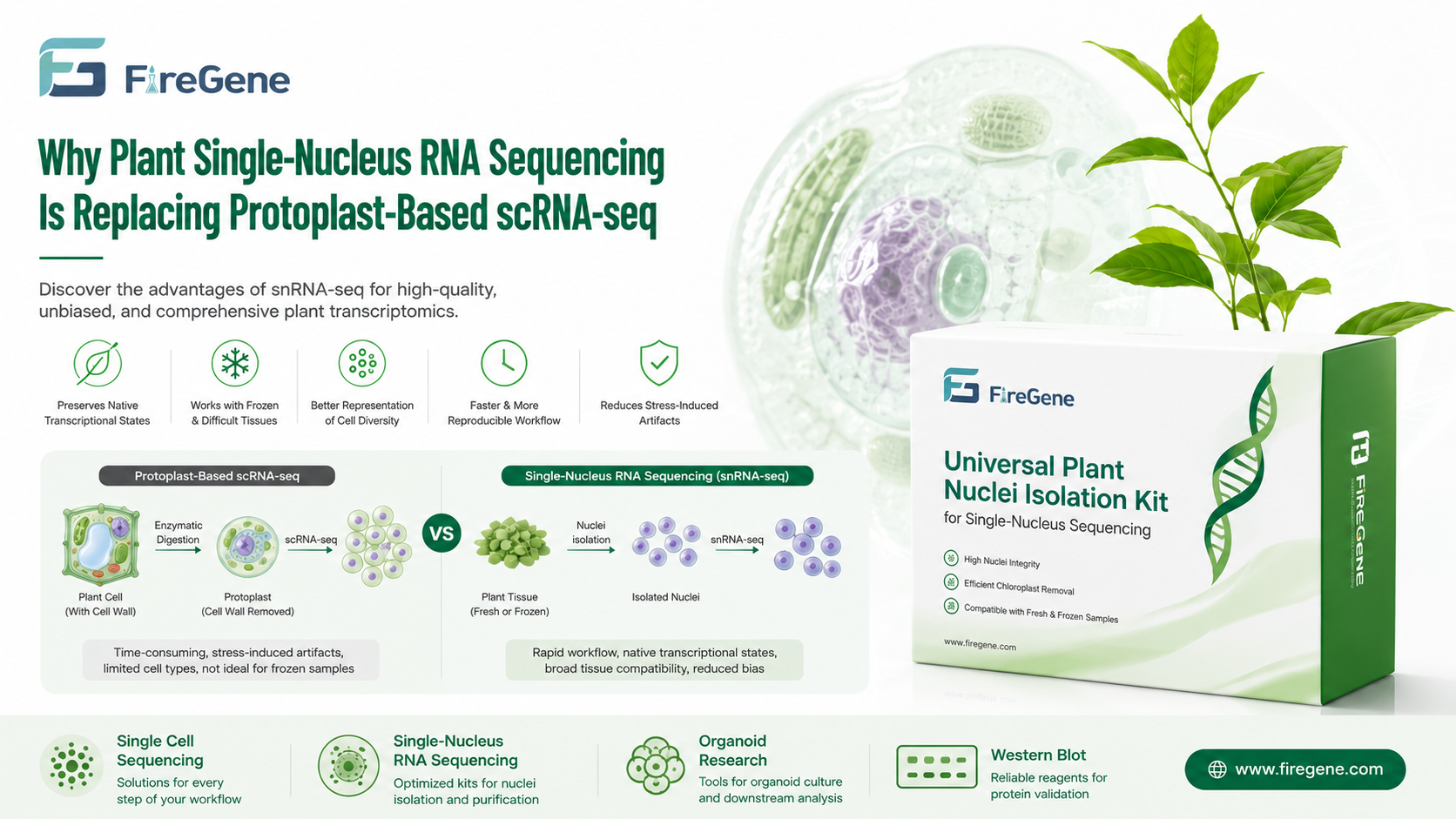
Plant biology has entered a new era driven by single-cell genomics. Over the past decade, single-cell RNA sequencing (scRNA-seq) has transformed our understanding of cellular diversity, developmental biology, and stress responses across a wide range of organisms. In plants, however, traditional scRNA-seq faces unique technical challenges because every plant cell is enclosed by a rigid cell wall.
To overcome this barrier, researchers have historically relied on protoplast isolation, a process that enzymatically removes the cell wall before sequencing individual cells. While effective in some applications, protoplast preparation introduces several limitations that can compromise transcriptomic data and restrict the types of tissues that can be analyzed.
As a result, single-nucleus RNA sequencing (snRNA-seq) has rapidly emerged as the preferred strategy for plant transcriptomics. By isolating nuclei instead of intact cells, researchers can profile gene expression from fresh, frozen, woody, or otherwise difficult plant tissues while minimizing preparation-induced artifacts.
In this article, we'll explore why plant snRNA-seq is becoming the new standard, compare it with traditional protoplast-based scRNA-seq, and discuss what researchers should consider when choosing a nuclei isolation workflow.
The Challenge of Single-Cell Sequencing in Plants
Unlike animal cells, plant cells possess:
- A rigid cellulose-rich cell wall
- Large central vacuoles
- Abundant chloroplasts
- High levels of secondary metabolites
- Variable tissue rigidity among species
These characteristics make it difficult to obtain viable single-cell suspensions without enzymatic digestion.
Traditional plant scRNA-seq therefore begins with protoplast isolation, typically requiring prolonged incubation with cellulase and pectinase enzymes. While this approach removes the cell wall, it also exposes cells to significant physiological stress.
The longer the digestion process, the greater the likelihood that the transcriptome being measured no longer accurately reflects the tissue's original biological state.
What Is Plant Single-Nucleus RNA Sequencing?
Instead of isolating intact cells, plant snRNA-seq isolates nuclei directly from tissue samples.
Because nuclei are released mechanically rather than through extensive enzymatic digestion, the workflow is generally:
- Tissue homogenization
- Nuclei release
- Debris removal
- Chloroplast depletion
- Nuclei purification
- Fluorescence staining and quality control
- Library preparation
Since nuclear RNA remains protected inside the nuclear membrane, researchers can preserve much of the original transcriptional state while avoiding many artifacts associated with protoplast preparation.
Major Limitations of Protoplast-Based scRNA-seq
1. Enzymatic Digestion Alters Gene Expression
One of the biggest concerns is that enzymatic digestion itself activates stress-response pathways.
Studies have shown that prolonged exposure to digestion enzymes induces genes involved in:
- Heat shock responses
- Oxidative stress
- Wound signaling
- Hormone pathways
- Defense responses
These artificially induced transcripts can obscure genuine biological differences and complicate downstream analyses.
2. Some Cell Types Are Lost
Not all plant cells respond equally to enzymatic digestion.
Highly lignified tissues, mature vascular cells, woody stems, and mechanically robust cell types are often underrepresented or absent after protoplast preparation.
This introduces bias into cell atlases and reduces the completeness of transcriptomic datasets.
3. Limited Compatibility with Frozen Samples
Traditional protoplast preparation generally requires fresh tissue with high cell viability.
This limits:
- Multi-center collaborations
- Clinical or field sample collection
- Long-term sample storage
- Rare specimen preservation
4. Long Experimental Workflow
A typical protoplast isolation protocol may require several hours of enzymatic digestion before sequencing can begin.
Longer handling times increase:
- RNA degradation
- Cell death
- Experimental variability
Why snRNA-seq Is Becoming the Preferred Solution
Preserves Native Transcriptional States
Because nuclei are isolated rapidly without prolonged enzymatic treatment, snRNA-seq better reflects the in vivo transcriptional landscape.
Researchers obtain cleaner biological signals with fewer stress-induced artifacts.
Works with Difficult Plant Tissues
snRNA-seq performs well with:
- Mature leaves
- Roots
- Seeds
- Woody stems
- Floral tissues
- High-fiber crops
- Frozen specimens
This dramatically expands the range of biological questions that can be addressed.
Compatible with Frozen Samples
Frozen tissue compatibility is one of the biggest advantages of nuclei-based workflows.
Researchers can:
- Collect samples in the field
- Store specimens
- Batch process experiments
- Reduce experimental variation
Better Representation of Cell Diversity
Because nuclei isolation avoids selective survival during enzymatic digestion, more cell populations are retained.
This results in:
- Higher cell-type diversity
- More complete cell atlases
- Improved developmental trajectory analysis
Reduced Experimental Bias
Mechanical nuclei isolation is generally more reproducible than enzyme-dependent digestion.
Benefits include:
- Shorter preparation time
- Lower batch effects
- Improved protocol standardization
- Higher reproducibility across laboratories
Protoplast scRNA-seq vs Plant snRNA-seq
| Feature | Protoplast scRNA-seq | Plant snRNA-seq |
|---|---|---|
| Cell wall removal | Required | Not required |
| Enzymatic digestion | Extensive | Minimal |
| Stress-induced genes | High | Low |
| Frozen tissue compatibility | Poor | Excellent |
| Woody tissues | Difficult | Excellent |
| Cell-type bias | Higher | Lower |
| Workflow time | Longer | Shorter |
| Reproducibility | Moderate | High |
Why High-Quality Nuclei Isolation Matters
Although snRNA-seq offers significant advantages, the quality of sequencing data still depends heavily on nuclei isolation.
Poor nuclei preparation can lead to:
- Nuclear rupture
- RNA leakage
- Chloroplast contamination
- High debris levels
- Doublets
- Low sequencing efficiency
An optimized isolation workflow is therefore essential for obtaining high-quality single-nucleus libraries.
Characteristics of an Ideal Plant Nuclei Isolation Workflow
Researchers should look for protocols or kits that provide:
- Broad species compatibility
- Fresh and frozen tissue support
- Efficient chloroplast removal
- High nuclei integrity
- Low debris contamination
- High recovery rate
- Compatibility with major sequencing platforms
These features help maximize data quality while simplifying experimental workflows across different plant species.
FireGene Universal Plant Nuclei Isolation Kit for Single-Nucleus Sequencing
The FireGene Universal Plant Nuclei Isolation Kit for Single-Nucleus Sequencing is designed to simplify plant nuclei preparation across a wide variety of species and tissue types.
Key features include:
- Universal workflow for multiple plant species
- Compatible with fresh and frozen tissues
- Efficient nuclei enrichment
- Reduced chloroplast contamination
- Optimized for downstream single-nucleus sequencing workflows
- Reproducible results with streamlined sample preparation
By minimizing sample handling complexity and improving nuclei quality, the kit helps researchers generate reliable datasets for modern plant transcriptomics studies.
Future Trends: Plant Cell Atlases and Beyond
Large-scale initiatives such as global plant cell atlas projects are accelerating demand for standardized nuclei isolation methods.
Emerging applications include:
- Crop improvement
- Developmental biology
- Plant immunity
- Stress tolerance
- Epigenomics
- Spatial transcriptomics
- Multi-omics integration
As these technologies continue to evolve, high-quality nuclei isolation will remain one of the most critical steps in experimental success.
Conclusion
While protoplast-based scRNA-seq played an essential role in the early development of plant single-cell genomics, its limitations have become increasingly apparent. Enzymatic digestion, stress-induced transcriptional artifacts, limited tissue compatibility, and workflow complexity have encouraged researchers to adopt more robust alternatives.
Plant single-nucleus RNA sequencing (snRNA-seq) addresses many of these challenges by enabling rapid, reproducible isolation of intact nuclei from a wide range of tissues—including frozen and difficult-to-dissociate samples. The result is higher-quality transcriptomic data that more accurately reflects the native biological state.
As plant genomics moves toward comprehensive cell atlases and multi-omics integration, standardized nuclei isolation workflows will be essential. Researchers seeking reliable, reproducible, and sequencing-ready nuclei can benefit from optimized solutions such as the FireGene Universal Plant Nuclei Isolation Kit for Single-Nucleus Sequencing, which is designed to streamline sample preparation while supporting consistent downstream performance.
Build Your Complete Single-Cell and Single-Nucleus Research Workflow with FireGene
Successful transcriptomic studies depend on much more than sequencing alone. From sample collection and preservation to nuclei isolation and downstream validation, every step influences data quality and reproducibility.
FireGene provides a comprehensive portfolio of sample preparation solutions designed to support researchers throughout the entire workflow, whether you're performing single-cell RNA sequencing (scRNA-seq), single-nucleus RNA sequencing (snRNA-seq), organoid-based disease modeling, or downstream protein validation.
Explore Related Research Solutions
🌱 Single-Cell Sequencing Sample Preparation
Whether you're working with animal tissues, plant samples, PBMCs, or tumor specimens, FireGene offers specialized solutions for tissue dissociation, sample preservation, cell cleanup, and suspension optimization to help maximize cell viability and sequencing quality.
Explore the complete collection:
👉 Single Cell Sequencing Collection
🧬 Single-Nucleus RNA Sequencing Solutions
For frozen tissues, difficult-to-dissociate samples, or applications where preserving native transcriptional states is critical, FireGene's snRNA-seq portfolio includes optimized nuclei isolation kits developed for reliable downstream sequencing.
Featured applications include:
- Plant nuclei isolation
- Muscle nuclei isolation
- Blood vessel nuclei isolation
- Adipose tissue nuclei isolation
Browse the collection:
👉 Single-Nucleus RNA Sequencing Collection
🧫 Organoid Research Solutions
Three-dimensional organoid models have become indispensable tools for developmental biology, cancer research, regenerative medicine, and drug discovery.
FireGene provides specialized reagents that support organoid establishment, maintenance, and downstream molecular analyses, enabling researchers to generate more physiologically relevant experimental models.
Learn more:
👉 Organoid Research Collection
🔬 Validate Transcriptomic Findings with Western Blot
RNA sequencing provides valuable insights into gene expression, but protein-level validation remains essential for confirming biological significance.
FireGene offers a comprehensive selection of antibodies, electrophoresis reagents, transfer systems, and detection solutions to help researchers validate transcriptomic discoveries using Western blot analysis.
Explore Western Blot solutions:
One Partner for the Entire Research Pipeline
Whether you're constructing a plant cell atlas, investigating tissue heterogeneity, developing organoid models, or validating differentially expressed proteins, FireGene supports every stage of your research workflow—from sample preparation to downstream analysis.
Explore our complete portfolio to streamline your experiments with reliable, reproducible, and research-ready solutions.
FireGene Single-Cell Sample Prep
Looking for validated dissociation kits?
FireGene's tissue dissociation kits are optimized for specific organ types — brain, tumor, liver, GI, reproductive, and more. Validated for 10x Genomics Chromium and BD Rhapsody workflows.


