
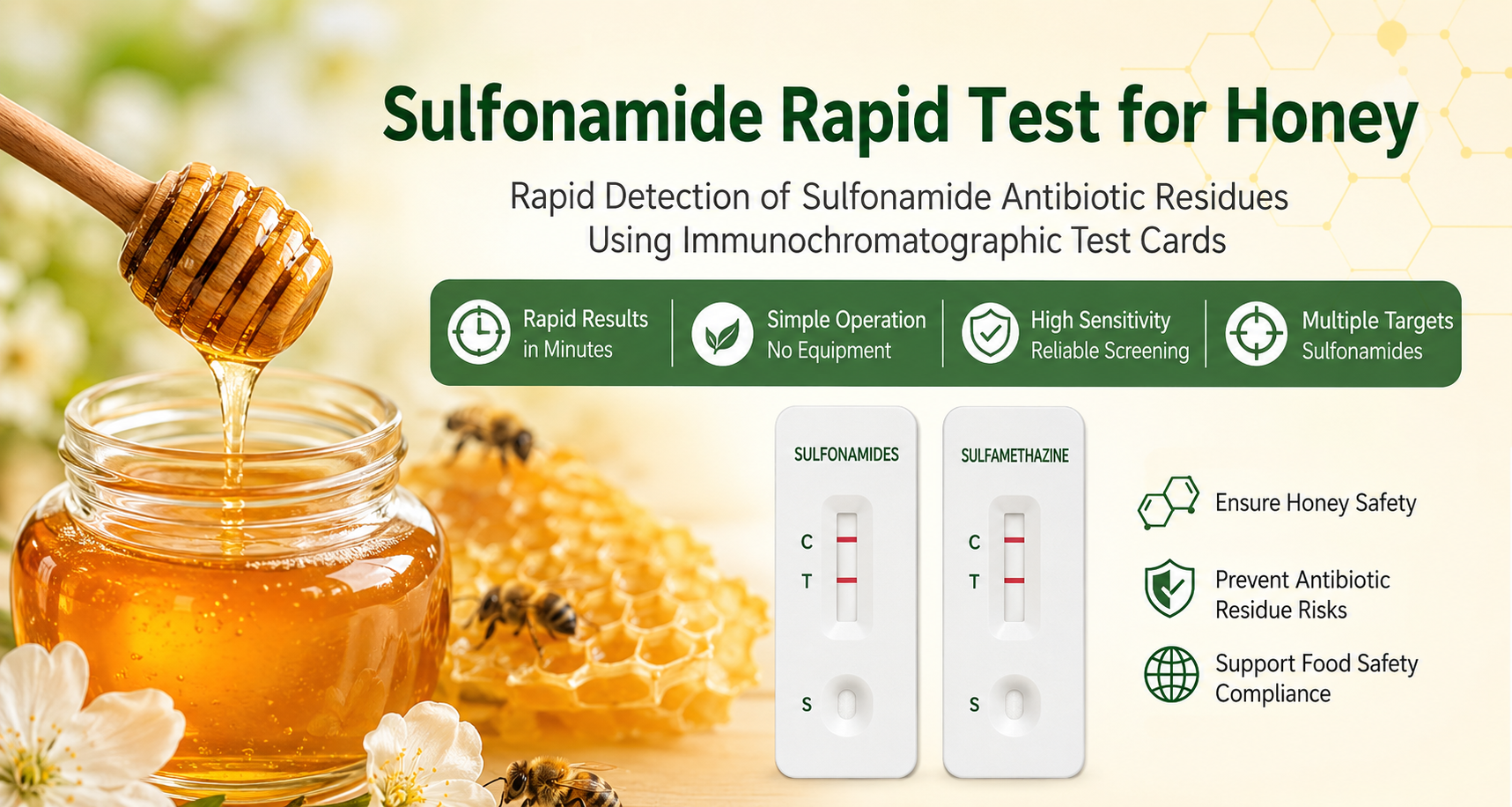
Honey is a natural food product valued for its nutritional benefits and health-related properties. However, veterinary drug residues, especially sulfonamide antibiotic residues, have become an important concern in honey safety management. Rapid honey testing methods based on colloidal gold immunochromatography provide a fast, simple, and cost-effective solution for screening antibiotic contamination. Sulfonamide rapid test cards enable on-site detection of multiple sulfonamide residues in honey samples, supporting quality control, raw material inspection, and food safety monitoring.
Rapid Honey Testing: Ensuring Food Safety Through Sulfonamide Residue Detection
Honey has been consumed worldwide for centuries due to its natural sweetness, nutritional value, and unique bioactive compounds. As consumer demand for high-quality honey continues to increase, ensuring honey purity and safety has become a major focus for beekeepers, honey processors, food laboratories, and regulatory agencies.
One of the key challenges in honey quality control is the presence of veterinary drug residues, particularly sulfonamide antibiotics. These compounds may enter honey through inappropriate use of veterinary medicines during bee disease management. Therefore, rapid screening methods are increasingly used to identify potential contamination before honey enters the market.
Sulfonamide antibiotic rapid detection cards provide an efficient solution for honey residue screening by combining immunological recognition technology with simple testing procedures.
Why Detect Antibiotic Residues in Honey?
Potential Sources of Sulfonamide Residues
Sulfonamides are a group of synthetic antibacterial compounds widely used in veterinary medicine. In beekeeping, antibiotics may sometimes be applied to control bacterial diseases affecting bee colonies.
Improper antibiotic management may lead to:
· Residual antibiotics in honey
· Non-compliance with food safety regulations
· Restrictions in international honey trade
· Reduced consumer confidence
Strict monitoring of honey products helps ensure that antibiotic residues remain within acceptable safety limits.
What Are Sulfonamide Antibiotic Rapid Test Cards?
Sulfonamide rapid test cards are immunochromatographic detection devices designed for rapid screening of sulfonamide residues in honey samples.
These test cards commonly use:
Colloidal Gold Immunochromatography Technology
This technology relies on specific antigen-antibody interactions to identify target antibiotic molecules.
The testing process usually involves:
1. Honey sample preparation
2. Sample extraction and dilution
3. Application onto the test card
4. Antigen-antibody reaction
5. Visual result interpretation
Results can typically be obtained within several minutes, making the method suitable for rapid screening applications.
Applications of Honey Sulfonamide Rapid Detection Cards
1. Honey Farm and Beekeeping Raw Material Screening
Beekeepers and honey suppliers can use rapid test cards to monitor honey quality before collection or delivery.
Applications include:
· Screening honey batches
· Monitoring antibiotic usage practices
· Reducing contaminated raw materials
Early detection helps prevent non-compliant honey from entering the supply chain.
2. Honey Processing and Quality Control
Honey processing companies require efficient quality control systems to verify incoming raw materials.
Rapid detection cards allow companies to:
· Perform preliminary antibiotic screening
· Identify suspicious samples quickly
· Improve production safety management
· Reduce testing costs
Compared with laboratory-based analytical methods, rapid test cards require minimal equipment and technical expertise.
3. Export Honey Safety Inspection
International honey markets have strict requirements for veterinary drug residues.
Before export, honey producers often perform rapid screening for:
· Sulfonamide antibiotics
· Chloramphenicol residues
· Tetracycline antibiotics
· Nitrofurans metabolites
Rapid test cards provide a convenient first screening step before confirmatory laboratory analysis.
4. Food Safety Supervision and Field Testing
Regulatory organizations and inspection laboratories can use rapid detection cards for:
· Market surveillance
· On-site food inspection
· Emergency screening
· Large-scale sample monitoring
Their portability and ease of operation make them suitable for field applications.
Common Sulfonamide Detection Targets in Honey
Sulfonamide rapid detection cards may be designed for different target compounds, including:
Sulfonamides (SAs)
A broad screening category used to detect multiple sulfonamide antibiotic residues.
Common applications:
· Honey quality inspection
· Veterinary drug residue monitoring
· Food safety screening
Sulfaquinoxaline Rapid Test Card
Sulfaquinoxaline is a sulfonamide compound that has been used in veterinary applications.
Detection helps identify:
· Illegal antibiotic use
· Residue contamination risks
· Non-compliant honey products
Sulfamethazine Rapid Test Card
Sulfamethazine is another important sulfonamide antibiotic target.
Testing helps monitor:
· Veterinary medicine residues
· Honey safety compliance
· Raw material quality
Sulfadimethoxine Rapid Test Card
Sulfadimethoxine residue detection is important for preventing antibiotic contamination in food products.
Other Sulfonamide Compounds
Depending on the product design, rapid test cards may also detect:
· Sulfamethoxazole-related compounds
· Sulfamethoxydiazine-related compounds
· Sulfonamide combination residues
Advantages of Colloidal Gold Immunochromatographic Testing
1. Rapid Detection
Traditional laboratory testing methods often require complex sample preparation and expensive instruments.
Rapid test cards provide:
· Fast results
· Simple operation
· Convenient screening
2. Easy Operation
The testing process does not require advanced laboratory skills.
Advantages include:
· No complicated instruments
· Minimal training requirements
· Suitable for field environments
3. Cost-Effective Screening
Rapid detection technology reduces the cost of large-scale honey monitoring.
It is especially useful for:
· Honey suppliers
· Food manufacturers
· Inspection agencies
4. High Practicality for Large Sample Testing
Honey production and distribution often involve large numbers of samples.
Rapid test cards allow:
· Batch screening
· Quick identification of risk samples
· Efficient quality management
Rapid Screening vs Laboratory Confirmation
Although rapid detection cards provide excellent screening capability, they are generally considered qualitative or semi-quantitative screening tools.
When a sample shows a positive result, further confirmation is recommended using advanced analytical techniques, such as:
LC-MS/MS (Liquid Chromatography-Tandem Mass Spectrometry)
Advantages:
· High sensitivity
· Accurate identification
· Quantitative analysis
HPLC (High Performance Liquid Chromatography)
Advantages:
· Reliable separation
· Quantitative residue analysis
The combination of rapid screening and laboratory confirmation creates an effective honey safety testing workflow.
A Complete Honey Safety Screening Strategy
A modern honey quality control system typically follows:
Step 1: Rapid Screening
Use sulfonamide rapid test cards for:
· Initial inspection
· Batch screening
· Field testing
↓
Step 2: Risk Identification
Positive samples are separated for further investigation.
↓
Step 3: Laboratory Confirmation
Use:
· LC-MS/MS
· HPLC
for accurate residue identification and quantification.
This workflow improves efficiency while maintaining reliable food safety control.
Conclusion
Sulfonamide antibiotic residues represent an important challenge in honey safety management. Rapid detection cards based on colloidal gold immunochromatography provide a practical solution for fast and convenient honey residue screening.
By enabling rapid detection of sulfonamide antibiotics such as sulfaquinoxaline, sulfamethazine, and sulfadimethoxine, these test cards support beekeepers, honey producers, food companies, and regulatory organizations in maintaining high-quality honey standards.
For comprehensive honey safety management, rapid screening technologies combined with advanced analytical confirmation methods provide an efficient approach to protecting consumers and ensuring compliance with global food safety requirements.


