
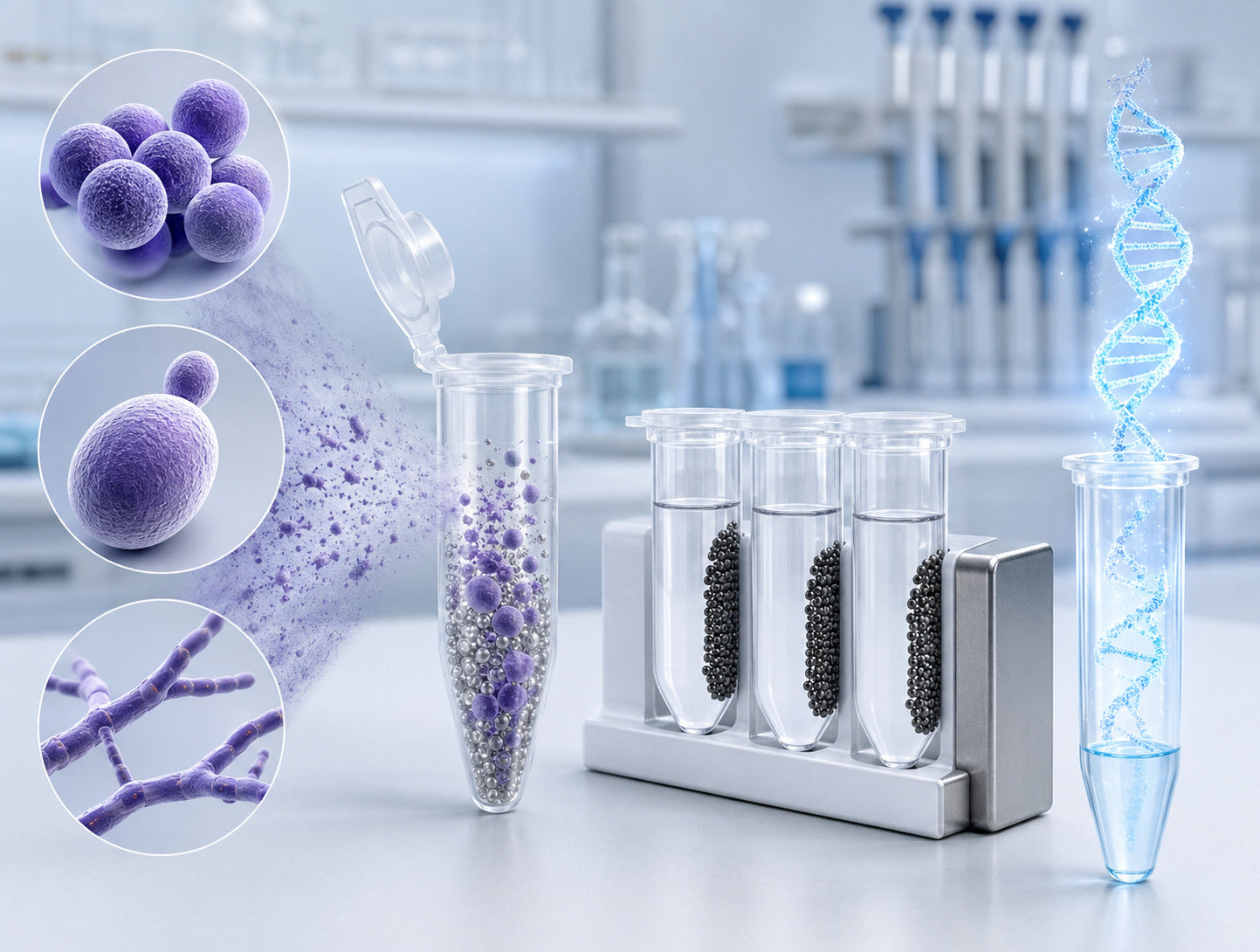
The best DNA extraction kit for Gram-positive bacteria and fungi combines effective cell-wall disruption with reliable magnetic-bead purification, inhibitor removal and downstream compatibility. These difficult-to-lyse microbial samples require more than a general lysis buffer: the selected workflow should support mechanical disruption, enzymatic treatment and efficient recovery of intact microbial genomic DNA. FireGene offers the FireMag Gram-Positive Bacteria and Fungi DNA Extraction Kit for microbial samples including Gram-positive bacteria, Mycobacterium tuberculosis, yeast, fungi and spores. The available 48-reaction format combines grinding beads, Proteinase K, lysis and wash buffers, magnetic bead binding and elution reagents for manual or compatible automated processing.
Need DNA extraction for Gram-positive bacteria, yeast or fungi?
Choose the available 48-reaction FireMag kit for mechanical disruption and magnetic-bead purification, or contact FireGene for bulk quantities and workflow guidance.
Request Bulk Pricing or Technical Support
Quick Product Selection Guide
|
Laboratory requirement |
Feature to prioritize |
FireMag product fit |
Buyer action |
|
Gram-positive bacterial DNA extraction |
Strong wall disruption plus enzymatic lysis |
Grinding beads, compatible wall-breaking enzymes and Proteinase K |
|
|
Fungal or yeast DNA extraction |
Mechanical disruption and inhibitor removal |
Designed for difficult-to-lyse fungi and yeast |
Review specifications |
|
Spore-forming microbial samples |
Robust disruption before DNA binding |
Grinding-bead and lysis workflow |
Confirm protocol fit |
|
PCR and qPCR preparation |
Clean DNA with effective washing |
Extraction kit followed by a compatible amplification reagent |
|
|
Library construction and sequencing |
DNA integrity and scalable purification |
Magnetic-bead workflow with high-throughput sequencing relevance |
Confirm input requirements |
|
Automated laboratory processing |
Instrument and workstation compatibility |
Compatible with most automated extraction instruments and pipetting workstations |
Recommended Product
The FireMag Gram-Positive Bacteria and Fungi DNA Extraction Kit is the primary match for difficult-to-lyse Gram-positive bacteria, mycobacteria, yeast, fungi and spores. It combines organism-focused disruption with magnetic-bead genomic DNA purification in an available 48-reaction format.
Downstream PCR Product
After extraction, FireAmp FastPfu Fly DNA Polymerase supports high-fidelity PCR, long-fragment amplification and compatible blunt-end cloning. Select it according to target length, template concentration and assay requirements.
Other Sample Types
For non-microbial starting materials, use a sample-specific extraction product. The available Tissue DNA Extraction Kit is intended for supported tissue samples, while the Viral DNA/RNA Isolation Kit is designed for supported viral nucleic-acid workflows. These products are alternatives for different sample types, not substitutes for Gram-positive bacterial or fungal extraction.
Why Gram-Positive Bacteria and Fungi Need a Specialized DNA Extraction Kit
Gram-positive bacteria have thick peptidoglycan-rich walls, while fungal and yeast walls contain complex structural components such as chitin, glucans and mannoproteins. Spores and some mycobacteria add further resistance. A suitable kit must coordinate mechanical or enzymatic disruption, protein digestion, chemical lysis, DNA binding, washing and elution. High binding capacity cannot compensate for incomplete lysis.
Gram-Positive vs Gram-Negative DNA Extraction
|
Selection factor |
Gram-positive bacteria |
Gram-negative bacteria |
|
Cell-wall characteristic |
Thick peptidoglycan layer |
Thinner peptidoglycan plus outer membrane |
|
Main extraction priority |
Effective wall disruption |
Membrane and cell lysis with inhibitor removal |
|
Enzymatic pretreatment |
Often especially valuable |
Depends on species and protocol |
|
Mechanical disruption |
Useful for resistant or difficult samples |
May be optional for easily lysed samples |
|
Kit-selection focus |
Verified compatibility with difficult-to-lyse organisms |
Broad bacterial compatibility may be sufficient |
A general bacterial kit should not be assumed to perform equally across resistant Gram-positive organisms, yeast, fungi or spores. Match the documentation to the planned microbial group.

Six Factors to Compare Before Buying a Microbial DNA Extraction Kit
1. Supported Organisms
Start with the exact organism or microbial group. Record whether the sample contains Gram-positive bacteria, mycobacteria, yeast, filamentous fungi, spores or a mixed microbial population. Species-level differences can influence wall structure, biomass and inhibitor content. The FireMag kit is documented for difficult-to-lyse samples such as Gram-positive bacteria, M. tuberculosis, yeast, fungi and spores. For a specialized organism, share the species, sample matrix and expected biomass when requesting technical guidance.
2. Cell-Wall Disruption Strategy
Efficient recovery requires the cells to be disrupted before DNA purification. Mechanical grinding can break resistant structures, while wall-breaking enzymes target specific cell-wall components. Proteinase K supports protein digestion and helps release nucleic acids from associated cellular material. The available kit includes individual grinding-bead tubes for its 48-test format and is compatible with different wall-breaking enzymes. This gives laboratories a defined mechanical stage with room to match enzymatic pretreatment to the microorganism and current protocol.
3. Purification Technology
After lysis, DNA must be separated from proteins, cell-wall debris, salts and other contaminants. Magnetic beads selectively bind nucleic acids under appropriate buffer conditions, allowing the captured DNA to move through wash and elution stages. Magnetic-bead purification is commercially useful for laboratories that want a workflow suitable for both manual processing and automation. It can reduce dependence on repeated centrifugation and support consistent handling across a larger sample batch.
4. DNA Integrity and Yield
DNA concentration alone does not show whether the extracted material is appropriate for cloning, library preparation or long-target amplification. Buyers should consider yield, purity, integrity and fragment-size requirements together.
The manufacturer describes the recovered DNA as high-molecular-weight material with strong integrity and limited small-fragment shearing. According to FireGene’s product specifications, the documented workflow provides crushing efficiency above 90% under the stated operating conditions. Evaluate these manufacturer-reported claims with the current protocol and representative samples.
5. Downstream Application
The required DNA quality depends on how the extract will be used. FireMag documentation lists compatibility with:
- Enzyme digestion
- Library construction
- Cloning
- Conventional PCR
- Quantitative PCR
- Chip-based detection
- High-throughput sequencing
For sequencing, confirm the required DNA input, purity, fragment integrity and library-preparation method. For PCR or qPCR, inhibitor removal and consistent amplification are primary selection factors.
6. Throughput and Automation
A small research project may be processed manually, while surveillance, diagnostic-development or screening laboratories may need a scalable format. The product composition is documented as the same for manual and automatic operation, and the workflow is described as compatible with most automated nucleic acid extraction instruments and pipetting workstations.
Before ordering for automation, confirm instrument programming, plate or tube format, magnetic-separation requirements, liquid volumes and sample capacity. The available kit contains 48 reactions, so planned samples, controls and repeat extractions should be included in the quantity calculation.
FireMag Gram-Positive Bacteria and Fungi DNA Extraction Kit
The FireMag Gram-Positive Bacteria and Fungi DNA Extraction Kit (SKU: FG-FG1108D01-48rxns) is a magnetic-bead microbial genomic DNA purification system supplied in a 48-reaction format. Review the current product documentation and confirm that the kit’s intended use, sample type and workflow requirements match your laboratory application before ordering.
Main Kit Components
The documented 48-test configuration includes:
- 48 tubes of grinding beads
- Proteinase K
- Buffer A
- Buffer B
- Buffer D
- Wash 1
- Wash 2
- Elution Buffer
- Magnetic Bead Suspension
Absolute ethanol must be added to Wash 2 in the volume indicated on the bottle before use. Storage conditions vary by component: Proteinase K is stored at −20°C, the magnetic bead suspension at 2–8°C and the remaining listed components at room temperature. The documented shelf life is 12 months.
General Extraction Principle
The workflow combines bacterial wall breaking, digestion and lysis, magnetic-bead nucleic-acid binding, washing and final elution. Specially surface-treated nanoscale superparamagnetic microspheres selectively adsorb nucleic acids during purification. This integrated format is particularly valuable for buyers who want organism-focused disruption and scalable magnetic-bead cleanup in one kit rather than assembling unrelated lysis and purification products.
Ready to order the 48-reaction format?
The product page currently provides direct Add to cart purchasing. Bulk users can submit the organism, sample count and automation requirements for a customized quotation.
Buy the 48-Reaction Kit — $339 | Request Bulk Pricing or Technical Support
General Workflow for Microbial DNA Extraction
Follow the current manual for reagent volumes, incubation times and magnetic-separation steps. The general workflow is:
- Prepare the microbial sample. Match biomass and sample volume to the supported protocol.
- Disrupt the cell wall. Use grinding beads and any compatible organism-specific enzymatic treatment.
- Digest and lyse the sample. Apply Proteinase K and the specified lysis buffers.
- Bind the DNA. Allow genomic DNA to adsorb to the magnetic bead suspension under the required conditions.
- Wash the beads. Remove proteins, cell debris, salts and other impurities while retaining the DNA.
- Elute purified DNA. Recover the DNA into the specified elution buffer for quality assessment and downstream use.
Plan for absolute ethanol, magnetic-separation equipment, pipettes, nuclease-free consumables and any required organism-specific enzymes.

Manual vs Automated Magnetic-Bead Extraction
|
Workflow consideration |
Manual processing |
Automated processing |
|
Best suited to |
Small or moderate sample batches |
Repetitive or higher-throughput batches |
|
Primary equipment |
Magnetic rack and standard pipettes |
Compatible extraction instrument or pipetting workstation |
|
Flexibility |
Convenient for pilot studies and mixed samples |
Supports standardized liquid handling |
|
Purchasing priority |
Reaction quantity and bench workflow |
Instrument compatibility and programming requirements |
Both routes use the same product composition. Confirm extraction quality and instrument parameters on representative organisms before scaling automation.

Evaluating Extracted Microbial DNA
Assess the extract against the intended downstream method using relevant measures such as:
- Fluorometric DNA concentration
- Spectrophotometric purity ratios
- Agarose-gel integrity assessment
- PCR or qPCR amplification
- Restriction digestion or library-preparation input, where relevant
- Sequencing quality metrics, when applicable
A high concentration with inhibitor carryover may be less useful than a clean, consistent extract. For sequence-sensitive PCR, long-target amplification or compatible cloning, the available FireAmp FastPfu Fly DNA Polymerase provides a hot-start, high-fidelity downstream option.
Ordering Checklist for Research Laboratories
Prepare the following information before purchasing or requesting technical support:
- Product SKU FG-FG1108D01-48rxns
- Microbial species or group
- Sample type, matrix and starting biomass or volume
- Number of samples and controls
- Manual or automated workflow and instrument model
- Required wall-breaking enzyme or pretreatment
- Downstream PCR, qPCR, cloning or sequencing application
- Required DNA yield, purity and integrity
- Standard or bulk quantity and project timeline
A complete inquiry is especially helpful for unusual organisms, mixed samples or automated processing.
FAQs
What is the best DNA extraction kit for Gram-positive bacteria?
Choose a kit that combines verified Gram-positive compatibility, effective wall disruption and inhibitor-removing purification. FireMag provides grinding beads, compatible enzymatic pretreatment, Proteinase K and magnetic-bead DNA purification for difficult microbial samples.
Can the same kit extract fungal and yeast DNA?
Yes. The product documentation lists yeast and fungi among the supported difficult-to-lyse microbial samples. Match the disruption and enzymatic treatment to the organism and current protocol.
Is the kit suitable for PCR and sequencing?
The documented applications include PCR, qPCR, cloning, library construction and high-throughput sequencing. Confirm input and quality requirements for the specific downstream method.
Can the kit be used with automated extraction instruments?
The product is described as compatible with most automated nucleic acid extraction instruments and pipetting workstations. Confirm liquid volumes, magnetic handling and instrument programming before implementation.
Is the microbial DNA extraction kit currently available?
Yes. The 48-reaction product page currently displays an Add to cart option. Bulk quantities, samples and technical questions can also be submitted through the inquiry page.
Choose the Right Microbial DNA Extraction Kit
A strong selection begins with the organism’s cell wall and ends with the required downstream result. Choose a specialized kit when Gram-positive bacteria, fungi, yeast, mycobacteria or spores require coordinated mechanical disruption, enzymatic treatment and magnetic-bead purification. Review the available 48-reaction format, confirm the planned organism and downstream assay, then purchase the standard kit or request a customized quantity for a larger laboratory workflow.
Need DNA extraction for Gram-positive bacteria, yeast or fungi?
Choose the available 48-reaction kit for mechanical disruption and magnetic-bead purification, or contact the supplier for bulk quantities and workflow guidance.
Buy the 48-Reaction Kit — $339 | Request Bulk Pricing or Technical Support


