
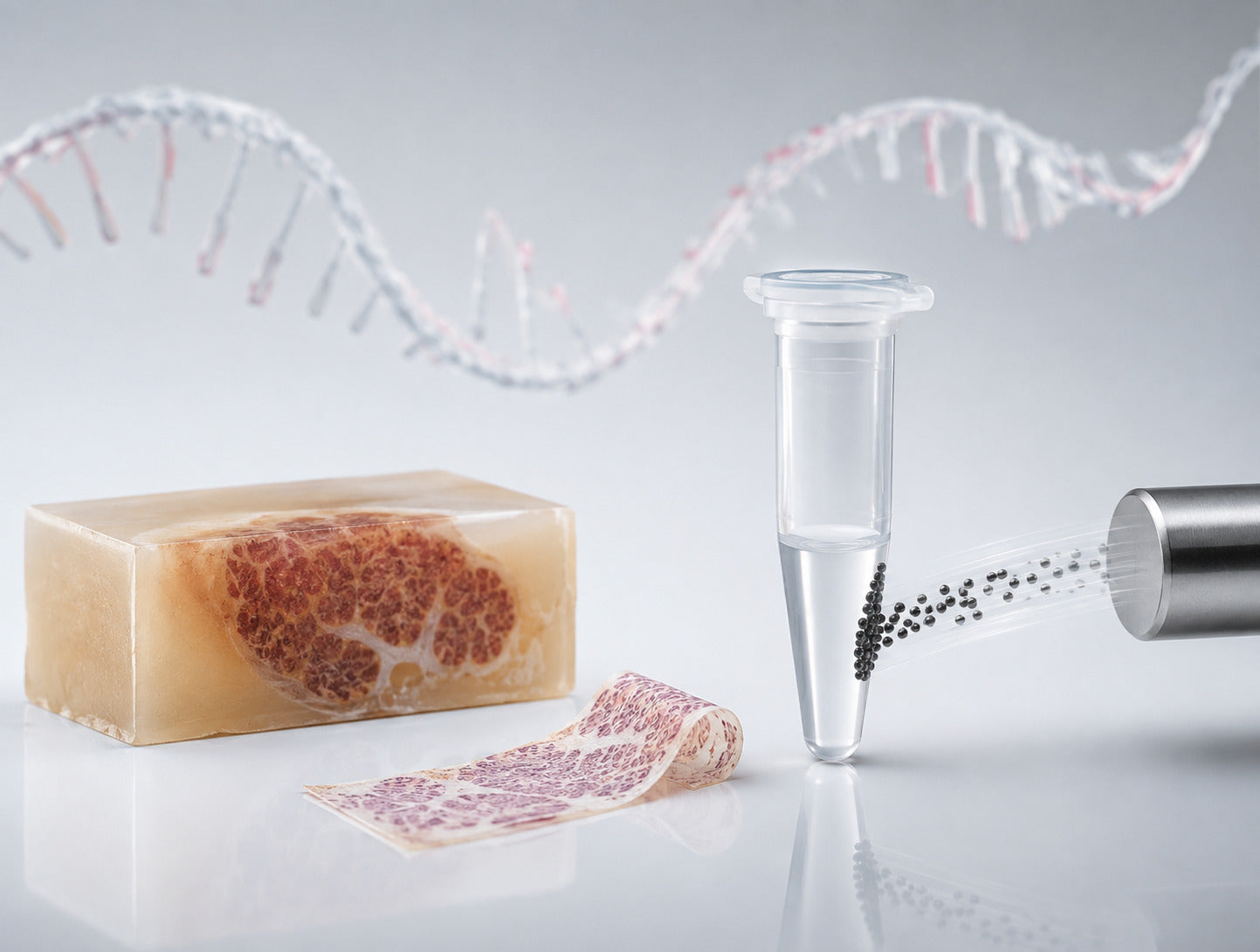
The best FFPE RNA extraction kit should combine effective paraffin removal, tissue digestion, DNase treatment and recovery of fragmented total RNA suitable for the planned RT-qPCR or RNA sequencing workflow. Buyers should compare section thickness, tissue area, fixation history, purification chemistry, DNA-removal strategy, reaction format, automation compatibility and downstream assay requirements before ordering. FireGene offers an FFPE-specific magnetic-bead extraction kit with a xylene-free dewaxing workflow. The recovered total RNA is documented for RT-PCR, fluorescence-based quantification and next-generation sequencing applications.
Planning an FFPE gene-expression or RNA-sequencing study?
Match the tissue section, sample count, RNA quality requirements and downstream method to the extraction format.
Request Bulk Pricing or Technical Guidance
Quick FFPE RNA Kit Selection Guide
|
Research requirement |
Feature to prioritize |
Recommended product or action |
Buyer action |
|
RNA from 5–10 µm FFPE tissue sections |
Dewaxing, digestion and magnetic-bead purification |
FFPE RNA Extraction Kit |
|
|
RT-qPCR gene-expression analysis |
DNase treatment and inhibitor removal |
FFPE-specific total RNA extraction |
Confirm amplicon and cDNA requirements |
|
RNA sequencing from archived sections |
Recovery compatible with fragmented RNA |
FFPE RNA Extraction Kit followed by a suitable library workflow |
Validate RNA and library QC together |
|
Pilot study or workflow evaluation |
Small reaction format |
Currently listed 10-reaction option |
Review product specifications |
|
Larger research batch |
Reaction count and automation compatibility |
Ask FireGene about larger-volume configurations and project pricing |
|
|
DNA analysis from FFPE sections |
Genomic DNA rather than RNA recovery |
Select by target nucleic acid |
Why FFPE RNA Needs a Specialized Extraction Workflow
Archived FFPE blocks connect histology with retrospective molecular research, but fixation and storage can crosslink, fragment or modify RNA. Paraffin must also be removed before digestion and purification. A general fresh-tissue RNA kit may not include a suitable dewaxing step or sufficient treatment for fixed material. An FFPE RNA workflow should coordinate:
- Paraffin removal
- Tissue digestion and protein removal
- Release of fragmented RNA
- Genomic DNA removal
- RNA binding and washing
- Controlled elution
The goal is to recover usable, representative RNA within the limitations of the preserved specimen.
Seven Factors to Compare Before Buying an FFPE RNA Extraction Kit
1. FFPE Sample Compatibility
Confirm that the kit is designed specifically for paraffin-embedded tissue sections. Record the tissue type, block age, fixation duration, section thickness, number of sections and approximate tissue area. These variables influence digestion, RNA yield and inhibition. The featured kit documents compatibility with 5–10 µm paraffin tissue sections. The product page does not define every tissue-area or section-count combination, so projects using unusually large, small or low-cellularity specimens should confirm input limits before routine processing.
2. Dewaxing Method
Residual paraffin can interfere with lysis, binding and liquid handling. Select a dewaxing method validated for the sample and purification chemistry. The FFPE RNA Extraction Kit uses a documented xylene-free dewaxing formula. This can reduce dependence on a separate xylene-processing stage, but laboratories should still follow the current manual for section preparation, mixing, incubation and transfer steps.

3. Tissue Digestion and Crosslink Reversal
Protein digestion helps release nucleic acids from fixed tissue. Use the kit-specific incubation conditions rather than a universal time or temperature. Compare whether the kit includes Proteinase K, specialized treatment buffers and clearly defined incubation steps. For highly fibrotic, necrotic, calcified or pigment-rich specimens, ask whether any sample-specific preparation is recommended.
4. DNase Treatment
Residual genomic DNA can affect RNA measurements, RT-qPCR and sequencing results. The product components include DNase I and a DNase dilution solution. DNase treatment should be performed according to the current protocol. Laboratories can assess residual DNA with a no-reverse-transcriptase control or another validated DNA-contamination check appropriate for the assay.
5. Magnetic Beads vs Spin Columns
Purification format affects equipment needs, throughput and automation—not only bench preference.
|
Consideration |
Magnetic-bead workflow |
Spin-column workflow |
|
Separation method |
Magnetic capture |
Centrifugation or vacuum |
|
Automation |
Generally easier to transfer to compatible workstations |
Often more manual |
|
Batch processing |
Suitable for scalable sample handling |
Convenient for small batches |
|
Key implementation check |
Mixing, bead capture and wash removal |
Column capacity and centrifuge access |
|
Selection priority |
Instrument compatibility and recovery |
Protocol fit and membrane performance |
Performance depends on the specific product, specimen and validated protocol. Purification format alone does not determine RNA yield, integrity or downstream success. For laboratories processing multiple FFPE sections, a magnetic-bead format may be especially useful when scalable batch handling or transfer to compatible automated extraction equipment is required. FireGene documents compatibility with most automated nucleic-acid extraction instruments and pipetting workstations, although the exact platform should be confirmed before ordering.

6. RT-qPCR and RNA-Seq Compatibility
“Suitable for RT-qPCR or RNA sequencing” does not mean every FFPE sample will produce the same result. Extraction supplies purified RNA; reverse transcription, amplification, library preparation, target enrichment and sequencing remain separate workflow stages.
For RT-qPCR, compare:
- RNA input per reverse-transcription reaction
- Amplicon length and primer design
- Reference-gene performance
- No-RT and no-template controls
- Inhibitor sensitivity and replicate consistency
For RNA sequencing, record:
- Total RNA input requirement
- Targeted, exome-capture, rRNA-depletion or other library strategy
- Minimum fragment-size or quality threshold
- Stranded or unstranded library design
- Indexing, pooling and sequencing-platform compatibility
Shorter RT-qPCR amplicons and library methods designed for degraded RNA may be practical for FFPE research, but the exact design should be selected using representative sample quality rather than assumed from block age alone.
7. Reaction Count, Throughput and Total Cost
The product page currently shows a selectable 10-reaction format under SKU FG-FG1103R-10rxns, while the specifications table separately references 96 reactions. Confirm the required configuration, current price and availability with FireGene before placing a larger order. Include samples, blanks, controls, repeats and optimization in the reaction count. Compare total cost per usable sample and establish success criteria with a pilot batch.
Recommended Product: FFPE RNA Extraction Kit
The FireGene FFPE RNA Extraction Kit (SKU: FG-FG1103R-10rxns) is designed to isolate total RNA from 5–10 µm paraffin tissue sections using xylene-free treatment and magnetic-bead purification.
Product Features to Review
- FFPE-specific xylene-free dewaxing chemistry
- Proteinase K-supported tissue processing
- Magnetic-bead RNA binding and purification
- Included DNase I and dilution solution
- Compatibility with RT-PCR, fluorescence quantification and NGS
- Support for compatible extraction instruments and pipetting workstations
- Documented 12-month shelf life under stated storage conditions
Components include dewaxing, de-protein, lysis and wash buffers, eluant, magnetic beads, Proteinase K, DNase I and dilution solution. Storage varies by component, so follow the current label and manual. Review the product’s current intended-use statement and confirm that the sample type, section input and workflow requirements match the planned research application before ordering.
Who Is This Kit Best Suited For?
The FireGene FFPE RNA Extraction Kit may be a suitable option for research laboratories that need total RNA from 5–10 µm paraffin sections, prefer xylene-free dewaxing, require included DNase treatment or want a magnetic-bead workflow that can be evaluated for automated sample processing.
Before ordering: Confirm section count, approximate tissue area, instrument compatibility, desired reaction format and downstream RNA-quality requirements. Ready to evaluate FFPE RNA extraction? Review the currently listed 10-reaction format for pilot testing, or contact FireGene about larger project requirements.
View the FFPE RNA Extraction Kit | Submit an Inquiry or Free Sample Request
General FFPE RNA Extraction Workflow
Use the current manual for exact volumes, incubation conditions and magnetic-separation steps. A typical workflow includes:
- Prepare FFPE sections. Record thickness, count, tissue area and block information.
- Remove paraffin. Apply the documented xylene-free treatment and transfer procedure.
- Digest the tissue. Use the specified buffers and Proteinase K conditions.
- Bind RNA to magnetic beads. Mix under the required conditions for nucleic-acid capture.
- Apply DNase treatment. Reduce genomic DNA according to the protocol.
- Wash the beads. Remove proteins, salts and other contaminants.
- Elute the RNA. Recover RNA in the specified volume for immediate QC or storage.
Use RNase-controlled practices and nuclease-free consumables. Standardize sectioning and include appropriate extraction and process controls.
How to Evaluate FFPE RNA for RT-qPCR and Sequencing
No single metric fully predicts downstream performance. Use an assay-matched QC plan:
|
QC question |
Possible assessment |
Buying or workflow relevance |
|
How much RNA was recovered? |
Fluorometric RNA quantification |
Supports reverse-transcription or library input planning |
|
Is the sample pure enough? |
Spectrophotometric ratios interpreted cautiously |
May reveal substantial carryover but does not prove usability |
|
How fragmented is the RNA? |
Electrophoretic sizing, DV200 or another validated metric |
Helps select a compatible library strategy |
|
Is genomic DNA present? |
No-RT control or DNA-specific test |
Evaluates DNase effectiveness |
|
Does amplification work? |
Short-amplicon RT-qPCR control |
Tests reverse transcription and inhibition together |
|
Did the library succeed? |
Yield, size distribution and adapter assessment |
Connects extraction output to sequencing readiness |
Fragmentation is inherent to FFPE RNA. Interpret concentration, fragment distribution and functional assay performance together.

Related Available Products by Sample or Target
Keep the primary buying journey centered on FFPE RNA. Use related products only when the starting material or target changes:
FFPE DNA Extraction
For genomic DNA from paraffin sections, the FFPE gDNA Extraction Kit provides a distinct xylene-free magnetic-bead workflow. It does not replace the RNA kit for transcript analysis.
RNA From Cultured Cells
For cultured-cell RNA rather than fixed tissue, the Cell RNA Extraction Kit offers a 48-reaction magnetic-bead format.
Reverse Transcription and cDNA Synthesis
After RNA extraction, compare reverse-transcription and cDNA-synthesis products by RNA input, gDNA-removal strategy, reaction format and downstream RT-qPCR requirements. Confirm individual product availability before adding a downstream reagent to the order.
Common FFPE RNA Selection Mistakes
Using a Fresh-Tissue Kit Without FFPE Preparation
Select an FFPE-specific workflow with validated dewaxing and fixed-tissue digestion.
Selecting by Concentration Alone
Total concentration does not describe fragmentation, inhibition or residual DNA. Use functional RT-qPCR or library QC with quantitative measurements.
Treating RNA Extraction as Library Preparation
Extraction isolates RNA. RNA-seq library construction, adapter addition, indexing and optional target enrichment require separate, platform-compatible reagents.
Scaling Automation Without a Pilot
Confirm bead mixing, magnetic capture, wash removal, section input and cross-contamination control on the exact workstation before routine high-throughput use.
Ordering Checklist for FFPE RNA Research Workflows
Prepare the following information before purchasing or requesting guidance:
- Product SKU and desired reaction format
- Tissue type, block age and fixation information
- Section thickness, number and approximate tissue area
- Number of samples, controls and repeats
- Manual or automated extraction method
- Instrument model and batch size
- RT-qPCR assay or RNA-seq library strategy
- RNA input, fragment-quality and project-timeline requirements
Review the current product documentation before incorporating the kit into any regulated or clinical workflow.
FAQs
What is the best RNA extraction kit for FFPE tissue?
Choose an FFPE-specific kit that combines paraffin removal, tissue digestion, DNase treatment and purification compatible with fragmented RNA. Match the section input and output quality to the planned RT-qPCR or RNA-seq workflow.
Can RNA extracted from FFPE tissue be used for RT-qPCR?
Yes, when the recovered RNA meets the assay requirements. Short amplicons, appropriate controls and validated reference genes can be useful for fragmented FFPE RNA.
Is FFPE RNA suitable for RNA sequencing?
FFPE RNA can support validated targeted or broader RNA-seq methods designed for degraded material. Select the library strategy using RNA quantity, fragment distribution and representative pilot results.
Why is DNase treatment important for FFPE RNA?
DNase reduces genomic DNA that could affect RNA quantification or amplification. Verify removal with a no-RT control or another assay-appropriate method.
What section thickness does the featured kit support?
The product specifications list 5–10 µm paraffin tissue sections. Confirm the supported section count and tissue area for the planned specimen.
Can magnetic-bead FFPE RNA extraction be automated?
The product is documented for compatible automated nucleic-acid extraction instruments and pipetting workstations. Confirm the exact platform and validate it with representative sections.
Choose the Right FFPE RNA Extraction Kit
The right kit fits the specimen before it fits the downstream instrument. Compare FFPE section input, dewaxing, digestion, DNase treatment, fragmented-RNA recovery, throughput and assay compatibility as one workflow. FireGene’s magnetic-bead kit produces total RNA documented for RT-PCR, fluorescence quantification and next-generation sequencing. Researchers planning RT-qPCR should confirm that the recovered RNA quality, input amount and assay design meet their specific workflow requirements.
Select an FFPE RNA extraction format for the planned research workflow.
Review the currently listed 10-reaction format for pilot testing, or contact FireGene about larger project requirements.
View or Order the FFPE RNA Extraction Kit | Request Bulk Pricing or Technical Support


