
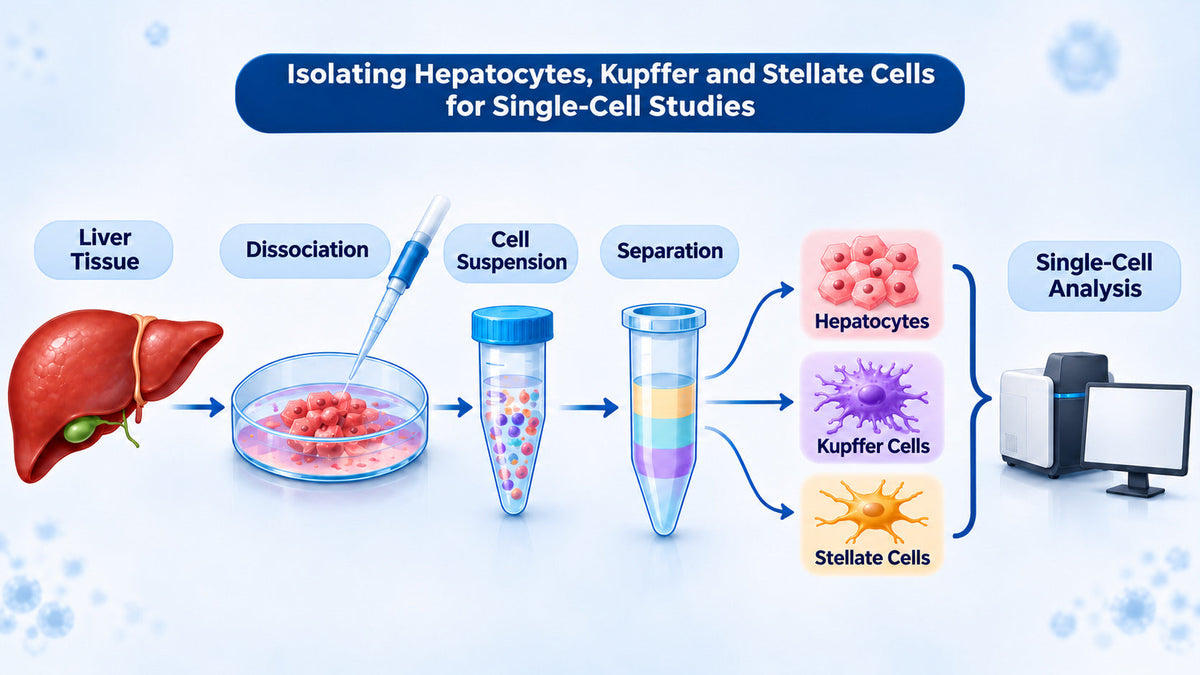
Quick answer. Start with a mixed liver single-cell suspension if you want to profile several cell types together. If your pilot recovers too few hepatocytes, Kupffer cells, or hepatic stellate cells for your analysis, enrich the target population in a separate fraction. Keep a matched mixed aliquot when you need broader tissue context.
|
FireGene product |
Catalog number |
Role in the workflow |
Pack size |
Ordering |
|
Liver Dissociation Kit |
FG-BA3323 |
Enzymatic preparation of a liver cell suspension for single-cell analysis or downstream enrichment |
10 or 50 reactions |
|
|
Red Blood Cell Lysis Kit |
FG-BA3311 |
Optional erythrocyte removal when red blood cells interfere with sample assessment or downstream analysis |
100 mL |
Why Choose the FireGene Liver Dissociation Kit (FG-BA3323)?
FG-BA3323 provides a dedicated enzyme reagent for preparing a liver single-cell suspension. You can take the suspension into mixed-cell profiling or use it as the starting material for a separate hepatocyte, Kupffer cell, or hepatic stellate cell enrichment workflow. firegene.com
FireGene’s certificate for lot FG250821 records a pass against two functional release criteria: at least 85% viable hepatocytes after digestion and at least 1 million viable cells per 100 mg of mouse liver. These lot acceptance thresholds give buyers a concrete reference when reviewing the kit for a pilot study.
Liver Cell Types at a Glance
|
Cell type |
Relative size and shape |
Density and fractionation behavior |
Representative identity markers |
|
Hepatocytes |
Large, typically polygonal in tissue |
Sediment readily and often dominates the early pellet. Size contributes to sedimentation. |
ALB, HNF4A |
|
Kupffer cells |
Generally smaller than hepatocytes, with variable macrophage morphology |
Recovered in the non-parenchymal fraction. Additional enrichment can distinguish them from other cells in that fraction. |
CLEC4F in mice. CD68 can support identification in human tissue as part of a broader panel. |
|
Hepatic stellate cells |
Smaller cell bodies than hepatocytes, with processes in intact tissue |
Vitamin A-rich quiescent cells can form a low-buoyant-density fraction. Lipid content can change with activation. |
LRAT and vitamin A autofluorescence for quiescent cells. ACTA2 can help assess activation. |
Liver Cell Atlas vs. Enriched Populations
For a liver cell atlas, use a mixed suspension to profile multiple populations from each specimen. For a targeted study, use cell-type enrichment when the mixed pilot yields too few cells for the planned comparison. A matched mixed aliquot provides context for the enriched population.
|
Study objective |
Preparation to prioritize |
What to check in the pilot |
|
Compare responses across several liver cell types |
Mixed liver single-cell suspension |
Whether each population of interest is represented in the sequencing data |
|
Compare hepatocyte gene expression |
Mixed suspension or hepatocyte-rich fraction |
Viable hepatocyte recovery before loading and representation after sequencing |
|
Study resident liver macrophages |
Kupffer cell-enriched fraction |
Whether your identification strategy distinguishes Kupffer cells from other myeloid cells |
|
Compare stellate cell states during fibrosis |
Hepatic stellate cell-enriched fraction |
Whether the preparation recovers the stellate cell states of interest across study groups |
When you prepare mixed and enriched fractions from the same liver, carry the original specimen ID through both. Record the fraction type with each sample. For comparisons of relative cell abundance, use samples prepared consistently across groups and account for how dissociation and capture can shape the proportions you observe.

How Do You Separate Fractions From One Liver Dissociation?
Liver tissue dissociation releases cells into suspension. Fractionation separates that suspension into portions with different cell compositions. Targeted enrichment can then increase the proportion of a particular population. Decide which fractions you need before processing, especially when one study includes both hepatocytes and non-parenchymal cells. firegene.com
For non-parenchymal liver cell isolation, plan around a diverse fraction that can include Kupffer cells, hepatic stellate cells, sinusoidal endothelial cells, and other immune populations. Published human workflows demonstrate how multiple populations can be recovered from the same specimen through fractionation and subsequent cell-type separation. In liver cell isolation for single-cell studies, retain a mixed aliquot first if your design calls for an atlas. Fractionate the remaining suspension into a hepatocyte-rich pellet and a non-parenchymal fraction. Retain both if your study compares hepatocytes with other liver cells. The non-parenchymal fraction can then supply separate aliquots for Kupffer cell and hepatic stellate cell enrichment.

Hepatocyte Isolation for Single-Cell RNA Sequencing
Assess hepatocytes before loading and again after sequencing. The first check tells you how many viable hepatocytes made it into the preparation. The second tells you how many the platform captured and you could identify in the dataset. A published mouse liver protocol used centrifugation to prepare viable hepatocytes and non-parenchymal cells for scRNA-seq.
Kupffer Cell Isolation for Liver Immune Studies
Define whether your endpoint is resident Kupffer cells or the broader liver macrophage compartment. That distinction matters when studying injury, where several myeloid populations may contribute to the response. Use an identification strategy suited to your species and model. A matched mixed aliquot can help place the enriched Kupffer cell data in the context of other immune populations.
Hepatic Stellate Cell Isolation for Fibrosis Studies
Build hepatic stellate cell isolation around the cell states you want to compare. For a fibrosis study, evaluate recovery from both control and affected tissue during the pilot. Published mouse work has recovered stellate cells alongside other major liver populations from normal and disease-model livers. Use the pilot to check whether your enrichment represents the stellate cell states relevant to your experiment.
What Should You Check for QC and Cell Recovery?
Record viable cell yield and target-cell recovery at the same points for each specimen. A fraction may contain a higher percentage of target cells after enrichment while yielding fewer target cells in absolute terms. Track both measures to decide whether enrichment provides enough usable cells for your planned analysis.
|
QC measure |
What to record |
When to check |
|
Viable cell recovery |
Viable cells relative to tissue input |
After dissociation and again after cleanup |
|
Target-cell proportion and count |
Estimated proportion and absolute number of the target population |
Before and after enrichment |
|
Aggregates and debris |
Suspension appearance against your sequencing core’s intake criteria |
Before loading |
|
Sequencing representation |
Annotated cell counts by population, specimen, and fraction |
After the pilot run |
How Can You Account for Dissociation Stress?
Record handling time and temperature across specimens, particularly when your endpoint involves cell activation or stress. Published work in tumor tissues identified dissociation-associated changes involving FOS and JUN. In a liver study, use handling records alongside cell-type annotations when interpreting these signals across groups.

Which FireGene Kit Should You Order?
|
Your workflow |
Product option |
Buying consideration |
|
Pilot a mouse liver dissociation workflow |
FG-BA3323, 10 reactions |
Estimate how many preparations you need to compare mixed and enriched fractions |
|
Process an established series of samples |
FG-BA3323, 50 reactions |
Match the pack to your planned number of preparations and pilot repeats |
|
Remove erythrocytes when they interfere with analysis |
FG-BA3311, 100 mL |
Include cleanup in your pilot and record viable recovery afterward |
Choose the pack based on the number of tissue preparations you plan to run. If your study requires a purified or enriched population, budget the relevant separation reagents and cell identification panel alongside the liver dissociation kit. firegene.com
Frequently Asked Questions
Can you isolate hepatocytes, Kupffer cells, and stellate cells from one liver?
Yes. Published mouse and human workflows have recovered all three populations from the same specimen. Keep a mixed aliquot if you need a broad tissue profile. For focused studies, plan which fractions to retain and how you will confirm cell identity in each.
When should you enrich Kupffer cells or hepatic stellate cells before scRNA-seq?
Consider enrichment when a mixed pilot yields too few cells for the comparison you intend to make. For example, a fibrosis study may need more stellate cells to compare cell states across conditions. Keep a matched mixed aliquot if you also need to examine the broader tissue response.
Can you use the same isolation workflow for mouse and human liver?
Choose a workflow suited to your species and specimen format. Published human and mouse methods address different tissue inputs and collection conditions. If you are evaluating FG-BA3323 for human tissue, share your specimen format, target cells, and downstream assay when requesting application guidance.
What should you include in a quote request for a larger study?
Include the species, tissue format, number of preparations, target populations, and downstream assay. Specify whether you plan to sequence a mixed suspension, enriched fractions, or both. Ask for pack availability, lead time, and the certificate of analysis for the lot you expect to receive. Request a FireGene quote
References
- Simultaneous isolation of multiple major liver cell types from normal and NASH mouse livers
- Preparation of mouse liver cells for scRNA-seq using centrifugation
- Isolation of mouse Kupffer cells for phenotypic and functional studies
- Isolation of primary human hepatocytes and non-parenchymal liver cells
- Single-cell RNA sequencing of human liver and intrahepatic macrophage populations
- Dissociation-associated gene expression changes in single-cell RNA sequencing
Order Reagents for Your Liver Single-Cell Study
Start with FG-BA3323 to prepare your liver cell suspension. Add FG-BA3311 if your workflow calls for erythrocyte removal. Share your specimen type, target population, and sample count so FireGene can help you choose the pack for your study.
Shop the Liver Dissociation Kit · Browse sample preparation reagents · Request a quote


