
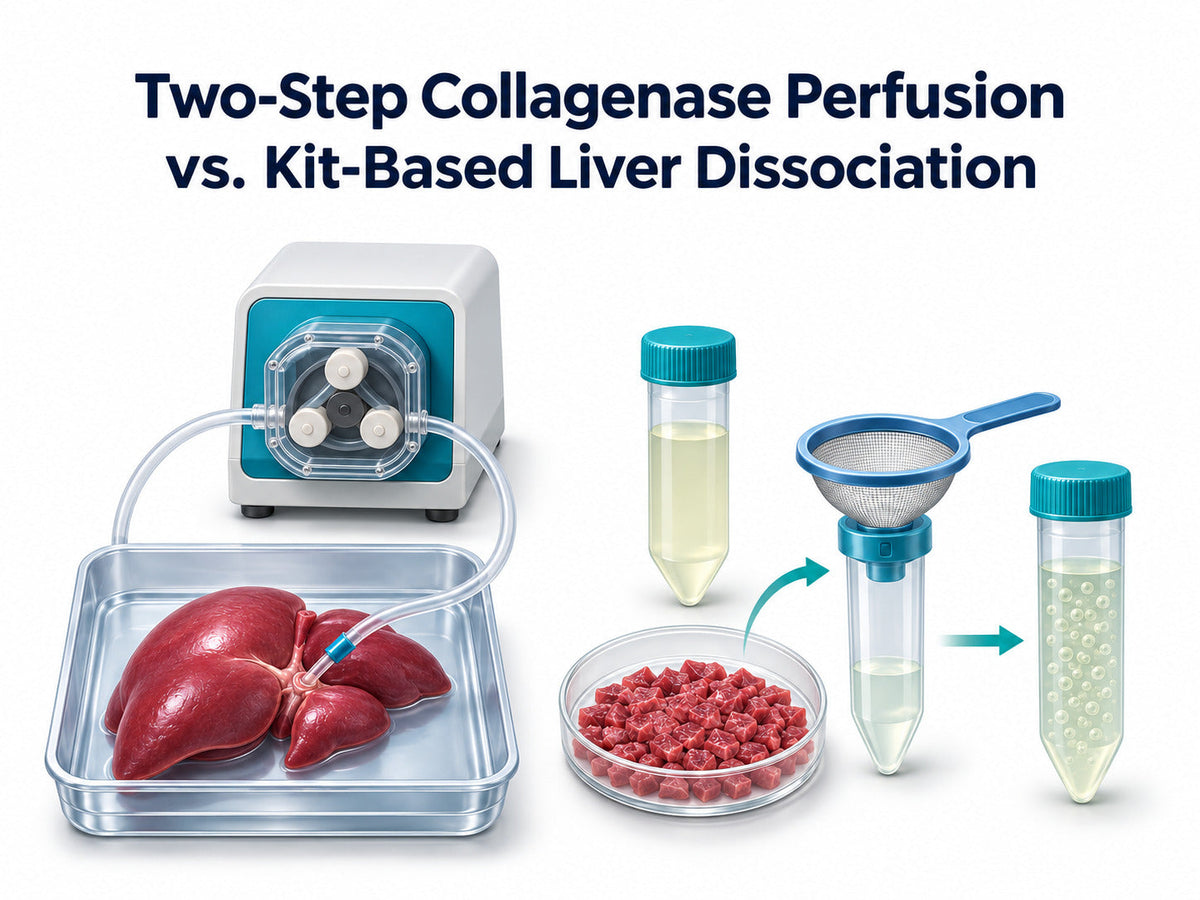
Quick answer: Choose two-step collagenase perfusion for bulk hepatocyte culture when the liver has accessible vessels. Consider fragment-based kit digestion for small liver samples or parallel scRNA-seq preparation. For two-step collagenase perfusion vs. kit-based liver dissociation, base your decision on the sample, target cells, and assay.
The Firegene Liver Dissociation Kit (FG-BA3323) Catalog
|
Product |
Catalog number |
Format / sample |
Species |
QC / performance evidence |
Pack size |
Price, USD |
Order |
|
Liver Dissociation Kit |
FG-BA3323-10rxns |
Liver DS enzyme solution |
Mouse liver used in lot QC |
Lot FG250821 passed viability and mouse liver cell yield criteria |
10 reactions |
$399 |
|
|
Liver Dissociation Kit |
FG-BA3323-50rxns |
Liver DS enzyme solution |
Mouse liver used in lot QC |
See published FG-BA3323 lot criteria below |
50 reactions |
$1,419 |
Why Choose FireGene Liver Dissociation Kit (FG-BA3323)?
FG-BA3323 provides a defined enzymatic liver dissociation workflow for fresh tissue fragments. The manual specifies a water bath or rotating oven and a horizontal centrifuge. FireGene lists sequencing and culture as applications and publishes a lot-specific certificate with functional release tests. The 10-reaction pack suits a pilot. The 50-reaction pack lowers the listed reagent cost from $39.90 to $28.38 per reaction when you use the full pack. Plan separately for media, filters, and cleanup reagents. Browse sample preparation reagents.
How Does a Two-Step Collagenase Perfusion Technique Work?
A liver perfusion protocol delivers buffers through accessible blood vessels. The initial wash clears blood and loosens calcium-dependent cell contacts. A collagenase-containing medium then digests the extracellular matrix, allowing cells to disperse. The Seglen method helped establish this approach for hepatocyte isolation. Buffer chemistry changes between stages. A calcium-free perfusion medium supports the initial chelation step; calcium is supplied during collagenase digestion. An EGTA liver perfusion workflow and an EDTA-based workflow follow related principles, but their published recipes differ.
For primary mouse hepatocyte isolation, the cited protocol uses cannulation, digestion, and density-based purification. Its digestion section takes 10–15 minutes; purification adds 30–40 minutes. These are protocol-specific stages, rather than a total processing-time claim. Published primary human hepatocyte isolation methods can perfuse surgical liver pieces through suitable vessels. Research on isolation of rat hepatocytes also informed later adaptations. Tissue access and the chosen hepatocyte isolation protocol determine whether perfusion is practical.

How Does Fragment-Based Kit Digestion Work?
Fragment-based liver tissue dissociation exposes minced tissue directly to enzyme solution. Controlled mechanical dissociation supports cell release and helps prepare a liver single-cell suspension. The kit manual specifies about 200 mg of fresh liver tissue per preparation. Mix 240 µL of Liver DS with 2,760 µL of RPMI 1640. Digest the minced tissue at 37 °C for 30–120 minutes, checking cell count and viability during digestion. Filter through a 70 µm strainer and collect cells by centrifuging at 300 × g for 5 minutes at 4 °C. Follow the manual for rinses, washes, and resuspension.

Two-Step Collagenase Perfusion vs. Kit-Based Liver Dissociation: Which Fits Your Lab?
Compare usable preparations per operator and per session. Include equipment setup, hands-on time, sample cleanup, and any enrichment required for your assay.
|
Decision factor |
Conventional collagenase perfusion |
Fragment-based kit digestion |
|
Technical skill |
Requires vessel access, cannulation, and flow control |
Requires consistent mincing, digestion, and gentle handling |
|
Equipment |
Liver perfusion apparatus, tubing, pump, temperature control |
Digestion setup, centrifuge, filters, and cell counter |
|
Processing time |
Published mouse protocol budgets 10–15 min for digestion and 30–40 min for purification |
Kit manual budgets 30–120 min for digestion, followed by filtration, washes, and QC |
|
Throughput planning |
Depends on perfusion stations and trained operators |
Parallel processing depends on equipment and staffing |
|
Cell coverage |
Hepatocyte purification can be prioritized; other fractions can be retained |
Coverage depends on digestion and downstream fraction handling |
|
Sample type |
Whole organs or pieces with usable vessels |
Accessible fragments, subject to the selected protocol |
|
Experiment fit |
Hepatocyte culture and functional studies |
Single-cell preparation and fragment-based studies |
|
Purchase decision |
Budget enzymes, buffers, apparatus, and labor |
Budget kit reactions, consumables, cleanup, and labor |
Which Method Should You Choose for Your Experiment?
Bulk hepatocyte culture
Start with perfusion when your priority is hepatocyte enrichment for culture. Define success through hepatocyte yield and viability, attachment, and the functional endpoint your assay needs. A high total cell count alone does not establish hepatocyte purity. Published human isolation work links perfusion with pharmacokinetic and toxicology research. Match procurement to the complete culture workflow, including enrichment and culture supplies.
Single-cell profiling and small liver samples
For small liver samples without accessible vessels, discuss fragment-based digestion during kit selection. Ask which sample inputs and target populations the supplier supports. Build your processing schedule around the sequencing core's intake requirements. Define the intended populations before selecting cleanup or enrichment. Hepatocyte and non-parenchymal fractions can be processed toward different endpoints. Preserve the fractions your experiment needs, and use cell-type recovery alongside total viability when judging preparation quality.
Non-parenchymal cell experiments
For non-parenchymal liver cell isolation, decide which fractions to retain before centrifugation. Kupffer cell isolation and recovery of liver sinusoidal endothelial cells need workflows suited to those populations. A hepatocyte-focused purification strategy answers a different experimental question. Perfusion can also support non-parenchymal recovery. A published human protocol separates hepatocytes and subsequently isolates Kupffer, endothelial, and stellate populations. Therefore, choose based on the complete isolation process rather than assigning each cell type to one method.
Repeated sample batches
For routine experiments, calculate cost per usable sample. Include reagent consumption, staff time, cleanup, and failed preparations in your purchasing worksheet. Select a pack against the manufacturer's tissue-input definition and your expected sample schedule.

What Does FireGene's Lot QC Show?
The certificate for lot FG250821 records a Pass against two functional release criteria. Post-digestion viability had to reach at least 85% viable hepatocytes. The mouse liver assay required at least 1 million viable cells per 100 mg of tissue. There are a lot of acceptance thresholds. For culture, measure attachment and function alongside recovery. For sequencing, track viable singlets and representation of the populations you need. For cytometry, assess cell surface epitope preservation and cell surface marker integrity using your planned antibody panel.
Does Semi-Automated Liver Perfusion Change the Comparison?
Semi-automated liver perfusion combines vascular reagent delivery with controlled processing. A published rodent study describes gentleMACS perfusion technology using dedicated perfusion consumables and standardized reagents. This illustrates why a liver perfusion kit can still require a perfusion workflow. When comparing automation with fragment-based digestion, include instrument access, consumable costs, operator workload, and scheduling. Choose the workflow your facility can support consistently across the planned study.
How Should You Assess Dissociation Stress Genes?
Dissociation conditions can change expression during sample preparation. O'Flanagan and colleagues identified collagenase-associated stress responses, including FOS and JUN, in tumor tissues and experimental models. Cold-active protease reduced these responses under the study's conditions. For a liver pilot, record warm exposure and time from harvest to processing. Compare stress signatures within the same cell type alongside viable recovery and mitochondrial transcript patterns.

Which Liver Dissociation Kit Should You Order?
|
Purchasing goal |
Catalog option |
Information to include with your request |
|
Initial workflow setup |
FG-BA3323-10rxns |
Species, tissue input, target population, downstream assay |
|
Planned sample batches |
FG-BA3323-50rxns |
Sample schedule, expected consumption, storage capacity |
|
Non-perfusion hepatocyte isolation |
Discuss FG-BA3323 before ordering |
Sample access, culture endpoint, required enrichment |
|
Mouse liver dissociation kit selection |
Discuss FG-BA3323-10rxns or FG-BA3323-50rxns |
Species support, age, tissue input, intended coverage |
|
Human liver tissue preparation |
Request application guidance |
Biopsy or resection, transport conditions, target cells |
For a mouse liver dissociation kit purchase, include animal age, tissue condition, and target cells in your quote request.
Frequently Asked Questions
Is every liver perfusion kit suitable for non-perfusion processing?
Check the delivery method in its instructions. "Kit" describes reagent packaging, while perfusion describes how reagents reach tissue. A liver perfusion kit may still require cannulation. For non-perfusion work, ask specifically for fragment-based instructions, supported tissue input, and the required equipment before ordering.
Can a kit replace perfusion for primary hepatocyte culture?
Choose against your culture's endpoint. Perfusion-based protocols provide established routes to hepatocyte recovery and enrichment. When considering a kit, discuss sample species, available tissue, attachment requirements, and functional measurements. Request application evidence aligned with your intended culture experiment rather than relying on a sequencing application alone.
How should I compare processing time and throughput?
Compare complete workflows from tissue receipt to an assay-ready suspension. Include equipment setup, digestion, enrichment, washing, counting, and cleanup. Ask suppliers to define any quoted processing time. For batch planning, measure operator time as well as elapsed time, and include the capacity of your sequencing or culture facility.
What should I include in a bulk quote or sample request?
Provide the catalog option, species, tissue mass, expected sample frequency, delivery location, and experimental endpoint. Add your procurement deadline and any evaluation-sample request. Ask for current lead time, bulk pricing, available application documentation, and custom-workflow options.
Can I request species guidance or a custom workflow?
The published lot certificate uses mouse liver in its functional assay. For human tissue, another species, or a custom workflow, send your tissue input, sample condition, and target populations. Include the assay and acceptance criteria so the quotation can address the preparation you intend to run.
References
- FireGene. Liver Dissociation Kit: product specifications, pack options, and ordering. Includes the user manual and lot FG250821 certificate of analysis. Accessed November 7, 2026.
- Protocol for Primary Mouse Hepatocyte Isolation. STAR Protocols. 2020.
- Lee SML, et al. Isolation of Human Hepatocytes by a Two-step Collagenase Perfusion Procedure. Journal of Visualized Experiments. 2013.
- Protocol for Isolation of Primary Human Hepatocytes and Corresponding Major Populations of Non-parenchymal Liver Cells. Journal of Visualized Experiments. 2016.
- Isolation of Hepatocytes from Liver Tissue by a Novel, Semi-Automated Perfusion Technology. Biomedicines. 2022.
- O'Flanagan CH et al. Dissociation of solid tumor tissues with cold active protease for single-cell RNA-seq minimizes conserved collagenase-associated stress responses. Genome Biology. 2019.
Request a Quote for Your Liver Dissociation Workflow
Move from method comparison to a reagent plan for your next experiment. Choose the FireGene Liver Dissociation Kit pack that matches your study schedule. Send your species, tissue input, target cells, and delivery location for pricing and workflow guidance.
Buy the Liver Dissociation Kit · Request a Quote or Talk to a Scientist.


