
Preservation is one of the most important practical challenges in modern Tissue engineering and Regenerative medicine. No matter how advanced a cell-based construct, scaffold-supported therapy, or engineered tissue product becomes, its value still depends on how well it can be stored, transported, recovered, and prepared for use. That is why both Long-term preservation and Short-term preservation are now central topics in translational science.
A strong preservation strategy does more than keep material cold. It helps protect structure, function, sterility, and especially Cell viability. In research and product development, preservation choices shape workflow timing, consistency of quality, and clinical or experimental readiness. This is particularly important for sensitive cell populations, such as Mesenchymal stem cells, which are widely discussed in regenerative applications due to their flexibility, biological relevance, and broad research use.
Why preservation matters in tissue engineering and regenerative medicine
In Tissue engineering, preservation supports the transition from manufacturing to storage, shipment, and final use. In Regenerative medicine, preservation helps ensure that cells and biologically active products remain useful over time and across distances. Without a reliable storage strategy, even high-quality products may suffer performance degradation.
The goals of preservation
A successful preservation strategy usually aims to support:
- strong Cell viability
- structural and functional stability
- consistent recovery after storage
- practical handling and transport
- compatibility with downstream use
Why are short-term and long-term strategies both important?
Short-term preservation and Long-term preservation solve different problems. Short-term approaches help bridge immediate workflow needs such as transport, staging, and temporary holding. Long-term methods help support product banking, inventory planning, and extended storage for research or translational applications.
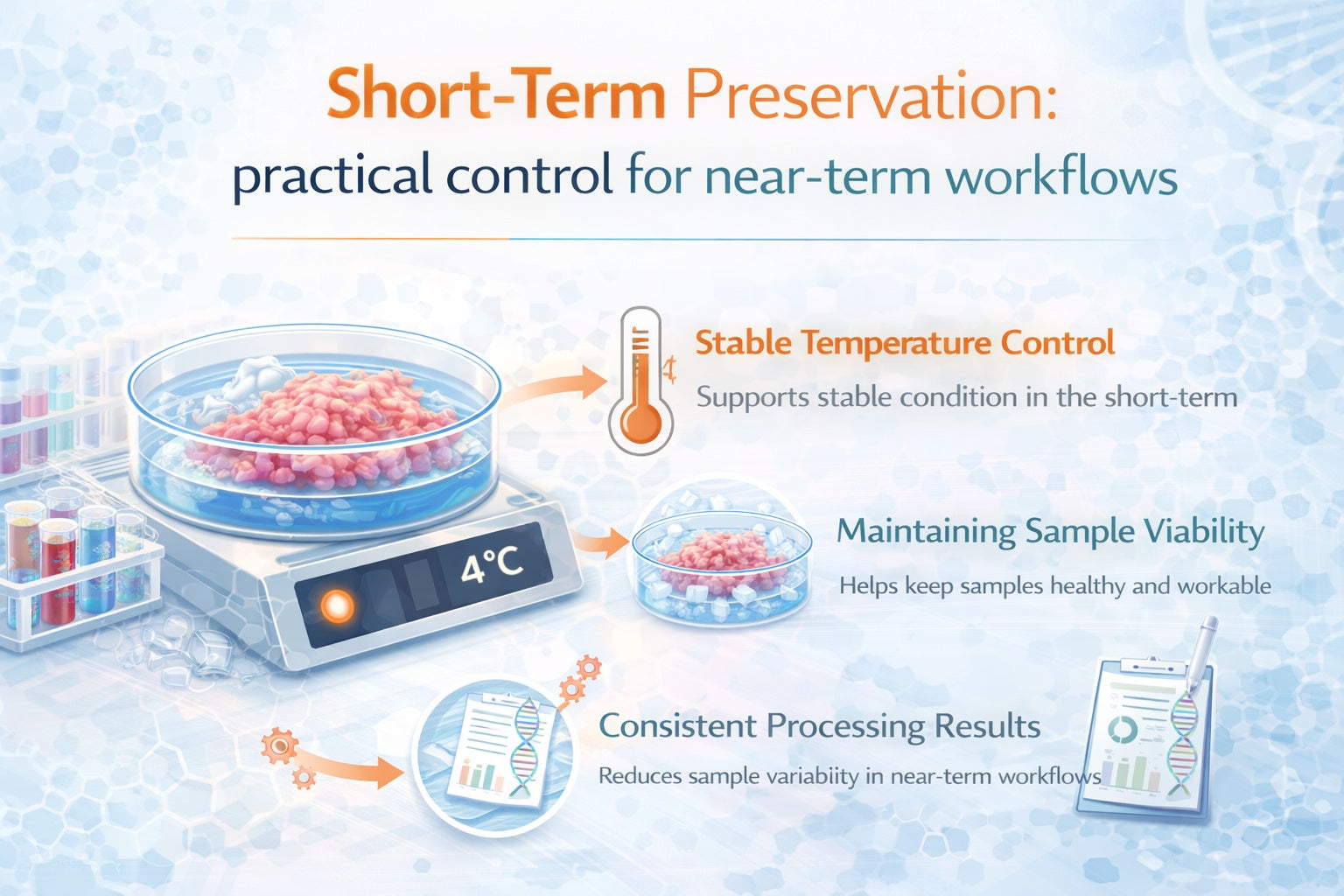
Short-term preservation: practical control for near-term workflows
Short-term preservation is especially important when tissues or cell-based products need to remain stable for hours or a limited number of days before processing, analysis, or application. In many workflows, this period is just as critical as long-term storage because early decline can affect downstream success.
What short-term preservation is designed to do
A good Short-term preservation workflow helps maintain a usable biological state while reducing stress during handling, transportation, or temporary holding.
Hypothermic preservation in short-term workflows
Hypothermic preservation is one of the most important short-term approaches. By storing cells or tissues at reduced temperatures above freezing, this method helps slow metabolism while avoiding the more extreme stresses associated with deep freezing.
For selected workflows, Hypothermic preservation may support:
- easier transport planning
- reduced metabolic demand
- practical short-window storage
- smoother workflow timing between collection and use
Why short-term preservation matters so much
Even when storage lasts only briefly, preserving Cell viability and biological function is essential. A strong Short-term preservation strategy can improve readiness for downstream analysis, tissue processing, or product application.
Long-term preservation for regenerative medicine products
Long-term preservation becomes essential when products need to be banked, held for future use, or moved through complex supply chains. In these settings, deeper preservation methods help maintain product availability and scheduling flexibility.
Cryogenic preservation as a core long-term strategy
Cryogenic preservation remains one of the most established approaches for long-term storage. By storing cells or tissues at very low temperatures, this strategy helps reduce biological activity to a minimum and supports extended stability.
Long-term preservation and workflow planning
A strong Long-term preservation strategy supports:
- product banking for future use
- better inventory management
- flexibility in manufacturing and scheduling
- stronger support for distributed regenerative workflows
Why cell viability remains the key measure
No matter how advanced the method, successful Long-term preservation still depends on post-thaw or post-recovery performance. This is why Cell viability remains one of the most important indicators of preservation quality.

Slow freezing in cell and tissue preservation
Slow freezing is one of the most recognised approaches in cryopreservation workflows. It is designed to cool samples in a controlled way so cells have time to adapt during the freezing process.
Why slow freezing remains widely used
Many laboratories and manufacturing settings value Slow freezing because it offers a familiar and practical approach for preserving cell-based materials over time.
Slow freezing and cell viability
When controlled carefully, Slow freezing can support good Cell viability after recovery. The quality of the workflow depends on factors such as cooling rate, formulation, sample type, and post-thaw handling.
Vitrification and emerging preservation innovation
Vitrification is another major preservation strategy and is often discussed as an advanced alternative in selected applications. Instead of forming ice traditionally, Vitrification aims to create a glass-like state that minimises the formation of damaging crystals.
Why Vitrification attracts attention
Vitrification is especially interesting because it may support preservation of sensitive biological structures where ice-related stress is a major concern. This makes it highly relevant in advanced Regenerative medicine and specialized Tissue engineering discussions.
Vitrification as an emerging trend
As preservation science continues to evolve, Vitrification remains part of the broader conversation around state-of-the-art storage methods and emerging trends in biologics handling.
Mesenchymal stem cells and preservation strategy
Mesenchymal stem cells are among the most widely discussed cell types in Regenerative medicine, which makes their preservation especially important. Because these cells are used in many research and translational settings, storage quality directly affects workflow success.
Why mesenchymal stem cells need thoughtful preservation
The value of Mesenchymal stem cells depends not only on storage survival, but also on how well they recover their functional properties after preservation.
Matching preservation method to stem-cell needs
Whether using Short-term preservation, Cryogenic preservation, Slow freezing, or Vitrification, the key is choosing a strategy that supports both Cell viability and practical workflow goals.
Emerging trends in preservation science
The field is moving beyond simple storage toward smarter, more application-specific preservation systems. This is one reason the topic remains so important in state-of-the-art discussions.
Trends shaping the future
Emerging trends include:
- more specialised formulations for sensitive cell products
- stronger focus on post-recovery function, not just survival
- workflow designs tailored to different tissue types
- improved integration between manufacturing and preservation steps
- more refined strategies for Short-term preservation and Long-term preservation
Why preservation is becoming more strategic
In both Tissue engineering and Regenerative medicine, preservation is increasingly seen as part of product design rather than a separate storage step. This shift helps support better consistency and broader translational value.

FireGene’s relevance to preservation-focused workflows
FireGene is well aligned with this topic because preservation starts with how samples are prepared, stabilised, and handled. Through cell and tissue storage solutions, tissue dissociation kits, cell cleanup reagents, molecular biology reagents and kits, nucleic acid extraction support, and life science buffers, FireGene fits naturally into laboratory environments where preservation quality matters.
FAQs
What is short-term preservation?
Short-term preservation refers to storage strategies designed to maintain cells or tissues over shorter time windows, often for transport, staging, or near-term processing.
What is long-term preservation?
Long-term preservation refers to storage methods that maintain biological materials for extended periods, often under deep-freeze or cryogenic conditions.
What is hypothermic preservation?
Hypothermic preservation is a reduced-temperature storage method above freezing that helps slow metabolism during short-term handling.
What is cryogenic preservation?
Cryogenic preservation is a very low-temperature storage strategy used to support extended preservation of cells and tissues.
What is slow freezing?
Slow freezing is a controlled-rate freezing method designed to help cells adapt during cooling and support post-thaw recovery.
What is Vitrification?
Vitrification is a preservation approach that aims to create a glass-like state and reduce ice crystal formation in sensitive biological materials.
Why are mesenchymal stem cells important in preservation research?
Mesenchymal stem cells are widely used in Regenerative medicine, so preserving their viability and functional quality is a major priority.
How does FireGene fit into this topic?
FireGene supports preservation-related workflows through cell and tissue storage solutions, sample preparation tools, cell cleanup reagents, molecular biology reagents and kits, nucleic acid extraction products, and life science buffers.
Conclusion:
The future of preservation in Tissue engineering and Regenerative medicine is becoming more precise, more strategic, and more closely connected to product quality. Short-term preservation supports the practical realities of handling and transport, while Long-term preservation provides the flexibility needed for banking and broader workflow planning.
Methods such as Hypothermic preservation, Cryogenic preservation, Slow freezing, and Vitrification each play an important role in this landscape. Their value is ultimately measured by how well they protect Cell viability, support recovery, and preserve the functional promise of products such as Mesenchymal stem cells.


