
Strong RNA recovery begins long before the final eluate is measured. It starts with how the sample is handled, how quickly processing begins, and how well the workflow protects nucleic acids during tissue or cell extraction. In modern molecular biology, the quality of RNA isolation can shape everything that follows, from expression studies to assay sensitivity and downstream interpretation.
Researchers often focus solely on yield, but the best workflows balance yield with RNA integrity, sample consistency, and processing speed. A well-designed extraction strategy helps preserve fragile RNA molecules while reducing degradation, contamination, and variability. That is especially important when working with challenging inputs such as tissue samples, mixed cell populations, or workflows involving Frozen tissue processing.
Why RNA recovery matters in Tissue or cell extraction
High-quality RNA recovery is important because RNA is central to gene expression analysis, molecular diagnostics, and many research applications. The success of qPCR, RT-PCR, transcript analysis, and broader nucleic acid workflows often depends on the quality of the starting RNA.
A good RNA isolation workflow does more than collect nucleic acid. It helps preserve the biological value of the sample, ensuring downstream data remain meaningful and reproducible.
The main goals of RNA isolation
A strong RNA workflow usually aims to support:
- efficient RNA recovery
- high RNA integrity
- low degradation risk
- reproducible sample handling
- compatibility with downstream molecular analysis
Why extraction conditions shape the final result
RNA is highly sensitive to handling conditions. Delays, poor homogenization, inconsistent lysis, or suboptimal storage can all reduce quality. That is why careful planning during Tissue or cell extraction can significantly impact the final result.

RNA isolation starts with smart sample handling
The best RNA isolation protocols begin with thoughtful sample handling. Whether the starting material is fresh cells, cultured material, or tissue, the early steps often determine how much intact RNA can be recovered.
Speed and consistency improve RNA recovery.
Fast and consistent handling helps protect the sample from degradation. When the extraction workflow is organized well, RNA recovery is often more reliable and easier to reproduce across samples.
Tissue and cells need slightly different strategies.
Cells are often easier to lyse quickly, while tissue may require more active disruption. This is why Tissue or cell extraction is not a single process. The method should reflect the structure and complexity of the starting material.
Frozen tissue processing and RNA integrity
Frozen tissue processing is a common part of molecular workflows because freezing helps preserve samples until extraction can be performed. When done carefully, this approach can maintain strong RNA integrity and simplify workflow scheduling.
Why frozen tissue processing is useful
Many labs rely on Frozen tissue processing because it allows samples to be stored and then extracted under controlled conditions. This flexibility is especially useful in research environments handling multiple batches or limited sample material.
How frozen tissue processing affects RNA recovery
The key to good RNA recovery from frozen tissue is maintaining control during thawing and disruption. The sample should move efficiently from storage to lysis so RNA remains protected throughout the workflow.
RNA integrity is the priority
In frozen workflows, RNA integrity matters as much as yield. A sample with strong integrity supports more reliable gene expression analysis and stronger downstream confidence.

Mincing Tissue before extraction
For many solid samples, Mincing Tissue is an important early step. Cutting Tissue into smaller pieces increases surface area, improves contact with lysis reagents, and supports more effective homogenization.
Why mincing TissueTissue can help
Mincing Tissue can make extraction more efficient because smaller fragments are easier to disrupt and process. This often supports more uniform lysis and improved RNA release.
Keep the workflow controlled.
The benefit of Mincing Tissue is greatest when the process is done quickly, cleanly, and in a way that limits unnecessary warming or handling delays. That combination supports stronger RNA isolation and more consistent results.
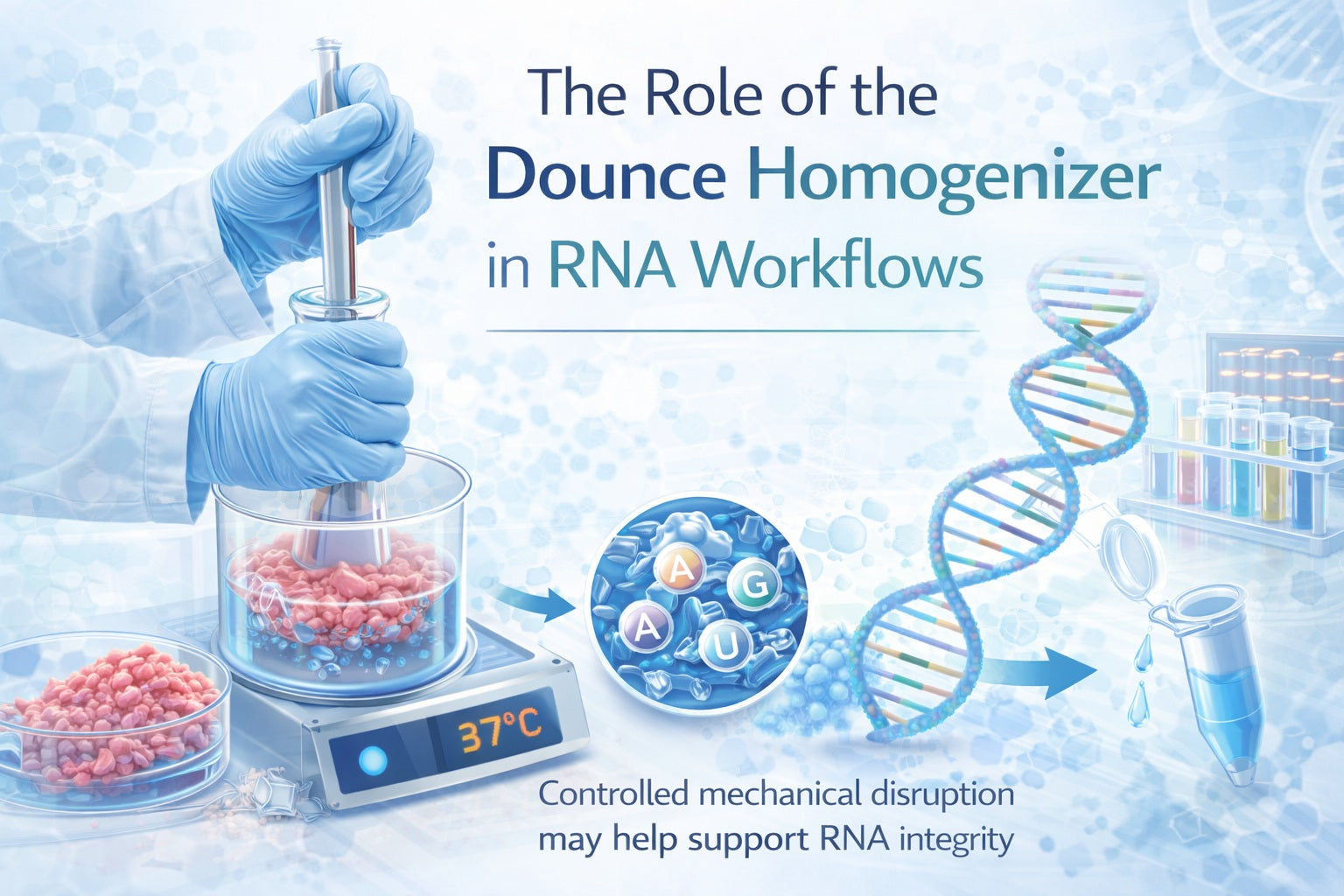
The role of the Dounce homogenizer in RNA workflows
A Dounce homogenizer is a familiar tool in many extraction workflows because it helps break apart tissues or cells in a controlled mechanical way. For selected sample types, it can support efficient homogenization without overly harsh processing.
Why a Dounce homogenizer is useful
The Dounce homogenizer is valued because it can help create a more even lysate, especially when careful manual control is helpful. In tissue workflows, it may support improved disruption after Mincing Tissue or during soft-tissue processing.
Homogenization and RNA integrity
Good homogenization helps support RNA integrity by reducing incomplete lysis and promoting faster contact between the sample and protective extraction reagents. This is one reason mechanical disruption remains an important part of RNA isolation.
Guanidine buffer and RNA protection
A Guanidine buffer plays a valuable role in many RNA workflows because it helps create strong lysis conditions and protects RNA during extraction. In practice, a guanidine-based environment can help stabilize nucleic acid handling during early processing.
Why guanidine buffer matters
The value of a Guanidine buffer lies in its support for lysis and protection of sensitive RNA from unwanted breakdown during tissue or cell extraction.
Buffer choice can shape extraction quality.
Choosing a suitable lysis and protection system is one of the most important parts of RNA isolation. The right chemistry supports both RNA recovery and RNA integrity, especially when working with complex tissue inputs.
RNA integrity: why quality matters more than quantity alone
A successful extraction is not only about how much RNA is recovered. RNA integrity is equally important because downstream applications rely on structurally intact RNA.
Why RNA integrity matters in gene expression work
When RNA remains intact, gene expression analysis is more dependable. This is important for qPCR, RT-PCR, transcript profiling, and other molecular workflows that depend on meaningful starting material.
Better integrity leads to better downstream data.
Strong RNA integrity supports:
- clearer gene expression results
- more reliable amplification
- better reproducibility
- stronger confidence in interpretation
How to improve RNA recovery during Tissue or cell extraction
Improving RNA recovery usually comes down to workflow discipline. The strongest results often come from combining clean handling, efficient disruption, robust lysis chemistry, and rapid progression through the critical early steps.
Practical ways to improve RNA isolation
Researchers often improve RNA isolation by:
- Organizing the workflow before starting
- reducing handling delays
- using effective homogenization tools
- supporting lysis with a suitable Guanidine buffer
- controlling Frozen tissue processing carefully
- protecting RNA integrity at every stage
Small improvements can make a big difference.
Even simple refinements, such as better Mincing tissue technique or more consistent use of a Dounce homogenizer, can improve extraction quality in meaningful ways.
FireGene’s relevance to RNA extraction workflows
This topic aligns well with FireGene, as RNA workflows depend on robust sample preparation and reliable nucleic acid support. FireGene’s relevance includes sample preparation tools, nucleic acid extraction solutions, molecular biology reagents and kits, life science buffers, tissue and cell handling support, and related products that help laboratories build stronger extraction systems.
FAQs
What is RNA recovery?
RNA recovery refers to the extent to which RNA is recovered from a sample during extraction while maintaining its usable quality for downstream applications.
Why is RNA integrity important?
RNA integrity is important because intact RNA supports more reliable gene expression analysis, amplification, and overall data quality.
How does frozen tissue processing affect RNA isolation?
Frozen tissue processing can support strong RNA isolation when samples are handled carefully and moved efficiently into lysis conditions.
What does a Dounce homogenizer do?
A Dounce homogenizer mechanically disrupts tissue or cells in a controlled manner to support uniform lysis and improved extraction.
Why use a guanidine buffer in RNA extraction?
A Guanidine buffer supports strong lysis conditions and helps protect RNA during the early steps of Tissue or cell extraction.
Is mincing tissue useful before RNA extraction?
Yes. Mincing Tissue can increase surface area and improve homogenization and lysis.
How does FireGene fit into RNA workflows?
FireGene supports RNA-related laboratory workflows through sample preparation tools, nucleic acid extraction solutions, molecular biology reagents and kits, life science buffers, and related scientific resources.
Conclusion
Strong RNA recovery is built through careful decisions at every stage of tissue or cell extraction. From Mincing Tissue and using a Dounce homogenizer to choosing the right Guanidine buffer and managing Frozen tissue processing, each step contributes to better RNA isolation and stronger RNA integrity.


