
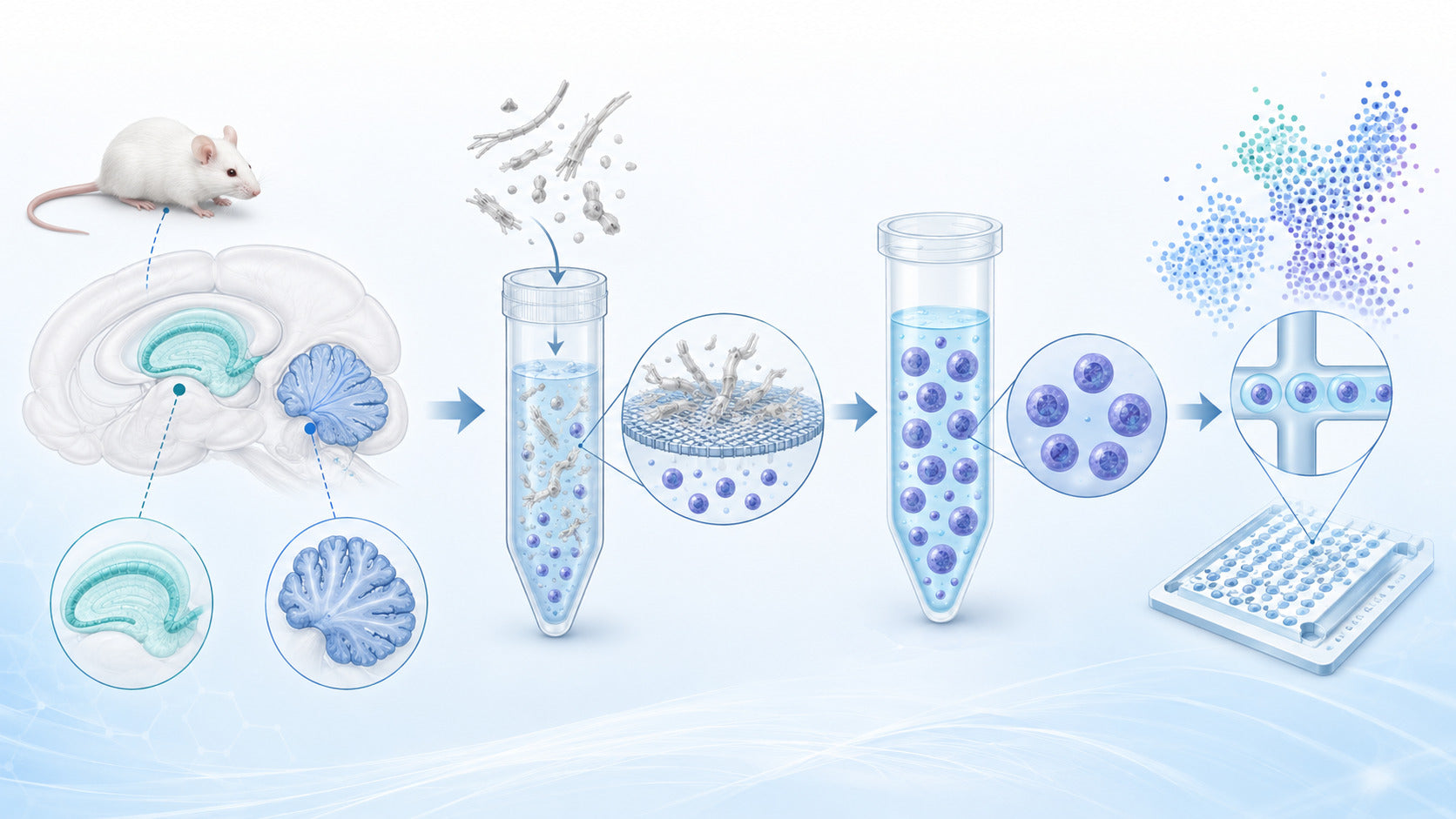
Isolating high-quality, myelin-free nuclei from adult mouse hippocampus (15–20 mg) and cerebellum (50–70 mg) for snRNA-seq requires a combination of tissue homogenization, low-volume sucrose-gradient centrifugation, and optional magnetic enrichment. These workflows reduce the need for ultracentrifugation while helping preserve delicate neuronal and non-neuronal nuclei. For myelin-rich adult mouse brain regions, nuclei isolation requires special care. The mouse hippocampus and mouse cerebellum both contain valuable neuronal and non-neuronal populations, but they can also create technical challenges during sample preparation. Myelin, lipid-rich material, fine debris, and tissue-specific density differences can reduce nuclei quality if they are not managed properly.
A strong myelin-free nuclei isolation workflow helps researchers prepare cleaner nuclei suspensions for downstream single-nucleus RNA sequencing. With cold handling, gentle homogenization, debris reduction, benchtop sucrose-gradient nuclei purification, and careful quality control, researchers can improve sample consistency and support reliable snRNA-seq library preparation.
Why Myelin-Free Nuclei Isolation Matters for snRNA-Seq
Myelin-free nuclei isolation is important because adult brain tissue contains lipid-rich myelin that can carry over into the nuclei suspension. This carryover can make counting more difficult, increase debris, affect loading concentration, and reduce confidence before single-nucleus RNA sequencing. In snRNA-seq, the goal is to prepare a nuclei-dominant suspension with intact nuclei, low debris, minimal clumping, and suitable concentration for the selected sequencing platform. A clean preparation helps improve downstream handling, quality control, and data interpretation.
For mouse brain research, this is especially important because brain regions differ in size, cellular density, myelin content, and fragility. A method that works well for one region may need adjustment for another. That is why nuclei isolation from myelin-rich adult mouse brain should be viewed as a workflow, not just a single extraction step.
Challenges in Mouse Hippocampus and Mouse Cerebellum Nuclei Isolation
The mouse hippocampus and mouse cerebellum both support important neuroscience research, but they behave differently during nuclei isolation.
Mouse Hippocampus
The mouse hippocampus is a smaller brain region, so the available tissue input is limited. This means every step should protect nuclei recovery. Gentle handling, careful aspiration, and low-loss tubes can help preserve yield. A mouse hippocampus nuclei isolation protocol should focus on minimizing sample loss while keeping debris low. Since the tissue amount is smaller, over-processing or aggressive cleanup may reduce the final nuclei count.
Mouse Cerebellum
The mouse cerebellum can provide more tissue input, but it may also generate more fine debris. The cerebellum contains dense cell populations, including abundant small granule neurons, which can make cleanup more challenging.
For mouse cerebellum nuclei isolation, the workflow often needs stronger debris and myelin control. A cleaner final suspension may require careful gradient handling and optional magnetic enrichment, especially when the preparation still shows visible debris after density cleanup.
Overview of a Single-Nucleus RNA Sequencing Workflow
A strong single-nucleus RNA sequencing workflow usually includes several connected steps:
Tissue Collection and Cold Handling
Fresh or frozen mouse brain tissue should be handled quickly and kept cold. Cold handling helps preserve nuclear integrity and RNA quality. Before starting tissue disruption, buffers, tubes, centrifuge rotors, filters, and tools should be prepared in advance.
Nuclei Isolation
Nuclei isolation separates nuclei from tissue structure, cytoplasmic material, myelin, and debris. This step often includes mechanical homogenization, filtration, low-speed pelleting, and resuspension in a nuclei-compatible buffer.
Debris and Myelin Removal
Adult mouse brain tissue often needs an added cleanup step. Benchtop sucrose-gradient nuclei purification can help separate nuclei from myelin-rich material and debris without requiring ultracentrifugation.
Nuclei QC Before Sequencing
Before loading into a platform such as 10x Genomics or Parse Biosciences, nuclei should be checked for concentration, morphology, clumping, and debris burden. This QC step helps researchers move forward with greater confidence.
Benchtop Sucrose-Gradient Nuclei Purification
Benchtop sucrose-gradient nuclei purification is a practical approach for cleaning nuclei suspensions from myelin-rich brain tissue. Instead of relying on large ultracentrifuge gradients, a lower-volume gradient setup can be used with a compatible benchtop centrifuge. The main goal is to separate lipid-rich myelin and lighter debris from nuclei. After centrifugation, myelin-rich material often appears near the upper layer, while nuclei are recovered from the lower portion or pellet area depending on the method design.
This approach can be useful for laboratories that want a more accessible workflow for adult mouse brain nuclei isolation. It can also reduce hands-on complexity compared with more equipment-heavy methods, while still supporting clean nuclei preparation when carefully optimized.
Gentle Homogenization Protects Nuclei Integrity
Homogenization is one of the most important steps in nuclei isolation. The purpose is to release nuclei from tissue while avoiding unnecessary shear damage.
Tube-and-Pestle Homogenization
Tube-and-pestle homogenization can be a practical option for small tissue inputs such as mouse hippocampus. It allows tissue disruption in low-volume tubes and can reduce sample transfer steps.
The key is to use slow, controlled strokes. Aggressive grinding, vortexing, foaming, or repeated harsh pipetting can damage nuclei and increase debris.
Dounce Homogenization
Dounce homogenization is another common option for brain nuclei isolation. It may be useful when working with larger inputs or when a lab already has an optimized Dounce-based workflow. Whichever method is used, the goal remains the same: release nuclei gently while keeping the suspension cold and reducing mechanical stress.
Myelin Removal and Cleanup Strategy
Myelin removal is a central part of nuclei isolation from myelin-rich adult mouse brain. If myelin remains in the final suspension, it can increase background material, make counting less accurate, and create problems during downstream library preparation.
Removing the Myelin Layer Carefully
After density cleanup, the myelin-rich layer should be removed gently. The nuclei pellet may be faint or difficult to see, so aspiration should be slow and controlled. Leaving a small residual volume above the pellet can help prevent nuclei loss.
Magnetic Enrichment
Magnetic enrichment can be useful when the preparation still contains visible myelin, debris, or non-nuclear carryover after sucrose cleanup. This step can improve purity, but it may also reduce total recovery. The best approach depends on the sample goal. If the priority is maximum nuclei yield, cleanup should be balanced carefully. If the priority is sequencing-ready purity, magnetic enrichment may be a helpful final polishing step.
FireGene supports single-nucleus sample preparation workflows where clean nuclei recovery, debris reduction, and downstream sequencing readiness are key goals.
Quality Control Before Single-Nucleus RNA Sequencing
A clean nuclei preparation should be evaluated before it is used for single-nucleus RNA sequencing.
Nuclei Morphology
Microscopy can help confirm whether the preparation is nuclei-dominant. Good preparations usually show round, intact nuclei-sized particles with limited large debris and minimal clumping.
Nuclei Concentration
Counting nuclei is important for accurate platform loading. Overloading or underloading can affect downstream recovery and sequencing quality.
Debris and Clumping
Debris and clumps should be minimized before library preparation. Filtration, gentle resuspension, and cleanup can improve suspension quality.
RNA Quality and Timing
Although isolated nuclei are more stable than intact cells in some workflows, processing should still be efficient. Long delays, warming, and harsh handling can affect RNA quality and downstream results.
Common Problems and Positive Troubleshooting Tips
Nuclei isolation from adult mouse brain can be optimized with a calm, stepwise troubleshooting approach.
Low Nuclei Integrity
Low nuclei integrity may come from over-homogenization, tissue warming, harsh detergent exposure, or rough pipetting. Use gentler strokes, keep buffers cold, avoid vortexing, and minimize processing delays.
Heavy Myelin or Debris Carryover
Heavy carryover may happen when the density interface is disturbed, tissue input is overloaded, or the myelin layer is removed too aggressively. Layer samples slowly, avoid bubbles, reduce input if needed, and consider magnetic enrichment.
Low Nuclei Yield
Low yield may result from pellet loss, over-filtration, harsh cleanup, or small tissue input. Assume the pellet may be present even if it is not visible, aspirate carefully, and use low-binding tubes.
Clumping
Clumping can occur when nuclei are damaged or debris remains high. Gentle pipetting, filtration, and avoiding long pauses after homogenization can help maintain a cleaner suspension.

Mouse Hippocampus Nuclei Isolation Protocol: Key Considerations
A mouse hippocampus nuclei isolation protocol should protect limited starting material. Since hippocampal tissue input is usually smaller than cerebellar input, the workflow should reduce unnecessary transfers and avoid aggressive cleanup. Important considerations include gentle homogenization, careful filtration, slow aspiration, and early QC. If the nuclei suspension looks clean after density purification, additional cleanup may be used only when needed.
For hippocampus samples, the positive goal is to preserve recovery while still producing a nuclei suspension that is clean enough for single-nucleus RNA sequencing.
Mouse Cerebellum Nuclei Isolation Protocol: Key Considerations
Mouse cerebellum nuclei isolation often requires extra attention to debris management. Cerebellar tissue can generate dense fine particles and may have a stronger myelin/debris burden. In this tissue type, benchtop sucrose-gradient nuclei purification can help improve cleanup. Optional magnetic enrichment may also be useful when the final suspension needs additional polishing before sequencing.
The positive goal for cerebellum is to balance purity and yield. A cleaner preparation may support better counting, easier handling, and more confident library preparation.
Benchtop Gradient Centrifugation vs Other Methods
Different nuclei isolation methods can work well depending on tissue type, equipment, and downstream application.
Benchtop Gradient Centrifugation
Benchtop gradient centrifugation is practical for labs that do not want to depend on ultracentrifugation. It can support accessible myelin removal when density conditions, layering, and aspiration are handled carefully.
Commercial Kits
Commercial nuclei isolation kits may simplify some workflows, but myelin-rich adult brain regions may still require added optimization or cleanup.
Ultracentrifugation-Based Methods
Ultracentrifugation-based gradients can provide strong separation in some protocols, but they require specialized equipment and careful gradient handling. The best method is the one that produces intact nuclei, low debris, reproducible recovery, and compatibility with the intended snRNA-seq platform.
FireGene Support for Nuclei Isolation Workflows
Reliable snRNA-seq data starts with high-quality sample preparation. For adult mouse brain tissue, this means protecting nuclei integrity, reducing myelin carryover, and confirming quality before library preparation.
FireGene supports research-use workflows for tissue preparation, nuclei isolation, sample cleanup, and single-nucleus sequencing readiness. These workflow solutions can help researchers prepare cleaner nuclei suspensions from challenging tissues such as mouse hippocampus and mouse cerebellum.
FAQs
What is myelin-free nuclei isolation?
Myelin-free nuclei isolation is a sample preparation approach that removes or reduces myelin and lipid-rich debris from brain nuclei suspensions before downstream analysis such as single-nucleus RNA sequencing.
Why is myelin removal important for mouse brain snRNA-seq?
Myelin removal helps produce cleaner nuclei suspensions. This can improve nuclei counting, reduce debris, limit clumping, and support better downstream library preparation.
How do you isolate nuclei from mouse hippocampus?
Mouse hippocampus nuclei isolation usually requires cold handling, gentle homogenization, filtration, density-based cleanup, careful pellet recovery, and QC before snRNA-seq loading.
How do you isolate nuclei from mouse cerebellum?
Mouse cerebellum nuclei isolation often requires stronger debris management because cerebellar tissue can produce fine particles and myelin-rich carryover. Sucrose-gradient cleanup and optional magnetic enrichment can help improve final suspension quality.
What is benchtop sucrose-gradient nuclei purification?
Benchtop sucrose-gradient nuclei purification is a density-based cleanup method that separates nuclei from myelin and debris using sucrose conditions compatible with a standard benchtop centrifuge.
Can nuclei isolation from myelin-rich adult mouse brain be done without ultracentrifugation?
Yes, benchtop gradient centrifugation can be a practical option when optimized carefully. The workflow should be validated for the specific brain region, tissue input, and downstream sequencing platform.
Why does mouse cerebellum produce more debris during nuclei isolation?
Mouse cerebellum contains dense cell populations and can generate abundant fine particulate material during homogenization. This makes cleanup and myelin removal especially important.
How can nuclei integrity be preserved before snRNA-seq?
Keep samples cold, prepare buffers in advance, use gentle homogenization, avoid vortexing, minimize delays, use wide-bore tips, and check nuclei quality by microscopy before sequencing.
Conclusion
Myelin-free nuclei isolation from mouse hippocampus and mouse cerebellum is an important step for successful single-nucleus RNA sequencing. Adult mouse brain tissue can be challenging because myelin and debris may affect nuclei quality, but a well-planned workflow can make the process more reliable.
By combining cold handling, gentle homogenization, benchtop sucrose-gradient nuclei purification, careful myelin removal, optional magnetic enrichment, and strong QC, researchers can prepare cleaner nuclei suspensions from myelin-rich adult mouse brain. This positive, structured approach supports better sample consistency, smoother library preparation, and more confident snRNA-seq results.


