
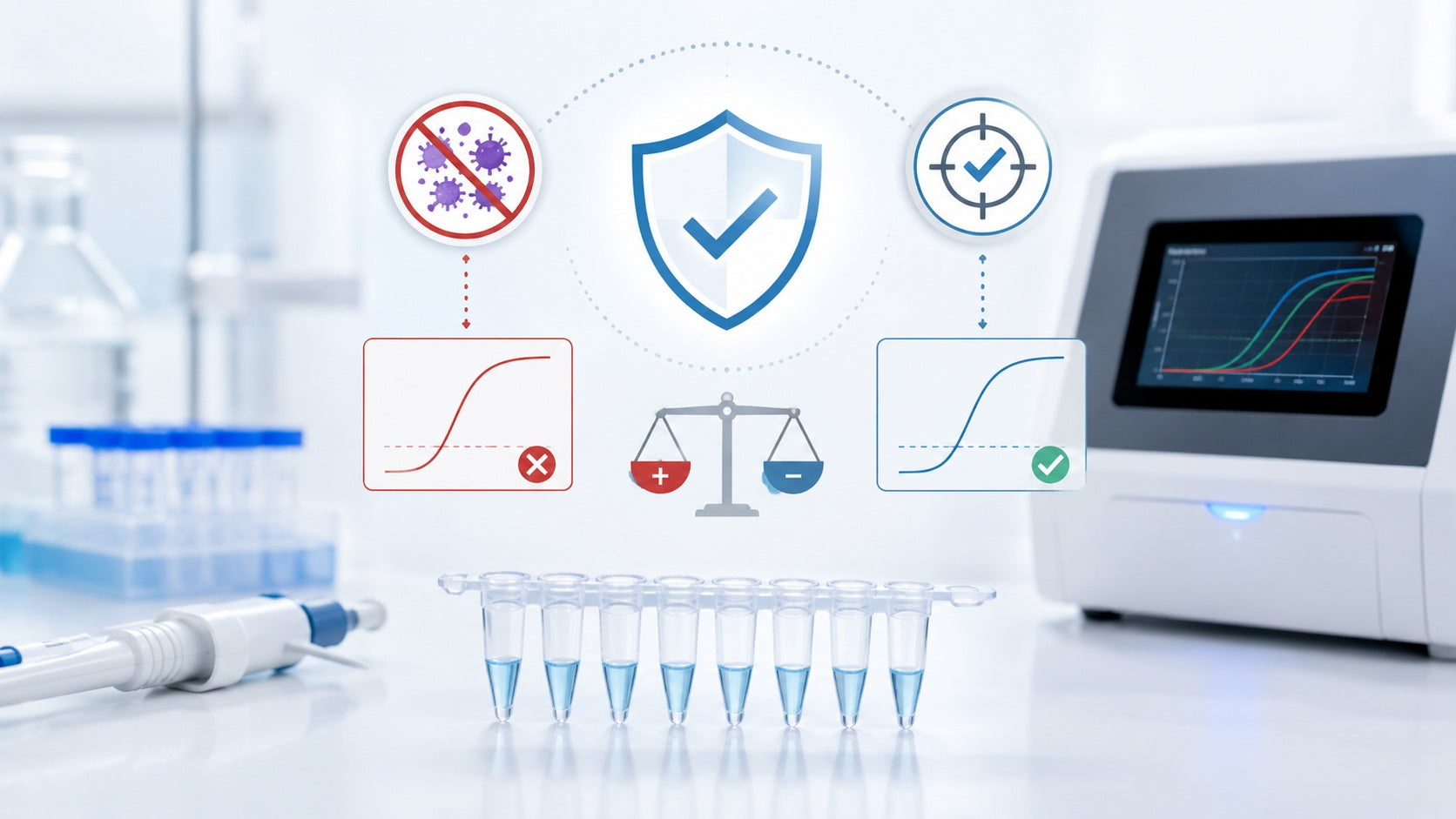
Polymerase Chain Reaction, commonly known as PCR, is one of the most valuable techniques in molecular biology, genetics, infectious disease research, and molecular diagnostics. PCR tests help laboratories detect and amplify very small amounts of DNA or RNA-derived cDNA, making them useful for research, quality control, and diagnostic workflows. Because PCR is highly sensitive, even small changes in sample handling, reagent preparation, assay design, or laboratory workflow can influence the final result. With the right controls and good laboratory practices, PCR results can be made more accurate, specific, reproducible, and reliable.
Two important areas in PCR troubleshooting are false positive PCR results and false negative PCR results. A false positive result shows amplification when the true target is not present. A false negative result does not show amplification even when the target is present. Both can be managed effectively by improving PCR contamination control measures, strengthening assay design, and following a clean workflow from sample preparation to result interpretation.
What Are False Positive and False Negative PCR Results?
A false positive PCR result means the assay shows the presence of a target sequence even though the actual target is not present in the sample. This can happen due to PCR contamination, non-specific amplification, primer-dimer formation, carryover amplicons, or background signal in qPCR. A false negative PCR result means the assay does not detect the target sequence even though the target is present. This may happen because of low template input, degraded nucleic acid, PCR inhibitors, inefficient extraction, poor primer design, or unsuitable cycling conditions.
The positive side is that both types of results can often be reduced through a well-planned PCR workflow. Clean sample handling, proper controls, validated reagents, and optimized PCR conditions can greatly improve confidence in PCR tests.
Why Reliable PCR Results Matter
PCR results often support important research and diagnostic decisions. In research laboratories, accurate PCR results help scientists understand genes, pathogens, mutations, expression patterns, and biological mechanisms with more confidence. In molecular diagnostics, reliable PCR tests help support timely and accurate detection workflows. Strong PCR practices also reduce repeated testing, save reagents, improve laboratory efficiency, and support better decision-making. Reliable PCR testing depends on two major performance qualities: PCR specificity and PCR sensitivity.
PCR Specificity
PCR specificity means the assay amplifies only the intended target sequence. High specificity helps reduce false positive PCR results by limiting non-specific amplification and unwanted PCR products.
PCR Sensitivity
PCR sensitivity means the assay can detect low amounts of target nucleic acid. High sensitivity helps reduce false negative PCR results by improving the detection of low-copy targets. The best PCR workflow balances both specificity and sensitivity. A good assay should detect the target clearly while avoiding unwanted amplification.
Common Causes of False Positive PCR Results
False positive PCR results usually occur when the assay detects something other than the intended target. Understanding these causes helps laboratories build stronger prevention strategies.
PCR Contamination
PCR contamination is one of the most common reasons for false positive PCR results. Since PCR can amplify very small amounts of nucleic acid, even a tiny contaminant can produce a signal. Contamination may come from previous PCR products, positive controls, other samples, aerosols, pipettes, gloves, tubes, reagents, work surfaces, or lab coats. In busy PCR laboratories, carryover contamination from amplified products is especially important to control.
Cross-Contamination Between Samples
Cross-contamination happens when material from one sample accidentally enters another sample. This can occur during pipetting, sample transfer, extraction, aliquoting, or plate setup. Using careful pipetting, fresh tips, clean gloves, and separate work areas helps reduce this risk and supports more dependable PCR testing.
Non-Specific Amplification
Non-specific amplification occurs when primers bind to sequences other than the intended target. This may produce a PCR product that looks similar to the expected result. This can be improved by better primer design, optimized annealing temperature, hot-start polymerase, and validated reaction conditions.
Primer-Dimer Formation
Primer-dimers form when primers bind to each other instead of the target template. In SYBR Green qPCR, primer-dimers can create fluorescence because the dye binds to double-stranded DNA. Melting curve analysis is useful because it helps confirm whether the qPCR signal comes from the correct target product or from primer-dimers.
Late qPCR Signal
Late amplification signals in qPCR should be interpreted carefully. A late signal may reflect very low target concentration, minor contamination, primer-dimers, or background fluorescence. Reviewing amplification curves, Cq values, melting curves, controls, and replicates helps laboratories make more confident result calls.

How to Prevent False Positive PCR Results
Preventing contamination in PCR laboratories is one of the best ways to improve PCR accuracy. A clean, organized, and consistent workflow can greatly reduce false positive results.
Separate PCR Work Areas
PCR laboratories should ideally separate the workflow into different areas:
- Reagent preparation area
- Sample preparation area
- PCR amplification area
- Post-PCR analysis area
The workflow should move in one direction, from clean areas to amplified-product areas. This helps prevent amplified PCR products from entering new reactions.
Use No-Template Controls
A no-template control, also called NTC, contains all PCR components except sample DNA or cDNA. If the NTC shows amplification, it may suggest contamination, primer-dimer formation, or background signal. Including NTCs in PCR and qPCR runs is one of the simplest and most useful PCR contamination control measures.
Use Filter Tips and Dedicated Pipettes
Aerosol-resistant filter tips help reduce the transfer of nucleic acid aerosols. Dedicated pipettes should be used for specific workflow areas to maintain clean separation. Regular cleaning and calibration of pipettes also support accurate and reproducible PCR tests.
Prepare Reagent Aliquots
Dividing reagents into smaller aliquots reduces repeated opening, freeze-thaw cycles, and contamination risk. This is useful for PCR master mixes, primers, probes, enzymes, nuclease-free water, and other sensitive reagents.
Use Clean PCR Setup Practices
Simple habits can make a major difference:
- Keep tubes closed when possible
- Change gloves regularly
- Use sterile, nuclease-free consumables
- Avoid touching tube openings or inner caps
- Clean workspaces before and after setup
- Keep positive controls away from unknown samples
These steps help create a cleaner PCR environment and improve result confidence.
Consider UNG/dUTP Carryover Prevention.
For high-throughput PCR laboratories, UNG/dUTP carryover prevention systems can help reduce contamination from previous PCR products. This approach is especially helpful for molecular diagnostic workflows where repeat testing and high sensitivity are common.
Common Causes of False Negative PCR Results
False negative PCR results occur when the target is present, but the assay does not detect it. By understanding the main causes, laboratories can improve PCR sensitivity and strengthen the full workflow.
Poor Sample Quality
A PCR result depends on the quality of the starting sample. If a sample is not collected, stored, or transported properly, nucleic acid quality may decrease. Using suitable collection methods, stable storage conditions, and timely processing helps protect sample integrity.
Inefficient Nucleic Acid Extraction
Nucleic acid extraction is a key step in PCR success. If extraction yield is low or inhibitors remain in the sample, amplification may be weak or absent. Different sample types may require different extraction strategies. Blood, FFPE tissue, plasma, viral samples, bacteria, fungi, cultured cells, and tissue samples all have different preparation needs.
FireGene supports molecular biology workflows with nucleic acid extraction and purification solutions designed for different sample types and downstream PCR applications.
PCR Inhibitors
PCR inhibitors are substances that reduce amplification efficiency. They may come from the sample matrix or from incomplete purification. Common inhibitors include heme, salts, ethanol, phenol, detergents, proteins, polysaccharides, and extraction reagent carryover. Removing these inhibitors helps improve PCR sensitivity.
Low Template Input
If the target nucleic acid is present at a very low level, it may be close to or below the assay’s detection limit. This can lead to weak or inconsistent amplification. Optimized extraction, suitable template input, and validated assay sensitivity can help improve detection.
Primer or Probe Mismatch
If primers or probes do not match the target sequence well, amplification may be reduced. Sequence variation, mutations, high GC content, or strong secondary structure can affect primer binding. Regular assay review and sequence checking help maintain PCR specificity and sensitivity.
Reagent or Instrument Conditions
PCR reagents and instruments perform best when they are stored, handled, and maintained correctly. Enzymes, probes, master mixes, and fluorescent dyes should be protected from repeated freeze-thaw cycles and unsuitable storage. Well-maintained instruments and validated thermal cycling conditions support consistent PCR performance.
How to Prevent False Negative PCR Results
False negative PCR results can be reduced by improving sample quality, extraction efficiency, reaction conditions, and control design.
Use Proper Sample Storage
Samples should be stored based on the target type and sample matrix. DNA, RNA, viral nucleic acids, and clinical or research samples may each require specific handling. For RNA workflows, nuclease-free tubes, nuclease-free water, clean tips, and fast processing help preserve sample quality.
Improve Extraction Quality
Good extraction should recover enough nucleic acid and remove substances that may inhibit PCR. For challenging sample types, optimized lysis, magnetic bead-based purification, column-based extraction, or sample-specific kits can help improve yield and purity.
Include an Internal Control
An internal control confirms that the PCR reaction worked and that the sample did not strongly inhibit amplification. If the internal control does not amplify as expected, the sample may need dilution, re-extraction, or workflow review before interpretation.
Include a Positive Control
A positive control confirms that the assay, reagents, primers, probes, enzyme, and cycling conditions are working properly. This gives laboratories confidence that the PCR system is ready to detect the target when it is present.
Use an Extraction Control
An extraction control helps confirm that the nucleic acid extraction and purification process worked properly. This is especially useful in molecular diagnostics, pathogen detection, and low-copy target workflows.
Optimize PCR Conditions
Annealing temperature, extension time, primer concentration, magnesium concentration, cycle number, and enzyme choice can all influence PCR performance. Gradient PCR, hot start PCR, and primer redesign are useful ways to improve difficult assays.
PCR Contamination Control Measures
PCR contamination control measures should be easy to follow and part of daily laboratory routine.
Important measures include:
- Separate pre-PCR and post-PCR areas
- Use unidirectional workflow
- Use aerosol-resistant filter tips
- Change gloves frequently
- Use dedicated pipettes and racks
- Keep tubes closed when possible
- Clean benches and equipment regularly
- Store reagents in aliquots
- Keep positive controls away from unknown samples
- Include no-template controls in PCR runs
These practices help laboratories build a clean, reliable, and repeatable PCR workflow.
Improving PCR Specificity and Sensitivity
Improving PCR specificity and sensitivity starts with assay design and continues through every step of the workflow.
How to Improve PCR Specificity
PCR specificity can be improved by:
- Designing primers for unique target regions
- Avoiding primer self-complementarity
- Checking primer sequences for non-target binding
- Using hot start polymerase
- Optimizing annealing temperature
- Reviewing melting curves in qPCR
- Avoiding excessive primer concentration
- Using probe-based qPCR when higher specificity is needed
How to Improve PCR Sensitivity
PCR sensitivity can be improved by:
- Using high-quality nucleic acid
- Reducing PCR inhibitors
- Improving extraction efficiency
- Avoiding sample degradation
- Optimizing template input
- Using validated PCR master mixes
- Including internal controls
- Confirming the assay’s limit of detection
- Maintaining instrument calibration
FireGene offers PCR/qPCR and molecular biology reagents that can support reliable amplification workflows when combined with good assay design and clean laboratory practice.
Best PCR Controls for Reliable Results
Strong PCR controls make result interpretation easier and more reliable.
|
PCR Control |
Purpose |
|
No-template control |
Helps detect contamination, primer-dimers, or background signal |
|
Positive control |
Confirms the assay can amplify the target |
|
Internal control |
Checks reaction performance and possible inhibition |
|
Extraction control |
Confirms extraction and purification quality |
|
No-RT control |
Helps detect genomic DNA contamination in RT-PCR |
|
Replicates |
Improve confidence in result consistency |
Controls are not just extra steps. They are important tools for accurate PCR testing.
Practical PCR Troubleshooting Workflow
When a PCR result needs review, use a step-by-step approach.
- First, check the no-template control. If it amplifies, review contamination control, primer-dimers, reagent quality, and workflow separation.
- Second, check the positive control. If it does not amplify, review reagent storage, master mix preparation, primer/probe quality, cycling conditions, and instrument performance.
- Third, check the internal control. If it does not perform as expected, review sample quality, extraction efficiency, or PCR inhibition.
- Fourth, review the qPCR amplification curve, Cq value, melting curve, replicate consistency, and expected amplicon size.
- A structured troubleshooting process helps laboratories find the cause faster and improve the next run with confidence.
How Reliable PCR Workflows Support Better Molecular Results
Preventing false positive and false negative PCR results is best achieved through a complete workflow approach. Every step matters, from sample collection and extraction to amplification and data review. Clean sample preparation helps reduce contamination. High-quality nucleic acid extraction improves sensitivity. Specific primers improve PCR specificity. Strong controls support reliable interpretation. Good documentation improves reproducibility.
For laboratories working in molecular biology, infectious disease research, genetic analysis, and diagnostic assay development, these practices support dependable PCR tests and better molecular insights. FireGene’s molecular diagnostics and PCR-related product categories align with this goal by supporting sample preparation, extraction, amplification, and detection workflows.
FAQs
What causes false positive PCR results?
False positive PCR results are commonly caused by PCR contamination, cross-contamination, non-specific amplification, primer-dimers, carryover amplicons, or background signal in qPCR.
What causes false negative PCR results?
False negative PCR results may be caused by poor sample quality, degraded nucleic acid, PCR inhibitors, low template input, extraction failure, poor primer design, reagent problems, or incorrect cycling conditions.
How can PCR contamination be prevented?
PCR contamination can be prevented by separating pre-PCR and post-PCR areas, using filter tips, changing gloves regularly, using dedicated equipment, cleaning workspaces, preparing reagent aliquots, and including no-template controls.
How can PCR specificity be improved?
PCR specificity can be improved through better primer design, optimized annealing temperature, hot-start polymerase, probe-based detection, and careful review of melting curves or amplicon size.
How can PCR sensitivity be improved?
PCR sensitivity can be improved by using high-quality nucleic acid, removing inhibitors, improving extraction efficiency, optimizing template input, validating the limit of detection, and using reliable PCR reagents.
Which PCR control is best for detecting false positives?
A no-template control is one of the most useful controls for detecting false positive PCR results because it helps identify contamination, primer-dimer signal, or background amplification.
Which PCR control helps detect false negatives?
An internal control helps detect possible false negatives by showing whether the PCR reaction worked properly and whether inhibitors affected amplification.
Conclusion
Preventing false positive and false negative PCR results is possible with a clean, well-controlled, and optimized workflow. By focusing on sample quality, contamination control, primer design, extraction efficiency, PCR specificity, PCR sensitivity, and proper controls, laboratories can improve the accuracy and reliability of PCR tests.
PCR is powerful because it is sensitive. When that sensitivity is supported by strong specificity, clean technique, validated reagents, and careful interpretation, PCR becomes an even more dependable tool for research and molecular diagnostic applications.


